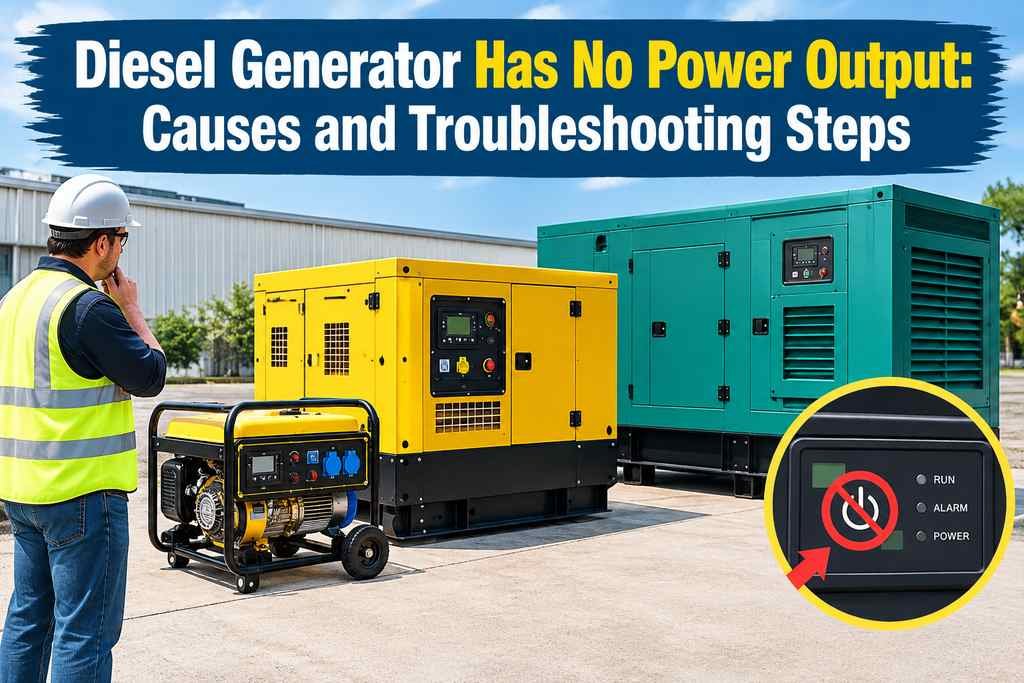
A diesel generator with no power output can be confusing because the engine may sound perfectly normal. You hear the diesel engine running, the display lights up, and the generator appears ready to work—but the outlets are dead, the transfer switch does not pick up the load, or the voltage falls away as soon as equipment is connected.
When I troubleshoot this problem, I do not immediately assume the alternator is bad. A generator is really two major machines working together: the diesel engine provides mechanical power, while the alternator converts that power into electricity. On top of that, breakers, voltage regulation, controls, receptacles, cables, and transfer equipment all have to work correctly. A fault in any one of those areas can look like “the generator has no power.”
In this guide, I will show you how I narrow the problem down, what symptoms point toward each cause, which checks you can safely do from the outside, and when I would stop and call a generator technician or electrician.




What Does “No Power Output” Actually Mean?
Before I diagnose anything, I define the symptom. “No power” can mean several different things, and each one points me in a different direction.
| Symptom | What It Usually Tells Me | First Area I Check |
|---|---|---|
| Engine runs, but outlets show no power | Output breaker, GFCI, receptacle circuit, excitation, AVR, or alternator issue | External breaker/GFCI and indicated voltage |
| Voltage is present but very low | Engine speed, excitation, AVR, sensing, or alternator field issue | Frequency and voltage regulation |
| Correct voltage with no load, but voltage collapses under load | Overload, weak engine response, fuel/air restriction, AVR, alternator, or a shorted load | Load size and generator performance |
| Generator shows normal voltage, but building is still dark | Transfer switch, feeder, disconnect, breaker, or connection problem | Power path after the generator |
| Voltage comes and goes | Loose connection, failing breaker, intermittent AVR/sensing, brushes, controller, or wiring fault | Fault history and qualified inspection |
| Breaker trips immediately | Short circuit, ground fault, overload, damaged cable, or defective connected equipment | Disconnect loads before resetting |
This distinction matters. If the generator itself is producing normal voltage but the transfer switch is not passing it to the building, replacing alternator parts will not fix anything. Likewise, if the alternator has lost excitation, repeatedly resetting a building breaker will not solve the problem.
Diesel Generator Electrical Output: Technical Details
Generator specifications vary widely, so I always use the nameplate and manufacturer manual for the exact set I am working with. The table below shows the main electrical details I pay attention to when diagnosing output problems.
| Technical Item | Typical Examples | Why It Matters |
|---|---|---|
| Frequency | 50 Hz or 60 Hz | Frequency follows engine/alternator speed and can reveal a speed problem |
| Engine/alternator speed | 1,500 rpm, 1,800 rpm, 3,000 rpm, or 3,600 rpm depending on pole count and frequency | Incorrect speed can produce incorrect frequency and sometimes abnormal voltage |
| Output voltage | Examples include 120/240 V single phase and 208/120 V or 480/277 V three phase | The set must match the connected electrical system |
| Phase | Single phase or three phase | Wrong phase configuration can prevent equipment from operating correctly |
| Power rating | kW and often kVA | Helps determine whether the load is within generator capacity |
| Power factor | Often 1.0 for small single-phase loads; many larger three-phase sets are rated at 0.8 PF | kVA demand can overload the alternator even when kW appears acceptable |
| Voltage regulation | AVR or other excitation/regulation system | Controls alternator field strength to maintain voltage |
| Output protection | Breaker, overload relay, GFCI/RCD, controller protection | Protection may open the circuit even while the engine continues running |
1. Start With the Simplest Cause: A Tripped Output Breaker
The first thing I check is the generator’s output breaker or receptacle breaker. This sounds obvious, but it is one of the easiest problems to miss. A generator can continue running normally after its electrical output breaker trips.
If I find a tripped breaker, I disconnect the loads before resetting it. If the breaker trips again with no load connected, or trips immediately when a specific load is connected, I stop repeatedly resetting it. Repeated tripping can indicate a short circuit, ground fault, damaged cable, overloaded circuit, failing breaker, or an internal generator fault.
For a portable unit, I also check any GFCI or RCD protection that serves the outlets. Some units have separate reset buttons or breakers for individual receptacles.
2. Check Whether the Problem Is the Generator or the Equipment Connected to It
I next remove the external load from the equation. A defective tool, appliance, cord, transfer device, or distribution panel can make a healthy generator look like it has failed.
With the generator unloaded, I look at the controller or built-in meter if the unit has one. If the display reports normal voltage and frequency but nothing works downstream, I focus on breakers, receptacles, cords, connectors, disconnects, and the transfer system rather than immediately blaming the alternator.
For a small portable generator, a properly rated plug-in voltage monitor can be a safer way for an owner to confirm receptacle output than probing exposed electrical parts. For permanently installed or three-phase generators, I leave live electrical measurements to qualified personnel using appropriately rated test equipment.
3. Inspect Plugs, Cords, and Connections
A surprisingly large number of “generator has no power” complaints are actually connection problems. I check for burned plugs, loose locking connectors, damaged cord ends, melted insulation, broken conductors, corroded terminals, and adapters that do not fit correctly.
I also make sure the generator’s receptacle or output configuration actually matches the equipment. A cord that physically fits does not automatically mean the voltage, phase, neutral arrangement, or grounding configuration is correct.
If the generator feeds a building through an inlet or transfer switch, I do not bypass that equipment to “see if it works.” Backfeeding a building through an improvised cord or receptacle can energize utility lines and create a lethal hazard. I use approved transfer equipment only.


4. Verify Engine Speed and Frequency
If the diesel engine runs too slowly, the generator may produce low frequency and sometimes low or unstable voltage. That is why frequency is one of my favorite diagnostic clues.
For a synchronous generator, frequency is related to rotational speed and the alternator’s number of poles. Common examples are shown below.
| System Frequency | 2-Pole Alternator | 4-Pole Alternator |
|---|---|---|
| 60 Hz | 3,600 rpm | 1,800 rpm |
| 50 Hz | 3,000 rpm | 1,500 rpm |
If a 60 Hz generator is only producing, for example, 52 or 54 Hz under no load, I would not start adjusting the AVR first. I would investigate why the engine is not reaching the speed the generator design requires. Possible causes include a governor problem, fuel restriction, air restriction, engine fault, control issue, or an overloaded prime mover.
If the generator bogs down when a load is applied, I use the troubleshooting approach in my guide on diesel generators bogging down under load. A weak engine cannot provide the mechanical power the alternator needs.
5. Understand Overload Before Blaming the Generator
A generator can make normal voltage with no load and then lose voltage when too much load is added. That is very different from a generator that has zero voltage all the time.
I compare actual load with the generator’s continuous or prime/standby rating as appropriate. I also pay attention to motor starting current. Pumps, compressors, air conditioners, refrigeration equipment, and some power tools can demand several times their normal running current for a short period during startup.
| Example Load | Running Demand | Possible Starting Demand | What I Watch For |
|---|---|---|---|
| Resistive heater | 5 kW | About 5 kW | Little startup surge |
| Small motor load | 3 kW | May briefly require substantially more than 3 kW | Voltage/frequency dip at startup |
| Air compressor | 5 kW running example | Starting kVA can be much higher | Engine lugging or breaker trip |
| Mixed building load | 20 kW average example | Can spike when multiple motors start together | Load sequencing can matter |
Those are planning examples, not universal motor multipliers. The equipment nameplate, motor-starting data, and generator manufacturer’s transient-performance data are what I use for an actual design.
6. Loss of Residual Magnetism or Excitation
If the engine runs at the correct speed but the alternator produces little or no voltage, the excitation system becomes a strong suspect.
Synchronous alternators need magnetic field strength in the rotor to build output voltage. Depending on the alternator design, residual magnetism helps the system begin building voltage when the generator starts. If that residual magnetism is lost or the excitation circuit cannot establish field current, the generator may run normally but produce almost no usable output.
This sometimes happens after long storage, certain electrical faults, incorrect service procedures, or excitation-system failure. Older advice on the internet often tells owners to “flash the field” using improvised batteries or household devices. I do not recommend improvised field-flashing procedures because the correct method depends on the alternator and regulator design, and a mistake can damage the AVR, rectifier, windings, or expose you to dangerous voltage.
If I suspect lost excitation, I use the manufacturer’s service procedure or have a generator technician test the excitation circuit.
7. Automatic Voltage Regulator (AVR) Failure
The AVR monitors generator output and controls excitation so the voltage stays near its target as the load changes. If the AVR loses its sensing input, loses power, develops an internal fault, or cannot drive the field circuit, voltage may be absent, too low, too high, or unstable.
AVR problems can also be secondary. A failed sensing fuse, loose sensing connection, damaged rotating rectifier, open field winding, or incorrect engine speed can make a good AVR appear bad.
That is why I do not replace an AVR just because voltage is missing. A technician should verify the inputs and outputs of the regulator and check the rest of the excitation system first.
8. Rotor or Stator Winding Faults
If the excitation and regulation systems are working but voltage is still missing or severely abnormal, I consider the main rotor or stator windings.
Winding problems can include open circuits, shorted turns, ground faults, insulation breakdown, overheating damage, moisture contamination, or physical damage. Three-phase machines may show one phase missing or significant voltage imbalance rather than a total loss of power.
| Observed Output | Possible Direction |
|---|---|
| Zero voltage on all phases | Breaker/open circuit, excitation loss, AVR/exciter fault, main alternator fault |
| Very low voltage on all phases | Weak excitation, low speed, regulator/sensing problem |
| One phase abnormally low or missing | Connection, breaker pole, winding, or downstream phase problem |
| Voltage imbalance | Unbalanced load, connection fault, winding issue, or measurement problem |
| Voltage normal unloaded but poor under load | Overload, engine power problem, AVR/excitation weakness, alternator fault, or load fault |
Insulation-resistance and winding tests are valuable diagnostic tools, but I leave them to qualified service personnel because the procedure and acceptable readings depend on the machine and test method.
9. The Generator Is Producing Power, but the Transfer Switch Is Not Passing It
On a standby generator, the alternator may be completely healthy while the home or business still has no power. In that case, I trace the problem conceptually along the power path:
- Generator starts.
- Generator reaches acceptable voltage and frequency.
- Controller signals that generator power is available.
- Automatic transfer switch transfers from utility to generator.
- Generator feeder and distribution equipment deliver power to the loads.
A fault anywhere after step two can leave the building dark even though the generator itself is making electricity.
Possible problems include a transfer-switch control fault, failed contactor mechanism, open generator breaker, feeder fault, blown control fuse, wiring issue, or a controller interlock that prevents transfer.
If you are working with a house connection, see my guide on connecting a diesel generator to a home. I do not recommend opening or manually manipulating energized transfer equipment unless you are qualified to do so.
10. Controller Alarms and Protection Can Disable Output
Modern generator sets can protect themselves electrically without shutting off the diesel engine immediately. Depending on the controller, protection may respond to overvoltage, undervoltage, overfrequency, underfrequency, overload, short circuit, reverse power, phase imbalance, or other abnormal conditions.
I record the fault code before clearing anything. The original code can save a lot of diagnostic time. If the code is cleared before it is written down, the best clue may disappear.
If you are unsure whether the generator is producing correct output, I also use the checks described in how to test if a diesel generator is working properly.
11. Why Voltage Can Drop When a Load Is Connected
If the generator has power until a load is applied, I look at both sides of the machine: engine power and electrical capacity.
The engine must increase fuel delivery as electrical load rises. If the engine cannot maintain speed, frequency falls. At the same time, the excitation system must increase field strength to support voltage. A weakness in either system can show up only under load.
| What Happens Under Load | Likely Areas to Investigate |
|---|---|
| Frequency and voltage both fall | Engine overload, fuel restriction, air restriction, governor problem, excessive load |
| Frequency stays near normal but voltage falls | AVR, excitation, alternator capacity, winding issue, poor connection |
| Breaker trips | Overload, short, ground fault, damaged load or cable |
| Voltage dips only during motor starting, then recovers | Starting surge may be near generator transient limit |
| One phase sags much more than others | Severe load imbalance, connection problem, phase fault |
12. kW, kVA, and Power Factor Can Cause Hidden Overload
Another mistake I see is sizing only by kW. Alternators are also limited by current and kVA.
For many generator applications, a useful simplified relationship is:
kW = kVA × power factor
So a generator rated at 100 kVA at 0.8 power factor is commonly associated with an 80 kW rating. A load can stay below the kW number but still create excessive current or kVA demand if power factor is poor.
| Example | kVA | Power Factor | kW |
|---|---|---|---|
| Example A | 50 kVA | 1.0 | 50 kW |
| Example B | 50 kVA | 0.8 | 40 kW |
| Example C | 100 kVA | 0.8 | 80 kW |
| Example D | 250 kVA | 0.8 | 200 kW |
These are simple mathematical examples. Your generator’s actual rating and allowable load come from its nameplate and manufacturer data.
13. A Safe Troubleshooting Sequence I Use
When I approach a running diesel generator with no electrical output, I follow a sequence rather than replacing parts randomly.
- Record alarms and symptoms. I note whether the engine runs normally, whether voltage is zero or low, and whether the fault started suddenly or gradually.
- Disconnect external loads. This separates generator problems from load problems.
- Check external breakers and GFCI/RCD devices. I reset only after the load has been removed and only if there is no sign of damage.
- Inspect cords and visible connections. I look for heat damage, loose plugs, corrosion, or burned components.
- Check the generator’s indicated voltage and frequency. If the controller has reliable metering, this is a useful first clue.
- Confirm engine speed/frequency behavior. Low frequency sends me toward the engine/governor side.
- Determine whether power exists at the generator but not downstream. This points toward the breaker, transfer switch, feeder, or distribution system.
- If voltage is absent at the alternator output, move to excitation/AVR diagnosis. This is where I involve a qualified generator technician.
- Test under controlled load after repair. A generator that makes voltage unloaded still needs to prove it can carry load.
What I Do Not Recommend
There are several shortcuts I avoid because they can create much bigger problems than the original fault.
- I do not bypass generator breakers or safety protections.
- I do not backfeed a building through a dryer outlet, wall receptacle, or homemade double-male cord.
- I do not repeatedly reset a breaker that keeps tripping.
- I do not probe live three-phase terminals unless I am qualified and using appropriate test equipment and PPE.
- I do not adjust an AVR blindly to “get voltage back.”
- I do not improvise a field-flashing procedure without the exact manufacturer instructions.
- I do not change neutral-ground bonding or transfer-switch wiring as a troubleshooting experiment.
- I do not assume that because the engine runs, the generator is electrically safe.
When I Call a Generator Technician
I would bring in a generator technician or qualified electrician when the problem involves internal alternator testing, AVR diagnosis, exciter or rotating rectifier testing, winding resistance, insulation resistance, phase imbalance, repeated breaker trips, transfer-switch faults, or exposed energized components.
I would also stop using the generator if I see smoke, burning insulation, overheated terminals, melted connectors, repeated overvoltage, severe voltage imbalance, electrical arcing, or a breaker that will not remain reset with all loads disconnected.
Those symptoms can indicate faults that damage equipment or create fire and shock hazards.
How to Prevent No-Output Problems
Many output failures cannot be eliminated completely, but regular maintenance and testing can catch problems before an outage.
| Preventive Check | Why I Do It |
|---|---|
| Exercise generator regularly | Confirms starting, charging, controls, and basic electrical output |
| Test under meaningful load periodically | Reveals problems that no-load running can hide |
| Inspect breakers, plugs, cables, and terminals | Finds heat damage, corrosion, and loose connections |
| Record voltage and frequency trends | Makes gradual changes easier to spot |
| Keep cooling and ventilation systems clean | Reduces overheating of engine and alternator components |
| Follow scheduled generator maintenance | Helps prevent engine-side problems that reduce electrical performance |
| Service the transfer switch | A healthy generator is useless if the transfer system cannot deliver power |
For a broader maintenance schedule, see my diesel generator maintenance guide.
Frequently Asked Questions
Why is my diesel generator running but not producing electricity?
If the engine runs but there is no electrical output, I first check the output breaker, GFCI/RCD protection, external cables, and the generator’s displayed voltage and frequency. If those basic items are normal but voltage is still absent, the problem may involve excitation, the AVR, brushes on a brush-type alternator, the exciter/rectifier system, or the main alternator windings.
Can a bad AVR cause zero generator output?
Yes. A failed AVR can result in low, unstable, or absent voltage, depending on the alternator design. However, I do not assume the AVR is bad until its sensing circuit, excitation circuit, engine speed, and related components have been checked.
Can a generator make power but still leave my house without electricity?
Yes. If the generator produces correct voltage but the automatic transfer switch, generator breaker, feeder, disconnect, or control circuit does not transfer that power to the building, the house can remain without electricity.
Why does my generator have voltage with no load but lose it under load?
This can happen because of overload, high motor starting demand, engine speed drop, fuel or airflow restriction, weak excitation, AVR problems, poor connections, alternator faults, or a defective connected load.
Bottom Line
When a diesel generator has no power output, I avoid jumping straight to the alternator. I first determine whether voltage is truly absent, whether the output breaker or receptacle protection has opened, whether the load itself is faulty, whether engine speed and frequency are correct, and whether the generator is actually producing power that is simply not reaching the load.
If the generator runs at the correct speed but produces little or no voltage, the likely diagnostic path moves toward the excitation system, AVR, exciter or rectifier components, rotor, stator, and internal connections. If voltage is normal at the generator but the building remains dark, I focus instead on the breaker, feeder, transfer switch, and distribution path.
The most important thing is to troubleshoot in a logical order and not bypass protection devices or work on exposed energized components just to get power back quickly. A generator output problem is often fixable, but the correct diagnosis matters because the electrical side of a generator can produce dangerous voltage even while the diesel engine sounds completely normal.