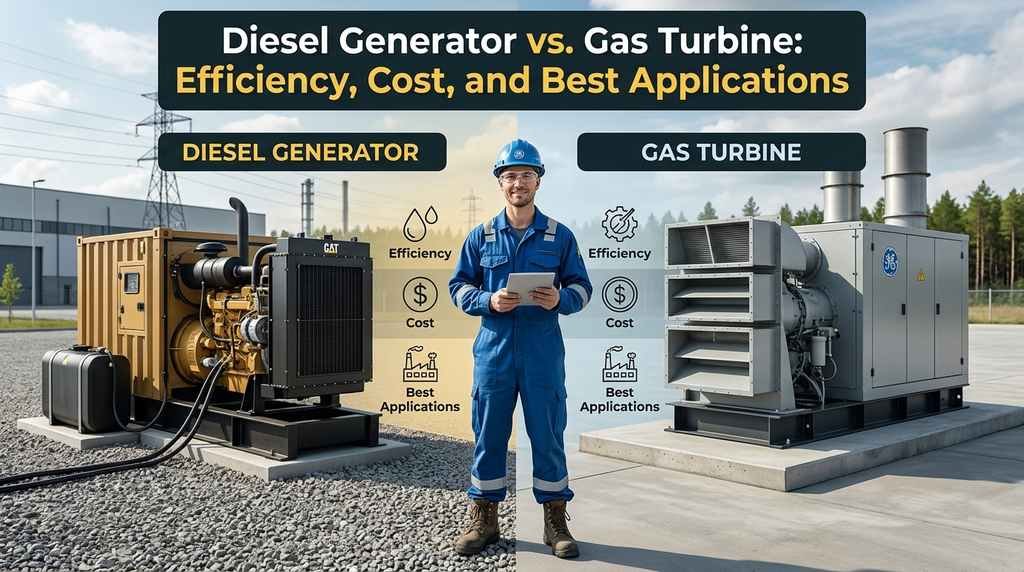
When I compare a diesel generator vs. gas turbine, I do not ask only which one is more efficient. I look at the size of the load, how quickly power must be available, how many hours per year the unit will run, which fuel is available, how the site handles maintenance, whether exhaust heat can be used, and how much capital I am willing to put into the project.
A diesel generator is a reciprocating internal-combustion engine coupled to an alternator. A gas turbine uses compressed air, combustion, and a high-speed turbine to drive a generator. Both convert fuel into electricity, but they do it in very different ways, and those differences become important once you move from a 100 kW standby set to a 50 MW industrial power plant.
In this guide, I will compare efficiency, fuel consumption, capital cost, operating cost, startup time, part-load performance, emissions, maintenance, reliability, noise, heat recovery, and the applications where each technology fits best. I will also show you why a simple “diesel is more efficient” or “gas turbines are cheaper” answer can be misleading.




Diesel Generator vs. Gas Turbine at a Glance
| Factor | Diesel Generator | Gas Turbine |
|---|---|---|
| Typical role | Standby, emergency, prime power, remote sites, smaller distributed generation | Utility peaking, large industrial power, CHP, district energy, large microgrids |
| Practical size range | From small portable units to multi-megawatt generator sets | Roughly a few MW to hundreds of MW for conventional simple-cycle units |
| Startup | Usually very fast; many standby sets are designed to accept load within seconds | Modern aeroderivatives can start in minutes; large frame units may take longer |
| Part-load behavior | Generally strong for a reciprocating engine, though prolonged very-low-load operation can be undesirable | Efficiency typically falls as load drops, though modern aeroderivatives can perform well at part load |
| Fuel | Diesel stored on site | Usually natural gas; many designs can use liquid backup fuel |
| Heat recovery | Possible from exhaust and jacket-water heat | Excellent high-temperature exhaust for steam and CHP |
| Maintenance style | Frequent engine-fluid, filter, injector, cooling, and mechanical maintenance | Fewer reciprocating parts but specialized turbine and hot-section maintenance |
| Best fit | Fast backup and smaller-to-medium distributed power | Large-scale power, peaking, industrial CHP, high annual output |
How the Two Technologies Produce Electricity
How a diesel generator works
In a diesel generator, the engine compresses air inside cylinders, injects diesel fuel, and converts the resulting combustion pressure into crankshaft rotation. The crankshaft turns an alternator that produces electrical power. Because the engine is mechanically linked to the alternator, generator frequency depends on engine speed and alternator design. A common 60 Hz, four-pole generator runs at 1,800 rpm; a comparable 50 Hz set often runs at 1,500 rpm.
This architecture scales well from small sets into the multi-megawatt range. As one current example, Caterpillar lists its C175-16 diesel generator at up to 3,100 ekW standby, 2,825 ekW prime, and 2,600 ekW continuous in one 60 Hz configuration. That is a very large diesel generator, but it is still much smaller than many utility-scale gas turbine installations.
How a gas turbine works
A gas turbine draws air into a compressor, raises its pressure, mixes it with fuel, burns the mixture, and expands the hot gas through turbine stages. Part of the turbine output drives the compressor and the remainder drives the generator. Conventional simple-cycle gas turbines used for CHP are available from roughly 2 MW to about 400 MW, according to the U.S. Department of Energy.
Gas turbines also discharge a large quantity of very hot exhaust. DOE notes exhaust temperatures of roughly 800°F or higher in CHP applications. That is one reason gas turbines are so attractive when a factory, hospital, refinery, university, or district-energy system needs both electricity and useful steam.
Technical Comparison
| Technical characteristic | Diesel generator | Gas turbine | Why it matters |
|---|---|---|---|
| Prime mover | Reciprocating compression-ignition engine | Continuous-flow combustion turbine | Changes maintenance, response, vibration, and load behavior |
| Typical rotational speed | Often 1,500 or 1,800 rpm for larger four-pole sets | Turbine shaft speed is much higher; gearbox/free power turbine arrangement depends on design | Different mechanical architecture |
| Common electrical output | kW to several MW per set | MW to hundreds of MW | Gas turbines dominate at much larger plant sizes |
| Fuel storage | On-site diesel tank is common | Pipeline natural gas is common; dual-fuel may provide liquid backup | Affects resilience and logistics |
| Exhaust heat | Useful but split between exhaust, jacket water, and other losses | Large, high-temperature exhaust stream | Gas turbines are strong CHP candidates |
| Part-load operation | Usually comparatively tolerant | Simple-cycle efficiency generally declines at low load | Important for variable-load sites |
| Black-start suitability | Very common | Possible but plant auxiliaries and starting system matter | Important for emergency power |
| Typical maintenance emphasis | Oil, filters, coolant, injectors, turbocharger, valves, bearings | Compressor cleanliness, combustor, hot section, bearings, turbine inspections | Changes staffing and service strategy |
Which Is More Efficient: Diesel Generator or Gas Turbine?
This is where I see the most oversimplification. The honest answer is that efficiency depends on size, load, fuel, design, and whether you compare simple-cycle electricity only or CHP.
Older EPA CHP references have put diesel reciprocating-engine electrical efficiency in a broad range of roughly 27% to 45% on a higher-heating-value basis. Modern large diesel engines at favorable loads can be toward the upper part of the reciprocating-engine range. Small engines and lightly loaded generators can be lower.
Gas turbines span an equally wide range. DOE CHP material shows conventional gas-turbine electrical efficiency varying significantly with size. At the high-performance end, GE Vernova currently lists its LM6000 aeroderivative models at approximately 39.7% to 41.0% net simple-cycle efficiency on a lower-heating-value basis, depending on model. I always check whether an efficiency number is quoted on an LHV or HHV basis, because the numbers are not directly interchangeable.
A real diesel-generator example
Caterpillar’s current C175-16 data for one 60 Hz configuration lists 2,600 kW continuous output and 168.5 gallons per hour of diesel consumption at 100% continuous load. If I combine that with the EIA heat-content value for distillate fuel, I get an illustrative electrical efficiency of roughly the high-30% range on an HHV basis. That is my calculation from published data, not an official Cat efficiency rating.
| Example | Rated output | Fuel / heat-rate figure | Efficiency context |
|---|---|---|---|
| Cat C175-16 diesel, continuous configuration | 2,600 kW | 168.5 gal/hr at 100% load | Illustrative calculation is around the high-30% HHV range |
| GE LM6000VELOX PC Sprint | 51.1 MW | 8,595 Btu/kWh LHV | 39.7% net LHV efficiency |
| GE LM6000VELOX PF+ Sprint | 56.9 MW | 8,328 Btu/kWh LHV | 41.0% net LHV efficiency |
If you are trying to understand fuel use on the diesel side in more detail, I recommend reading my guide to diesel generator burn rate. For actual economics, efficiency is only one piece of the calculation.
Part-Load Efficiency Can Change the Answer
Suppose your site has a 5 MW peak load but normally runs at only 1.5 MW. A machine that looks excellent at 100% rated output may not look nearly as good at 30% load.
Reciprocating diesel engines generally maintain useful efficiency over a broad load range, but I still avoid long periods of very low loading because low cylinder temperature can contribute to incomplete combustion, deposits, and wet stacking. A generator that spends most of its life far below rated load may be oversized.
Gas turbines also lose efficiency as load falls. Modern aeroderivatives can be much better than older industrial turbines at part load, but I still want the OEM heat-rate curve before I model fuel cost. A gas turbine plant can also improve part-load economics by using multiple turbine modules and shutting one down when demand falls.


Startup Time: Diesel Usually Has the Advantage
If I am designing an emergency standby system for a hospital, data center, water plant, industrial process, or commercial building, startup time matters enormously. Diesel generators are popular in this role because they can start quickly and can be configured to accept load within seconds after an outage.
Gas turbines used to have a reputation for slow starts, but modern aeroderivatives have changed that picture. GE lists a 5-minute fast start for the LM6000. That is extremely fast for a roughly 50 MW-class machine, but it is still a different emergency-power response than a standby diesel generator that is expected to restore critical loads in seconds.
| Situation | Typical priority | Technology I would usually investigate first |
|---|---|---|
| Critical building backup | Seconds to power | Diesel generator |
| Utility peaking plant | Minutes to dispatch | Gas turbine |
| Remote mine with stored fuel | Fuel independence and modularity | Diesel generator |
| Industrial plant needing high-pressure steam | Electricity plus useful exhaust heat | Gas turbine CHP |
| Temporary construction power | Mobility and quick installation | Diesel generator |
For long-outage planning, see my guide on how long a diesel generator can run continuously.
Capital Cost: Which One Costs More?
This comparison can become misleading very quickly because a packaged 500 kW diesel standby generator and a 100 MW combustion-turbine project are not the same type of project. Site work, fuel infrastructure, emissions controls, switchgear, interconnection, transformers, buildings, sound attenuation, heat recovery, and financing can cost as much as or more than the prime mover itself.
For large U.S. utility projects, EIA’s 2024 construction data reported a capacity-weighted average of about $841 per kW for combustion-turbine projects and about $1,490 per kW for internal-combustion-engine projects. I would not use those figures as a quote for a diesel standby generator: EIA’s internal-combustion category includes utility-scale engine projects and is not a diesel-only standby price list. The figures are useful mainly for showing how economies of scale can favor very large turbine projects.
| EIA 2024 utility-scale context | Capacity-weighted average construction cost | Average generator size at new plants |
|---|---|---|
| Combustion turbine | $841/kW | 233 MW |
| Internal combustion engine | $1,490/kW across all fuels in the prime-mover category | 7 MW overall in the EIA prime-mover table |
For a business buying backup power, diesel may still have the lower absolute project cost because the required output may be only hundreds of kilowatts or a few megawatts. For a utility that needs 200 MW, trying to assemble that output from dozens of diesel engines can create a large footprint, a huge fuel-storage requirement, many exhaust systems, and a much more complicated maintenance program.
Fuel Cost per kWh
Fuel price can reverse a decision even when two machines have similar electrical efficiency. Diesel contains a lot of energy and is easy to store, but it is usually more expensive per unit of energy than pipeline natural gas in markets with reliable gas infrastructure.
Here is how I calculate fuel-only power cost:
Fuel cost per kWh = hourly fuel cost ÷ hourly electrical output in kWh
Illustrative diesel example
Using the Cat continuous example above, 168.5 gallons per hour at 2,600 kW:
| Diesel price | Hourly fuel cost | Fuel-only cost per kWh |
|---|---|---|
| $3.00/gal | $505.50/hr | About $0.194/kWh |
| $4.00/gal | $674.00/hr | About $0.259/kWh |
| $5.00/gal | $842.50/hr | About $0.324/kWh |
Those are illustrative fuel-only numbers. They exclude DEF, lubricating oil, maintenance, labor, capital recovery, taxes, delivery, fuel polishing, storage losses, and downtime.
Illustrative gas-turbine example
For the GE LM6000 PF+ Sprint, the published net heat rate is 8,328 Btu/kWh LHV. If I use a purely illustrative natural-gas price, fuel-only cost looks like this:
| Natural-gas price | Heat rate | Illustrative fuel-only cost |
|---|---|---|
| $4/MMBtu | 8,328 Btu/kWh LHV | About $0.033/kWh |
| $6/MMBtu | 8,328 Btu/kWh LHV | About $0.050/kWh |
| $10/MMBtu | 8,328 Btu/kWh LHV | About $0.083/kWh |
Again, these are not delivered electricity prices. They exclude gas transportation, demand charges, compression, turbine maintenance, capital recovery, emissions systems, operators, auxiliary power, and other project costs. But the table shows why a gas turbine can become economically attractive for high-hour operation when low-cost pipeline gas is available.
If you want to model the full cost rather than fuel alone, see my guide to diesel generator cost per kWh.
Fuel Supply and Energy Security
Diesel’s strongest advantage is that I can physically store the fuel at the site. If the utility grid and natural-gas network fail, a properly designed diesel installation can keep operating as long as I have usable fuel, adequate tank capacity, and a resupply plan.
That same advantage creates responsibilities. Diesel can collect water, grow microbial contamination, oxidize during long storage, and require polishing or replacement. Large emergency sites may need many thousands of gallons, secondary containment, permits, spill planning, and scheduled fuel testing.
A gas turbine connected to a reliable gas pipeline avoids the need to store enormous quantities of fuel. On the other hand, the turbine is dependent on gas pressure and supply unless the project has dual-fuel capability. GE’s LM6000, for example, is offered with dual-fuel capability, which can provide an additional resilience option.
Maintenance and Overhaul Costs
Diesel engines and gas turbines both require serious maintenance, but the maintenance pattern is different.
With a diesel generator I expect regular oil and filter service, coolant inspection, batteries, belts and hoses where applicable, fuel filtration, injector and turbocharger attention, valve-train work on some engines, and periodic load testing. High annual run hours eventually lead to deeper engine work.
A gas turbine does not have pistons, connecting rods, and cylinder heads, but that does not mean it is maintenance-free. Compressor fouling, combustor inspection, borescope inspections, hot-section components, bearings, fuel nozzles, control systems, and major turbine inspections all matter. Service events may be less frequent than on a fleet of high-speed reciprocating engines, but they can be highly specialized and expensive.
For a small business or remote facility, diesel service may be easier to source locally. For a large industrial site, a long-term turbine service agreement and planned outage schedule may fit the operation better.
Reliability and Redundancy
One large turbine gives me a lot of power from one machine, but it also concentrates capacity. If a 50 MW turbine is unavailable, 50 MW may disappear at once unless the plant has other units.
Diesel systems are often modular. Instead of one 6 MW machine, I can install three 2 MW generators or four smaller units. This allows maintenance on one unit while others remain available, and it can improve efficiency when demand varies because I can run fewer engines closer to their preferred load.
The tradeoff is complexity: more engines mean more starters, batteries, cooling systems, exhaust systems, controllers, fuel lines, and maintenance tasks.
Emissions: Natural Gas Usually Has the Combustion-CO2 Advantage
Fuel chemistry matters. EIA’s current carbon coefficients list distillate fuel oil at about 163.45 lb CO2 per MMBtu of fuel energy and natural gas at about 116.65 lb CO2 per MMBtu. On an equal fuel-energy basis, burning natural gas therefore produces less direct CO2 than burning diesel.
| Fuel | EIA combustion CO2 coefficient | What I take from it |
|---|---|---|
| Diesel / distillate fuel oil | 163.45 lb CO2/MMBtu | Higher direct combustion carbon intensity per unit of fuel energy |
| Natural gas | 116.65 lb CO2/MMBtu | Lower direct combustion carbon intensity per unit of fuel energy |
That table does not include upstream methane leakage, fuel production, transport, plant efficiency, or emissions controls. Those factors matter when I compare full life-cycle emissions.
Diesel engines can also produce particulate matter and NOx, while gas turbines require NOx management and may use dry-low-emissions combustors, water or steam injection, or selective catalytic reduction depending on project and permit requirements. The exact emissions package depends heavily on jurisdiction and application.
For a broader discussion, see my article on the environmental impact of diesel generators.
Combined Heat and Power Can Strongly Favor a Gas Turbine
If I only need electricity, I compare electrical efficiency. If I also need steam or process heat, the calculation changes completely.
Gas turbine exhaust is hot enough to feed a heat-recovery steam generator. DOE notes that gas turbines are particularly well suited to CHP because of their large high-temperature exhaust stream. EPA says CHP systems can often reach total system efficiencies of roughly 60% to 80% when useful heat is recovered.
A diesel engine can also support CHP by recovering exhaust and jacket-water heat, but the heat is split across several streams and is often available at lower temperature. If my industrial process needs large quantities of steam, a gas turbine with heat recovery may fit much better than a diesel-only power plant.
Noise, Vibration, and Footprint
A diesel generator produces strong low-frequency engine noise, exhaust noise, and vibration. Enclosures, silencers, isolators, radiator design, and site layout are all important.
A gas turbine can be physically compact for the amount of power it produces, but its compressor, turbine, inlet, and exhaust systems can produce intense broadband and high-frequency noise. Large installations use acoustic enclosures, inlet silencers, exhaust silencers, and building treatments.
At multi-megawatt scale, a turbine may deliver much more power from fewer prime movers. A diesel plant may need multiple generator sets, fuel tanks, radiators, exhaust stacks, and service clearances.
Diesel Generator vs. Gas Turbine by Application
| Application | Diesel generator | Gas turbine | Why |
|---|---|---|---|
| Home or small commercial standby | Excellent fit | Not practical | Required power is far below normal industrial gas-turbine scale |
| Hospital/data-center backup | Very common | Possible at campus scale, but not the default | Diesel offers fast black-start capability and on-site fuel |
| Construction site | Excellent | Rare | Portable and rental diesel sets are easy to deploy |
| Remote mine/island microgrid | Strong option | Can work at larger scale | Decision depends on fuel logistics and load size |
| Utility peaking plant | Possible with engine plants | Excellent | Gas turbines scale efficiently into tens or hundreds of MW |
| Industrial CHP with steam demand | Possible | Excellent | High-temperature turbine exhaust is valuable |
| Temporary event power | Excellent | Rare | Mobility and rental availability favor diesel |
| Large baseload station | Possible with large engine plant | Often better as combined cycle rather than simple cycle | Plant scale and heat-rate economics dominate |
For portable and temporary work, see my guide to portable diesel generators for construction sites. If you are still deciding on capacity, start with what size diesel generator you actually need.
When I Would Choose a Diesel Generator
- I need emergency power in seconds.
- I need only a few kilowatts to a few megawatts.
- I want fuel stored on site instead of depending entirely on a pipeline.
- The site is remote or temporary.
- I need modular capacity that can be expanded one generator at a time.
- Annual run hours are relatively low, so fuel cost is less important than reliability and capital simplicity.
- Local technicians and parts support are stronger for diesel equipment.
When I Would Choose a Gas Turbine
- I need tens or hundreds of megawatts from a relatively small number of machines.
- The site has a reliable natural-gas supply.
- The plant will run enough hours for lower fuel cost to dominate life-cycle economics.
- I need high-temperature exhaust for process steam or CHP.
- I am building a utility peaking or grid-support plant.
- I can support specialized turbine maintenance and planned outages.
- I am considering combined-cycle operation for substantially higher plant efficiency.
What About Combined-Cycle Gas Turbines?
A simple-cycle turbine sends hot exhaust to the stack. A combined-cycle gas turbine routes that exhaust through a heat-recovery steam generator, then uses the steam to produce additional electricity in a steam turbine.
This is a different efficiency class from the diesel-generator comparison most facility owners have in mind. GE’s LM6000 data, for example, shows combined-cycle configurations with net LHV efficiency above 50% for certain arrangements. Large modern heavy-duty combined-cycle plants can reach even higher values.
So if someone tells you a “gas turbine is 55% efficient,” I immediately ask whether they mean simple cycle or combined cycle. A 3 MW diesel standby generator should not be compared with a 150 MW combined-cycle plant as if they are interchangeable products.
Questions I Ask Before Choosing
| Question | Why I ask it |
|---|---|
| What is the continuous and peak electrical load? | Defines the required capacity and whether turbine scale is realistic |
| How many hours per year will the plant run? | Determines how strongly fuel efficiency affects life-cycle cost |
| How quickly must power be restored? | Separates emergency standby from dispatchable generation |
| Is pipeline natural gas firm and reliable? | Critical to gas-turbine resilience |
| How much diesel can legally and practically be stored? | Limits diesel runtime |
| Is steam or useful process heat needed? | Can dramatically improve turbine CHP economics |
| What are local air-permit limits? | Can change equipment and aftertreatment cost |
| What redundancy is required? | Determines number and size of units |
| What is the expected fuel price over the project life? | Fuel often dominates high-hour operating cost |
| Who will maintain the equipment? | Local service capability affects real availability |
Frequently Asked Questions
Is a gas turbine more efficient than a diesel generator?
Not automatically. Large modern aeroderivative gas turbines can exceed 40% simple-cycle efficiency on an LHV basis, while large diesel engines can also operate in the high-30% to low-40% range depending on design and measurement basis. Combined-cycle gas turbines can go much higher because they recover exhaust heat to produce additional electricity.
Which is cheaper to run?
If natural gas is inexpensive and the plant operates many hours, a gas turbine can have a major fuel-cost advantage. If the unit runs only during outages, the lower complexity and fast standby capability of diesel may matter more than fuel cost per kWh.
Which is better for backup power?
For most building-scale emergency systems, I would normally investigate diesel first because it starts quickly, stores fuel on site, and is available in a very wide range of generator sizes. Very large campuses and utility systems may use turbines, engines, batteries, or combinations.
Can a gas turbine burn diesel fuel?
Some gas turbines are dual-fuel and can operate on natural gas plus a liquid backup fuel. Fuel capability is model-specific, so I always verify the exact OEM configuration and emissions permit.
Which technology lasts longer?
Both can achieve long service lives when properly maintained. The maintenance pattern is different, so I compare overhaul intervals, parts support, operating hours, start cycles, duty profile, and lifecycle service contracts rather than relying on a single expected-life number.
Which is better for variable loads?
Diesel engines are usually strong at following variable loads. Gas turbines can also respond quickly, especially aeroderivative models, but part-load efficiency and minimum turndown should be checked carefully. A multi-unit plant can improve flexibility for either technology.
Bottom Line
When I compare a diesel generator vs. gas turbine, I see two technologies optimized for different jobs. Diesel generators are exceptionally practical for fast-starting standby power, remote sites, temporary installations, and distributed generation from small sizes into several megawatts. Gas turbines become especially attractive as power demand grows into tens or hundreds of megawatts, when natural gas is available, when annual operating hours are high, or when valuable steam can be recovered from the exhaust.
I would not choose between them based on one efficiency percentage or one $/kW figure. I would model the actual load profile, fuel price, startup requirement, emissions permit, maintenance plan, heat demand, redundancy requirement, and lifetime operating hours. That is what tells you which technology will actually deliver the lower-cost and more reliable power for your site.
Sources and Technical References
- U.S. Department of Energy – CHP Technologies: Gas Turbines
- GE Vernova – LM6000 Aeroderivative Gas Turbine
- Caterpillar – C175-16 Diesel Generator Set
- U.S. EIA – Construction Cost Data for Electric Generators
- U.S. EIA – Carbon Dioxide Emissions Coefficients
- U.S. EPA – Methods for Calculating CHP Efficiency