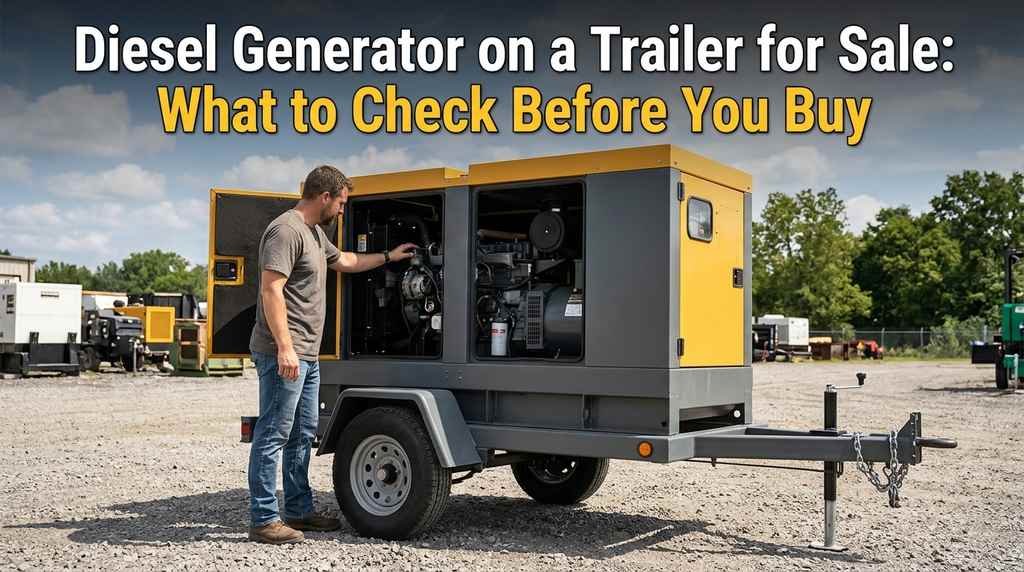
Meta description: Buying a diesel generator on a trailer? Learn what to check before you buy, including engine hours, load testing, trailer condition, tires, brakes, fuel tank, wiring, title, and transport readiness.
Quick answer: If I am looking at a diesel generator on a trailer for sale, I inspect it as two machines in one: a generator set and a road-going trailer. I want to know the generator’s age, engine hours, maintenance history, rated kW and voltage, fuel condition, cold-start behavior, output under load, and any active fault codes. Then I inspect the trailer frame, hitch, safety chains, tires, wheel bearings, axles, brakes, lights, breakaway system, VIN or identification plate, and legal paperwork. I would rather buy a slightly more expensive unit that passes a proper load test and has clear records than save money on a generator that looks good but cannot carry its rated load.
Diesel Generator on a Trailer for Sale: What I Check Before I Buy
A trailer-mounted diesel generator can be a very practical piece of equipment. You can move it between job sites, farms, events, buildings, emergency locations, or remote properties without needing a permanent installation. But that mobility also means you are buying more than an engine and alternator. You are buying a generator, fuel system, control system, enclosure, trailer, running gear, and road-safety equipment all at once.



That is why I do not judge a used trailer generator by paint, hours, or price alone. A machine with low hours can still be a poor buy if it sat outside with old fuel, ran under very light load for years, has electrical faults, or rides on a neglected trailer. On the other hand, a higher-hour machine with documented maintenance, clean fluids, a healthy load test, and a sound trailer may be the better value.
When I inspect one, I follow a fixed order so I do not miss anything expensive.
| Area | What I Check | Why It Matters |
|---|---|---|
| Generator rating | kW, kVA, voltage, phase, frequency | It must match the intended load |
| Engine | Hours, cold start, leaks, smoke, noises | Major repairs can exceed the purchase savings |
| Electrical output | Voltage, frequency, amperage, load test | No-load operation does not prove full performance |
| Fuel system | Tank, contamination, leaks, filters | Old diesel and water can damage the fuel system |
| Cooling system | Coolant, radiator, fan, hoses | Overheating can indicate hidden problems |
| Trailer | Frame, coupler, axles, tires, brakes, lights | Road repairs and safety defects add real cost |
| Documentation | Serial numbers, VIN, title/registration, records | Helps verify identity, ownership, and service history |
1. Confirm the Generator Rating Before Looking at Condition
Before I get excited about a low price, I make sure the generator is actually the right size and electrical configuration. A 20 kW unit is not automatically useful to me if I need 40 kW, and a three-phase generator may not be suitable for the same loads as a 120/240-volt single-phase unit.
I look for the generator nameplate and photograph it. The important details normally include rated kW, kVA, voltage, phase, frequency, amperage, power factor, model number, and serial number.
| Nameplate Item | What It Tells Me | Example |
|---|---|---|
| Rated power | Maximum or duty-rated electrical output | 20 kW, 60 kW, 100 kW |
| Voltage | Available system voltage | 120/240 V, 208 V, 480 V |
| Phase | Single-phase or three-phase | 1-phase or 3-phase |
| Frequency | System frequency | 50 Hz or 60 Hz |
| Power factor | Relationship between kW and kVA | Often 0.8 on three-phase sets |
| Rated current | Approximate output current at rated conditions | Varies with voltage and phase |
I also make sure I understand whether the rating is standby, prime, or continuous. Those terms are not interchangeable. If I plan to operate the generator for long periods on a job site, I want the duty rating to match that use.
2. Check the Engine Hours, but Do Not Judge on Hours Alone
Engine hours matter, but I treat them like mileage on a truck: useful information, not the whole story. A generator with 800 hours can be badly neglected. Another with 5,000 hours may have had professional maintenance throughout its life and still be in strong condition.
I compare the hour meter with maintenance records and the physical condition of the machine. If the meter shows very low hours but the controls, seatless service areas, door hinges, hoses, paint, and connectors look heavily worn, I ask questions. Hour meters can fail or be replaced.
I also ask how the generator was used. A former rental unit may have higher hours but regular service. A standby unit may have fewer hours but could have spent years idling lightly during exercise cycles. Long periods at very low load can contribute to wet stacking in diesel engines, so low hours are not automatically proof of ideal use.
3. Ask for Maintenance Records
If the seller has records, I want to see them. Service documentation can tell me far more than fresh paint. I look for engine oil and filter changes, fuel-filter replacement, coolant service, air-filter changes, valve adjustments where applicable, battery replacement, belt replacement, load-bank tests, injector work, turbocharger work, alternator repairs, and controller faults.
I also compare service dates with the hour meter. If the seller says the generator was maintained every 250 hours but cannot show any invoices, logs, or filter dates, I treat that history as unverified.
If you are comparing used equipment, you may also want to read my guide on used diesel generator risks and benefits before making an offer.
4. Insist on a Cold Start
One of the most useful tests I can do is a true cold start. I ask the seller not to warm the generator before I arrive. A warm engine can hide weak batteries, glow-plug problems, injector issues, poor compression, thick smoke, and difficult starting.


When I start it cold, I watch how quickly it cranks, whether it needs repeated attempts, how long the preheat cycle takes, and what comes out of the exhaust.
| Cold-Start Observation | What It May Suggest |
|---|---|
| Slow cranking | Weak battery, poor cables, starter issue, thick oil |
| Long cranking with white smoke | Poor preheat, injector issue, low compression |
| Heavy black smoke | Air restriction, overfueling, injector/turbo issue |
| Blue smoke | Oil entering combustion chamber |
| Starts then dies | Fuel restriction, air leak, shutdown fault |
| Sharp knock or abnormal metallic noise | Possible internal engine or injection problem |
A short puff of smoke during a cold start is not necessarily a deal breaker. What concerns me is persistent smoke, rough running, repeated cranking, loud mechanical noise, or a machine that cannot settle into stable speed.
5. Check Oil Condition and Look for Leaks
I check the oil level before starting when the engine is cold and parked level. Oil that is slightly dark is normal in a diesel engine, but I still look for warning signs such as milky contamination, a strong diesel smell, metal particles, severe overfilling, or very low level.
Then I inspect underneath the engine, around the oil pan, filters, valve cover, turbo oil lines, crank seals, and hoses. A light film of oil on an older machine may be manageable. Fresh dripping oil is different.
If the generator is expensive enough to justify it, an oil analysis can be worthwhile. Wear metals, fuel dilution, coolant contamination, and abnormal soot can reveal problems that are not visible during a short inspection.
6. Inspect the Cooling System Carefully
Trailer generators often work outdoors in dusty environments, so the radiator deserves close attention. I look through the fins for dirt, chaff, grease, bent fins, and blocked airflow. I also inspect coolant hoses, clamps, the fan, belt condition, overflow tank, radiator cap area, and signs of dried coolant residue.
After the generator is running under load, I watch coolant temperature. A generator that is fine at idle but overheats under load may have a restricted radiator, weak fan drive, thermostat problem, coolant-flow issue, or excessive load.
If you want a deeper checklist for this area, see my article on diesel generator overheating.
7. Inspect the Fuel Tank and Fuel Quality
A trailer-mounted generator usually carries its own diesel tank, which means I am also buying whatever has been happening inside that tank. Water, rust, microbial contamination, sediment, and old fuel can create expensive problems.
I inspect the tank externally for dents, corrosion, wet seams, damaged mounts, and repairs. I check the filler cap and vent, and I look at the water separator if fitted. If the seller allows it, I want a bottom sample of the fuel because contamination tends to settle low in the tank.
| Fuel-System Condition | What I Look For | Possible Cost Impact |
|---|---|---|
| Clean fuel | Clear sample, no visible water or sludge | Normal service |
| Water present | Separate layer or droplets | Drain, filters, possible tank cleaning |
| Dark sludge | Microbial growth or aged fuel deposits | Tank cleaning and repeated filter service |
| Rust/debris | Particles in sample or separator | Tank and fuel-system inspection |
| External leak | Wet seams, hoses, fittings | Repair before transport or operation |
8. A Load Test Is One of the Best Pre-Purchase Tests
I do not consider a generator proven just because it starts and makes voltage with no load. The real question is whether it can carry load while maintaining acceptable voltage, frequency, temperature, and engine speed.
A professional load-bank test applies a controlled electrical load to the generator. For a serious purchase, I prefer a documented load test rather than a seller simply plugging in one tool or light.
During the test, I watch voltage, frequency, current, coolant temperature, oil pressure, exhaust smoke, engine sound, and alarms. If possible, I want the test to progress through increasing load levels rather than jumping immediately to maximum output.
| Example Test Stage | 20 kW Generator | 60 kW Generator | 100 kW Generator |
|---|---|---|---|
| 25% load | 5 kW | 15 kW | 25 kW |
| 50% load | 10 kW | 30 kW | 50 kW |
| 75% load | 15 kW | 45 kW | 75 kW |
| 100% load | 20 kW | 60 kW | 100 kW |
I use these percentages only as a testing illustration. The actual procedure should follow the generator manufacturer’s limits and the qualified technician’s test plan.
Caterpillar specifically recommends asking whether a used generator can be load tested and describes full-rated load testing as part of its used-generator evaluation process. Cummins likewise emphasizes load-bank testing to verify a generator’s ability to perform under real load. That is why I consider a successful load test much more valuable than a no-load demonstration.
9. Watch Voltage and Frequency Under Load
If the generator produces the correct voltage with no load but voltage collapses as load increases, I investigate further. Possible causes include engine-speed loss, fuel restriction, governor issues, automatic voltage regulator problems, excitation faults, loose connections, or alternator damage.
For a conventional synchronous generator, frequency is closely tied to engine speed. Common examples are 1,800 rpm for a 60 Hz four-pole machine and 1,500 rpm for a 50 Hz four-pole machine.
| Frequency | Common 4-Pole Speed | Common 2-Pole Speed |
|---|---|---|
| 50 Hz | 1,500 rpm | 3,000 rpm |
| 60 Hz | 1,800 rpm | 3,600 rpm |
If frequency falls sharply under load, I want to know whether the engine itself is losing speed. If engine speed is correct but voltage is unstable, I pay closer attention to the electrical side.
10. Inspect the Control Panel and Fault History
Modern mobile generators may store warnings and shutdown events. I scroll through the controller before the seller clears anything. I look for recurring high-temperature, low-oil-pressure, underfrequency, overfrequency, undervoltage, overvoltage, emergency-stop, low-fuel, and overcrank faults.
I also test switches, emergency stop, gauges, warning lamps, hour meter, voltage selector if fitted, receptacles, breaker operation, and remote-start functions where applicable.
A dead screen or missing alarm history is not necessarily fatal on an old mechanical generator, but on a newer electronic unit it can make diagnosis more difficult and more expensive.
11. Inspect the Alternator and Electrical Connections
I look for burned insulation, discoloration, loose lugs, damaged cable glands, water entry, rodent damage, corrosion, and evidence of overheating. If the enclosure has been pressure washed carelessly, moisture may have entered electrical components.
I also check receptacles for broken covers and burned contacts. On large units with cam-locks or distribution terminals, I inspect the connectors closely because high-current connection damage can become a major repair.
If the unit has a selectable-voltage configuration, I verify that the switch and output terminals are correctly labeled. I never assume a used generator is wired exactly as the decal says without checking.
12. Inspect the Trailer Frame Like You Would Inspect Equipment
Now I move to the trailer. The generator can run perfectly and still be a bad purchase if the trailer is unsafe.
I inspect the main frame rails, crossmembers, tongue, generator mounting points, welds, fenders, jack mounts, and tie-down points. Surface rust is common. Deep scaling, cracks around welds, bent frame members, or fresh paint over suspicious areas deserves closer inspection.
Trailer Inspection Checklist
| Trailer Component | What I Check | Red Flag |
|---|---|---|
| Frame | Rust, cracks, bends, repairs | Structural corrosion or cracked welds |
| Coupler/pintle ring | Wear, cracks, correct rating | Loose or heavily elongated connection |
| Safety chains | Condition and attachment | Missing, undersized, badly corroded |
| Axles | Alignment, leaks, rating plate | Bent axle or overloaded setup |
| Wheel bearings | Noise, play, grease leakage | Excessive looseness or overheating |
| Brakes | Operation and wiring | Inoperative or disconnected brakes |
| Lights | Brake, turn, tail, marker | Dead or damaged wiring |
| Jack | Operation and load capacity | Bent or unstable jack |
13. Check Tire Age, Load Rating, and Condition
I never judge trailer tires only by tread depth. Trailer tires can have good tread and still be unsafe because of age, sidewall cracking, internal damage, or long-term sun exposure.
I read the DOT date code, inspect both sidewalls, and confirm the tire load rating is adequate for the trailer’s gross weight. I also check that all tires are the correct size and type and that the wheels are not cracked or badly corroded.
If four or six old tires need immediate replacement, I subtract that cost from what I am willing to pay.
14. Verify Axle and Trailer Weight Ratings
A large diesel generator, enclosure, full fuel tank, batteries, cables, and trailer can become very heavy. I want the trailer’s gross vehicle weight rating and axle ratings to comfortably cover the actual loaded weight.
Fuel weight matters too. Diesel weighs roughly 7 lb per U.S. gallon, depending on temperature and fuel formulation. That means a 100-gallon tank can add around 700 lb when full, while a 200-gallon tank can add about 1,400 lb.
| Fuel Capacity | Approximate Diesel Weight at 7 lb/gal |
|---|---|
| 50 gal | 350 lb |
| 100 gal | 700 lb |
| 150 gal | 1,050 lb |
| 200 gal | 1,400 lb |
| 300 gal | 2,100 lb |
I compare the generator’s actual weight, full-fuel weight, accessories, and trailer weight against the trailer rating. I also make sure my tow vehicle is rated for the resulting trailer weight and tongue weight.
15. Test the Trailer Brakes and Breakaway System
Many larger generator trailers use electric or electric-over-hydraulic brakes. I check whether the brakes actually work, not just whether brake assemblies are visible behind the wheels.
I inspect the seven-pin connector, brake wiring, breakaway switch, breakaway battery where fitted, and controller compatibility with the tow vehicle. If the trailer has been sitting for years, brake components may be seized or badly corroded.
Brake requirements vary by jurisdiction and trailer weight, so I verify the rules where the trailer will be registered and operated rather than relying on the seller’s statement.
16. Confirm the Hitch Type Before You Arrive to Tow It
Commercial trailer generators commonly use pintle rings, while smaller units may use ball couplers. I check the coupler size and rating in advance so I arrive with the correct towing setup.
I also check hitch height. A badly nose-high or nose-low trailer can tow poorly and distribute weight incorrectly. Heavy trailer generators may need a substantial tow vehicle and properly rated receiver or pintle hitch.
17. Check the VIN, Serial Number, and Ownership Paperwork
This is one area where I do not take shortcuts. I compare the trailer VIN or identification number with the title, registration, bill of sale, or other ownership documents required where I live. I separately record the generator model and serial number.
If identification plates are missing, altered, painted over, or inconsistent with the paperwork, I resolve that before paying. Requirements for titling and registering equipment trailers vary by state and jurisdiction, so I confirm local rules before purchase.
18. Look for Evidence of Rental or Job-Site Abuse
Rental equipment is not automatically bad. In fact, rental fleets often follow scheduled maintenance closely. But rental machines can experience hard towing, dusty operation, repeated starting, heavy loads, and frequent handling.
I look for dented doors, bent fenders, damaged locks, scraped control panels, broken receptacles, crushed exhaust pipes, patched harnesses, mismatched tires, damaged lifting eyes, and signs the machine has been dragged or struck.
I then compare that condition with the price. A rugged-looking rental unit with clean service records and a strong load test may still be an excellent buy. Cosmetics alone do not decide it for me.
19. Listen for Wet Stacking and Low-Load History
Diesel generators that spend long periods running lightly loaded may develop wet stacking, where unburned fuel and combustion byproducts accumulate in the exhaust system. I look for oily black residue around the exhaust, heavy soot, and a history of constant unloaded exercise.
This is another reason I like a load-bank test. Cummins notes that proper loading helps bring a diesel engine to the operating conditions needed to reduce wet-stacking effects.
20. Estimate the Real Purchase Cost, Not Just the Asking Price
I build a repair allowance before I make an offer. The asking price is only one part of the cost.
| Possible Expense | What Could Trigger It |
|---|---|
| New batteries | Old batteries or slow cranking |
| All trailer tires | Age cracking, low load rating, damage |
| Brake service | Seized or nonworking trailer brakes |
| Fuel-system cleaning | Water, algae, sludge, rust |
| Oil/coolant/filter service | Unknown maintenance history |
| Load-bank test | No recent documented performance test |
| AVR/alternator repair | Unstable or missing voltage |
| Trailer lights/wiring | Damaged harness or connectors |
| Title/registration work | Incomplete ownership documentation |
| Transport | Unit too heavy or unsafe to tow immediately |
A generator listed for $12,000 may actually be a $17,000 purchase if it immediately needs tires, batteries, brake work, tank cleaning, filters, and electrical repair. That does not necessarily mean I reject it, but I price the work before I negotiate.
21. Questions I Ask the Seller
- How long have you owned the generator?
- What was it used for?
- Why are you selling it?
- Are the engine hours original?
- When was the oil last changed?
- When were the fuel filters last changed?
- How old are the batteries?
- Has the generator ever overheated?
- Has it had injector, turbo, engine, alternator, or AVR repairs?
- Can I see the maintenance records?
- Can I start it completely cold?
- Can it be load-bank tested?
- Does the trailer have a clear title or required ownership paperwork?
- Do the brakes, lights, and breakaway system work?
- Are there any known faults or active alarm codes?
22. My Pre-Purchase Inspection Checklist
If I were standing in front of a trailer-mounted diesel generator today, this is the condensed list I would work through before handing over money.
- Photograph generator and engine nameplates.
- Confirm kW, voltage, phase, frequency, and duty rating.
- Record generator and trailer identification numbers.
- Compare engine hours with service history.
- Inspect engine oil and coolant before starting.
- Check fuel for water or contamination.
- Perform a true cold start.
- Observe smoke, noise, leaks, oil pressure, and temperature.
- Read controller alarms and history.
- Check voltage and frequency at no load.
- Perform or witness a proper load test.
- Inspect radiator, hoses, fan, and belts.
- Inspect alternator, wiring, breakers, and receptacles.
- Inspect trailer frame, tongue, welds, and mounts.
- Check tires, wheel bearings, axles, and wheels.
- Test trailer brakes, lights, and breakaway equipment.
- Confirm hitch type and trailer weight.
- Verify title, registration, bill of sale, or local paperwork requirements.
- Price all immediate repairs before making an offer.
When I Would Walk Away
I would become very cautious if the seller refuses a cold start, will not allow a meaningful load test on an expensive unit, cannot explain major fault codes, has inconsistent serial numbers or paperwork, or wants me to ignore obvious trailer safety problems.
I would also think twice about severe blow-by, persistent blue smoke, coolant in the oil, oil in the coolant, repeated overheating, major structural trailer rust, badly cracked frame welds, unstable output voltage, or a generator that cannot carry a reasonable load without bogging or shutting down.
Some of these problems are repairable. The issue is whether the purchase price leaves enough room for the repairs and whether I can accurately estimate them.
Frequently Asked Questions
Is a trailer-mounted diesel generator a good buy?
It can be. I like trailer-mounted generators when I need portable power at multiple locations. The key is buying a generator that passes a performance test and a trailer that is safe and correctly rated for the weight.
How many hours are too many on a used diesel generator?
I do not use a single hour limit. Engine design, maintenance history, duty cycle, loading, and operating environment matter more than the number by itself. A professionally maintained higher-hour generator may be a better purchase than a neglected low-hour unit.
Should I buy a used generator without a load test?
For a low-cost unit, you may decide the risk is acceptable. For an expensive trailer generator, I strongly prefer a load test. A no-load demonstration cannot prove that the engine and alternator will hold voltage and frequency at rated output.
What should I check on the trailer first?
I start with the frame, coupler or pintle ring, safety chains, tires, axle ratings, brakes, lights, breakaway equipment, and identification plate. I also verify that the tow vehicle and hitch are rated for the actual loaded trailer weight.
Does low engine hours mean the generator is in good condition?
No. Low hours can be attractive, but I still check maintenance history, fuel condition, coolant, batteries, load performance, and evidence of long-term low-load operation or outdoor storage.
How much does diesel fuel add to trailer weight?
A useful estimate is about 7 pounds per U.S. gallon. A 100-gallon tank can therefore add roughly 700 pounds when full. I include fuel when checking trailer and tow-vehicle ratings.
Can I tow a generator trailer home immediately after buying it?
Only if I know the trailer is roadworthy, properly registered where required, correctly hitched, within the tow vehicle’s ratings, and equipped with functioning tires, lights, brakes, safety chains, and breakaway equipment as applicable. If I am unsure, I arrange professional transport instead.
Final Thoughts
When I see a diesel generator on a trailer for sale, I never look at it as just a generator. I am buying an engine, alternator, controls, fuel tank, cooling system, electrical distribution system, and trailer running gear in one package.
The generator side needs to start cold, run cleanly, hold stable voltage and frequency, and carry a real electrical load. The trailer side needs a sound frame, correct weight rating, safe tires, working brakes, proper lights, a dependable hitch, and clear ownership documentation.
If I can verify those things, a used trailer-mounted diesel generator can offer a lot of value. If I cannot verify them, I price the uncertainty into my offer or I walk away. A bargain generator is only a bargain if I can safely tow it home and depend on it when I actually need power.