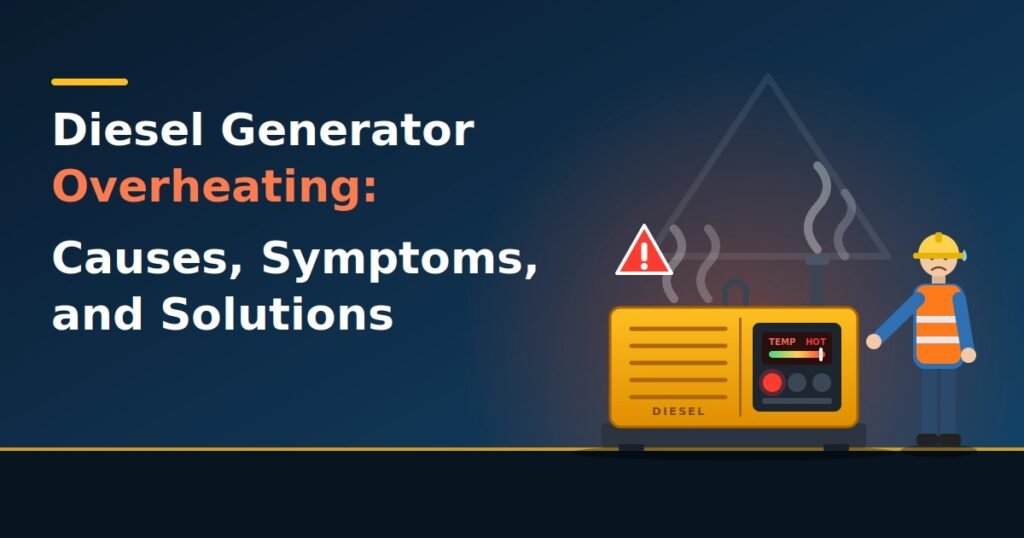
Meta description: Diesel generator overheating? Learn the most common causes, warning signs, normal temperature ranges, troubleshooting steps, and practical solutions to prevent engine damage.
Quick answer: If your diesel generator is overheating, I would first reduce or remove the electrical load, shut the unit down safely, let it cool, and then check coolant level, radiator airflow, fan operation, belts, hoses, coolant leaks, and the condition of the radiator core. Overheating can also come from a clogged radiator, a failing thermostat or water pump, trapped air in the cooling system, an undersized ventilation setup, excessive ambient heat, or operating the generator above its rated load. I never keep resetting a high-temperature shutdown without finding the cause because repeated overheating can damage the cylinder head, head gasket, pistons, bearings, engine oil, hoses, and alternator.
Diesel Generator Overheating: What It Means
When I say a diesel generator is overheating, I mean the engine or cooling system is operating beyond the temperature range the manufacturer considers safe. In many modern generator sets, the controller will display a high coolant temperature warning or shut the engine down automatically before severe damage occurs.



The important thing to understand is that there is no single coolant temperature that applies to every diesel generator. A portable air-cooled unit, a residential liquid-cooled standby generator, and a large industrial genset can have very different normal operating temperatures and shutdown settings. I always use the service manual or controller specifications for the exact model.
As a broad reference, many liquid-cooled generator engines operate with coolant somewhere around the high-170s to low-200s °F once fully warmed, but the exact thermostat opening point and high-temperature shutdown threshold vary considerably. Cummins application guidance notes that cooling systems must be designed for the engine and ambient conditions, and some standby applications may allow radiator top-tank temperatures up to roughly 220°F (104°C). I treat figures like these as design references, not as a universal operating target for every generator.
| Temperature Situation | What I Look For | What I Do |
|---|---|---|
| Temperature rises normally and stabilizes | Thermostat and cooling system appear to regulate | Continue monitoring under load |
| Temperature keeps climbing under steady load | Cooling capacity, airflow, coolant flow, overload | Reduce load and inspect system |
| Sudden temperature spike | Coolant loss, belt failure, pump problem, sensor issue | Shut down and investigate immediately |
| High-temp alarm or shutdown | Controller has reached protective threshold | Do not repeatedly reset without diagnosis |
| Overheats only on hot days | Marginal radiator capacity or poor ventilation | Improve airflow and verify derating requirements |
Common Symptoms of an Overheating Diesel Generator
Sometimes the controller tells me exactly what is happening. Other times, I have to recognize the signs before the generator reaches an automatic shutdown.
- High coolant temperature warning
- Automatic high-temperature shutdown
- Temperature gauge climbing steadily
- Coolant smell around the enclosure
- Coolant pushed into or out of the overflow bottle
- Steam or vapor near the radiator
- Reduced engine power
- Engine knocking or unusual mechanical noise
- Fan running continuously on systems with variable fan control
- Hot enclosure or excessive heat around the generator
- Repeated shutdown during heavy loads
If I see steam, active coolant leakage, or a high-temperature shutdown, I stop treating the issue as a minor nuisance. I shut the generator down safely and let it cool before opening or touching the cooling system.
1. Low Coolant Level
Low coolant is one of the first things I check on a liquid-cooled diesel generator. If the system does not contain enough coolant, it cannot carry heat away from the cylinder head and engine block effectively.
Coolant can become low because of a loose hose clamp, cracked hose, radiator leak, worn water-pump seal, damaged pressure cap, internal engine leak, or simply poor maintenance.
I check coolant only after the engine has cooled. A hot pressurized cooling system can release boiling coolant and steam violently. I never remove a radiator cap from a hot engine.
Where Coolant Can Disappear
| Leak Source | Typical Clue | What I Check |
|---|---|---|
| Radiator | Wet fins or dried coolant residue | Core, seams, tanks, drain plug |
| Hose or clamp | Wet connection or crusty deposit | Hoses, clamps, fittings |
| Water pump | Leak near pump or weep hole | Pump seal and bearing |
| Pressure cap | Overflow or coolant loss | Seal and cap pressure rating |
| Head gasket | Persistent coolant loss, bubbles, white exhaust | Cooling-system pressure and combustion-gas test |
2. Dirty or Blocked Radiator
A radiator can look fine from a distance while its fins are packed with dust, grass, oil, insects, cottonwood, construction debris, or other contamination. When airflow through the core drops, cooling performance falls sharply.
I pay particular attention to generators used on construction sites, farms, dusty yards, industrial facilities, and locations surrounded by vegetation. A generator can run normally for months and then begin overheating as the core gradually plugs.
I clean radiator fins carefully because high-pressure water or aggressive compressed air can bend thin fins and make airflow even worse. I follow the manufacturer’s cleaning method and work from the clean side toward the dirty side when practical.
3. Restricted Airflow Around the Generator
Even a perfectly clean radiator cannot cool an engine if the hot air cannot leave the enclosure or if fresh air cannot enter.
I check for blocked louvers, vegetation, stored materials, temporary walls, tarps, dust screens, snow, leaves, and debris. I also look for hot-air recirculation. This happens when the generator exhausts heated radiator air and that same hot air gets pulled back into the intake side.


That recirculation can raise inlet-air temperature dramatically and make a generator overheat even though the cooling system itself is mechanically healthy.
Airflow Problems I Commonly Look For
- Generator installed too close to a wall
- Blocked intake or discharge louvers
- Vegetation growing around the enclosure
- Radiator exhaust recirculating into the intake
- Indoor installation with inadequate ventilation
- Added acoustic panels restricting airflow
- Dirty intake screens
- Snow or leaves blocking the enclosure
For installations, I use the clearance and ventilation requirements supplied by the manufacturer rather than relying on a generic distance. Airflow requirements vary widely with generator size and enclosure design.
4. Generator Is Overloaded
An overloaded generator produces more heat because both the engine and alternator are being asked to deliver more power. If the unit is already near the cooling system’s limit, a sustained overload can push temperature upward quickly.
I compare the connected load with the generator’s actual rating. I also remember that the nameplate can include different ratings such as standby, prime, or continuous duty. A generator rated for emergency standby service should not automatically be assumed suitable for continuous operation at that same load.
| Generator Rating | Example Load | Approximate Load Percentage |
|---|---|---|
| 10 kW | 5 kW | 50% |
| 10 kW | 7.5 kW | 75% |
| 10 kW | 9 kW | 90% |
| 10 kW | 10 kW | 100% |
| 10 kW | 12 kW | 120% — overload |
If the generator only overheats when several large loads start or when the load remains close to maximum for a long period, I reduce the demand and retest.
I also account for motor starting current. Pumps, compressors, air conditioners, refrigerators, and similar loads can draw several times their normal running current during startup.
5. Loose, Slipping, or Broken Fan Belt
On generator engines that use a belt-driven cooling fan or water pump, belt condition is critical. A loose belt may still turn the fan but not fast enough under load. A badly worn belt can slip more as the engine heats up.
I inspect the belt for cracks, glazing, fraying, contamination, incorrect tension, and damaged pulleys. Cummins specifically notes in its generator maintenance documentation that a loose fan belt can cause engine overheating.
I do not run the generator with the belt guard removed. If I am servicing the belt, I disable the starting system first according to the manufacturer’s instructions.
6. Cooling Fan Not Working Properly
A damaged fan, loose hub, electrical fan failure, hydraulic fan fault, or incorrect fan rotation can drastically reduce airflow.
I visually confirm that the fan operates as intended. On variable-speed or electrically controlled systems, I also consider the fan controller, relay, fuse, temperature sensor, and wiring.
A fan that is turning is not always a fan that is moving enough air. Damaged blades, wrong fan installation, or slipping drive components can reduce airflow considerably.
7. Faulty Thermostat
The thermostat regulates coolant flow as the engine warms up. If it sticks closed or fails to open sufficiently, coolant flow through the radiator is restricted and engine temperature rises.
A thermostat problem often produces a generator that warms up normally at first and then rapidly becomes too hot. In some cases, the upper radiator hose becomes very hot while circulation through the radiator remains poor.
I replace a suspect thermostat with the correct temperature-rated part for the engine. Removing the thermostat permanently is not a proper repair because the cooling system was designed around controlled coolant flow and engine operating temperature.
8. Water Pump Failure
The water pump circulates coolant through the engine and radiator. A failed pump, damaged impeller, leaking seal, broken drive, or worn bearing can reduce or stop circulation.
I look for coolant leakage near the pump, bearing noise, shaft play, and poor circulation. Some impellers can deteriorate internally, so a pump may appear to turn normally while moving less coolant than it should.
9. Air Trapped in the Cooling System
Air pockets are easy to overlook after a coolant change, hose replacement, radiator replacement, or repair. Trapped air reduces heat transfer and can interfere with water-pump operation.
Cummins application guidance specifically warns that entrained air reduces heat transfer and, in severe cases, can contribute to loss of pump prime.
I use the manufacturer’s bleeding and deaeration procedure. Some systems self-bleed through a surge tank, while others require specific vent points or filling procedures.
10. Wrong Coolant Mixture or Contaminated Coolant
Coolant does more than prevent freezing. It controls corrosion, raises boiling protection when used in a pressurized system, lubricates certain components, and transfers heat.
I use the coolant type and mixture specified by the engine manufacturer. Too much glycol can reduce heat-transfer efficiency, while too little antifreeze or improper additives can reduce corrosion and freeze protection.
| Coolant Condition | Potential Problem | My Response |
|---|---|---|
| Correct approved mixture | Normal protection | Maintain service interval |
| Too much glycol | Reduced heat transfer | Correct concentration |
| Mostly plain water | Corrosion and reduced protection | Drain/refill to specification |
| Rusty or muddy coolant | Corrosion or contamination | Inspect and service system |
| Oil in coolant | Possible internal engine fault | Stop and diagnose |
11. Clogged Internal Cooling Passages
Scale, rust, incompatible coolant deposits, sealant residue, and neglected coolant can restrict internal passages. When that happens, cleaning the outside of the radiator may not fix the overheating problem.
If the system has a long history of neglected coolant service, I consider internal restriction in the radiator, engine block, or heat exchanger. A cooling-system flow test or radiator evaluation may be necessary.
12. Defective Radiator Pressure Cap
The pressure cap helps the cooling system operate above atmospheric pressure, which raises the boiling point of the coolant. A cap that cannot maintain the specified pressure can allow coolant to boil or escape at a lower temperature.
I inspect the cap seal, spring, filler neck, overflow hose, and recovery bottle. I replace the cap with the correct pressure rating rather than using a higher-pressure cap as a shortcut.
13. High Ambient Temperature
A generator that works perfectly at 70°F can behave differently in extreme summer heat. Radiators reject heat to the surrounding air, so hotter intake air reduces the temperature difference available for cooling.
High ambient temperature can also reduce engine and alternator output ratings. If the installation routinely sees extreme heat, I check the manufacturer’s ambient-temperature and derating charts.
| Ambient Condition | Cooling Challenge | What I Check |
|---|---|---|
| Mild weather | Normal heat rejection | Standard airflow and load |
| Hot summer day | Reduced cooling margin | Radiator cleanliness and ventilation |
| Very high ambient temperature | Possible derating required | Manufacturer temperature rating |
| Hot enclosed room | Heat recirculation | Ventilation design and discharge air |
14. High Altitude
Altitude can contribute indirectly to overheating because air density decreases as elevation increases. Lower-density air moves less mass through the radiator for a given fan volume and can reduce engine power as well.
I consult the generator manufacturer’s derating guidance for altitude and temperature together. I do not assume a sea-level rating applies unchanged at high elevation.
15. Blocked or Restricted Exhaust
An exhaust restriction increases engine backpressure and can increase operating temperature. I inspect for crushed pipes, collapsed flexible sections, blocked mufflers, soot buildup, or improper exhaust modifications.
This is especially important on permanently installed generators where exhaust piping may have been modified during building renovations.
16. Poor Engine Lubrication
Engine oil carries away heat as well as lubricating moving parts. Low oil, incorrect viscosity, degraded oil, or poor oil circulation can increase friction and temperature.
I check oil level and condition, but I never assume that topping up the oil automatically solves a high-temperature problem. If oil pressure is low or mechanical noise is present, I stop the engine and diagnose the lubrication system.
17. Dirty Air Filter and Poor Combustion
A badly restricted air filter can cause inefficient combustion, black smoke, reduced power, and higher thermal stress. A clogged filter may not be the only cause of overheating, but it can contribute to a generator that runs hot under load.
I inspect the filter and replace it according to the service schedule. I do not run the engine without an air filter as a permanent workaround.
18. Injector or Fuel-System Problems
Poor injector spray patterns, incorrect injection timing on applicable engines, or fuel-system faults can increase exhaust temperature and engine heat. If I see heavy smoke, rough running, abnormal combustion noise, or high exhaust temperature along with overheating, I consider fuel-system diagnosis.
Modern high-pressure common-rail systems are not systems I casually open or loosen. Injection pressure can be dangerous, and proper diagnosis often requires scan tools and manufacturer procedures.
How I Troubleshoot an Overheating Diesel Generator
I prefer a logical sequence because it prevents unnecessary parts replacement.
- Reduce or remove the load. I see whether temperature stabilizes.
- Check the controller. I record the actual coolant temperature and fault code before clearing anything.
- Shut down and cool the engine. I never open a hot pressurized cooling system.
- Check coolant level. I look for leaks and signs of coolant loss.
- Inspect the radiator. I check both internal and external blockage possibilities.
- Inspect airflow. I verify intake and discharge openings are unobstructed.
- Check the fan and belt. I verify correct operation and tension.
- Inspect hoses and cap. I look for collapsed hoses, leaks, and pressure-cap problems.
- Consider thermostat and water pump. If airflow and coolant level are good, circulation becomes a major suspect.
- Check installation conditions. I consider ambient heat, altitude, enclosure design, and hot-air recirculation.
- Inspect engine condition. If overheating persists, I investigate lubrication, combustion, head-gasket, and internal cooling problems.
What Should I Do Immediately If My Generator Overheats?
If the generator is still running and the temperature is climbing rapidly, I reduce nonessential loads first if it is safe to do so. If a high-temperature alarm is active or the temperature continues rising, I shut the unit down according to the manufacturer’s procedure.
I let the engine cool completely before opening the cooling system. I do not pour cold water into an extremely hot engine because rapid temperature change can create thermal stress.
Can I Keep Running a Generator That Is Overheating?
I would not. Continuing to operate an overheating diesel generator can turn a relatively inexpensive cooling-system repair into major engine damage.
Possible consequences include a warped cylinder head, failed head gasket, damaged piston rings, scored cylinders, degraded oil, bearing damage, cracked hoses, coolant loss, and eventually engine seizure.
How Load Affects Generator Temperature
As electrical load increases, the engine burns more fuel and creates more heat. A healthy cooling system should be able to control temperature within the generator’s rated operating envelope, but dirty radiators, weak airflow, marginal coolant flow, or extreme ambient temperatures reduce that margin.
| Load Level | General Heat Production | What I Watch |
|---|---|---|
| 25% | Relatively low | Stable warm-up |
| 50% | Moderate | Normal temperature regulation |
| 75% | High | Cooling system should remain stable |
| 100% | Maximum rated heat rejection | Ambient and airflow become critical |
| Above rating | Excessive | Overload and overheating risk |
These percentages are general operating references, not a recommendation that every generator should be run continuously at 100%. I follow the model’s standby, prime, or continuous rating.
Why a Generator Overheats Only Under Load
If the generator idles normally but overheats under load, I suspect a cooling system that is only marginally effective. Common causes include a partially clogged radiator, weak fan airflow, slipping belt, restricted coolant flow, overload, fuel-system problems, or insufficient ventilation.
This situation is useful diagnostically because it tells me the cooling system can handle low heat output but not full heat rejection.
Why a Generator Overheats After 20 or 30 Minutes
A delayed overheat often points toward heat accumulation rather than an immediate catastrophic failure. I think about radiator fouling, thermostat operation, coolant circulation, recirculated hot air, marginal ventilation, or a load that keeps the system close to its maximum capacity.
If temperature climbs at a consistent rate every time, I record the coolant temperature at five- or ten-minute intervals. A repeatable pattern can help a technician identify the problem.
Preventing Diesel Generator Overheating
I find prevention much cheaper than repairing heat damage. My preventive checklist includes regular coolant inspection, scheduled coolant replacement, belt inspection, radiator cleaning, air-filter service, leak checks, load monitoring, and keeping the enclosure clear.
| Maintenance Item | Why It Matters | When I Check It |
|---|---|---|
| Coolant level | Maintains heat transfer | Routine inspection / before heavy use |
| Radiator cleanliness | Maintains airflow | More often in dusty environments |
| Fan belt | Drives cooling components | At scheduled service |
| Hoses and clamps | Prevent coolant loss | Routine visual inspection |
| Coolant quality | Controls corrosion and boiling protection | Per manufacturer interval |
| Load level | Controls heat generation | During operation |
| Ventilation openings | Prevents heat recirculation | Before running |
When I Would Call a Generator Technician
I stop DIY troubleshooting when the basic checks do not reveal the cause, or when the problem involves internal engine components, high-voltage equipment, or repeated protective shutdowns.
I would call a qualified technician for a suspected head-gasket failure, internal coolant loss, thermostat or pump diagnosis I cannot safely perform, repeated high-temperature shutdowns with correct coolant and airflow, abnormal oil pressure, injector problems, controller faults, or a cooling system that needs pressure or flow testing.
Related Diesel Generator Problems
Overheating often overlaps with other symptoms. If your generator loses power when loads are connected, see Diesel Generator Bogs Down Under Load: Causes, Diagnosis, and Fixes. If the unit will not start after a high-temperature shutdown, see Troubleshooting: Why Won’t My Diesel Generator Start?. For a broader diagnostic process, see Diesel Generator Not Working? Complete Troubleshooting Guide.
If you are using a standby system at home, also see Diesel Generator for Home Backup: How to Choose the Right Size and Setup. And if fuel consumption seems unusually high while the generator runs hot, compare your usage with Diesel Generator Burn Rate: How Much Fuel Does a Generator Use?.
Frequently Asked Questions
What is the most common cause of a diesel generator overheating?
I most often start with coolant level and airflow. Low coolant, a dirty radiator, blocked ventilation, fan or belt problems, and excessive load are common causes and are relatively easy to inspect before moving into deeper engine diagnosis.
Can too much load cause a diesel generator to overheat?
Yes. More electrical load requires more engine power and fuel, which creates more heat. A sustained overload can exceed both the engine and cooling system’s capability.
Can low coolant make a generator shut down?
Yes. Low coolant can cause rapid temperature rise. Many generator controllers will shut the engine down when coolant temperature exceeds a protective limit.
Can a dirty radiator cause overheating?
Absolutely. Dirt and debris reduce airflow through the radiator fins and reduce heat rejection. Internal scale or deposits can also reduce coolant-side heat transfer.
Why does my generator overheat only in summer?
If it only overheats in hot weather, I suspect that the cooling system has very little reserve capacity. Dirty fins, restricted ventilation, hot-air recirculation, high load, or an installation that requires temperature derating are common possibilities.
Why does my generator overheat even though the coolant is full?
A full cooling system can still overheat because of a stuck thermostat, failed water pump, slipping belt, blocked radiator, trapped air, wrong coolant concentration, fan problems, overload, or poor ventilation.
Can a bad thermostat cause a generator to overheat?
Yes. If the thermostat does not open correctly, coolant flow through the radiator can be restricted and engine temperature can rise quickly.
Can I add coolant while the generator is hot?
I do not open a hot pressurized cooling system. I let the engine cool and follow the manufacturer’s filling procedure because hot coolant and steam can cause severe burns.
Does a diesel generator need to cool down before shutdown?
Some larger diesel engines benefit from a short unloaded cool-down period after heavy operation, especially turbocharged units. I follow the manufacturer’s shutdown procedure because required cool-down time varies by engine.
Final Thoughts
When a diesel generator overheats, I do not assume the engine itself is ruined. Many overheating problems begin with straightforward issues such as low coolant, a dirty radiator, restricted airflow, an overloaded generator, a slipping fan belt, or poor ventilation.
My approach is to start with the easy checks, then work deeper: load, coolant level, leaks, radiator condition, airflow, fan, belt, hoses, pressure cap, thermostat, water pump, coolant circulation, and finally internal engine problems.
The key is not to keep resetting a high-temperature shutdown and hoping it goes away. A generator controller is warning you that the engine is outside its safe operating range. Finding the cause early can turn a minor cooling-system service into a simple repair instead of a major engine rebuild.