
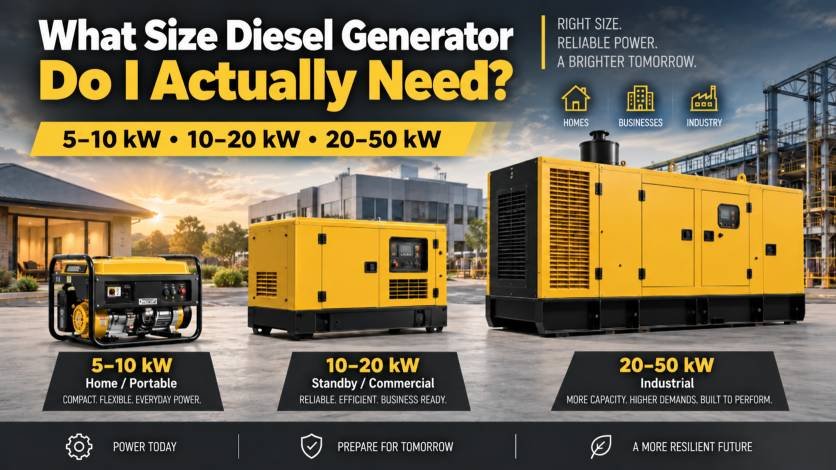
If you are asking, “What size diesel generator do I actually need?” I would start with the load you must run at the same time, add the largest starting surge from any motor-driven equipment, then leave a sensible margin so the generator is not working at its absolute limit. For a simple home or small-business estimate, I use total running watts + the single highest additional starting watts, then apply a planning margin. For commercial, industrial, three-phase, motor-heavy, or mission-critical systems, I do not stop there—I also check kVA, power factor, voltage, phase, load steps, duty rating, altitude, temperature, and allowable voltage/frequency dip.
Quick answer: The right diesel generator is not simply “the next size above your running watts.” It must be large enough for your continuous load and the worst short-duration starting demand. At the same time, I avoid grossly oversizing a diesel generator because long periods at very light load can contribute to poor combustion and wet stacking.
I am going to show you the same process I would use when narrowing down a generator for a house, shop, construction site, farm, office, or small commercial facility. I will also show you where a simple wattage worksheet stops being reliable and when you should use a manufacturer sizing tool or an electrical engineer.
Diesel Generator Size at a Glance
Before I get into the calculations, the table below gives you a rough feel for common generator classes. I would use these only as planning ranges. Your actual generator size depends on the equipment you connect, especially motors, compressors, pumps, air-conditioning equipment, welders, UPS systems, and other loads that can create high inrush current or non-linear demand.
| Typical Use | Rough Planning Range | What Usually Controls the Size |
|---|---|---|
| Essential home circuits | 5–10 kW | Refrigeration, sump pump, furnace blower, lights, electronics |
| Home essentials plus more comfort loads | 10–20 kW | Pumps, HVAC, water heating, simultaneous appliance use |
| Large home, small office, retail, workshop | 20–50 kW | HVAC, refrigeration, tools, pumps, multiple branch circuits |
| Construction or small commercial site | 50–125 kW | Motor starting, compressors, pumps, temporary distribution, load steps |
| Larger commercial or industrial facility | 125–500+ kW | Three-phase motors, elevators, HVAC plants, process equipment, UPS loads |
If you are renting rather than buying, these size classes also affect the price significantly. I recently broke down the cost differences in my guide to diesel generator rental rates by day, week, and month.
Step 1: Decide What You Really Need to Power
The first mistake I see in generator sizing is trying to power “the building” without defining what that means. I do not start with square footage. I start with loads.
Ask yourself what absolutely must stay on during an outage or while the generator is the primary power source. For a house, that might be refrigeration, a sump pump, lights, internet equipment, a furnace blower, and a few outlets. For a business, it may be point-of-sale equipment, refrigeration, security systems, selected HVAC equipment, computers, and production machinery. On a construction site, you may be dealing with compressors, pumps, lighting towers, welders, saws, trailers, chargers, and temporary panels.
I separate the list into equipment that must run continuously, equipment that cycles on and off, and equipment I can deliberately start later. That last group matters because load sequencing can let you use a smaller generator than a design in which everything starts at once.
Step 2: Find the Running Watts or Running kW
Running watts are the power an appliance or machine needs after it is already operating. The best source is the nameplate, manufacturer data sheet, motor data, or measured load. I use online wattage charts only for an early estimate because two machines that look similar can have very different electrical requirements.
If the equipment gives you volts and amps instead of watts, you can estimate power with the following formulas.
| Electrical Quantity | Formula | When I Use It |
|---|---|---|
| Single-phase real power | kW = Volts × Amps × Power Factor ÷ 1,000 | Single-phase AC loads when power factor is known |
| Three-phase real power | kW = 1.732 × Volts × Amps × Power Factor ÷ 1,000 | Three-phase motors and commercial/industrial loads |
| Single-phase apparent power | kVA = Volts × Amps ÷ 1,000 | Alternator/load sizing when kVA matters |
| Three-phase apparent power | kVA = 1.732 × Volts × Amps ÷ 1,000 | Three-phase generator and alternator sizing |
| Power factor | PF = kW ÷ kVA | Converting between real and apparent power |
A very important detail is that kW and kVA are not always the same. Cummins explains power factor as the ratio of kW to kVA, and many three-phase generator ratings are based around a 0.8 power factor. That is why you will often see a generator advertised with both a kW and a kVA rating.
| Generator/Load Example | Power Factor | Equivalent Relationship |
|---|---|---|
| 50 kW load | 0.8 | 62.5 kVA |
| 80 kW load | 0.8 | 100 kVA |
| 100 kW load | 0.8 | 125 kVA |
| 200 kW load | 0.8 | 250 kVA |
For a simple resistive load, watts may tell most of the story. For motor-heavy or commercial systems, I pay attention to both kW and kVA because the engine has to supply real power while the alternator has to handle current and transient kVA.
Step 3: Add Starting Watts and Motor Inrush
This is where undersized generators usually reveal themselves. A refrigerator, pump, compressor, fan, or air conditioner can require much more power for a short period while the motor accelerates.
Generac’s mobile-generator sizing guidance notes that a single-phase induction motor can require several times its running power during starting. Cummins likewise notes that larger motors started across the line can draw very high inrush current compared with normal running current. I treat those multipliers as rough screening tools only; the actual motor code letter, starting method, load inertia, and generator transient capability matter.
| Load Type | Rough Starting Behavior | What I Check |
|---|---|---|
| Resistive heaters / incandescent-type loads | Little or no motor surge | Running kW |
| Single-phase induction motor | Often about 3–5× running amps/watts during start | Starting watts, voltage dip, motor acceleration |
| Large across-the-line industrial motor | Inrush current can be around 6× rated current | Starting kVA, starting power factor, voltage/frequency dip |
| Motor with soft starter or VFD | Starting demand can be lower than across-the-line starting | Manufacturer data, harmonics, non-linear load effects |
For a small system, a practical first-pass method is to add all running watts and then add the single highest additional starting-watt requirement, assuming the largest motor is not starting at exactly the same instant as every other motor. Cummins gives a similar rough method for homes and small businesses and suggests adding a margin afterward.
For a commercial site with several large motors, I do not simply add one surge number and call it finished. I model the load sequence. Caterpillar’s current sizing tools specifically account for load steps, starting demand, and allowable voltage and frequency dip because those details can change the required generator substantially.
Step 4: Add a Practical Sizing Margin
Once I have a rough peak requirement, I do not normally choose a generator whose rating is exactly equal to that number. Small changes in equipment, future loads, measurement uncertainty, and environmental derating can leave you with no breathing room.
For a basic home or small-business estimate, Cummins recommends multiplying the rough requirement by at least 1.25 after accounting for running and starting watts. I like that as a planning shortcut, not as a substitute for engineered sizing.
| Calculation Stage | Example |
|---|---|
| Total running load | 6.0 kW |
| Highest additional starting requirement | 2.0 kW |
| Rough peak requirement | 8.0 kW |
| Planning multiplier | 1.25 |
| Planning target | 10.0 kW |
That does not mean every 8 kW load needs exactly a 10 kW generator. A generator with strong transient performance may handle certain loads very well, while another unit with the same nameplate kW may struggle with the same motor start. The model-specific data matters.
Worked Example: Sizing a Diesel Generator for Home Essentials
Here is a simple example using representative household loads. The refrigerator, furnace blower, and sump-pump figures are based on values published in a Generac sizing worksheet. I added a modest lighting load to show the method. I would still verify your own appliance nameplates before buying a generator.
| Load | Running Watts | Additional Starting Watts |
|---|---|---|
| Refrigerator / freezer | 700 W | 2,200 W |
| 1/2 HP furnace fan | 800 W | 2,350 W |
| Television | 500 W | 0 W |
| 1/2 HP sump pump | 1,050 W | 2,200 W |
| Selected lighting | 600 W | 0 W |
| Total running load | 3,650 W | — |
The largest additional starting requirement in this example is the furnace fan. I add that one surge to the total running load, then use the rough planning multiplier.
| Home Example Calculation | Result |
|---|---|
| Total running watts | 3,650 W |
| Highest additional starting watts | 2,350 W |
| Estimated peak | 6,000 W |
| Estimated peak × 1.25 | 7,500 W |
| Practical class to investigate | About 7.5–8 kW or the next suitable model size |
This is a much better answer than guessing based on the size of the house. If you add central air conditioning, electric water heating, an electric range, a well pump, or an EV charger, the required generator can jump substantially.
Worked Example: Motor-Heavy Shop or Jobsite
Now consider a small commercial or construction load where a motor is the biggest challenge. The numbers below are hypothetical so you can see the process.
| Load | Running kW | Starting Assumption |
|---|---|---|
| Lighting and office loads | 6 kW | No major surge |
| Refrigeration / process load | 4 kW | Included in normal load for this example |
| Compressor motor | 10 kW | 4× running power during start for rough screening |
| Pump and miscellaneous loads | 5 kW | Already running |
| Total running load | 25 kW | — |
If the 10 kW compressor requires roughly 40 kW while starting, and the other 15 kW of load is already online, the temporary demand could be around 55 kW. A rough 1.25 planning multiplier would put the screening target close to 69 kW.
| Shop Example Calculation | Result |
|---|---|
| Other load already online | 15 kW |
| Compressor rough starting demand | 40 kW |
| Temporary peak | 55 kW |
| Temporary peak × 1.25 | 68.75 kW |
| Class I would investigate first | About 70–75 kW |
That does not mean a 70 kW generator is automatically correct. A proper commercial sizing program may recommend a different model after it considers alternator capability, motor starting kVA, allowable voltage dip, starting method, sequence, ambient conditions, and the exact generator’s transient response.
kW vs. kVA: Which Rating Should You Use?
If you are shopping for a diesel generator, you may see one supplier talk in kW and another talk in kVA. I do not treat those as interchangeable unless I know the power factor.
kW is real power—the power doing useful work. kVA is apparent power—the product of voltage and current without the power-factor adjustment. On many three-phase generator sets, a 0.8 power factor is a common rating basis.
| Term | What It Means | Why It Matters |
|---|---|---|
| kW | Real electrical power | Reflects engine power required by the load |
| kVA | Apparent electrical power | Important for alternator/current loading |
| Power factor | kW ÷ kVA | Connects the two ratings |
| 0.8 PF example | 80 kW = 100 kVA | Common relationship on many three-phase gensets |
If your facility has large motors, UPS systems, variable-frequency drives, rectifiers, or other non-linear loads, I would not size from kW alone. Harmonics and transient current can drive alternator selection even when the engine kW appears adequate.
Single-Phase or Three-Phase Matters Just as Much as Generator Size
A generator can have enough kW and still be the wrong generator for the job if the voltage, phase, or frequency does not match your electrical system.
| Specification to Verify | Questions I Ask |
|---|---|
| Phase | Do you need single-phase or three-phase power? |
| Voltage | What voltage does the equipment and distribution system require? |
| Frequency | Is the system designed for 50 Hz or 60 Hz? |
| Connection | Will the generator feed individual loads, a temporary distribution panel, or a transfer switch? |
| Neutral / grounding arrangement | What does the installation and local code require? |
I would never choose a generator just because its advertised kW looks right. A 100 kW three-phase rental unit is not automatically a replacement for a 100 kW single-phase requirement, and voltage reconnection options vary by model.
Standby, Prime, and Continuous Ratings Are Not the Same
The duty rating changes how much power the generator is intended to deliver and for how long. Cummins describes three common classifications: standby, prime, and continuous. A standby rating is intended for backup use. Prime-rated sets are intended to be a primary source under varying loads. Continuous-rated sets are intended for long-duration constant-load operation.
| Rating | Typical Use | Relative Output Mentioned in Cummins Guidance |
|---|---|---|
| Standby | Backup to normal utility power | Highest of the three common ratings |
| Prime | Primary source for varying loads | Often about 90% of the standby rating |
| Continuous | Unlimited-hour constant-load applications | Often about 70% of the standby rating |
I always size to the rating that matches the real duty cycle. If you plan to run a generator every day as primary power, I would not base the decision only on its higher standby number.
Do Not Ignore Altitude and Ambient Temperature
Generator ratings are not completely independent of the environment. Higher altitude reduces air density, and high ambient temperature makes cooling more difficult. Cummins’ current generator-selection material specifically lists altitude and temperature as conditions that can reduce available performance.
I check the exact model’s data sheet for site derating rather than applying a universal percentage. Different engines, alternators, cooling packages, enclosures, and manufacturers have different limits. This matters especially on high-elevation sites, hot construction projects, enclosed generator rooms, mines, and locations where radiator airflow is restricted.
Why I Do Not Recommend “Just Buy the Biggest Generator You Can Afford”
Oversizing sounds safe, but diesel generators do not necessarily benefit from spending long periods at very light load. Caterpillar warns that extended operation below roughly 30% of rated output can contribute to underloading problems such as wet stacking or exhaust slobber.
| Average Operating Load | What I Would Consider |
|---|---|
| Very low load for long periods | Potential underloading; verify manufacturer minimum-load guidance and maintenance strategy |
| Around or below 30% for extended periods | Cat identifies this range as a wet-stacking concern for diesel gensets |
| Variable load with occasional peaks | Check that both minimum loading and transient peak capability are acceptable |
| Frequent high load | Confirm duty rating, cooling, fuel system, and continuous/prime capability |
So my goal is not “smallest possible” and not “largest possible.” I want enough capacity for the real peak, enough transient response for the worst start, reasonable spare capacity, and a normal operating load that suits the engine and application.
Load Sequencing Can Reduce the Generator Size You Need
One of the smartest ways to control generator size is to avoid starting every major load at the same time. Caterpillar notes that breaking loads into steps can reduce the severity of block loading and motor-starting demand.
For example, I may start the largest motor first, wait for it to reach speed, then bring on the next group of loads. In a building, an automatic transfer or load-management system can delay selected HVAC units or other noncritical loads. On a jobsite, the operator may simply avoid starting two large tools at the same moment.
This is why a real load profile can produce a smaller and more economical generator than simply adding every worst-case surge together.
What About Welders, UPS Systems, VFDs, and Electronics?
These loads deserve extra attention because a simple watts-only estimate can miss important electrical behavior.
A welder can have a highly variable duty cycle. A UPS can present non-linear input current. A VFD can reduce motor starting current but introduce harmonics. Sensitive electronics may tolerate less voltage or frequency disturbance than rugged construction equipment. Caterpillar’s sizing tools account for voltage and frequency dip, while Cummins sizing guidance discusses non-linear loads and alternator requirements.
If any of those loads are important to your operation, I would use the generator manufacturer’s sizing software or have the supplier run the exact load list rather than relying on a generic online calculator.
How Much Spare Capacity Should You Leave?
I like spare capacity, but I want it for a reason. Maybe you expect another pump next year. Maybe your measured load is incomplete. Maybe the site is hot and high enough to require derating. Maybe you want to avoid operating continuously at the maximum rating.
What I do not do is double the generator size without checking the low-load consequences. The 1.25 multiplier is a useful small-system planning method, but a commercial design may need more or less headroom depending on load steps, motor starting, duty classification, environmental conditions, and future expansion.
My Practical Diesel Generator Sizing Checklist
Before I commit to a diesel generator, I want the following information in front of me:
| Item | Information to Collect |
|---|---|
| Load list | Every appliance, machine, motor, HVAC unit, pump, tool, and electronic load that may run |
| Running demand | Watts, kW, amps, or kVA from nameplates/data sheets |
| Starting demand | Starting watts, locked-rotor amps, motor code data, or manufacturer starting kVA |
| Simultaneous operation | Which loads actually run at the same time |
| Load steps | Which large loads can be started in sequence |
| Electrical system | Voltage, phase, frequency, neutral and grounding requirements |
| Power quality | Acceptable voltage dip, frequency dip, harmonics, sensitive electronics |
| Duty | Standby, prime, or continuous operation |
| Site conditions | Altitude, maximum ambient temperature, ventilation and enclosure conditions |
| Future growth | Known equipment additions or expansion |
When I Would Stop Calculating It Myself
For a small portable setup, a home essentials panel, or a straightforward single-phase load, you can often get a useful estimate with a careful wattage worksheet.
I would move to professional sizing when the generator will serve a whole commercial building, life-safety loads, elevators, fire pumps, large HVAC motors, multiple compressors, medical equipment, data-center loads, large UPS systems, process machinery, or anything where failure during an outage could cause major loss or safety consequences.
Caterpillar currently offers a Three Step Sizer for relatively straightforward projects and SpecSizer for complex applications with multiple loads and load steps. These tools model details that a simple “add up the watts” calculation cannot.
What Size Diesel Generator Do I Actually Need? My Bottom Line
If you want the shortest version of my answer, I would do this: list what you truly need to run, total the running watts, identify the largest starting demand, add a reasonable planning margin, then verify that the generator’s voltage, phase, frequency, duty rating, kVA capability, and transient performance match the job.
For a small system, that process can get you very close. For a commercial or motor-heavy system, I treat it as the beginning of the sizing process—not the end.
And I would resist the temptation to oversize wildly “just to be safe.” A diesel generator that is too small can trip, bog down, or produce unacceptable voltage/frequency dip. A generator that is far too large may cost more to rent or buy and can spend too much time underloaded.
Once you know the kW class you need, you can use my diesel generator rental cost guide to compare daily, weekly, and monthly rental pricing. And if the generator will sit for long periods or use stored fuel, keep fuel quality in mind—my guide to water in diesel fuel explains what contamination looks like and what to do about it.
Frequently Asked Questions
Is a 10 kW diesel generator enough for a house?
It can be enough for a carefully selected group of essential household loads, but I would not decide from the generator rating alone. Add the running demand of the loads you will use together, then add the largest starting surge. Central air conditioning, large well pumps, electric water heating, electric cooking, and other high-demand equipment can push the requirement well above a basic essential-load setup.
Should I size a generator by amps or watts?
You can start with either if you have the necessary voltage, phase, and power-factor information. For simple single-phase loads, watts are convenient. For three-phase and commercial equipment, I often start with volts and amps, calculate kW and kVA, then check the load’s power factor and starting requirements.
Can I run a 20 kW load on a 20 kW generator?
I would not assume that is acceptable. If the 20 kW is truly continuous and there are no starting surges, the generator may still have essentially no reserve. If motors start, ambient conditions cause derating, or the duty rating is different from the advertised rating, the generator may be inadequate. I would verify the exact model and load profile.
How do I size a generator for a motor?
I use the motor’s running kW or kVA plus its starting requirement. For larger motors, I want locked-rotor current, starting kVA, starting method, load inertia, acceptable voltage dip, and the generator manufacturer’s transient data. Across-the-line starting can demand several times normal running current, so motor starting often determines the generator size.
Is it better to oversize a diesel generator?
A modest margin can be useful, but excessive oversizing is not automatically better. Caterpillar warns about extended low-load operation and wet stacking concerns. I size for peak and starting demand while also checking how heavily the generator will be loaded during normal operation.
What is the difference between standby and prime generator size?
The same generator family can have different output ratings depending on duty. Standby ratings are intended for backup use, while prime ratings are intended for longer operation as a primary power source under varying loads. I always compare the rating that matches how you will actually use the generator.
Pingback: Best Diesel Generators for Home Backup Power (2026) -
Pingback: How to Choose the Right Diesel Generator for Your Business -
Pingback: Diesel Generator Brands: Which Ones Are Most Reliable? (2026) -
Pingback: Portable vs. Standby Diesel Generators: What’s the Difference? -
Pingback: How Long Can a Diesel Generator Run Continuously? -
Pingback: Why Choose Diesel Over Gasoline Generators? Pros, Cons & Comparison -
Pingback: Environmental Impact of Diesel Generators: Emissions, Fuel Use & Cleaner Options -
Pingback: Portable Diesel Generators for Construction Sites -
Pingback: Cost to Install a Permanent Diesel Generator -
Pingback: Used Diesel Generators: Risks and Benefits -
Pingback: Diesel Generator Bogs Down Under Load: Causes, Diagnosis, and Fixes -
Pingback: Diesel Generator Burn Rate: How Much Fuel Does a Generator Use? -
Pingback: Diesel Generator Cost per kWh: How to Calculate Your True Power Cost -