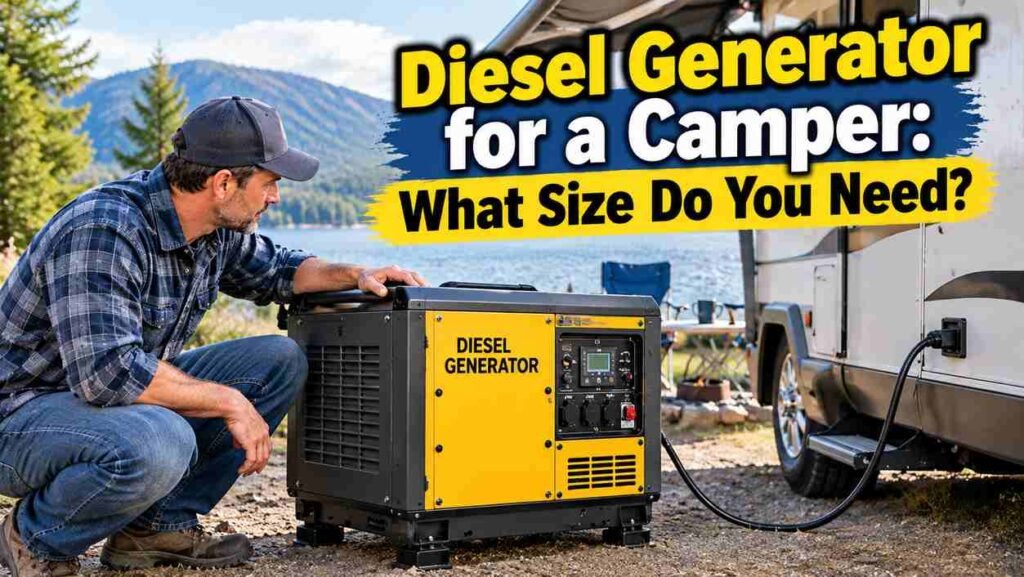
When someone asks me, “What size diesel generator do I need for my camper?” I do not start with a brand or a horsepower number. I start with the appliances you actually plan to run, the camper’s electrical service, and the starting surge of the largest motor load—usually the air conditioner.
A generator that is too small can bog down, trip breakers, produce unstable voltage, or fail to start your air conditioner. A generator that is much larger than you need can cost more, weigh more, use more fuel at light load, and create extra noise. My goal is to size the generator so you have enough margin without dragging around far more generator than your camper can use.
In this guide, I’ll show you how I size a diesel generator for a camper, how 30-amp and 50-amp RV services affect the calculation, what common camper appliances actually add to the load, why starting watts matter, and when a smaller generator can work if you manage loads carefully.



Quick Answer: Diesel Generator Size for a Camper
| Camper / RV setup | Typical generator size I would consider | What it can usually handle |
|---|---|---|
| Small camper, no rooftop A/C | 2,000-3,000 W | Battery charger, lights, TV, small microwave, electronics |
| 30-amp camper with one A/C | 3,500-5,000 W | One rooftop A/C plus moderate household loads |
| Large 30-amp RV with heavy appliance use | 4,000-5,500 W | A/C plus microwave or charger with some load management |
| 50-amp RV, one A/C at a time | 5,000-7,000 W | One A/C plus normal RV loads |
| 50-amp RV, two A/C units | 7,000-10,000+ W | Two A/C units and additional loads, depending on startup surge |
These are planning ranges, not universal specifications. I always check the actual nameplate watts or amps of the appliances in the camper before choosing the generator.
Why the Camper Plug Rating Does Not Tell Me the Generator Size
A common mistake is assuming that a 30-amp camper automatically needs a 3,600-watt generator and a 50-amp camper automatically needs a 12,000-watt generator.
Those numbers describe the maximum theoretical electrical service available at the shore-power connection. They do not tell me how much power you will actually use while camping.
| RV service | Nominal voltage | Maximum theoretical capacity | Important note |
|---|---|---|---|
| 30 amp | 120 V | 3,600 VA | One 120 V leg |
| 50 amp | 120/240 V split phase | 12,000 VA | Two 120 V legs, 50 A per leg |
For a 30-amp RV, the simple arithmetic is 120 volts × 30 amps = 3,600 volt-amps. For a 50-amp RV, the connection provides two 120-volt legs. That gives a theoretical 12,000 VA total service capacity.
But most people do not run every appliance at full load at the same time. If my 50-amp camper has one air conditioner running, the converter charging the battery, a refrigerator, and a few small devices, my actual load can be far below 12 kW.
That is why I size from the loads first and use the shore-power rating only as a boundary.
The Loads I Count First
When I size a diesel generator for a camper, I list every appliance I care about, then separate them into continuous loads and intermittent loads.
| Typical camper load | Approximate running watts | Possible startup / peak consideration |
|---|---|---|
| 13.5k BTU rooftop A/C | 1,300-1,800 W | Compressor startup can be much higher |
| 15k BTU rooftop A/C | 1,500-2,000 W | High startup surge without soft-start equipment |
| Microwave | 1,000-1,500 W input | Usually little motor surge, but high steady draw |
| Electric water heater element | 1,200-1,500 W | Mostly resistive |
| Converter / battery charger | 300-1,000+ W | Can draw more when batteries are deeply discharged |
| Residential refrigerator | 100-600 W | Compressor startup varies |
| Absorption refrigerator on electric | 250-500 W | Mostly steady heating load |
| Coffee maker | 700-1,500 W | Mostly resistive |
| Hair dryer | 1,000-1,800 W | High but short-duration load |
| TV / electronics | 50-300 W | Usually minor compared with A/C |
The air conditioner normally determines whether the generator feels “big enough.” A 3,000-watt generator may have plenty of power once the A/C is running, yet still struggle during compressor startup.
Running Watts vs. Starting Watts
This is the most important sizing distinction I explain to camper owners.
Running watts are what an appliance needs after it has started. Starting watts are the short burst of extra power that some motors and compressors need during startup.
If your rooftop air conditioner runs at 1,600 watts but requires a much larger momentary surge when the compressor starts, a generator sized only to 1,600 watts can dip in speed and voltage. That is when I hear complaints like “the generator runs fine until the A/C kicks on.”
If you have that symptom, my troubleshooting guide on why a diesel generator bogs down under load explains the mechanical and electrical causes in more detail.


I leave headroom for motor starting rather than sizing a generator so tightly that every compressor start pushes it to the limit.
How I Calculate the Generator Size
I use a simple process.
- I list every appliance I expect to run at the same time.
- I add the normal running watts.
- I identify the appliance with the largest starting surge.
- I add that surge margin to the running load.
- I add some practical headroom so the generator is not operating at its absolute maximum every minute.
Here is a simplified example for a 30-amp camper.
| Load | Running watts |
|---|---|
| Rooftop A/C | 1,600 W |
| Converter / charger | 500 W |
| Refrigerator | 300 W |
| TV and small electronics | 150 W |
| Total running load | 2,550 W |
If the A/C compressor needs significant extra startup power, I would not select a 2,600-watt generator just because the arithmetic says the running load is 2,550 watts. I would normally move into a 3,500- to 5,000-watt class depending on the A/C startup characteristics and what other loads I want to keep running.
What Size Diesel Generator for a 30-Amp Camper?
For many 30-amp campers, I find that roughly 3,500 to 5,000 watts is the practical range if air conditioning is important.
A 30-amp service itself tops out around 3,600 VA at 120 volts, so there is little benefit in trying to push much more than that through the RV’s main 30-amp connection. A somewhat larger generator can still be useful because the generator may handle motor-starting transients more comfortably, but the RV’s inlet and distribution system remain the limiting factor.
If I am not using the air conditioner, a 2,000- to 3,000-watt unit may be enough. That can run battery charging, lights, entertainment equipment, a refrigerator, and occasional small appliances, provided I manage high-draw devices.
What Size Diesel Generator for a 50-Amp Camper?
A 50-amp RV is different because the shore connection can provide up to 12,000 VA across two legs. That does not mean I automatically buy a 12-kW diesel generator.
If I only need one rooftop air conditioner, refrigeration, battery charging, and normal electronics, a 5- to 7-kW generator can often cover my real-world needs.
If I want to run two or three air conditioners, an electric water heater, a residential refrigerator, a microwave, and heavy household appliances with minimal load management, I may move into the 7- to 10-kW range or higher.
| 50-amp RV operating style | Approximate generator range I would consider |
|---|---|
| Basic camping, no A/C | 3-5 kW |
| One A/C plus normal loads | 5-7 kW |
| Two A/C units with load management | 6-8 kW |
| Two A/C units plus microwave / water heating | 7-10 kW |
| Large luxury RV with minimal load management | 10-12+ kW |
Again, the appliance nameplates and actual operating pattern matter more than the label “50 amp.”
Does a Camper Need a Diesel Generator at All?
Diesel has some advantages, especially if the tow vehicle or motorhome already uses diesel and I want one fuel type. Diesel engines are durable, efficient under substantial load, and well suited to long running periods.
But I also consider the downsides. Small diesel generators are often heavier and more expensive than comparable gasoline or inverter generators. Open-frame diesel units can also be noisy.
If noise matters at a campground, I compare actual dBA specifications rather than assuming every “quiet” generator is quiet. My guide on diesel generator decibel levels explains how sound ratings and distance affect what you hear.
Portable Diesel Generator vs. Built-In RV Generator
| Feature | Portable diesel generator | Built-in RV diesel generator |
|---|---|---|
| Installation | Separate unit, no permanent mount required | Integrated into RV |
| Fuel supply | Own tank or approved external setup | Often draws from vehicle/RV fuel tank |
| Noise control | Varies widely | Usually engineered for RV compartment installation |
| Weight | Must be transported and secured | Weight becomes part of RV installation |
| Convenience | Manual setup | Often remote/electric start from inside RV |
| Cost | Often lower upfront | Usually higher installed cost |
If I use a portable generator, I treat exhaust and carbon monoxide as major safety issues. I never run a combustion generator inside the camper, storage compartment, truck bed with a closed cover, garage, or enclosed awning area. I follow the generator manufacturer’s placement instructions and keep exhaust directed away from occupied spaces and openings.
Can I Run My Camper Air Conditioner on a 3,000-Watt Generator?
Sometimes, yes—but this is one of those questions where “3,000 watts” alone does not give me the answer.
A smaller rooftop A/C may run comfortably on a 3,000-watt generator once started. The problem is compressor startup, battery charger demand, refrigerator load, and anything else that happens to be running at the same time.
If the air conditioner has a compatible soft-start system, the startup demand can be easier for the generator to handle. I still verify the A/C manufacturer’s electrical requirements and the generator’s continuous and surge ratings rather than assuming a soft start guarantees compatibility.
Can a 2,000-Watt Diesel Generator Run a Camper?
A 2,000-watt generator can be useful for a small camper if I do not need conventional rooftop air conditioning.
It can handle battery charging, lights, electronics, refrigeration, and selected small appliances. But a microwave, coffee maker, hair dryer, or electric water heater can consume most of that capacity by itself.
I consider 2,000 watts a load-management size. I have to think before turning on high-draw devices.
Why I Do Not Run Every Appliance at the Same Time
Load management lets me use a smaller, lighter generator without sacrificing the functions I care about.
For example, I may turn off the electric water heater while using the microwave. I may switch the refrigerator to propane, where appropriate for that appliance and camping situation, while the air conditioner is running. I may let the battery charger reduce its demand before using another heavy appliance.
| Combination | Approximate total running load |
|---|---|
| A/C 1,600 W + charger 500 W + fridge 300 W | 2,400 W |
| Above + 1,300 W microwave | 3,700 W |
| A/C 1,600 W + water heater 1,400 W + charger 500 W | 3,500 W |
| Two A/C units at 1,600 W each + 500 W charger | 3,700 W before startup surge |
Those examples show why a generator that seems large on paper can become marginal when several high-draw appliances overlap.
Generator Continuous Rating vs. Maximum Rating
I size from the generator’s continuous or rated output, not the biggest number printed on the sales page.
A unit advertised as “5,000 watts” may have a lower continuous rating and a higher short-duration peak rating. The continuous number is what matters for sustained camper operation.
I also check whether the generator provides the voltage configuration my camper requires. A generator can have enough total kW but still be a poor match if the output arrangement is wrong for the RV connection.
Do Not Confuse kW With kVA
Some diesel generators, especially commercial units, are rated in kVA rather than kW.
At a power factor of 0.8, a 10 kVA generator corresponds to 8 kW of real power. The simple relationship is:
kW = kVA × power factor
| Generator rating | Power factor | Approximate real power |
|---|---|---|
| 5 kVA | 0.8 | 4 kW |
| 7.5 kVA | 0.8 | 6 kW |
| 10 kVA | 0.8 | 8 kW |
| 12.5 kVA | 0.8 | 10 kW |
For a general sizing overview, I also use my diesel generator sizing guide.
Fuel Consumption Matters in a Camper
Generator size affects more than electrical capacity. It also affects fuel storage, runtime, and how often I need to refuel.
A lightly loaded generator still consumes fuel. If I choose a unit far larger than my actual camper load, I can end up carrying extra weight and fuel without getting useful electrical benefit.
Diesel burn rate varies by engine, load, generator rating, altitude, temperature, and maintenance condition. My detailed diesel generator burn-rate guide explains how to estimate gallons per hour and runtime.
For camping, I pay attention to the fuel tank’s usable capacity—not just its nominal capacity—and I keep a reserve instead of planning to run the tank completely dry.
How Long Should I Run a Diesel Generator While Camping?
I run it based on actual need, campground rules, battery state of charge, weather, and appliance demand.
If I only need to recharge a battery bank, I do not necessarily need to run a large diesel generator all day. If I am using air conditioning in hot weather, runtime can be much longer.
Long-term low-load operation is not ideal for many diesel engines. If the generator spends most of its life barely loaded, deposits and incomplete combustion can become concerns depending on the engine design. That is another reason I try not to oversize excessively.
Noise: One of the Biggest Camper Considerations
I can live with a generator that is slightly larger than necessary. I have a harder time living with a generator that annoys me, nearby campers, or violates quiet-hour rules.
Diesel generator noise depends heavily on enclosure design, exhaust system, engine speed, fan noise, load, and measurement distance.
I compare ratings at the same distance. A 70 dBA figure at 7 meters and a 70 dBA figure at 1 meter are not equivalent specifications.
Weight and Payload Can Limit Generator Size
This is easy to overlook.
A diesel generator, fuel, mounting hardware, cables, and accessories all add weight. On a travel trailer or truck camper, that weight counts against payload or cargo capacity and can affect axle loading and tongue weight.
I check the vehicle and trailer ratings before deciding that a larger generator is automatically better.
I also secure portable equipment properly for transport. I do not rely on a loose generator sitting in the back of a vehicle or on an RV bumper that was not designed to carry the weight.
Altitude and Hot Weather Can Reduce Available Power
Engines breathe less dense air at higher elevation, and high ambient temperature can also reduce available power. The exact derating depends on the engine and generator manufacturer.
If I regularly camp at high altitude, I leave more sizing margin than I would for sea-level operation.
I do not use a generic percentage and assume it applies to every diesel generator. I check the manufacturer’s altitude and temperature derating chart for the exact model.
What About Winter Camping?
Cold weather introduces different issues: battery performance drops, diesel can have cold-flow problems, and the engine may need longer to warm up.
If winter camping is part of my plan, I verify the approved fuel grade, oil viscosity, cold-start aids, and battery specifications for the generator. My winter diesel-generator maintenance guide goes into those details.
How I Connect a Generator to a Camper Safely
I use the RV’s approved power inlet and a properly rated cord or adapter that matches the generator output and RV connection.
I do not improvise a backfeed cable, defeat grounding or bonding features, or modify the generator’s neutral configuration based on generic internet instructions. Neutral bonding and grounding requirements depend on the generator, RV electrical system, transfer equipment, and applicable code.
If the RV has built-in transfer equipment or a permanently installed generator, I follow the RV and generator manufacturers’ installation requirements and use a qualified RV/electrical technician for wiring changes.
My Practical Generator Size Recommendations
| If this describes your camper | I would start shopping around |
|---|---|
| Small teardrop / pop-up, no A/C | 2-3 kW |
| Small travel trailer with one modest A/C | 3-4 kW |
| Typical 30-amp travel trailer with one A/C | 3.5-5 kW |
| Larger camper with one 15k BTU A/C | 4-5.5 kW |
| 50-amp RV using one A/C at a time | 5-7 kW |
| 50-amp RV using two A/C units | 7-10 kW |
| Luxury RV with multiple heavy simultaneous loads | 10-12+ kW |
I treat that table as a starting point. The final decision comes from the actual appliance loads and startup requirements.
Signs Your Camper Generator Is Too Small
I suspect undersizing when the engine sounds heavily loaded every time the A/C starts, breakers trip frequently, voltage sags, the microwave sounds weak, the A/C fails to start reliably, or the generator shuts down when a second heavy appliance turns on.
If a generator used to carry the camper normally and now bogs down, I do not automatically assume it is undersized. A clogged fuel filter, restricted air filter, weak fuel delivery, contaminated fuel, turbo issue, altitude change, or mechanical fault can reduce available power.
Signs Your Generator May Be Much Larger Than You Need
An oversized diesel generator may spend most of its time at very light load. It can be heavier, louder, more expensive, and less convenient to transport than a smaller unit.
If my normal camper load is only 1 to 2 kW, buying a 12-kW generator simply because the RV has a 50-amp plug may not make practical sense.
I would rather size to my actual operating strategy and keep reasonable reserve capacity.
My Camper Generator Buying Checklist
- Continuous kW rating, not only peak watts
- Correct voltage and outlet configuration
- Air-conditioner startup capability
- Weight and physical dimensions
- Fuel-tank capacity and expected runtime
- Noise rating at a stated distance
- Altitude and temperature derating
- Service access and parts availability
- Cold-weather starting provisions if needed
- Approved RV connection method
I also think about maintenance access. A generator tucked into a cramped compartment that makes oil, filter, and coolant service difficult is less likely to receive proper maintenance.
For routine care, see my diesel generator maintenance guide.
Frequently Asked Questions
What size diesel generator do I need for a 30-amp camper?
For a 30-amp camper with one rooftop air conditioner, I usually start in the 3,500- to 5,000-watt range. Without air conditioning, 2,000 to 3,000 watts may be enough if I manage high-draw appliances.
What size generator do I need for a 50-amp RV?
A 50-amp RV can theoretically accept up to 12,000 VA, but I do not automatically need a 12-kW generator. One A/C plus normal loads may fit in a 5- to 7-kW range, while two A/C units and heavy simultaneous appliance use may call for 7 to 10 kW or more.
Will a 3,000-watt generator run a camper air conditioner?
It can in some campers, but the A/C compressor’s startup surge is the deciding factor. I verify both the running requirement and starting demand before relying on a 3,000-watt unit.
Is diesel better than gasoline for an RV generator?
Diesel can be attractive for long runtime, durability, and fuel commonality with a diesel motorhome or tow vehicle. Gasoline and inverter generators can be lighter and quieter in some portable applications. I choose based on the camper, runtime, noise, weight, and fuel logistics.
Can I use a 5,000-watt generator on a 30-amp RV?
Yes, provided the generator has a compatible output and the connection is made correctly. The 30-amp RV inlet still limits how much current the camper can accept through that connection.
Can I plug a 50-amp RV into a smaller generator?
Often yes with the correct approved adapter and output configuration, but the available power is limited by the generator and connection. I then manage loads so I do not try to use the RV as if full 50-amp shore power were available.
Do I need 240 volts for a 50-amp RV?
A standard 50-amp RV connection is 120/240-volt split phase, supplying two 120-volt legs. Many RV appliances are 120 volts, but the distribution system uses both legs. I verify the generator and RV connection rather than improvising adapters or wiring.
Should I buy the largest generator I can afford?
Not automatically. Bigger generators add weight, cost, fuel consumption, and often noise. I size for the actual camper load, startup surge, environmental derating, and a sensible reserve.
My Bottom Line
If you are choosing a diesel generator for a camper, I would not size it from the camper’s plug alone. I would list the appliances you actually use, total the running watts, account for air-conditioner startup, and then add practical headroom.
For a small camper without A/C, roughly 2 to 3 kW may be enough. For a typical 30-amp trailer with one rooftop A/C, I would usually look in the 3.5- to 5-kW range. For a 50-amp RV, 5 to 7 kW can work well when I manage loads, while two A/C units and heavier simultaneous use may push the requirement into the 7- to 10-kW range or beyond.
The number on the generator is only part of the decision. I also consider continuous output, startup capability, voltage configuration, noise, weight, fuel consumption, altitude derating, serviceability, and safe RV connection.
If I size from real loads instead of guesswork, I end up with a generator that starts the A/C reliably, carries the camper without struggling, and does not force me to transport far more generator than I actually need.