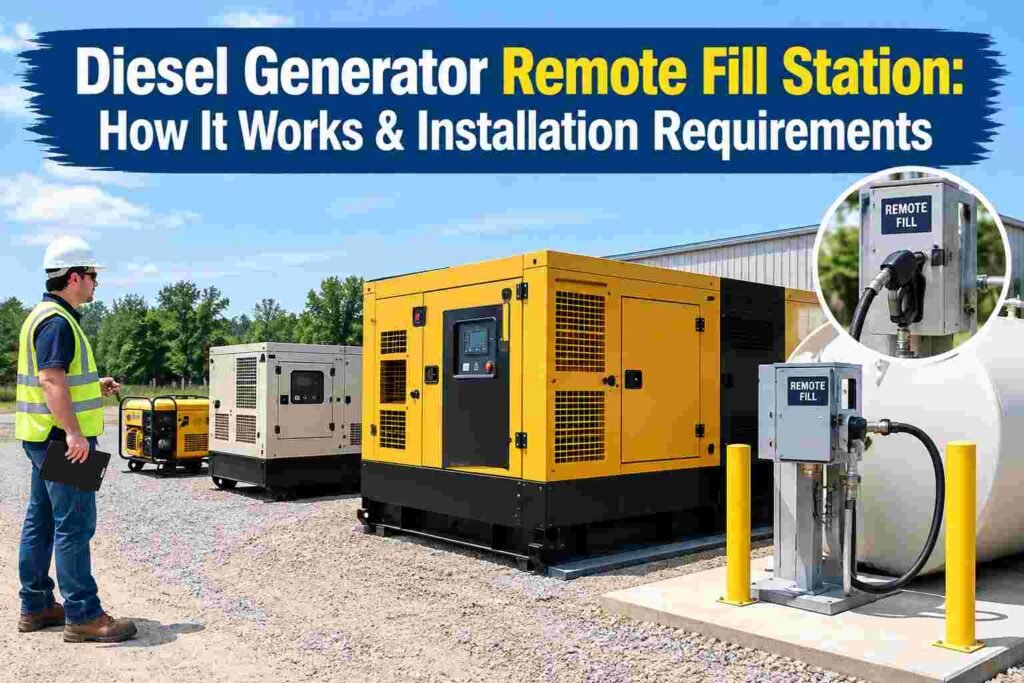
Meta description: Diesel generator remote fill station guide: learn how remote fuel filling works, required components, fill and vent piping, overfill protection, spill containment, grounding, alarms, and installation requirements.
Quick answer: A diesel generator remote fill station lets a fuel-delivery operator refill the generator’s storage tank from a safer and more accessible location instead of entering the generator room, climbing to a rooftop unit, or connecting directly at the tank. A typical system includes a weatherproof fill box or cabinet, fill connection, piping to the tank, tank venting, level indication, high-level alarm, spill containment, and often an overfill shutoff. On systems where gravity cannot move fuel to the tank, a transfer pump may also be required. The exact piping sizes, alarm points, tank capacity, vent arrangement, and fire-code requirements depend on the tank, generator, building, local code, and authority having jurisdiction.
What Is a Diesel Generator Remote Fill Station?
When I talk about a diesel generator remote fill station, I mean a dedicated fuel connection located away from the generator’s main fuel tank. Instead of the delivery truck running a hose through a building, onto a roof, or into a mechanical room, the driver connects to a fill point at an accessible location. Diesel then travels through permanent piping to the generator tank.



I commonly see remote fill stations used with indoor generators, rooftop generators, basement generator rooms, hospitals, data centers, commercial buildings, high-rise facilities, and any installation where the generator’s day tank or sub-base tank is not easy for a fuel truck to reach.
The basic idea is simple, but I do not treat a remote fill station as just a pipe with a cap. It is part of the generator’s fuel-storage and fire-safety system. The fill arrangement has to work with the tank vent, overfill protection, containment, fuel-transfer controls, and building layout.
| Component | What It Does | Why It Matters |
|---|---|---|
| Remote fill box/cabinet | Provides the delivery-hose connection | Keeps filling accessible and controlled |
| Fill pipe | Carries diesel from the fill station to the tank | Must handle the required flow and pressure |
| Tank vent | Lets displaced air escape while fuel enters | Prevents tank pressurization |
| Level gauge | Shows tank fuel level | Helps prevent unnecessary or excessive filling |
| High-level alarm | Warns that the tank is approaching full | Gives the driver time to stop delivery |
| Overfill shutdown | Stops a pump or closes a valve at a preset level | Adds another layer of spill protection |
| Spill containment | Captures drips or hose disconnect spills | Reduces environmental and fire risk |
| Transfer pump | Moves fuel when gravity filling is not practical | Often needed for long runs or elevated tanks |
| Bonding/grounding provisions | Controls static/electrical potential as required | Supports safe fuel-transfer practices |
How Does a Remote Fill Station Work?
I like to divide remote fill systems into two basic types: pressure-assisted direct fill and pump-assisted fill.
1. Direct Fill
With a direct-fill arrangement, the delivery truck connects to the remote fill point and the truck’s pumping system pushes diesel through the site or building piping to the generator tank. The tank does not need a separate transfer pump for the filling operation, although the generator may still have pumps for engine fuel supply or day-tank transfer.
As diesel enters the tank, air in the empty space has to leave through the tank vent. This is why I never evaluate the fill pipe alone. A tank that can receive fuel quickly but cannot vent displaced air safely can become pressurized, spit fuel back through the fill connection, or create a serious spill.
2. Pump-Assisted Remote Fill
In other installations, an electric transfer pump moves diesel from the remote filling point to the generator tank. Pump-assisted filling is especially useful when the tank is high above the fill point, the piping run is long, static head is significant, or the delivery truck’s pressure should not be applied directly to the final tank.
A pump-assisted system normally needs more controls. I may expect a start/stop station, motor controller, tank level switches, high-level alarm, high-high-level shutdown, check valve, isolation valves, strainers, and possibly a pressure-relief or bypass arrangement depending on the equipment.
Remote Fill Station vs. Day Tank
These terms are easy to confuse. A remote fill station is the location where fuel is introduced into the system. A day tank is a smaller tank near the generator that supplies the engine and is usually refilled automatically from a larger bulk tank.
A building can have both. For example, a fuel truck may connect to a remote fill box at ground level. That connection fills a 1,000-gallon bulk tank. A transfer pump then automatically feeds a 100-gallon day tank beside the generator. The day tank supplies the engine.
| Item | Remote Fill Station | Day Tank |
|---|---|---|
| Main purpose | Provides an accessible refueling point | Maintains local fuel supply at the generator |
| Typical location | Exterior wall, loading area, ground level | Near generator |
| Contains significant stored fuel? | Usually no; mainly connection/piping | Yes |
| Needs level controls? | Often receives tank level/alarm indication | Normally yes |
| May use transfer pump? | Yes | Yes, depending on arrangement |
| Primary user | Fuel-delivery operator | Generator fuel system |
Where Should the Remote Fill Station Be Located?
I start with the fuel truck. The fill point should be in a location that a delivery vehicle can reach without blocking emergency access, damaging landscaping, stretching hoses through occupied areas, or creating unnecessary exposure to traffic.
I also think about what happens during an emergency. If the generator is running during a long outage, the building may need refueling while other emergency operations are underway. A remote fill point hidden behind locked equipment, parked vehicles, dumpsters, or temporary barriers is not truly accessible.
- Can the delivery truck park safely?
- Can the hose reach the fill connection without crossing an emergency exit?
- Is the station protected from vehicle impact where necessary?
- Can the operator see the tank-level or high-level indication?
- Is the cabinet secure against unauthorized access?
- Will spills drain toward protected containment rather than a storm drain?
- Is the fill point separated from ignition sources, openings, and other hazards as required by the adopted code?
Fill Pipe Requirements
I do not recommend choosing a fill-pipe diameter by copying another generator installation. The required pipe size depends on the fill rate, pipe length, elevation change, number of elbows, fuel temperature, pump pressure, tank connection, and allowable pressure.


A long vertical run to a rooftop generator is especially important. Every foot of elevation adds static head that the fuel-delivery or transfer pump must overcome. At the same time, excessive pump pressure can exceed the design limits of tanks, valves, flexible connectors, or fittings.
The fuel-system designer should calculate the pressure drop and confirm the tank manufacturer’s allowable fill conditions.
| Design Variable | If It Increases | Likely Effect |
|---|---|---|
| Pipe length | More friction | Lower flow or greater required pump pressure |
| Vertical elevation | More static head | Greater pump pressure required |
| Number of elbows | More fitting loss | Reduced flow |
| Desired fill rate | Higher velocity | More pressure loss |
| Pipe diameter | Larger internal area | Generally lower friction at the same flow |
| Fuel viscosity | Thicker fuel | Can increase resistance |
The Tank Vent Is Just as Important as the Fill Line
When 100 gallons of diesel enters a tank, roughly 100 gallons of internal volume has to be displaced. The vent gives that air somewhere safe to go.
Cummins generator application guidance specifically warns that fuel storage tanks need adequate venting to prevent pressurization and notes that both normal and emergency venting requirements may apply depending on the installation and code. Its day-tank guidance also describes a vent pipe routed to the highest point in the system.
I would never assume that the vent can be reduced because the generator only consumes fuel slowly. The vent has to deal with the filling rate, which can be much higher than the engine’s consumption rate.
Why Expansion Space Matters
A diesel tank should not normally be treated as usable storage all the way to the physical top. Fuel expands as temperature changes, and the tank needs vapor and expansion space.
Cummins application guidance recommends at least 5% expansion space in its fuel-system design discussion. The final usable capacity should always follow the tank manufacturer’s listing, applicable code, and engineering design.
| Nominal Tank Capacity | 5% Expansion Space Example | Approx. Remaining Volume |
|---|---|---|
| 100 gal | 5 gal | 95 gal |
| 250 gal | 12.5 gal | 237.5 gal |
| 500 gal | 25 gal | 475 gal |
| 1,000 gal | 50 gal | 950 gal |
| 2,000 gal | 100 gal | 1,900 gal |
These figures demonstrate the math only. They are not a substitute for the listed usable capacity of a specific tank.
High-Level Alarm and Overfill Protection
One of the most important features I want at a remote fill station is clear overfill protection. The driver may be hundreds of feet away from the tank and may not be able to see or hear what is happening inside the generator room.
A good system can provide staged protection. A high-level alarm warns the driver that the tank is approaching its permitted fill level. A separate high-high-level device can stop a transfer pump or command an automatic valve to close where the system is designed for that function.
I prefer independent layers rather than relying solely on a visual gauge. A stuck gauge, failed float, wiring fault, or inattentive operator should not automatically become a major diesel spill.
| Control | Typical Function | Example Response |
|---|---|---|
| Normal level gauge | Shows fuel quantity | Operator monitors fill |
| High-level alarm | Warns near fill limit | Audible/visual alarm at fill station |
| High-high level | Independent overfill protection | Stops pump or closes approved valve |
| Low-level alarm | Warns of low reserve | Triggers refueling plan |
| Leak/containment alarm | Detects liquid in secondary containment | Signals inspection and corrective action |
Spill Containment at the Fill Point
Even when the main tank is double-wall, the fill connection itself can spill. A delivery hose contains fuel when it is disconnected. Caps can leak. Fittings can loosen. A driver can overfill a hose or disconnect before the line is fully depressurized.
For that reason, remote fill cabinets often include a spill basin, drainable containment compartment, or other means of capturing small releases. The main tank installation may also need secondary containment or a rupture basin. Cummins notes that environmental rules commonly require containment capable of keeping leaked fuel from entering soil or sewer systems.
I also consider where rainwater will go. An outdoor containment box that fills with rain can lose useful spill capacity unless it is designed and maintained correctly.
Grounding and Bonding
The complete installation may require electrical bonding and grounding provisions for metallic fuel-system components and dispensing equipment. Cummins’ commissioning checklist specifically includes electrical bonding for the fuel system.
I do not improvise this with a random wire or clamp. The electrical engineer, tank or fill-station manufacturer, applicable electrical code, fire code, and AHJ should determine what is required for the specific installation.
Remote Fill for a Rooftop Diesel Generator
Rooftop generators are one of the clearest reasons to install a remote fill station. I do not want a fuel-delivery operator dragging a hose up stairs, through occupied floors, or onto a roof if a permanent ground-level filling system can do the job safely.
However, the vertical rise creates additional engineering problems. A pump may need to lift fuel several stories. The fill pipe can retain a substantial column of fuel after filling. Check valves and isolation valves may be required by the engineered design. The tank must not be exposed to pressure beyond its rating.
If you are planning a rooftop generator, I would treat the fuel-fill system as part of the rooftop-generator design from day one rather than trying to add it after the generator is installed.
Remote Fill for an Indoor Generator Room
For an indoor generator, the remote fill point can keep fuel-delivery activity outside the building. The fill piping then passes through approved building penetrations to the tank.
The designer has to coordinate fire-rated walls, pipe sleeves, sealing systems, drainage, supports, flexible connections where required, tank vent routing, and access for inspection. The fill connection should not become an uncontrolled path for diesel into the generator room if a line or fitting fails.
Do You Need a Day Tank?
A remote fill station does not automatically mean you need a day tank. I use a day tank when the main fuel source cannot reliably supply the engine within the manufacturer’s allowable fuel-lift and return restrictions.
Cummins guidance says a day tank is required when pipe friction or the elevation of the supply tank would create excessive engine fuel-inlet or return restriction. Its application guidance describes day tanks commonly sized at about two hours of full-load operation, subject to code limits for fuel stored in the generator room. The exact tank size is a design decision, not a universal two-hour rule.
How Much Fuel Storage Do You Need?
I size stored fuel around required runtime, generator fuel consumption, usable tank volume, required emergency-power class, delivery reliability, and reserve margin. The basic runtime calculation is:
Runtime = Usable fuel volume ÷ Fuel consumption per hour
For example, if a system has 270 gallons of usable fuel and the generator consumes 4 gallons per hour at the expected load, 270 ÷ 4 = 67.5 hours of theoretical runtime.
| Usable Fuel | Consumption | Calculated Runtime |
|---|---|---|
| 100 gal | 2 gal/hr | 50 hr |
| 200 gal | 4 gal/hr | 50 hr |
| 400 gal | 5 gal/hr | 80 hr |
| 600 gal | 8 gal/hr | 75 hr |
| 1,000 gal | 10 gal/hr | 100 hr |
These are calculation examples only. Actual diesel consumption varies with generator size, load, engine, ambient conditions, and emissions system. If you need help estimating consumption, see my guide on how much fuel a diesel generator uses.
Codes and Standards That May Apply
In the United States, several standards can affect a generator fuel system. The most relevant family commonly includes NFPA 30 for flammable and combustible liquids, NFPA 37 for stationary combustion engines and gas turbines, NFPA 110 for emergency and standby power systems, applicable building and fire codes, environmental regulations, and the electrical code.
As of 2026, current NFPA editions include NFPA 30 (2024), NFPA 37 (2024), and NFPA 110 (2025). But I would never assume your city or state has adopted the newest edition. Local jurisdictions often enforce an earlier edition with amendments.
That is why I recommend checking permit requirements before construction. I have a separate guide explaining whether you need a permit for a diesel generator.
Typical Installation Requirements I Check
- Approved and accessible remote fill location
- Correct fill connection for the fuel supplier’s equipment
- Fill pipe sized for flow, distance, fittings, and elevation
- Pipe material compatible with diesel and code requirements
- Proper supports and protection against physical damage
- Tank normal vent and emergency venting where required
- Approved tank capacity and expansion space
- High-level alarm visible or audible at the fill point
- Independent overfill protection where required
- Spill containment at the fill station
- Secondary containment for the storage tank where required
- Leak detection or alarm where specified
- Grounding and bonding provisions
- Emergency shutoff or pump-stop controls when required
- Fire-rated penetrations and sealing
- Identification and labeling of fill and vent connections
- Protection from vehicle impact
- Commissioning and leak testing
What About an Overflow Pipe?
Some day-tank systems include an overflow path back to a lower bulk tank. Cummins describes this arrangement when the bulk tank is below the day tank. But I would not treat an overflow line as a substitute for proper level controls and overfill prevention.
The overflow line must be engineered so the receiving tank can accept the returned fuel and so the line itself cannot create excessive pressure or siphoning problems.
Manual Fill vs. Automatic Tank Transfer
A remote fill station is generally used by a fuel-delivery operator. Automatic transfer is different. In an automatic day-tank system, level switches turn a transfer pump on and off as the generator consumes fuel.
| Feature | Remote Manual Fill | Automatic Transfer |
|---|---|---|
| Who initiates fuel movement? | Delivery operator | Level controller |
| Source | Fuel truck | Bulk storage tank |
| Destination | Main tank or approved tank | Usually day tank |
| Typical control | High-level alarm/overfill shutdown | Low/high level switches |
| Frequency | Periodic deliveries | As generator consumes fuel |
How I Would Commission a New Remote Fill System
I would not consider the installation finished just because all the pipes are connected. Commissioning should verify that the system works as a complete fuel-transfer system.
The project team should confirm piping integrity, valve positions, pump rotation, level indication, alarm points, automatic shutdown, containment alarms, tank venting, identification labels, and communications to the building-management or generator controller.
A controlled initial fill is especially valuable. The operator can watch pressure, check for leaks, confirm the tank-level indication, verify the high-level alarm, and prove that the overfill shutdown performs as designed.
Common Remote Fill Station Problems
| Problem | Possible Cause | What I Would Check |
|---|---|---|
| Fuel fills very slowly | Undersized pipe, restriction, excessive head | Pressure drop, valves, strainer, elevation |
| Fuel spits back at fill point | Vent restriction or excessive fill rate | Vent path, tank pressure, fill rate |
| Transfer pump trips | Overload, blocked line, closed valve | Motor current, valve position, filter |
| Tank overfills | Failed alarm/control or operator error | Level switches, shutdown circuit, calibration |
| Fill box contains diesel | Hose disconnect spill or leaking fitting | Connection, drain/containment, seals |
| False high-level alarm | Faulty float or wiring | Sensor movement, continuity, controller input |
| Fuel leaks at pipe joints | Loose or damaged joint, corrosion, vibration | Supports, fittings, corrosion, pressure |
Maintenance of a Remote Fill Station
Because a remote fill station may only be used a few times a year, it is easy to ignore it until the day you urgently need fuel. I include it in the generator’s preventive-maintenance program.
I would inspect the fill cap and connection, cabinet locks, spill basin, labels, piping supports, visible corrosion, valves, level gauge, alarms, pump controls, containment sensors, and vent termination. I would also exercise alarms and shutdown functions according to the manufacturer’s instructions.
Generator maintenance frequency is a broader topic, so see my guide on how often diesel generators should be serviced.
Why Fuel Quality Still Matters
A perfect remote fill station cannot compensate for poor diesel quality. Bulk storage allows water, sediment, microbial growth, and oxidation to become long-term problems.
I recommend maintaining the tank, sampling stored fuel where appropriate, draining water and sediment where the tank design permits, and rotating or polishing aged fuel when needed. If contamination is suspected, my guide on water in diesel fuel explains the warning signs.
Remote Fill Station Design Example
Imagine a 300 kW standby generator located on the roof of a six-story commercial building. Its sub-base tank cannot practically be reached by a fuel truck.
I might expect the project design to include a lockable ground-level fill cabinet, delivery connection, spill basin, tank-level display, high-level alarm, pump-start controls, transfer pump sized for the vertical lift, permanent fill piping to the roof, approved isolation and check valves, tank venting, high-high-level pump shutdown, leak or containment alarms, labels, and a commissioning procedure.
The engineer would calculate the fill rate and pressure. The tank manufacturer would confirm allowable inlet pressure and vent requirements. The fire official would review the adopted codes. The electrical engineer would coordinate pump power, controls, bonding, and alarm interfaces. That is the level of coordination I mean when I say a remote fill station is a system, not just a fuel fitting.
Remote Fill Station Installation Checklist
| Item | Before Installation | Before Final Acceptance |
|---|---|---|
| Fill location | Confirm truck access and code clearances | Verify labels, protection and access |
| Tank | Confirm capacity/listing and connections | Check level gauge and containment |
| Fill piping | Calculate flow/head | Pressure/leak test as required |
| Vent | Size and route per tank/code | Confirm unobstructed termination |
| Pump | Select for required flow/head | Verify rotation, pressure and controls |
| Alarms | Define high/high-high points | Function-test all alarms |
| Overfill protection | Coordinate valve/pump shutdown | Prove shutdown during commissioning |
| Containment | Design spill/leak capacity | Test sensors and inspect drainage |
| Bonding | Coordinate electrical design | Verify completed installation |
| Documentation | Obtain permits/submittals | Provide as-builts and operating procedure |
Frequently Asked Questions
What is a remote fill station for a diesel generator?
It is an accessible refueling point connected by permanent piping to the generator’s fuel-storage system. It lets a fuel truck refill the tank without directly reaching the generator.
Does every diesel generator need a remote fill station?
No. If the main tank is easily and safely accessible to the fuel supplier, direct filling may be adequate. Remote fill becomes especially useful for rooftop, basement, indoor, secured, or otherwise difficult-to-access generator tanks.
Can a remote fill station be below the generator tank?
Yes, but the system may need a transfer pump capable of overcoming the elevation and piping losses. The fill pressure must remain within the limits of the tank and associated equipment.
Do I need an overfill alarm?
Many engineered and code-compliant installations use high-level alarms and additional overfill protection. The specific requirements depend on tank type, capacity, applicable code, and local AHJ.
Does the remote fill station need spill containment?
Spill containment is commonly provided because small spills can occur when connecting and disconnecting delivery hoses. Tank secondary containment may also be required by fire or environmental regulations.
How large should the fill pipe be?
I would not choose the pipe size from generator kW alone. It should be calculated using the desired fill rate, pipe length, elevation, fittings, pump pressure, fuel properties, tank inlet limits, and applicable code.
Can the fill line and vent line be the same pipe?
Normally the tank needs a dedicated vent path so displaced air can escape while fuel enters. Follow the tank manufacturer’s approved connections and the engineered design rather than combining functions without approval.
What happens if the generator runs out of fuel?
A diesel engine can draw air into the fuel system and may require priming before it will restart. I explain that process in what happens when a diesel generator runs out of fuel.
Final Thoughts
A diesel generator remote fill station can make refueling dramatically safer and easier, especially when the generator is on a roof, inside a building, or far from a place where a delivery truck can park. But I would never design it as an isolated plumbing accessory.
The fill point, fill piping, tank vent, expansion volume, spill containment, level controls, overfill protection, transfer pump, electrical bonding, fire-code requirements, and operating procedure all have to work together. I also want the system tested under controlled conditions before the first emergency.
If you are planning a new installation, involve the generator supplier, tank manufacturer, mechanical engineer, electrical engineer, fire-protection professional, fuel supplier, and local authority early. That coordination is what turns a remote fill box into a dependable generator-fueling system.
Important: This article is general educational information, not a substitute for engineered plans, the tank and generator manufacturers’ instructions, or requirements enforced by your local fire/building authority. Codes and adopted editions vary by jurisdiction.