
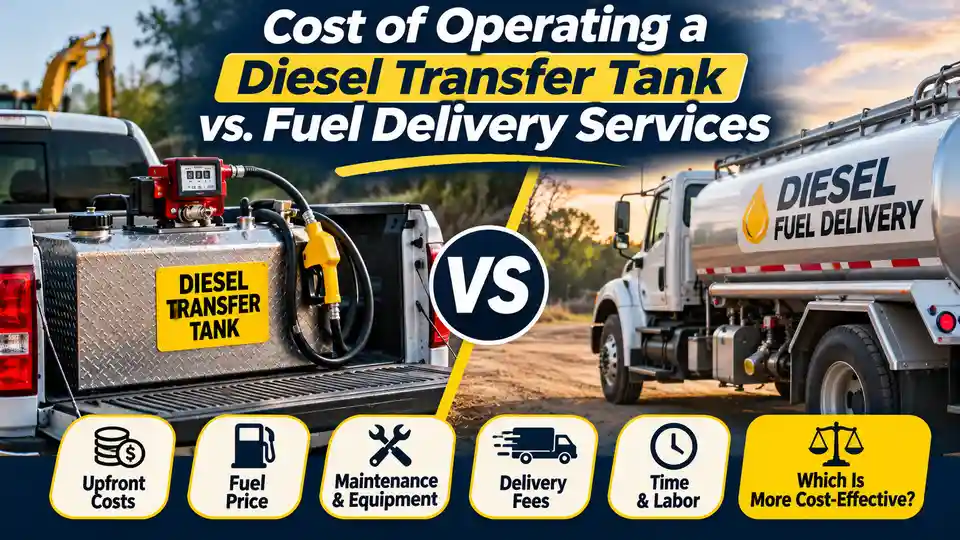
QUICK ANSWER — Which costs less?
A diesel transfer tank can cost less than a fuel delivery service if you buy fuel at a meaningful discount and collecting it adds little driving or labor. Fuel delivery can be cheaper when employees must make dedicated fuel runs, your site is far from a supplier, or you need machines fueled without interrupting work. In my illustrated 300-gallon-per-month example, a self-operated 100-gallon transfer tank costs $1,261.80 per month, while delivery directly to equipment costs $1,196.00—a $65.80 monthly advantage for delivery. If the same pickup trips are already on your route, the result flips: the tank can save about $63.20 monthly. These are planning assumptions, not national price quotes. Your mileage, discounts, delivery minimums, and equipment costs decide the winner.
Buying a diesel transfer tank seems cheaper than paying for delivery—until you count the hours and vehicle miles required to collect the fuel.
If you run an excavator, generator or diesel fleet, the posted price per gallon rarely tells the whole story. A fuel-price discount can disappear during one long pickup trip.
I’ll compare true operating expenses, work through a realistic example, and consider a third option: owning a tank that a supplier fills on site.
Diesel Transfer Tank vs. Fuel Delivery: Quick Cost Comparison
I separate three fueling methods because they solve different problems. Self-hauling means your vehicle carries a transfer tank to buy fuel and then dispenses it at your site. Wet-hose or direct-to-equipment delivery means a vendor brings diesel and fills equipment or fleet vehicles. Delivered bulk-to-tank means the vendor refills your own tank; you still dispense it yourself.
| Cost or responsibility | Own transfer tank, self-haul | Delivery directly to equipment | Own tank, supplier refill |
|---|---|---|---|
| Tank and pump purchase | Usually yours | Usually not needed | Usually yours |
| Fuel price | Retail, cardlock, or bulk pickup quote | Delivered quote | Delivered bulk quote |
| Travel to obtain diesel | Your driver and vehicle | Supplier handles it | Supplier handles it |
| Refueling machines on site | Your staff | Supplier often handles it | Your staff |
| Delivery fees/minimums | Typically none from delivery vendor | May apply | May apply |
| Equipment upkeep | Your responsibility | Mostly supplier’s equipment | Your responsibility |
| Inventory control | Your job | Depends on service records | Your job |
| Best fit | Predictable use, convenient supply route | Scattered equipment or expensive downtime | Central yard, reliable volumes |
My first rule: compare the exact service you need. A quote for a vendor to fill your storage tank is not equivalent to a quote for the vendor to drive around a jobsite and fill five machines. Both are called fuel delivery, but the labor included can be very different.
What Does a Diesel Transfer Tank Cost Up Front?
For a small business, the purchase price may be the first obstacle. A bare 100-gallon steel diesel transfer tank has been listed near $750, while a 12V fuel transfer pump may add a few hundred dollars or more. Some combination tank-and-pump systems are priced differently, so I always check exactly what’s included before comparing listings.
For budgeting, I’d use the following illustrative purchase ranges instead of treating one product price as a national average.
| Component | Budget planning range | What I would verify |
|---|---|---|
| Diesel transfer tank, around 50–100 gal | $500–$1,300 | Rated use, dimensions, mounts, cap and vents |
| 12V transfer pump and basic hose/nozzle | $300–$800 | Flow rate, duty cycle, diesel compatibility |
| Filter, meter, fittings or upgraded nozzle | $80–$400 | Whether already included with pump |
| Mounting, electrical and installation supplies | $100–$400 | Vehicle mounting and professional work |
| Possible complete setup | $980–$2,900 | Avoid double-counting bundle components |
These ranges are rough planning allowances. A premium certified system can exceed them, and a discounted all-in-one kit can cost less. I would obtain a complete installed quote, not simply add the lowest tank listing to the lowest pump listing.
For the detailed comparison later, I assume $1,600 installed. That is not a claim about what every 100-gallon tank costs. It is a model input you can replace.
Technical details that affect operating cost
Two transfer tanks may have the same capacity yet perform very differently in your day-to-day operation.
| Technical specification | Typical small-transfer-tank consideration | Cost impact |
|---|---|---|
| Nominal tank capacity | 50–100 gallons is common in pickup-based use | Limits how many supply trips you need |
| Practical refill volume | Less than nominal capacity; follow fill limit | More trips if usable volume is lower |
| Construction | Steel, aluminum or suitable polymer; model-specific | Affects empty weight and corrosion care |
| Pump supply | Often 12V DC; some systems use 24V or AC | Battery, wiring and duty-cycle needs |
| Advertised pump output | 8–20 gallons per minute on common examples | Determines theoretical dispensing time |
| Hose length | Often around 10–15 feet; varies | May require moving truck or equipment |
| Filter and water separation | Optional or integrated, model-dependent | Filter costs and contamination risk |
| Meter | Optional; mechanical or electronic | Helps reconcile usage and detect loss |
| Mounting and restraint | Vehicle-specific brackets and clearances | Installation and compliance expense |
For example, pumping 60 gallons at an ideal rated 8 GPM would take 7.5 minutes. At an ideal 15 GPM, it would take 4 minutes. Real flow may be slower due to restrictions, filter condition, hose, voltage and nozzle; setup and cleanup also take time. I would never budget labor using pump flow alone.
If you are deciding between container and dispensing systems, see Do Diesel Cans Come With Built-In Fuel Transfer Pumps? for the tradeoffs.


The Seven Costs of Operating Your Own Transfer Tank
A tank doesn’t become free to operate after you buy it. I track these seven categories rather than looking only at the posted diesel price.
- Fuel: Use the price actually available to your business, including applicable taxes. Don’t compare untaxed dyed diesel with taxed on-road diesel or mix different fuel specifications.
- Vehicle mileage: Dedicated pickup runs add fuel, tires, maintenance and depreciation to your pickup. My model uses $0.65 per mile as an illustrative cost—not an official or universal rate.
- Employee time: Driving, waiting, purchasing and securing fuel all cost money. At a loaded labor rate of $30/hour, a 50-minute run costs $25 before vehicle expenses.
- Equipment replacement: A $1,600 installed system spread across five years costs $320 per year, or $26.67 a month, in simple planning depreciation. This isn’t tax advice.
- Maintenance: Allow for hoses, seals, filters, electrical connections, water checks and corrosion inspection. Use the manufacturer’s service instructions, especially when equipment operates in dust or rain.
- Inventory controls: Track gallons purchased, dispensed and remaining. Unrecorded use, leaks and mistakes can erase a small pump-price discount.
- Safety and administration: Allow for appropriate installation, insurance, inspections and any applicable state, local, environmental or workplace requirements.
I also consider what happens when a pump fails or contaminated fuel enters a machine. A low-cost tank is not economical if it’s frequently out of service. For a damage-related decision, see Can You Repair a Cracked Diesel Transfer Tank?.
For a related operating requirement, see Do Diesel Transfer Tanks Need to Be Vented?. Venting depends on the equipment design; don’t modify caps or vent arrangements casually.
How Fuel Delivery Services Charge
Fuel delivery is usually quoted in one or more ways: an all-in delivered gallon price, a price per gallon plus a truck-roll fee, a minimum-volume requirement, or an additional charge for special access, hours, or emergency service.
I have seen providers advertise very different structures. One service may waive local delivery fees but require a high minimum order. Another may accept smaller jobs and charge a dispatch fee. That’s why I wouldn’t label any single delivery surcharge as typical nationwide.
| Delivery charge | How it appears | Question I would ask |
|---|---|---|
| Delivered price per gallon | One combined rate | Does this include the delivery margin and taxes? |
| Per-stop or dispatch fee | Fixed charge on each visit | Does it apply to every drop or invoice? |
| Minimum order | Required gallons per order | Can I consistently accept that volume? |
| Small-load fee | Added below a volume threshold | What happens during slow months? |
| Emergency/after-hours charge | Extra premium | What is the scheduled service lead time? |
| Access/wait fee | Charge for site delays | Must I have equipment accessible and staffed? |
| Metering/reporting | Included or separately billed | Will I get gallons by machine and a usable report? |
I would request two written quotes: scheduled delivery directly into equipment, and delivery into an approved on-site tank. They shouldn’t be treated as the same product.
Worked Example: 300 Gallons per Month
Let’s compare a small contractor using 300 gallons of diesel per month, or 3,600 gallons per year. The contractor can either buy diesel using a pickup-mounted 100-gallon transfer tank or pay a vendor to fill equipment on site.
To make the calculation transparent, I choose these hypothetical, same-period quotes and operating assumptions. They are not live quotes from any named supplier.
| Input | Own tank / self-haul | Direct fuel delivery |
|---|---|---|
| Monthly diesel volume | 300 gal | 300 gal |
| Price of diesel | $3.55/gal | $3.82/gal |
| Trip or delivery frequency | Four pickups/month | Two deliveries/month |
| Usable gallons per pickup | 90 gal assumed | Not applicable |
| Driver time per pickup | 50 minutes | None for obtaining fuel |
| Loaded driver cost | $30/hour | Not applicable |
| Round-trip mileage | 18 miles | None for customer |
| Vehicle cost rate | $0.65/mile | Not applicable |
| Per-delivery fee | None | $25/visit |
| Tank equipment and upkeep allowance | $50/month | $0/month |
Why four pickup trips? At 90 gallons per trip, the minimum is ceiling(300 ÷ 90) = 4. Two deliveries, by contrast, could each place 150 gallons directly into eligible equipment, assuming the provider accepts those orders. In a real quote, check its minimums and service scope.
Step 1: Calculate the self-haul diesel expense
300 gallons × $3.55 = $1,065 per month.
Step 2: Calculate mileage and labor
18 miles × $0.65 = $11.70 per trip in vehicle cost.
50 minutes ÷ 60 × $30/hour = $25.00 per trip in labor.
Together: $11.70 + $25.00 = $36.70 per trip.
Four trips cost $146.80 per month.
Step 3: Include ownership
I budget $50 per month for equipment cost allocation, routine care and related overhead. That allowance can be broken down into approximately $26.67 in capital recovery, $11.67 in upkeep, $8.33 in inspection/insurance allowance, and $3.33 in carrying cost. These are accounting assumptions, not a claim that every operation pays those exact expenses.
The total self-haul cost is:
$1,065 + $146.80 + $50 = $1,261.80 per month.
Step 4: Calculate delivery cost
300 gallons × $3.82 = $1,146 in delivered fuel.
Two visits × $25 = $50 in stop fees.
The total is $1,196 per month.
Step 5: Compare the results
| Cost line | Own transfer tank | Fuel delivery |
|---|---|---|
| Fuel | $1,065.00 | $1,146.00 |
| Dedicated pickup travel and labor | $146.80 | $0.00 |
| Delivery stop fees | $0.00 | $50.00 |
| Tank ownership allowance | $50.00 | $0.00 |
| Total per month | $1,261.80 | $1,196.00 |
| Effective cost per gallon | $4.21 | $3.99 |
| Annual cost at same usage | $15,141.60 | $14,352.00 |
Result: delivery is $65.80 cheaper per month, or $789.60 cheaper per year, under these assumptions. This calculation deliberately leaves out any additional advantage if the delivery company also saves your crew the time of fueling individual machines; that benefit could make delivery more attractive.
The Original Break-Even Test I Would Use
Rather than asking only, “How many gallons until a tank pays for itself?” I prefer a more practical question: How much travel can my fuel-price savings afford?
In the example, the delivery fuel price exceeds the pickup price by $0.27 per gallon. That creates a $81 monthly fuel-price advantage for self-hauling: 300 × $0.27.
Delivery also charges $50 in stop fees, while the transfer tank has $50 in monthly ownership allowance. Those two items cancel each other in this specific model.
That leaves $81 available for pickup-trip costs. Since each run costs $36.70, the tank can afford only $81 ÷ $36.70 ≈ 2.2 dedicated runs per month before its advantage disappears.
But 300 gallons requires four runs with the assumed usable capacity. That’s the problem. You can’t solve it simply by buying the same diesel more often.
This “affordable fuel-run budget” is the decision metric I would use before investing in a tank. It links your actual available capacity, fuel spread and driving burden in one number.
Fuel-price sensitivity table
Hold monthly volume at 300 gallons and keep four dedicated runs, $50/month tank overhead and $50/month delivery fees. Change only the difference between the delivered price and self-pickup price.
| Delivery premium vs pickup | Monthly delivery cost minus tank cost | Lower-cost option |
|---|---|---|
| $0.10/gal | -$116.80 | Delivery |
| $0.27/gal | -$65.80 | Delivery |
| $0.35/gal | -$41.80 | Delivery |
| $0.45/gal | -$11.80 | Delivery |
| $0.50/gal | +$3.20 | Own tank, narrowly |
In this narrow case, the break-even delivery premium is approximately $0.49 per gallon. That is not a universal break-even threshold. It changes with volume, required trips, driver costs, capacity, delivery schedule and fees. At higher volumes you may need more pickup runs, which is why a fixed-per-month trip assumption can be misleading.
What If the Fuel Stop Is Already on Your Route?
Here is the change that can completely reverse the result. Suppose a worker already passes the supplier during normal duties. Picking up diesel adds only three miles and five minutes to each trip, instead of a dedicated 18-mile, 50-minute run.
At the same assumed rates, the incremental pickup cost becomes:
- Three miles × $0.65 = $1.95.
- Five minutes × $30/hour = $2.50.
- Total additional cost = $4.45 per trip, or $17.80 for four trips.
The transfer-tank monthly total is now $1,065 + $17.80 + $50 = $1,132.80.
Compared with delivery at $1,196, the tank saves $63.20 per month, or $758.40 per year.
That change is not magic. We have simply stopped charging the fuel operation for travel that would happen anyway. I would only do this when the work schedule really supports the detour and the extra load is appropriate for the vehicle.
My conclusion from the two versions: the same tank, diesel price and volume can be either a good investment or a poor one depending on trip logistics. A gallon-price comparison hides this.
Does a Bigger Transfer Tank Lower Costs?
A larger tank can reduce pickup frequency, but it also increases purchase cost, weight, footprint and operational obligations. I would first estimate usable capacity, not just the advertised number.
For example, with 300 gallons needed each month, a hypothetical 90-gallon usable fill produces four trips. A 150-gallon usable fill would reduce the arithmetic to two trips, if that larger tank and configuration are lawful and practical for your use. Do not assume a 150-gallon vehicle-mounted tank receives the same non-bulk transportation treatment as a 100-gallon one.
A US gallon of diesel weighs roughly 7.1 pounds for rough planning. Thus, 100 gallons contains around 710 pounds of fuel before adding the tank, pump, accessories and passengers. Your vehicle’s payload rating may be the limiting factor long before the pump’s gallons-per-minute rating matters.
I would verify the fuel’s classification, the tank’s approved transportation use, vehicle mounting, securement, and applicable DOT, OSHA and state rules. The non-bulk definition used in many federal hazmat contexts refers to 119 gallons or less per package, but that is not a blanket permission to transport a tank of any design or to ignore other rules.
For additional context, see Do Diesel Cans Meet Transportation Regulations?. I also compare storage configurations in Are Diesel Cans Designed to Be Stackable for Storage?; ordinary cans should not be stacked unless their manufacturer permits it.
Hidden Costs That Are Hard to Put in a Quote
Downtime can outweigh small per-gallon savings. A late delivery can idle machinery, but so can a worker being unavailable to collect fuel. Access matters too: a large delivery truck may struggle to reach a remote, muddy or gated site, while a pickup can sometimes reach it more easily.
I also evaluate fuel quality, inventory accuracy and security. Ask whether the vendor produces machine-level fuel tickets and who is responsible for spills, contaminated diesel or damaged equipment. If you own the tank, use controlled dispensing and record gallons in and out.
I wouldn’t invent a percentage for theft or downtime. Instead, I would track actual incidents over three months and add the costs to the comparison.
A Third Option: Own a Tank and Have Diesel Delivered Into It
People often frame this as an either-or decision. I wouldn’t. For a central workshop, farmyard, or stable construction site, owning a tank while outsourcing its refilling may offer a useful middle path.
You keep local fuel access and handle dispensing, but remove the supplier pickup trip. That may be worth paying a delivered price, particularly if the provider accepts your order size and can fill the specific tank legally.
It also means you still own maintenance, inventory and most of the on-site storage responsibilities. And the supplier may charge more—or decline the delivery—if your tank is too small to meet its minimum drop size.
I would ask for a quote at your real reorder quantity. A provider who requires a 250-gallon minimum cannot simply place that fuel into a 100-gallon tank. The arithmetic should be checked before signing anything.
This arrangement makes most sense if you have a fixed location and consistent demand, but you don’t want to divert employees to the fuel supplier.
How to Compare Quotes Fairly: My Six-Step Process
- Count gallons: Use the last 90 days of consumption and separate on-road from eligible off-road diesel.
- Map equipment: Check whether machines operate in one yard or several distant jobsites.
- Get comparable quotes: Price self-pickup, direct-to-machine delivery and a supplier refill of an approved tank on the same fuel and tax basis.
- List additional fees: Record delivery minimums, dispatch, emergency service, equipment and payment charges.
- Cost pickup trips: Count incremental driver time, miles and trip frequency using usable tank capacity.
- Stress-test: Run the numbers again for a quiet month, a busy month and a late delivery.
I would revisit the model after three months of real invoices and fuel logs rather than assuming the original estimates remain accurate.
Decision Guide: Which Fueling Method Would I Choose?
| Your situation | I would lean toward | Why |
|---|---|---|
| Under 100 gal/month, occasional use | Portable approved containers or small-scale purchase | A dedicated tank may be hard to justify |
| 200–400 gal/month, dedicated fuel runs required | Compare delivery first | Travel and labor can erase fuel savings |
| 200–400 gal/month, supplier on existing route | Transfer tank may win | Marginal pickup cost is low |
| Multiple machines across changing jobsites | Direct-to-equipment delivery | Can reduce crew interruptions |
| One central yard, regular consumption | Supplier-filled approved tank | Balances availability and transport labor |
| Remote site with unreliable delivery | Suitable reserve tank plus backup plan | Continuity may outweigh lowest price |
| Tight truck payload or mounting constraints | Delivery or different approved setup | Fuel weight and securement matter |
I use these as starting points, not rigid gallon thresholds. Two businesses burning 300 gallons a month may make opposite choices and both be correct.
Frequently Asked Questions
Is a diesel transfer tank cheaper than diesel delivery?
Sometimes. It is more competitive when your fuel price is lower and pickup trips add little time or mileage. Delivery can win once you count dedicated trips, equipment expenses and downtime.
How much does a 100-gallon diesel transfer tank cost?
A bare steel tank has been listed near $750, but pumps, installation, fittings and appropriate accessories may add hundreds more. Get an installed quote for a complete compatible system.
How much extra does diesel delivery cost?
There is no reliable nationwide surcharge. Some companies use an all-in gallon price; others add stop fees or enforce minimum orders. Compare written prices for the same location, quantity and diesel grade.
Can I own a tank and still use fuel delivery?
Yes. A supplier may refill an approved onsite tank, subject to its minimums and access requirements. You still manage the tank and dispense diesel yourself.
Do I need an SPCC plan for a small tank?
Not automatically. Federal SPCC applicability depends on several conditions, including the potential for a discharge to waters and aggregate oil storage capacity. The aboveground trigger is greater than 1,320 gallons, counting relevant containers 55 gallons or larger. Smaller operations may still face other rules.
What if a transfer tank develops a leak or crack?
Stop using the damaged tank and have it assessed or replaced. Don’t assume a sealant patch restores safe service. Read Can You Repair a Cracked Diesel Transfer Tank?.
Final Thoughts: Choose the Lowest Cost per Usable Gallon
My preference isn’t automatically to own a diesel transfer tank or to hire a delivery service. It’s to buy the fueling method that moves diesel to the equipment reliably at the lowest total cost.
For some operations, a tank is an excellent investment. Its purchase price gets spread across many gallons, drivers buy diesel during trips they already make, and the business controls its own fuel reserve. For other operations, delivery wins because it removes dedicated fuel runs and keeps workers focused on productive equipment time.
In the worked example, delivery wins when pickup requires four dedicated monthly runs. The tank wins when those trips add only a short detour. That is the decision I want you to test with your own numbers before spending money.
The next practical question is whether your chosen equipment will safely dispense and store diesel. Continue with Do Diesel Transfer Tanks Need to Be Vented? and Do Diesel Cans Come With Built-In Fuel Transfer Pumps? to check the setup—not just the price.


Pingback: Temperature Effects on Diesel Storage and Tank Durability: Heat, Cold & Maintenance -