
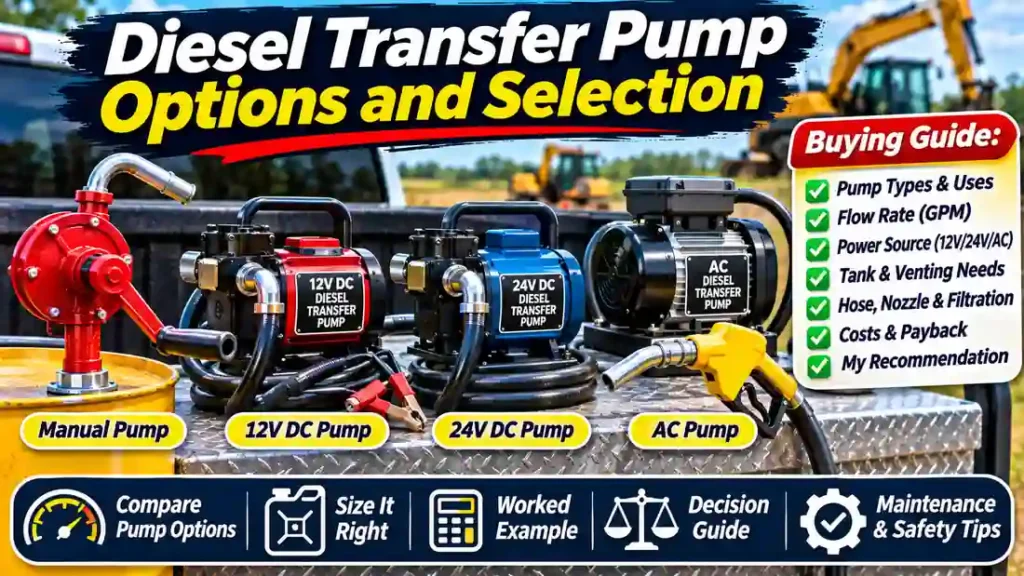
The best diesel transfer pump depends on how much fuel you move, how often you move it, and where the power comes from. For occasional small refills, I would consider an approved hand pump or pump-equipped caddy. For regular pickup-bed fueling, a compatible 12V DC electric pump is often more convenient. A 24V pump makes sense when the vehicle or equipment actually supplies 24V, while an appropriately rated AC pump can suit a fixed fueling station.
Don’t buy on gallons per minute alone. Check diesel and biodiesel-blend compatibility, duty cycle, suction lift, power demands, hose/nozzle size, filtration, tank venting and the rules for your installation. An automatic-shutoff nozzle is not permission to leave fueling unattended.
When someone asks me which diesel transfer pump to buy, I want to know what their actual refueling routine looks like before I talk about brands. Is it one generator every month? A tractor every afternoon? Several construction machines from a truck-bed tank? Those are three different jobs, and the biggest pump is not automatically the best tool.
I use a simple approach: choose the container and site first, work out the volume and time you need, and then select the pump and accessories as one compatible system. It keeps you from spending money on speed you cannot use—or installing a pump your tank was never designed to carry.
What Are the Main Diesel Transfer Pump Options?
Most small and medium diesel dispensing jobs fall into five categories. Each comes with its own tradeoffs in cost, effort, portability and maintenance.
| Pump option | Power or operation | Best-fit application | Main tradeoff |
|---|---|---|---|
| Hand rotary or lever pump | Your arm | Occasional drum or small-tank refills | Physical effort; variable flow |
| Gravity/siphon arrangement | Height difference, sometimes hand priming | Approved caddies positioned above receiving tank | Cannot reliably push fuel uphill |
| 12V DC electric pump | Suitable 12V battery/electrical supply | Pickup-bed transfer tanks and mobile equipment | Wiring, battery draw, duty-cycle limits |
| 24V DC electric pump | Suitable 24V electrical system | Vehicles and equipment already using 24V | Incorrect voltage can damage equipment |
| AC electric pump | Matched mains supply and installation | Fixed farm, workshop or fleet fueling points | Requires appropriate electrical installation |
1. Manual rotary and lever pumps
A manual pump is often my starting point when fuel movement is infrequent. You crank or move a handle rather than relying on a motor. It can be useful for a drum kept in a suitable storage area and avoids a battery cable trailing across the work zone.
The catch is that hand-pump ratings are not equivalent to sustained flow in real use. The rate depends on the model, your operating pace, hose routing and fuel conditions. If you need to transfer 40 gallons every morning, repetitive cranking becomes a job in itself.
2. 12V DC diesel transfer pumps
For a mobile tank on a truck or trailer, 12V DC is frequently the practical middle ground. A compatible vehicle electrical system can supply the pump, so there is no need to find a wall outlet at each machine. These pumps are offered with different rated flow rates, hose kits, meters and nozzles.
I pay particular attention to the pump’s actual electrical requirements. “12V” on a label does not make any small battery or undersized cable suitable. The manufacturer may specify wiring gauge, overcurrent protection, connection methods and whether the vehicle should be operated in a particular manner during dispensing.
For example, Fill-Rite lists the FR1210H as a 12V, 15-GPM model with a 30-minutes-on, 30-minutes-off duty cycle. Its stated maximum suction lift is 8 feet. Those figures belong to that model and should not be assumed for every pump.
3. 24V DC pumps
A 24V pump is useful when 24V is already available from the machinery or vehicle. It is not inherently safer or faster merely because the number is larger. The pump design, motor and operating point determine performance.
For an example of why model details matter, PIUSI’s Panther DC family includes a dual-voltage version advertised at up to 70 liters per minute at 24V, but up to 35 liters per minute at 12V. That’s a substantial difference for the same general product family. I would never connect an unverified pump to a different voltage and hope it behaves the same way.
4. AC pumps for fixed installations
At a permanent farm or workshop fueling point, an AC electric pump can remove the need to manage batteries. It can also be matched to the electrical installation and expected daily usage.
The PIUSI Panther AC range, for example, offers 56, 72 and 90 liters-per-minute versions, with duty-cycle differences among models. Availability, frequency, certification and voltage vary by regional version. That matters if you are shopping in the United States versus another country.
5. Complete pump-and-tank packages
Sometimes the best option is not a standalone pump. A complete approved package may already include a compatible suction pipe, conductive hose, nozzle, wiring and other components. I look for this when the tank and pump will be bought together.


Diesel Transfer Pump Technical Specifications Compared
To show the range of real options, here are representative manufacturer-published maximum ratings, not measured delivery rates at your nozzle. Versions and regional electrical approvals can differ, so match the exact model number before ordering.
| Example model or family | Power | Published maximum flow | Published duty or operating note | What I take from it |
|---|---|---|---|---|
| Fill-Rite FR1210H | 12V DC | 15 GPM (about 57 L/min) | 30 min on / 30 min off | A mobile, mid-range pump example |
| Fill-Rite FR4210H | 12V DC | 20 GPM (about 76 L/min) | Model-specific limits apply | Faster flow requires matched hose/nozzle |
| PIUSI Panther DC dual-voltage version | 12V / 24V DC | Up to 35 L/min at 12V; 70 L/min at 24V | 30-minute duty cycle | Voltage changes the usable output |
| PIUSI Panther AC 56 | Model-specific AC supply | 56 L/min (about 14.8 GPM) | Region/version-specific duty and approval | A potential fixed-site choice |
GPM means U.S. gallons per minute. Ratings describe maximum performance under stated test conditions. Actual flow is affected by filters, hoses, lift, nozzle, power and fuel conditions. These examples are not a universal certification or product endorsement.
How Many Gallons per Minute Do You Actually Need?
Transfer time (minutes) = gallons to dispense ÷ effective GPM.
| Fuel to transfer | At 3 GPM | At 8 GPM | At 12 GPM | At 18 GPM |
|---|---|---|---|---|
| 5 gallons | 1.7 min | 0.6 min | 0.4 min | 0.3 min |
| 15 gallons | 5.0 min | 1.9 min | 1.3 min | 0.8 min |
| 30 gallons | 10.0 min | 3.8 min | 2.5 min | 1.7 min |
| 50 gallons | 16.7 min | 6.3 min | 4.2 min | 2.8 min |
These are illustrative effective rates, not promises for the named products. Filling a small opening at 18 GPM may be impractical or difficult to control even if the pump can deliver it. I would rather spend another minute filling than risk overflow.
My Worked Example: Choosing a Pump for a Tractor
Imagine you have a 100-gallon diesel transfer tank used to refill one tractor. You usually dispense 35 gallons, three times a week, for 48 working weeks each year. The tank has suitable mounting and venting, and the pump will be properly matched to its design.
Let’s compare a manual pump with an electric option using assumed real-world effective rates. I include setup and put-away time, because that is part of the job too.
- Manual pump: 3 effective GPM, plus 2 minutes handling the equipment.
- Electric pump: 10 effective GPM, plus 3 minutes for safe setup and stowing.
- Refills per year: 3 × 48 = 144.
- Diesel dispensed annually: 35 × 144 = 5,040 gallons.
The manual job takes 35 ÷ 3 + 2 = 13.7 minutes per fill. The electric job takes 35 ÷ 10 + 3 = 6.5 minutes. That’s about 7.2 minutes saved per visit, or 17.2 hours over the year.
| Annual operating example | Manual pump | Electric pump |
|---|---|---|
| Fuel per refill | 35 gal | 35 gal |
| Total time per refill | 13.7 min | 6.5 min |
| Refills per year | 144 | 144 |
| Estimated annual handling time | 32.8 hours | 15.6 hours |
| Difference | — | 17.2 hours saved |
Now suppose my illustrative installed costs are $220 for a complete manual arrangement and $750 for a suitable powered arrangement. The difference is $530. At an assumed $20 per hour for time, saving 17.2 hours is worth about $344 per year. Simple time-value payback would be $530 ÷ $344 = about 1.5 years, before maintenance, electricity, financing, repairs or other costs.
These prices and work times are planning assumptions, not vendor quotes or field measurements. I include the exercise to show how you can make your own decision. Replace the assumptions with your actual purchase quotes, transfer volume, and measured handling time.
If your real use is two 5-gallon fills per month, the value case changes dramatically. That’s why I don’t pick a pump based on the annual gallons handled by someone else’s business.
Choose the Tank and Power Source Before the Pump
A pump and its tank are not independent purchases. I check the fuel-container rating, opening size, vent arrangement, mounting method and location before deciding on a motor.
A tank that needs a specific pressure/vacuum vent must keep that approved path working. As diesel is removed, replacement air has to enter; otherwise excessive vacuum can reduce dispensing performance and potentially damage the tank. Never loosen a filler cap as a substitute for proper venting. I cover this in Do Diesel Transfer Tanks Need to Be Vented?.
For transport, I check the rules that apply to the container, fuel quantity, vehicle and intended use, not just whether the pump physically bolts to the tank. The related guide Do Diesel Cans Meet Transportation Regulations? is the next read for that issue.
Seven Specifications I Would Check Before Buying
1. Fuel and blend compatibility
“Diesel compatible” does not automatically include every biodiesel blend, renewable diesel formulation or other petroleum product. A pump described as suitable for B20, for example, is not automatically approved for B100. I match the exact fuel and seals to the maker’s current compatibility list.
2. Duty cycle
This tells you how long a motor is intended to run and whether cooling intervals are required. For a pump specified at 30 minutes on and 30 minutes off, I would not plan continuous hour-long dispensing, even if the pump seems capable of continuing.
3. Suction lift and hose routing
A pump’s maximum rated lift is not a promise of equal performance at that height. Long suction lines, air leaks and restrictions hurt priming. I prefer a manufacturer-approved installation with short, correctly sized suction plumbing and no improvised fittings.
4. Hose and nozzle diameter
High flow is only useful if the hose and nozzle can accommodate it. A restrictive nozzle may make a larger pump deliver much less than its nameplate rating. Choose a compatible complete system rather than combining unrelated parts by thread size alone.
5. Filtration and water management
A built-in inlet strainer mainly protects the pump from larger particles; it is not the same as a diesel fuel filter or water separator. I would select an appropriate downstream filter if the application needs it and account for its pressure drop and maintenance.
6. Electrical demand and protection
For a DC pump, the voltage, current draw, wire size and fuse or breaker arrangement should follow the manufacturer. On an AC system, the supply and installation need to meet the equipment requirements and local codes. Never use a damaged lead or household extension setup as a shortcut.
7. Nozzle control and meter options
An automatic-shutoff nozzle can improve control in an approved application, but it does not make the entire pump automatic or remove the need to supervise. A fuel meter can help record usage; verify its calibration, fuel compatibility and expected accuracy.
Diesel Transfer Pump Selection Decision Guide
| Your fueling situation | My starting recommendation | Why |
|---|---|---|
| Few gallons a month, no reliable power | Proper fuel-rated hand pump or approved can | Simple and avoids unnecessary equipment |
| Occasional 10–20 gallon fills | Manual rotary or modest powered caddy | Balance flow and handling effort |
| Repeated 20–50 gallon mobile fills | Compatible 12V DC pump and approved tank | Convenient where 12V power exists |
| Vehicle already operates on 24V | Manufacturer-approved 24V pump | Matches existing electrical system |
| Fixed shop or farm fueling station | Properly installed AC pump | Designed around stationary service |
| Multiple machines and larger daily volume | Higher-flow complete package, possibly metered | Time savings may justify installed cost |
| Small filler neck or difficult visibility | Controlled lower-flow system | Reduces risk of overfilling |
For the underlying choice between arm-powered and motor-powered systems, read Choosing Between Manual and Automatic Diesel Transfer. I would use that comparison before moving on to specific brands and models.
What About Pump Prices and Operating Costs?
I don’t treat the pump-only price as the full project cost. A package that looks inexpensive may still need a hose, approved nozzle, compatible suction tube, filter, meter, electrical installation and secure tank mounting.
My cost worksheet includes equipment, compatible accessories, installation, consumable filters, potential downtime and replacement parts. If diesel delivery is an alternative, I compare that option too. The useful next article is Cost of Operating a Diesel Transfer Tank vs. Fuel Delivery Services.
Basic Maintenance and Troubleshooting
I would rather inspect the system for five minutes than deal with a failed transfer on a busy day. The manufacturer’s schedule comes first, but these are the routine checks I would build into an equipment log.
| What I inspect | Why it matters | When I would stop using the system |
|---|---|---|
| Hose, nozzle, fittings | Prevent leaks and worn connections | Fuel wetness, cracks or damaged couplings |
| Pump wiring and switch | Prevent unreliable or unsafe operation | Damaged insulation, overheating or electrical faults |
| Tank vent and structure | Support safe pressure equalization | Bulging, collapse, cracks or leaking |
| Strainer and filter | Protect pump and receiving equipment | Persistent restriction or contaminated fuel |
| Pump operation and sound | Catch changes before a failure | Unusual noise, loss of prime or abnormal heating |
When the pump slows down, I don’t automatically assume the motor is failing. A blocked filter, suction air leak, wrong voltage or obstructed vent can produce similar symptoms. I stop dispensing and follow the manufacturer’s troubleshooting process rather than running the pump dry or removing parts while the system is operating.
If you see diesel escaping from the hose, pump, or tank, use the safety and spill-response steps in What to Do if Diesel Leaks from Your Transfer Tank before troubleshooting.
Safety Rules I Would Never Skip
- Supervise every transfer. Even an automatic-shutoff nozzle is not a substitute for an operator.
- Use fuel-rated, appropriately approved components. Never assume that a pump designed for water, DEF or lubricating oil can safely move diesel.
- Follow bonding and grounding instructions. Static-control requirements depend on the fuel, containers and installation; use the method specified for the system and applicable rules.
- Protect against spills. Position the nozzle securely, keep suitable spill supplies available and don’t dispense near open flames or other ignition sources.
- Shut equipment down as directed. Follow the machine’s cooling and refueling procedures.
- Keep children away from fueling and storage. Approved child-resistant closures help but cannot substitute for restricted access.
- Do not modify pressure vents or damaged tanks. Fix the underlying issue with approved parts or qualified service.
Frequently Asked Questions
Is a 12V diesel transfer pump powerful enough for a 100-gallon tank?
Often, yes, if the pump, suction arrangement and tank are appropriately matched. Tank capacity alone does not set pump size. I look at how many gallons you dispense in one session, the fuel’s height relative to the pump and the duty cycle.
Is 20 GPM always better than 15 GPM?
No. A higher rated flow may save time on large fills but be awkward at small filler openings. A longer hose or restrictive filter can also erase part of the advertised advantage. I would buy for controlled effective flow, not the largest number on the label.
Can one transfer pump handle diesel, gasoline and DEF?
Not unless the manufacturer explicitly approves all those fluids, which is uncommon for a typical diesel transfer setup. DEF needs compatible materials and handling to avoid contamination. Never interchange fluids based on appearance or hose size.
What is the difference between self-priming and dry running?
A self-priming pump may be designed to evacuate air and establish flow under specified conditions. That does not mean it can run indefinitely without liquid. I follow the maker’s priming and dry-run restrictions.
Do I need an automatic nozzle?
Not always. A suitable manual nozzle gives direct control, while an approved automatic-shutoff nozzle may offer additional convenience under the conditions it is designed for. Either way, I remain at the nozzle until the transfer ends.
Final Verdict: The Best Diesel Transfer Pump Is the One That Fits the Job
I would choose a manual pump for occasional small transfers, a correctly matched 12V pump for routine mobile fueling, a 24V pump only where the power system supports it, and a properly installed AC pump for an appropriate fixed station.
Before buying, I would confirm the exact fuel, tank rating, effective GPM, duty cycle, suction plumbing, voltage, nozzle and filtration. Then I’d run my own simple time-and-cost comparison rather than relying on a product’s headline flow rating.
If you’re still deciding between pumping methods, continue with Choosing Between Manual and Automatic Diesel Transfer. If your tank will live in a vehicle, the next safety question is Do Diesel Transfer Tanks Need to Be Vented?. Those two decisions usually tell me which pump category deserves a closer look.
Pingback: What to Do if Diesel Leaks from Your Transfer Tank (Immediate Steps, Cleanup & Prevention) -
Pingback: Is a Diesel Transfer Tank Easy to Move Around? Weight, Portability & Safety -