
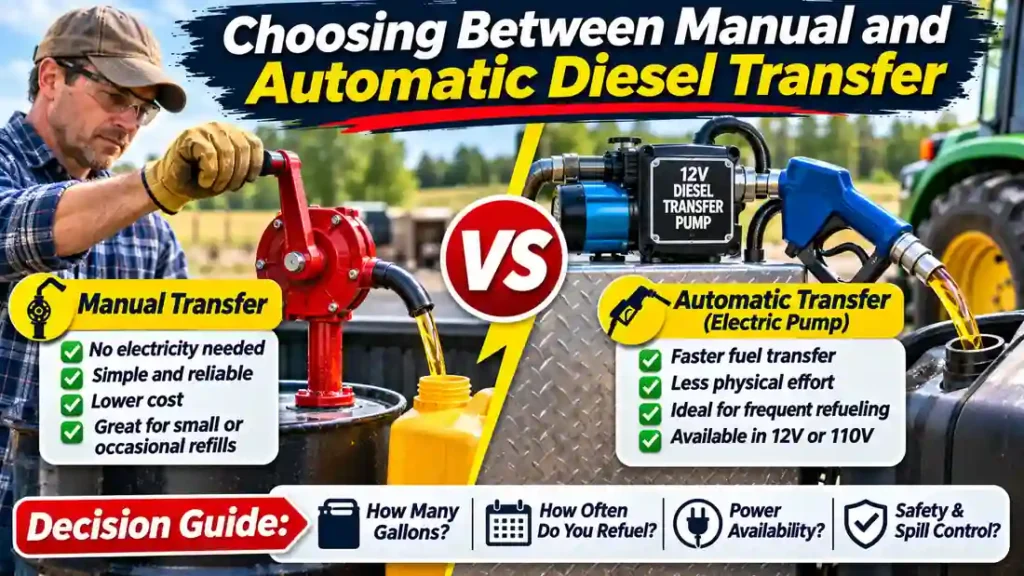
QUICK ANSWER
Manual diesel transfer is usually the better fit for occasional, small-volume jobs, while powered (often called automatic) transfer makes more sense when you refuel larger tanks or equipment frequently. A hand pump needs no electricity and offers straightforward control. A properly matched electric pump reduces physical effort and can move fuel faster. But remember: an electric pump is not necessarily an automatic-shutoff system, and even an automatic nozzle still requires an operator to watch the fill.
My starting rule: Choose based on gallons per session, refueling frequency, access to power, and the level of control you need—not the biggest flow-rate number on the label.
If you regularly refuel a generator, tractor, forklift, or piece of construction equipment, you have probably encountered two very different ways of moving diesel: a hand-operated pump or a motor-driven transfer system. I find that people often focus on speed first. I would begin with something less glamorous: how much diesel you actually handle, and how safely you can get it from one container to another.
A pump that seems quick in a demonstration may be awkward near a tall filler or far from power. Here is how I would decide.
What Is Manual Diesel Transfer?
Manual transfer means you supply the energy needed to move the fuel. You may turn a rotary crank, work a lever or piston pump, or use an approved siphon arrangement where the container and receiving tank are at suitable heights. Controlled pouring from an approved small diesel can is another manual method, but it is not the same as pumping.
I like that a hand pump needs no electricity or motor wiring. It still needs fuel-rated components, an appropriate container, and safe handling.
A rotary hand pump is not necessarily slow. One manufacturer’s RP10 manual pump is rated at up to 10 gallons per 100 handle revolutions. That is 0.1 gallon per turn under its rated conditions—not an assurance that a person can sustain a particular speed or that every installation will reach that output.
For small portable options, I explain the difference between cans, pump caddies, and larger tanks in Do Diesel Cans Come With Built-In Fuel Transfer Pumps?.
What Is Automatic Diesel Transfer?
In ordinary shopping language, automatic diesel transfer often means an electric-powered transfer pump. A 12-volt pump may run from a compatible vehicle battery; some larger or stationary systems use 24V DC or a specified AC supply. The motor does the pumping, but a person normally still controls the process.
I separate three claims often blurred in advertisements:
- Powered pump: A motor moves the diesel instead of your arm.
- Automatic-shutoff nozzle: A compatible nozzle is designed to stop flow when the fuel reaches the sensing point, under suitable operating conditions.
- Automated dispensing system: A more elaborate setup might include controls, meters, interlocks, or programmed limits; it should not be assumed from the word electric.
An electric pump may have either nozzle type. Both require an attentive operator.
Manual vs. Automatic Diesel Transfer: Technical Comparison
| Feature | Manual hand pump | Electric / powered transfer pump |
|---|---|---|
| Energy source | Hand effort | Approved DC battery or AC supply |
| Typical use | Occasional, smaller refills | Repeated, larger refills |
| Flow-rate example | 0.1 gal per turn for a specified rotary model | Some available models are rated at 8 or 15 GPM |
| Actual transfer speed | Depends on crank pace, fuel, lift, and restrictions | Depends on hose, filter, lift, battery, and nozzle |
| Setup complexity | Usually lower; no motor wiring | Proper electrical installation and protection needed |
| Operator effort | Repeated cranking or pumping | Less physical pumping effort |
| Maintenance focus | Seals, crank, hose, suction tube | Motor, wiring, switches, filters, hoses, and seals |
| Fueling control | Operator controls flow manually | Operator controls flow; optional auto-shutoff nozzle |
| Power-outage use | Can work without power | Needs a suitable independent power source |
| Buying priority | Ergonomics and fuel compatibility | Flow, power, duty cycle, and approved tank fit |
These are design comparisons, not universal performance ratings. Actual model specifications override generic categories. If you want to understand why the storage tank itself must also work with the pump, continue with Do Diesel Transfer Tanks Need to Be Vented?.
How Fast Is Manual Transfer Compared With an Electric Pump?
Gallons per minute (GPM) is the easiest common measure. But I treat it as one number in a larger decision. Manufacturers often publish a maximum or nominal flow rate measured under specific conditions. Long hoses, restrictive filters, a high receiving tank, or weak voltage may reduce real performance.
Here is a quick planning table using illustrative operating rates rather than guaranteed field performance:


| Fuel to move | Manual at 3 GPM | Powered at 8 GPM | Powered at 15 GPM |
|---|---|---|---|
| 5 gallons | 1.7 minutes | 0.6 minute | 0.3 minute |
| 15 gallons | 5.0 minutes | 1.9 minutes | 1.0 minute |
| 30 gallons | 10.0 minutes | 3.8 minutes | 2.0 minutes |
| 50 gallons | 16.7 minutes | 6.3 minutes | 3.3 minutes |
I calculated each entry by dividing gallons by assumed effective GPM. The manual 3-GPM illustration corresponds to roughly 30 revolutions per minute on a pump delivering 0.1 gallon per turn; actual effort and delivery can vary. The powered rates are chosen as practical examples, not predictions for your particular pump.
Speed matters more at high volumes, but preventing overfill still comes first.
Worked Example: Refueling a 30-Gallon Tractor
Imagine I am choosing a setup for a tractor that normally takes 30 gallons per refill. I refuel it four times per week for 48 working weeks each year.
First, I compare two illustrative methods:
- Manual pump: effective 3 GPM, plus 1 minute to position and put away the equipment.
- Electric pump: effective 10 GPM, plus 3 minutes to connect, inspect, and put away the equipment.
The calculations are straightforward:
Manual transfer: 30 ÷ 3 = 10 minutes of pumping; add 1 minute = 11 minutes per refill.
Powered transfer: 30 ÷ 10 = 3 minutes of pumping; add 3 minutes = 6 minutes per refill.
That makes the powered setup 5 minutes faster per visit in this example. Across 4 × 48 = 192 refills, the theoretical time difference becomes 960 minutes, or 16 hours per year.
| Annual comparison | Manual | Powered |
|---|---|---|
| Fuel moved | 5,760 gallons | 5,760 gallons |
| Total time per refill | 11 minutes | 6 minutes |
| Annual fueling time | 35.2 hours | 19.2 hours |
| Calculated time difference | — | 16.0 hours saved |
I include setup time so the result reflects whole-job time, not just advertised pump speed.
Those 16 hours are not guaranteed savings; real conditions and maintenance change the result.
My Three-Number Test Before Buying a Pump
Rather than recommending electricity to everybody, I use three numbers: gallons per visit, visits per month, and minutes spent handling the equipment. I multiply the first two to estimate monthly volume, then compare the complete time required by both setups.
For example, a person moving 4 gallons twice a month handles only 8 gallons monthly. Even a moderately powered pump may add more complexity than value. Someone moving 25 gallons three times per week handles roughly 300 gallons in a four-week month. That person has a stronger case for powered transfer.
This is my planning framework, not a safety standard.
How Much Does Manual vs. Powered Transfer Cost?
Prices vary widely because hand siphons, rotary drum pumps, and powered dispensers are different products.
I would compare total installed cost, not only the pump’s sticker price. An electric system may need appropriate power wiring, fusing, battery capacity, mounting hardware, hose, nozzle, and filtration. A manual setup still needs an approved container, suitable pump, hose, seals, and any required safety equipment.
Here is an example of how I would compare costs without pretending these are actual dealer quotes:
| Planning item | Manual example | Powered example |
|---|---|---|
| Pump and basic hardware | $180 | $480 |
| Additional installation/accessories | $40 | $170 |
| Illustrative initial total | $220 | $650 |
| Difference to recover | — | $430 |
If my personal time is worth $20 per hour and the powered setup saves the illustrative 16 hours annually, that is $320 of time value per year. Ignoring financing and maintenance differences, the $430 premium would take about 1.34 years to recover in time value alone.
This is an illustrative decision calculation, not a savings guarantee; repairs and refueling frequency change payback.
Which System Gives You Better Control Over Spills?
Neither hand pumping nor an automatic nozzle is universally safer.
Spills happen when a nozzle is positioned poorly, a hose is damaged, a cap or vent is incorrect, the receiving tank overfills, or an operator becomes distracted. A slow flow can give more reaction time, but poor technique can still spill diesel. A compatible automatic-shutoff nozzle can help, but its function depends on correct installation, flow, and sensing conditions.
I always inspect the hose and nozzle, control the flow, watch the level, and stop early when appropriate. Never leave diesel transferring unattended. Keep ignition sources away, follow applicable grounding or bonding instructions, and use equipment specifically rated for diesel and the job.
For small-container designs that improve pouring control, see Which Diesel Can Brands Offer Spill-Proof Designs?. I treat spill-proof as a manufacturer’s design claim rather than a guarantee that no spill is possible.
The Safety Details I Would Check First
Whether I choose manual or powered transfer, I check the complete system:
- Approved fuel and blend: A pump rated for diesel may not automatically be rated for every biodiesel blend, gasoline, DEF, or other liquid.
- Tank and vent: An appropriate transfer tank needs its manufacturer-specified venting path; never bypass it to improve pump flow.
- Hose, seals, and nozzle: Connections must be compatible, undamaged, and sized for the system.
- Electrical protection: Powered units need correct voltage, wire size, overcurrent protection, and installation according to the manufacturer.
- Duty cycle: Some 12V transfer pumps specify a limit such as 30 minutes on and 30 minutes off. I check the exact model before prolonged use.
- Fuel filtration: A strainer is not always a substitute for a proper diesel filter or water-separation setup.
- Transport and location: A truck-mounted fuel system must meet the rules for its tank design, fuel quantity, and intended use.
If I am moving fuel in a vehicle, I also consult Do Diesel Cans Meet Transportation Regulations? before deciding on a container or transfer arrangement.
Decision Guide: Which Diesel Transfer Method Should You Choose?
| Your situation | My first choice | Why |
|---|---|---|
| Emergency or occasional 2–5 gallon refill | Approved can or compatible manual pump | Simple and avoids power setup |
| Occasional 10–20 gallon equipment refill | Manual rotary pump or pump caddy | Moderate throughput without electrical installation |
| Regular 20–50 gallon refills | Diesel-rated electric pump | Lower physical effort and potentially faster work |
| No dependable electrical source | Manual transfer | Fewer power dependencies |
| Fixed fueling point with repeated daily use | Properly installed powered system | Better suited to repetitive duty |
| Small fill neck or hard-to-see fuel level | Controlled-flow setup, possibly slower | Avoid overfilling; flow control matters more than speed |
| Moving fuel in a vehicle | Approved tank/container and matched pump | Transport rules and tank design come first |
For infrequent refills I favor simplicity; for frequent work, I compare the time saved.
Common Mistakes I Would Avoid
Mistake 1: Assuming “automatic” means you can walk away. An electric pump only automates the energy input. Even a properly functioning shutoff nozzle requires supervision.
Mistake 2: Buying for maximum GPM. A high-flow pump can overwhelm a small receiving neck and may not be the right match for a 5- or 10-gallon fill.
Mistake 3: Forgetting the power source. A 12V label does not mean every battery, cable, or installation is suitable. I read the manufacturer’s electrical requirements first.
Mistake 4: Treating a cheap hand pump as universally compatible. Some pumps are intended for water, oil, or chemical solutions rather than diesel. I verify fluid compatibility before using one.
Mistake 5: Ignoring the condition of the tank. Even a new pump cannot make a cracked or corroded tank safe. If you suspect damage, read Can You Repair a Cracked Diesel Transfer Tank? and remove the tank from service for proper assessment.
Frequently Asked Questions
Is manual diesel transfer safer than automatic transfer?
Not automatically. Both require correctly rated components, attentive operation, and spill prevention. I look at the actual setup and the operator’s ability to control the fill instead of judging safety from the power source alone.
Can an electric diesel transfer pump have a manual nozzle?
Yes. Powered pump describes what moves the diesel; manual or automatic nozzle describes how dispensing is controlled at the outlet. Check the exact included components before ordering.
Is gravity dispensing the same as manual pumping?
No. Gravity flow relies on a suitable difference in height, while a hand pump supplies mechanical energy. Both can avoid electricity, but they behave differently when the receiving tank is above the source.
Do I need a high-flow pump for a 5-gallon diesel can?
Usually not. For a small refill, a compliant can with a controlled spout or an approved small transfer device is often simpler. I would prioritize manageable handling and control over speed.
Should I choose 12V DC or AC for automatic transfer?
I would generally consider a manufacturer-approved DC system for suitable mobile applications and an appropriate AC system for a fixed installation with available power. The tank, site classification, wiring, and intended use determine which is suitable.
Final Verdict: Manual or Automatic Diesel Transfer?
I would choose manual transfer for occasional, modest quantities, and powered transfer for repeated larger refills where the installation and added expense make sense. Manual systems are simple and independent of power; electric systems reduce cranking and can save meaningful time.
Calculate the whole job: setup, transfer, cleanup, and upkeep—not just the pump’s advertised GPM.
Once you have selected a pump, my next question would be how the container, nozzle, and vent work together. Start with Do Diesel Transfer Tanks Need to Be Vented? before installing or changing a transfer system.
Pingback: Diesel Transfer Pump Options and Selection: Complete Buying Guide -
Pingback: Is the Funnel on a Diesel Can Removable? Spout Types & Safe Removal -