QUICK ANSWER — How much does a diesel transfer tank cost?
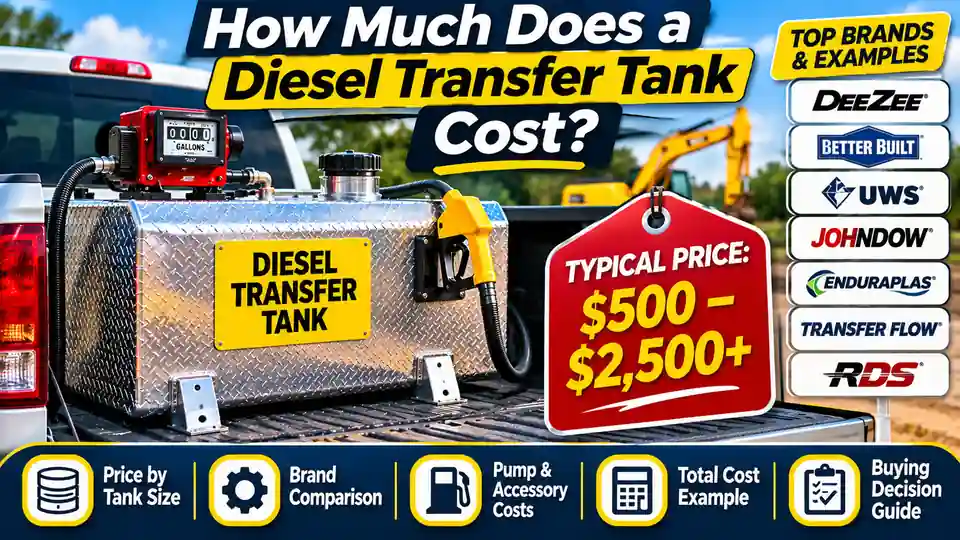
In the U.S., I would budget about $500–$1,500 for many bare truck-bed diesel transfer tanks, depending on capacity, steel versus aluminum construction, and design. A complete ready-to-use diesel refueling system often costs roughly $1,200–$2,500 or more, especially with a pump, hose, nozzle, and protective enclosure. Premium truck-mounted systems can cost more.
Don’t stop at the tank’s sticker price. A pump kit, filtration, mounting, electrical work, freight, and taxes can raise the total. As an example, a $1,050 tank plus $550 pump kit, $90 filter/fittings, and $150 installation supplies totals $1,840 before taxes and unusual freight. These are U.S. budgeting examples—not guaranteed quotes.
My buying rule: Compare the complete ready-to-dispense cost, the tank’s approved use, the loaded weight on your truck, and how often you’ll use it. The cheapest tank isn’t necessarily the least expensive fueling system.
If you’re shopping for a diesel transfer tank, it’s easy to compare two numbers on a product page and assume you’ve found the better deal. I wouldn’t make that decision until I know what is included, how the tank fits my truck, and what it will cost to start dispensing fuel safely.
For a farm, construction company, landscaping crew, or backup-generator owner, a transfer tank can reduce trips to a fuel station and bring diesel directly to equipment. But the upfront price is only part of the story. Some products are bare tanks, some are tank-and-toolbox combinations, and others come as complete self-contained refueling stations.
I’ll walk you through representative U.S. prices, compare Dee Zee, Better Built, UWS, RDS, JohnDow, Enduraplas, and Transfer Flow, and show a worked budget and payback calculation. I’ll also share the questions I’d ask before spending a dollar on a tank.
Diesel Transfer Tank Prices at a Glance
A practical price guide starts with what you’re actually buying, not just gallon capacity. Here are useful planning ranges, not standardized national averages or binding offers.
| Type of setup | Illustrative purchase range | What’s usually included |
|---|---|---|
| Small bare transfer tank, approximately 40–55 gal | $500–$1,000 | Tank, fill opening and mounting features; pump often extra |
| Mid-size bare tank, approximately 60–100 gal | $700–$1,600 | Steel or aluminum tank; accessories vary |
| Larger or toolbox-combo tank, approximately 75–110 gal | $1,200–$2,100+ | Combination storage and tank, sometimes no pump |
| Diesel-ready polyethylene refueling station, approximately 50–106 gal | $1,100–$1,800+ | Often includes pump, hose and nozzle |
| Premium turnkey refueling system | $2,000–$3,000+ | More integrated dispensing hardware and features |
| Separate electric pump kit | $450–$800+ | Depending on flow rate, nozzle, hose and filtration |
Prices are indicative U.S. shopping ranges, not a promise that every tank in a size category costs this much. Check whether a listing is current, in stock, and inclusive of freight.
Notice how a smaller tank with a high-quality pump could cost more than a larger bare steel tank. That’s why I compare total equipment package cost, not just tank size.
Diesel Transfer Tank Brands and Real-World Price Examples
When I compare brands, I focus on a representative model instead of pretending every manufacturer sells identical products. These example prices were visible in public U.S. manufacturer or retailer listings reviewed for this guide in November 2026. A listed price may be a sale price, and inventory and shipping vary by location.
| Brand | Example product and capacity | Advertised example price | Important buying note |
|---|---|---|---|
| Dee Zee | DZ91752, 40-gallon aluminum long rectangle | $644.36 | Tank-only listing; marked out of stock |
| Better Built | 50-gallon aluminum square tank | $649.00 | Example retailer price; pump separate |
| UWS | ST-75-L-W, 75-gallon steel L-shaped tank | $944.95 | Manufacturer catalog listing; check fit |
| Enduraplas | Diesel Fuel Boss, 100-gallon polyethylene system | $1,330.00 | Example advertised special; includes pump equipment |
| JohnDow | 106-gallon diesel carry tank | $1,439.99 | Example sale listing; 12V pump and nozzle included |
| UWS | TT-100-COMBO, 100-gallon aluminum combination tank | $1,743.95 | Toolbox-style combination; verify accessories |
| Transfer Flow | 100-gallon L-shaped refueling system | $2,300.00 | Manufacturer listing; availability varies |
| RDS | Aluminum transfer tank, several capacities | Request a current retailer quote | Pump not generally included in base tank specifications |
The examples intentionally compare different configurations. They do not rank durability, certify a particular installation, or establish the price of every product in a brand’s range.
Dee Zee: Consider the shape before the discount
Dee Zee offers different fuel transfer and auxiliary tank configurations, including compact rectangular tanks and larger tanks designed for truck-bed installations. A 40-gallon aluminum model was listed for roughly $644, but that particular listing showed limited or unavailable stock. I would verify availability before treating it as a buying option.
I like that a narrow tank can preserve bed space. The tradeoff is capacity: if your machinery consumes a lot of diesel, you’ll refill more frequently. Check the actual product instructions to distinguish transfer-only use from an auxiliary vehicle-fuel setup. They’re not automatically interchangeable.


Better Built: A useful starting point for steel and aluminum
Better Built sells square, rectangular, and L-shaped designs. One retailer showed a 50-gallon aluminum square tank at $649. The company’s 100-gallon L-shaped steel model, by contrast, has a specified 14-gauge steel body and an approximate empty weight of 182.5 pounds.
Steel may provide the construction style you want, but I would always calculate truck payload before comparing it against a lighter alternative. A lower upfront tank price can be offset by lost carrying capacity or the cost of a separate pump.
UWS: Compare conventional tanks with toolbox combinations
UWS has published pricing for steel L-shaped tanks and aluminum combination models. A 75-gallon steel L-shaped tank was shown at $944.95, while a 100-gallon aluminum combo model was listed at $1,743.95.
For me, the higher-priced combo earns consideration only if the integrated storage solves a real problem. If I already own a secure toolbox, paying extra for another one may not improve the setup. I also verify whether pump equipment is included rather than assuming “combo” means ready to dispense.
RDS: Aluminum construction, but price the complete kit
RDS publishes a broad line of aluminum transfer tanks, including tank-and-toolbox arrangements. Its published specifications describe fittings, baffles, gauges, vents and mounting provisions; a transfer pump is not normally included with the base tanks shown.
I wouldn’t invent a universal RDS price because retailer offers vary widely by model. My comparison would request a current quote for the exact part number, then add a compatible pump, fittings, shipping and installation.
JohnDow: Compare a ready-to-use system with bare tanks
JohnDow’s 106-gallon diesel carry tank has been listed at $1,439.99 in a sale offer. Its appeal is that the package includes a 12V pump, hose and automatic nozzle, simplifying what you need to purchase separately.
However, I would check the pump duty cycle, power connection, dimensions, tank approval and delivery charge before buying. A complete kit can be a good value when the included components actually meet your workflow.
Enduraplas: A polyethylene diesel-only refueling station
The Enduraplas Diesel Fuel Boss line includes several capacities. An advertised 100-gallon model was listed for $1,330 with pump, hose and automatic shutoff nozzle. Manufacturer specifications for the 100-gallon model describe a 10 GPM pump, a 16-foot hose, a 47 × 34 × 34-inch footprint and approximately 100 pounds dry weight.
That makes it an interesting comparison with a bare metal tank. Still, I would confirm whether the seller’s exact model has the same parts and approved uses. The diesel refueling model must not be confused with similar-looking DEF or gasoline tanks.
Transfer Flow: A premium integrated option
Transfer Flow lists a 100-gallon L-shaped refueling system around $2,300. The manufacturer specifies a 53¾-inch length, 35⅞-inch width and 27⅝-inch height; its 329-pound figure is a shipping weight, not something I would automatically use as an empty installed weight.
This is a higher-ticket system. I’d consider it when frequent refueling, a particular truck fit, and the integrated design justify the additional investment. I wouldn’t buy it simply because it looks more substantial than a budget tank.
Tank Capacity, Material and Technical Specifications
Price comparisons become much more meaningful when you compare capacity, tank-only weight, footprint, pump requirements and approved use. The following examples illustrate how specifications differ; individual models must be verified separately.
| Technical detail | Representative example | What I check |
|---|---|---|
| Nominal capacity | 40, 50, 75, 100 or 106 gallons | How much usable fuel your operation actually needs |
| Steel construction | Better Built 100-gal L-shape: 14-gauge body | Coating, corrosion, empty weight, mount design |
| Polyethylene construction | Enduraplas 100-gal system | Diesel compatibility, sunlight rating, instructions |
| Aluminum construction | RDS and Dee Zee configurations | Empty weight, welds, tank dimensions |
| Integrated pump flow | Enduraplas 100-gal: 10 GPM rated | Real flow at hose/nozzle and pump duty cycle |
| Separate pump option | Fill-Rite FR1210H: 12V DC, 15 GPM rated | Voltage, nozzle, hose, filtration, duty cycle |
| Enduraplas 100-gal dimensions | 47 × 34 × 34 in. | Bed fit and safe access |
| Better Built 100-gal L-shape empty weight | Approx. 182.5 lb | Remaining vehicle payload |
Nominal ratings are model-specific; actual dispensing rate usually falls below the pump’s ideal rating when hoses, filters and lift introduce resistance.
Steel vs. aluminum vs. polyethylene
I would choose the material based on the installation rather than assuming one is always better.
Steel can offer rugged construction and many conventional truck-bed options, but coating damage and moisture require attention. Aluminum avoids ordinary red rust and often reduces weight, though weld quality and mounting still matter. Polyethylene can resist certain corrosion problems and often appears in ready-to-use diesel-only systems, but must be rated for the intended outdoor and transport conditions.
The shape is equally important. A long, narrow tank can preserve cargo space; a tall, compact tank can interfere with bed covers, visibility, toolbox doors or other equipment. I measure the truck bed, wheel wells, fifth-wheel clearance and tie-down positions before placing an order.
How Much Extra Does a Diesel Transfer Pump Cost?
A bare tank may appear cheap until you realize that it doesn’t dispense anything without the necessary system. A separately sold pump package can be a significant part of the final bill.
As one concrete reference, the Fill-Rite FR1210H 12V, 15-GPM manual-nozzle kit has appeared at approximately $492–$664 across retailer and manufacturer listings. The quoted package includes a pump, hose, nozzle, suction pipe and power leads. The manufacturer lists a 30-minute-on/30-minute-off duty cycle for this model.
I use the following budget buckets rather than promising one price for every installation.
| Added component | Illustrative allowance | What changes the price |
|---|---|---|
| 12V pump package | $450–$800 | Flow rate and included hose/nozzle |
| Water or particulate filtration | $50–$200+ | Filter type, housing and replacement media |
| Flow meter | $100–$400+ | Mechanical vs electronic accuracy/features |
| Hose/nozzle upgrade | $75–$300+ | Length, auto shutoff, compatibility |
| Mounting, electrical and installation | $100–$500+ | Truck wiring, labor, brackets and site |
| Freight and tax | Highly variable | Tank dimensions, shipping zone and local tax |
Some packages already include several of these items, so I would remove duplicate line items before adding the totals. An integrated system with an auto shutoff nozzle may be more expensive initially but save a separate purchase and assembly work.
If you’re comparing pumps and flow rates, continue to my Diesel Transfer Pump Options and Selection guide. If you’re deciding whether a hand pump is adequate, see Choosing Between Manual and Automatic Diesel Transfer.
How Much Does a Complete Diesel Transfer Tank Setup Cost?
Here’s a transparent example I use to compare a bare tank against a fully equipped system. The goal is to expose every line item, not to claim that all purchasers pay the same amount.
Suppose you choose a compatible 100-gallon transfer tank for your pickup and need a basic electric dispensing setup.
| Budget line | Illustrative cost |
|---|---|
| 100-gallon tank | $1,050 |
| Compatible 12V pump, hose and nozzle kit | $550 |
| Filtration, adapters or small fittings | $90 |
| Proper mounting and wiring supplies | $150 |
| Equipment total before taxes/freight | $1,840 |
I would then ask for a written final quotation including delivery, installation labor if contracted out, accessories, local taxes, and any additional protective equipment required for the location.
The biggest budget mistake is comparing this $1,840 operational system with a $650 bare tank and calling the latter 65% cheaper. Those offers contain different equipment and cannot accomplish the same task without further spending.
What Does 100 Gallons of Diesel Weigh in Your Truck?
A tank that fits in the truck bed might still exceed the vehicle’s available payload once filled. This is the check I would do before shopping for a bigger capacity.
For planning, I’ll use 7.1 lb per U.S. gallon for diesel. The actual density depends on formulation and temperature.
| Fuel volume | Approx. weight of diesel alone | Example total with 100-lb tank and 30-lb pump |
|---|---|---|
| 40 gallons | 284 lb | 414 lb |
| 50 gallons | 355 lb | 485 lb |
| 75 gallons | 532.5 lb | 662.5 lb |
| 100 gallons | 710 lb | 840 lb |
| 106 gallons | 752.6 lb | 882.6 lb |
The last column is a math illustration using the same assumed tank/pump weights in every row, not the weights of actual brand models. Actual empty weights vary markedly; don’t use this column as a vehicle-loading approval.
For a real purchase, I would replace the illustrative 100-pound tank weight with the manufacturer’s number and include mounting hardware, hose, tools, passengers, and every other load already on the vehicle. Compare the result with the specific truck’s door-jamb payload rating, gross vehicle weight rating, and axle ratings.
The gallon count also doesn’t establish permission to transport fuel. Tank design approval, installation, usage and the shipment’s regulatory circumstances all matter. My Do Diesel Cans Meet Transportation Regulations? guide explains why familiar capacity thresholds should not be mistaken for a universal truck allowance.
Worked Example: Is a $1,840 Diesel Transfer Tank Worth Buying?
I like to go beyond “this tank costs $1,840” and ask whether the equipment pays for itself. Consider a business using 300 gallons of diesel per month that currently pays a service to deliver and dispense fuel.
Assume self-purchased diesel is effectively $0.35 cheaper per gallon than a comparable delivered quote, after aligning fuel grade and taxes. Assume a 100-gallon system requires four pickups per month due to usable capacity and routing. Each trip is a short detour that adds $10 in combined mileage and labor, and I reserve $15 per month for routine consumables and upkeep. All numbers are hypotheses for planning, not market guarantees.
Step 1: Monthly fuel-price advantage
300 gallons × $0.35 = $105 saved before pickup expenses.
Step 2: Cost of collecting the fuel
4 trips × $10 = $40 per month in incremental mileage and paid time.
Step 3: Add a maintenance allowance
$15 per month for filters, inspection consumables and modest ongoing costs. Unexpected repairs and financing are not included.
Step 4: Calculate net monthly savings
$105 − $40 − $15 = $50 per month.
Step 5: Estimate simple payback
$1,840 ÷ $50 = 36.8 months, or roughly 3.1 years.
| Worked example metric | Value |
|---|---|
| Monthly diesel volume | 300 gal |
| Comparable delivered-price premium | $0.35/gal |
| Gross monthly fuel savings | $105 |
| Four detour pickups | −$40 |
| Upkeep allowance | −$15 |
| Net monthly savings | $50 |
| Initial system budget | $1,840 |
| Simple payback | 36.8 months |
This is not a guaranteed return. It ignores financing, taxes on the equipment, the time value of money, insurance differences, unexpected downtime, resale value, and any additional regulatory or installation requirements. Most importantly, if four trips are dedicated long-distance journeys, $10 per trip may be far too low.
My independent decision rule is to stress-test the trip cost before looking at payback. Increase each pickup trip from $10 to $25: the monthly pickup expense rises to $100, so the model becomes $105 − $100 − $15 = −$10 monthly. Under those assumptions, the tank never pays for itself compared with delivery. The size and sticker price didn’t change; the logistics did.
For a more detailed comparison of labor, mileage and delivery fees, read Cost of Operating a Diesel Transfer Tank vs. Fuel Delivery Services.
Should You Buy a 50-, 75- or 100-Gallon Transfer Tank?
Bigger is not automatically better. The right capacity depends on how quickly you use diesel, the vehicle, where you refill, and how often you can reach equipment.
Here’s how I’d make the initial shortlist:
- Choose approximately 40–55 gallons when you fuel one or two machines occasionally, truck payload is limited, or maintaining bed space is critical.
- Consider approximately 60–75 gallons when your jobs are more frequent but a large tank would cause a payload or access issue.
- Compare roughly 90–110 gallons when fuel demand is predictable, the truck has adequate rated payload, and the manufacturer approves the intended installation and use.
- Look beyond a portable transfer tank when your operation needs substantial daily volume. A correctly designed supplier-filled fixed tank or delivery service may be more sensible.
For example, using 60 gallons every working day means a 50-gallon tank won’t cover even one full day. In contrast, if you burn only 30 gallons a month, purchasing a 100-gallon unit may increase capital expense and the time fuel remains stored without meaningful benefit.
Which Features Are Worth Paying More For?
Some upgrades genuinely improve daily use. Others add cost without fixing a problem I actually have.
Automatic shutoff nozzle: Useful if you refuel several machines, provided the system is compatible and attended according to instructions. It is not permission to leave fueling unattended.
Flow meter: Valuable when you bill individual jobs, monitor equipment consumption or need auditable records. For occasional personal fueling, it may not earn back its price.
Fuel filtration: I consider appropriate filtration important for preventing avoidable contamination, especially when the stored fuel may contain water or particles. Choose the right filter for the fuel and environment.
Lockable cap or toolbox: Can reduce casual access, but do not confuse a lock with adequate mounting, ventilation, or spill control.
Baffles: Can help manage liquid movement where a tank is designed for transport; they do not compensate for improper securement or an overloaded vehicle.
Pump speed: A nominal 15-GPM pump can theoretically move 50 gallons in 3.3 minutes, but real dispensing will be slower due to nozzle, hose, filtration and electrical conditions. Infrequent users may not benefit much from paying for the highest rated speed.
New vs. Used Diesel Transfer Tank: Is Buying Used Worth It?
I understand why a used tank looks tempting. A secondhand bare tank may have an attractive price, but its true condition can be hard to judge.
I would want the model and serial information, original manufacturer specifications, a history of the fuel previously stored, and clear photographs of seams, underside, mounts and fittings. An unknown tank with evidence of repairs or corrosion isn’t a bargain just because it is cheap.
A replacement pump and hose can add several hundred dollars. If the tank turns out to be structurally unsafe, the purchase could be a complete loss.
I’d be particularly cautious of tanks with drilled openings, non-original fittings, improvised welds or no identifiable rated use. For details about assessing a crack, see Can You Repair a Cracked Diesel Transfer Tank?.
Never inspect or modify a tank that has held fuel using hot work unless qualified professionals have completed the appropriate procedures.
Don’t Overlook Venting, Storage and Spill Costs
A proper fuel system is more than a tank and pump. I would account for the safe placement, approved vent path, secure mounting, inspection access and spill-response supplies required for that specific use.
Do not obstruct the vent to stop a drip. The tank may need controlled pressure equalization. See Do Diesel Transfer Tanks Need to Be Vented?.
For outside storage, temperature changes, condensation and damaged seals can affect fuel and tank durability. My Temperature Effects on Diesel Storage and Tank Durability guide covers the maintenance implications.
I would also keep an appropriate spill-response plan and suitable equipment for the site. If a leak occurs, follow What to Do if Diesel Leaks from Your Transfer Tank rather than treating a repair as the first emergency action.
My Diesel Transfer Tank Buying Checklist
Before paying a seller, I want the complete answer to each of these questions:
- Is this exact model designed and approved for the diesel fuel and use I intend—transfer-only, portable refueling, or a vehicle auxiliary system?
- What is the full model number, actual capacity, empty weight and footprint?
- What do the manufacturer instructions say about installation, venting, securement, filling and inspection?
- Is the pump included? If so, what are its voltage, flow rating, duty cycle, hose length and nozzle type?
- What else is required to make the setup ready to use safely?
- Will the loaded tank fit within my vehicle’s available payload and axle limits?
- What is the final delivered price including freight, sales tax and any installation costs?
- How available are replacement seals, hoses, filters and pump components?
- What does the warranty cover, and who handles service?
- Would buying fuel through a delivery service cost less once my own pickup trips are included?
I recommend requesting a written quote with those answers. It avoids comparing a tank-only product with a ready-to-use system as though they were the same thing.
Decision Guide: Which Diesel Transfer Tank Should You Buy?
| Your situation | My starting recommendation | Main cost caution |
|---|---|---|
| Occasional fueling, limited truck space | 40–55-gal bare or compact package | Pump may cost nearly as much as tank |
| Frequent fueling with a capable pickup | 75–100-gal approved system | Payload and mounting costs |
| Need tools and fuel in one bed | Tank-toolbox combo | Extra cost and clearance |
| Want minimal assembly | Integrated diesel-only refueling station | Verify what’s actually included |
| Need precise fuel tracking | Suitable tank plus metered dispensing | Meter purchase and upkeep |
| Several jobsites, long fuel runs | Compare delivery service first | Your travel labor can erase price savings |
| Considering a bargain used tank | Inspected, fully documented equipment only | Hidden defects can eliminate savings |
My preference is to pick the least expensive complete system that fits the truck and the workflow safely. That is different from choosing the least expensive tank on a shopping results page.
Frequently Asked Questions
How much does a 100-gallon diesel transfer tank cost?
I would expect many bare 100-gallon models to fall somewhere in the high hundreds to roughly $1,600, with major variation by material, shape and supplier. Integrated or premium 100-gallon systems can cost roughly $1,300–$2,300 or more. A pump, installation and shipping may be additional.
How much does a 50-gallon diesel transfer tank cost?
A basic 50-gallon steel or aluminum tank may be around $500–$1,000 in the examples and ranges used here. A complete dispensing package costs more. Always verify whether the price includes a pump.
Is an aluminum diesel transfer tank worth the extra cost?
It can be if reducing empty weight or avoiding ordinary steel rust matters to your installation. I wouldn’t assume aluminum is automatically better: construction quality, design approval, mounts and actual payload come first.
Does a diesel transfer tank come with a pump?
Some do and some don’t. Brands offering ready-to-use refueling stations often include a pump and nozzle, while many bare metal transfer tanks leave those as separate purchases. Confirm the package contents in writing.
Can I use a transfer tank to feed my truck’s factory fuel tank?
Do not assume so. A transfer tank used to refuel equipment is different from an auxiliary vehicle-fuel installation. An approved auxiliary configuration may need special components and must comply with the manufacturer’s instructions and applicable requirements.
How long will a diesel transfer tank last?
There isn’t a reliable universal lifespan. Tank material, coating, installation, impact damage, fuel compatibility, UV exposure, condensation and inspection habits all matter. Follow manufacturer maintenance instructions and remove damaged tanks from service.
Is buying a transfer tank cheaper than getting diesel delivered?
Sometimes. If fuel pickup is on your usual route and you save enough per gallon, ownership may pay back. If every refill requires dedicated driving and labor, delivery can be cheaper even with a higher gallon price. Compare the complete operating cost rather than the fuel price alone.
Final Thoughts: What Would I Budget?
For a small U.S. operation needing a dependable diesel transfer setup, I would start with roughly $1,500–$2,500 as a broad complete-system planning budget, then refine it with actual local quotes. A bare tank may cost much less; a premium integrated or toolbox system may cost more.
I wouldn’t chase capacity or pump speed before verifying vehicle payload, intended use and what is included. In my experience-based evaluation framework, the most useful comparison is cost per working refill, not just cost per gallon of tank capacity.
If the tank is used often and collecting fuel adds little time, buying a reliable system may make sense. If it sits unused or forces expensive pickup trips, keeping the cash and using fuel delivery may be wiser.
Once you’ve narrowed the tank choice, I recommend reading Diesel Transfer Pump Options and Selection and Cost of Operating a Diesel Transfer Tank vs. Fuel Delivery Services. Those are the next two questions I’d answer before making the purchase.
Price note: U.S. retail examples were researched in November 2026. Listings, discounts, shipping charges and availability can change. This article is general purchasing and safety guidance, not an approval of any specific fuel-transport installation.