QUICK ANSWER — What is the best diesel fuel bladder bag?
I would start with Ready Containment when I need a fuel-rated collapsible bag with transparent U.S. pricing; ATL Petro-Flex or FueLocker for a marine fuel-range extension; Turtle-Pac Super Deck for marine buyers comparing multiple deck layouts; Husky Portable Containment for a made-to-order fuel bladder; and SEI Industries’ Desert King, Arctic King, or Double Drum for demanding remote operations. These are best-fit recommendations, not laboratory-tested rankings. Confirm that the specific model is approved for your diesel blend, intended installation, expected temperatures, and transport method. A marine or stationary bladder does not automatically qualify as a legal truck-bed or highway fuel container. As one concrete U.S. price reference, Ready Containment lists a 100-gallon fuel bladder at $1,075 and a 250-gallon model at $1,753, before accessories and delivery.
A diesel fuel bladder bag offers a different compromise: it expands as you fill it, lies low on a suitable supporting surface, and folds when emptied and prepared for storage. That flexibility is useful, but it also makes placement, abrasion protection, securing, and permitted use much more important.
I don’t recommend buying the first product advertised as a “portable fuel bag.” Some listings describe water bladders, emergency containers, or fuel bags with unclear materials. With diesel, I want written fuel compatibility, genuine manufacturer instructions, usable connections, and a realistic plan for handling the full weight.
What Is a Diesel Fuel Bladder Bag?
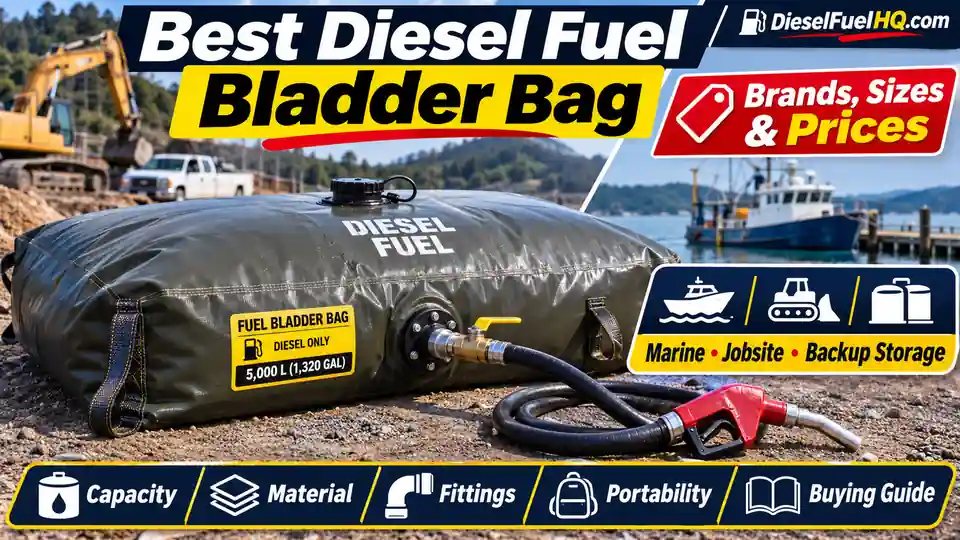
A diesel fuel bladder is a flexible container manufactured from fuel-compatible reinforced fabric. Larger models often resemble a flat pillow that rises as fuel enters. Smaller products may look like compact bags or low-profile deck tanks. Some specialized designs have multiple layers, internal baffles, protective harnesses, or engineered tie-down points.
The word bladder describes the shape and construction, not a universal safety approval. A product intended for stationary fuel storage isn’t automatically approved to travel full on a public road. A product built for a boat deck isn’t necessarily suitable for a pickup bed. I would ask the seller which operating environment is covered, which fuels are permitted, and what approvals or standards apply to the exact model.
Best Diesel Fuel Bladder Bags: Quick Brand Comparison
| Brand / product family | My best-fit use | Examples of published capacity | Technical feature to compare | Price visibility |
|---|---|---|---|---|
| Ready Containment fuel bladders | Price-conscious U.S. buyers needing temporary fuel storage | 25 to 25,000 US gal in its catalog | 250-gal model: 2-in fill/vent standpipe, 3/4-in discharge valve | Published U.S. prices |
| ATL Petro-Flex / FueLocker | Marine range extension and space efficiency | Petro-Flex 25–500 US gal; FueLocker 50–500 US gal | Fuel-compatible reinforced fabric, fill standpipe, ball-valve outlet | Request model-specific price |
| Turtle-Pac Super Deck | Marine fuel reserves in varied deck layouts | 50–1,000 L standard Super Deck listings | Multiple shapes and deck-oriented configurations | Indicative Australian-dollar ranges |
| Husky fuel bladder tanks | Custom fittings and specialty industrial storage | Around 25–25,000 US gal | Custom valves, D-rings, ground tarp and berm options | Quote required |
| SEI Industries fuel bladders | Remote, arctic, desert and heavy-duty projects | 250–33,000 US gal for Desert King; specialized Double Drum | RF-welded fuel fabrics and application-specific systems | Quote required |
1. Ready Containment: My Starting Point for Transparent U.S. Pricing
| Ready Containment example | Listed base price | Price per stated gallon |
|---|---|---|
| 25-gallon portable fuel bladder | $787 | $31.48 |
| 50-gallon collapsible fuel tank | $904 | $18.08 |
| 100-gallon flexible fuel bladder | $1,075 | $10.75 |
| 150-gallon flexible fuel container | $1,232 | $8.21 |
| 250-gallon fuel bladder tank | $1,753 | $7.01 |
| 500-gallon fuel bladder | $3,069 | $6.14 |
Prices are manufacturer listings checked in November 2026, not delivered quotes. The per-gallon column is my calculation using nominal capacity; it excludes accessories, taxes, shipping and operating costs.
The 250-gallon model has especially useful published details: 64.5 × 90 × 15 inches, an approximate 60-pound empty weight, a 2-inch fill/vent standpipe, and a 3/4-inch discharge ball valve. Those are the kinds of specifics I want before comparing a bladder against a rigid tank.
I would choose this brand when I want a known base price, a straightforward fuel-storage application, and a manufacturer I can contact for compatibility questions. I would still verify the exact product’s instructions, placement limits and storage duration; Ready’s marine guidance recommends its bladders for short-term storage and discusses a 90-day limit. Treat that as model/application guidance rather than a universal diesel shelf-life rule.
2. ATL Petro-Flex and FueLocker: My Marine-Focused Choices
For an example with published specifications, the ATL Petro-Flex 150-US-gallon model lists 72 × 55 × 18 inches filled dimensions and a 1/2-inch ball-valve fuel outlet, with a larger optional outlet. The manufacturer lists both diesel and gasoline compatibility for this family. Its products use a filling standpipe and can be folded when emptied.
I like ATL as a shortlist candidate when the problem is extending a vessel’s range without permanently installing another rigid tank. I would not assume that the same marine product is approved for an open truck bed, a trailer, or indoor generator storage. Those are different installations with different hazards.
3. Turtle-Pac Super Deck: A Flexible Marine Configuration Choice
This is the option I’d investigate when the vessel’s deck layout dictates the buying decision. A low, wide bag may be convenient in one location and obstruct drainage, access, visibility or safe movement in another. The most important dimension isn’t simply nominal gallons; it’s the bag’s actual filled footprint and the manufacturer’s required securing method.
Turtle-Pac publishes indicative prices in Australian dollars—for example, the Super Deck 50 at roughly A$370–A$500, the 500 at A$1,200–A$1,600, and the 1,000 at A$2,000–A$2,600, with the site explaining that location, currency and shipping affect price. I wouldn’t copy those figures into a U.S.-dollar budget without a current delivered quote.
4. Husky Portable Containment: Best for Custom Requirements
Its published specifications include a commonly offered 2-inch inlet, 3/4-inch outlet, custom flanges, reinforced attachment areas and optional ground tarps and secondary-containment berms. The company offers tailored dimensions rather than forcing every project into one standard footprint.


I would ask Husky for a quote if the worksite has a constrained footprint, a specific hose or pump standard, or a need to purchase the bladder and matching containment from one supplier. I’d require written confirmation that the ordered liner material is compatible with the actual diesel blend, including any biodiesel percentage.
A vital instruction from Husky’s bladder guidance is that these units are not pressure vessels and must not be treated like one. It also warns against unattended hard-piped pump filling and emphasizes keeping fuel vents functional. Those aren’t minor details: they’re reasons to buy a purpose-built system and follow its manual.
5. SEI Industries: Best to Investigate for Remote and Demanding Sites
SEI manufactures several specialized collapsible fuel-storage systems. I would look at its Desert King for hot, dry remote sites, Arctic King for severe cold, and Double Drum where a rugged, specialized portable configuration is required.
The Desert King is available in a broad range, approximately 250 to 33,000 U.S. gallons, and SEI describes radio-frequency-welded construction and options such as shading, secondary containment, filtration and transfer equipment. Its product guidance also specifies fuel composition limits, including aromatic-content limits, so you need to verify the exact diesel being stored.
Arctic King materials are designed for low temperatures, with the company describing a fabric cold-crack temperature below −50°F and compliance claims tied to a particular collapsible fabric storage standard. That makes it a relevant manufacturer to contact when storage temperatures are extreme; it does not mean diesel itself will necessarily flow through a filter at −50°F.
Diesel Fuel Bladder Technical Details That Actually Matter
Before comparing price tags, I would request a written specification sheet and installation instructions for the exact product number.
| Specification | What I check | Why it matters |
|---|---|---|
| Fuel compatibility | ULSD, biodiesel blend and any additives specifically permitted | Prevents material damage or invalid use |
| Nominal capacity | US gallons vs imperial gallons vs liters | Prevents sizing errors |
| Filled dimensions | Length, width and height at target volume | Determines usable footprint and clearance |
| Empty mass | Bag, valves, harness and accessories | Adds to handling and transport load |
| Inlet and vent | Size, cap type, venting method | Protects filling operation and bladder |
| Outlet | Ball valve size, thread or camlock type | Determines safe pump and hose connections |
| Construction | Fabric, coatings, seams and reinforcement | Influences wear and chemical resistance |
| Ambient temperature limits | Rated hot/cold conditions | Helps prevent brittle or softened materials |
| Intended use | Marine, stationary ground, aircraft or specifically authorized transport | Stops dangerous category mistakes |
| Inspection and repair | Approved leak tests, service life and repair kits | Supports maintenance and replacement decisions |
Diesel Fuel Bladder Bag vs. Rigid Transfer Tank
| Buying factor | Fuel-rated bladder | Rigid diesel transfer tank |
|---|---|---|
| Space when empty | Can collapse or fold after approved preparation | Keeps full physical footprint |
| Capacity options | Small marine models to very large temporary storage | Wide range; common pickup sizes tens to hundreds of gallons |
| Surface requirements | Protective prepared surface usually essential | Approved mounts or foundation needed |
| Abrasion and puncture risk | Especially important at contact surfaces | Metal or rigid shell offers different protection |
| Filling and pumping | Must match fittings, venting and bag limits | Must match tank, pump and venting design |
| Highway transport | Only when exact configuration and operation comply | Only when exact tank and installation comply |
| Typical purpose | Temporary, marine or engineered remote storage | Vehicle refueling or more permanent storage |
My rule: I would buy a bladder only when its collapsibility solves a genuine problem. If you repeatedly need to fuel machines from a pickup, a purpose-built rigid transfer tank may be the more convenient option. Compare the choices using How Much Does a Diesel Transfer Tank Cost? and Cost of Operating a Diesel Transfer Tank vs. Fuel Delivery Services.
How Much Diesel Does a Fuel Bladder Really Weigh?
This is the number I’d calculate before picking a capacity, especially if any movement or load-bearing surface is involved. Diesel weighs roughly 7.1 pounds per U.S. gallon at ordinary reference conditions, although actual density changes with blend and temperature.
| Nominal diesel volume | Approximate fuel-only weight | Real-world implication |
|---|---|---|
| 25 US gal | 178 lb | Heavy even before bag and fittings |
| 50 US gal | 355 lb | Requires a suitable load-bearing surface |
| 100 US gal | 710 lb | Too heavy for casual manual repositioning |
| 150 US gal | 1,065 lb | Secure placement and load assessment matter |
| 250 US gal | 1,775 lb | Over three-quarters of a ton in fuel |
| 500 US gal | 3,550 lb | Engineered placement and handling essential |
| 1,000 US gal | 7,100 lb | Multi-ton industrial-scale load |
These are illustrative fuel weights only. Add the bag, hoses, pump, protective mat and all other hardware. Actual gross vehicle weight, axle loads, deck ratings or ground bearing capacity must be checked against the proposed installation.
Worked Example: Is a 250-Gallon Diesel Bladder Worth the Total Cost?
Let’s build a realistic planning example, not a claimed customer case study. Suppose you need a temporary, approved fuel-storage installation for a remote equipment site. You compare a 250-gallon Ready Containment bladder listed at $1,753 with other storage solutions.
The base bag is only part of the project. To illustrate the purchase decision, I’ll add a transfer pump, compatible hoses, protective materials, secondary-containment provisions and shipping. These are illustrative allowances, not current quotes for a complete certified installation.
| Item | Budget assumption |
|---|---|
| 250-gallon diesel-compatible bladder | $1,753 |
| Compatible pump and nozzle equipment | $599 |
| Engineered containment / protective setup allowance | $500 |
| Hose, valves and fittings allowance | $130 |
| Shipping / site-delivery allowance | $170 |
| Estimated total setup | $3,152 |
Suppose the facility uses 400 gallons monthly. Owning this setup produces an assumed $0.28 per gallon purchase-price advantage and avoids $40 in delivery charges each month. However, pickup/delivery coordination and labor add $60 monthly, while maintenance and testing cost an assumed $20 monthly.
- Fuel-price advantage: 400 × $0.28 = $112 per month.
- Avoided delivery fees: $40 per month.
- Gross savings: $112 + $40 = $152 per month.
- Additional monthly operating expense: $60 + $20 = $80.
- Net monthly savings: $152 − $80 = $72.
- Simple payback: $3,152 ÷ $72 = 43.8 months, or about 3.7 years.
The original insight I’d emphasize is this: the bladder’s compactness saves space, not necessarily money. I only count that advantage financially when it lets me eliminate a storage expense, a rental fee or an otherwise necessary transport operation. See the detailed analysis in Cost of Operating a Diesel Transfer Tank vs. Fuel Delivery Services.
My Decision Guide: Which Diesel Fuel Bladder Should You Buy?
| Your primary need | My starting shortlist | First question to ask the manufacturer |
|---|---|---|
| Small temporary diesel reserve with visible U.S. prices | Ready Containment 25–100 gal | Is this exact model approved for my installation and diesel blend? |
| Marine diesel reserve with a conventional pillow profile | ATL Petro-Flex | What are the deck securing and transfer requirements? |
| Marine reserve with a tight footprint | ATL FueLocker or Turtle-Pac configurations | What are filled dimensions and access clearances? |
| Custom industrial fittings or berm | Husky | Can you supply a compatible bladder-and-containment design? |
| Remote high-capacity desert storage | SEI Desert King | What site preparation, sun protection and fuel limits apply? |
| Very cold remote storage | SEI Arctic King | What are both fabric limits and the fuel’s cold-flow limits? |
| Repeated road-based fueling from a pickup | First compare approved rigid transfer tanks | Is any proposed bladder system expressly compliant for my specific road operation? |
Can You Transport Diesel in a Bladder Bag on a Public Road?
Do not assume you can. The manufacturer calling a product portable or transportable doesn’t automatically establish that a filled bladder is an acceptable hazardous-materials package or highway fuel tank for your vehicle and operation.
The U.S. Federal Motor Carrier Safety Administration has specifically stated that rubberized collapsible bladder bags attached to trailers are considered tank vehicles for the CDL tank-vehicle endorsement question. That guidance is not a blanket authorization to haul diesel in any bag. Other packaging, cargo-securement, hazardous-materials, licensing and state rules may apply.
Before purchasing for road use, I would request written documentation identifying the permitted use, applicable approval or specification, mounting requirements and who is responsible for compliance. If the seller cannot provide it, I would not treat the bag as a truck-bed substitute.
Setting Up a Diesel Bladder: What I Would Check Before Filling
I would follow the actual manufacturer manual rather than a generic internet installation checklist. For a proposed stationary site, these are the questions I would resolve with the responsible operator or installer first:
- Is the surface suitable? A cleared, level, load-bearing area and manufacturer-approved protective underliner help prevent punctures and abrasion.
- Is secondary containment addressed? Confirm the site’s spill-control and environmental requirements before delivery.
- Is the vent system correct? Flexible bladders are not pressure vessels; do not improvise or cap required vents.
- Are valves and hoses compatible? Verify fitting sizes, pump arrangement, fuel type and manufacturer instructions.
- Is the filling supervised? Establish an authorized, attended filling procedure with spill response equipment ready.
- Can personnel inspect it? Keep access for visual checks, outlet protection and emergency response.
- Who authorizes return to service after damage? Have a documented stop-use and inspection plan.
Maintenance, UV Exposure, Cold Weather and Fuel Quality
Diesel fuel bladder care should cover both the fabric and the diesel. I would inspect the bag exterior, seams, valve connections, protective mat and containment area at the frequencies required by the manufacturer and facility plan. I would also monitor fuel condition and water contamination, particularly when fuel is stored for extended periods.
| Risk | Warning sign or condition | My preferred response |
|---|---|---|
| Abrasion | Scuffing beneath a filled bag | Stop use as necessary; assess surface and fabric |
| UV and heat | Long outdoor exposure beyond product limits | Use manufacturer-approved sun cover or shade |
| Cold temperatures | Stiff fabric or fuel-flow problems | Verify both bladder rating and seasonal diesel specification |
| Water contamination | Suspected free water or dirty fuel | Use approved sampling and qualified fuel management |
| Valve seepage | Wet fittings or unexplained fuel loss | Stop transfer and arrange qualified inspection |
| Aging seams | Peeling, bulging or visible damage | Remove from service until cleared by manufacturer |
I wouldn’t promise that diesel will remain usable for a fixed number of months in every bladder. Storage life depends on fuel formulation, age, temperature and handling. Review Temperature Effects on Diesel Storage and Tank Durability for the more detailed explanation.
If a bladder leaks, isolate the area and follow the incident plan before inspecting it. What to Do if Diesel Leaks from Your Transfer Tank covers response priorities that also apply to many diesel releases.
Common Buying Mistakes I Would Avoid
My biggest concern is sellers who treat all flexible liquid bags as interchangeable. A water bladder is not a diesel bladder unless its exact liner and construction are approved for diesel. I would also avoid choosing a model solely from a product photo, trusting an unverified “DOT approved” marketing claim, or comparing a $1,075 bag with a $1,075 complete dispensing system as if both included the same hardware.
Frequently Asked Questions
How much does a diesel fuel bladder bag cost?
Published U.S. examples from Ready Containment run from about $787 for 25 gallons to $1,753 for 250 gallons and $3,069 for 500 gallons, before pumps, delivery and installation allowances. Custom industrial and specialized marine products may need a manufacturer quote.
Are diesel fuel bladder bags reusable?
Many are designed for repeated use if maintained according to their specifications. I would inspect the seams, fittings and fabric each time and follow the manufacturer instructions for cleaning, drying, folding and storage. Never assume a damaged bag is reusable simply because it holds liquid during a short test.
Can a diesel bladder bag be used in a truck bed?
Only if the exact product and overall installation are authorized and compliant for the intended road use. A marine deck bladder or stationary pillow tank should not be assumed appropriate for pickup transport. Check manufacturer documentation and applicable DOT, state and local requirements.
Is a diesel bladder better than a rigid tank?
It can be better for space-saving temporary or marine applications. A rigid transfer tank may be better when regularly dispensing diesel from a purpose-equipped work truck. I would compare both on safety, legal suitability, total installed price and recurring labor.
Does a diesel fuel bladder need a vent?
Follow the bladder manufacturer’s approved fill and vent design. Do not block, remove or improvise venting. Some flexible bags require a specific standpipe, pressure-relief or overflow arrangement even though the body collapses as it empties.
Can I use a cheap water bladder for diesel?
No, not without explicit written compatibility and intended-use approval for that specific product. Diesel can damage unsuitable materials, coatings, valves or seams; water-tank pricing should not be used as diesel-tank pricing.
Final Verdict: The Best Diesel Fuel Bladder Is the One Approved for Your Job
If you want my shortlist, I would compare Ready Containment first for clear U.S. pricing, ATL and Turtle-Pac for marine layouts, Husky for custom industrial specifications, and SEI for demanding remote storage. None of those names replaces checking the exact model or operating conditions.
Before buying, I would verify five things: the permitted diesel blend, full dimensions and weight, connection and vent design, site containment and transport legality, and complete installed cost. That five-question check is more valuable than an unsupported claim that any one bag is “the toughest.”
Your next decision is usually flexible bladder versus rigid tank. Read How Much Does a Diesel Transfer Tank Cost?, then Diesel Transfer Pump Options and Selection if you need help specifying a compatible transfer system.
Price and specification note: Manufacturer-published information was reviewed in November 2026. Check the product’s current datasheet, delivered quote and local requirements before purchasing. Illustrative cost and weight calculations are not engineering approval or transport authorization.