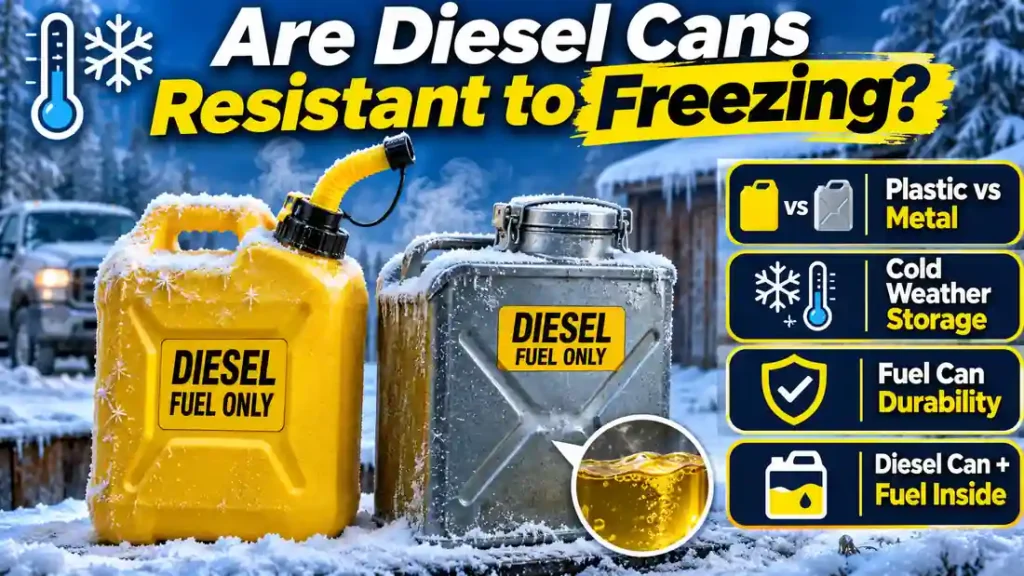
A common mistake is to ask, “Will my yellow diesel can freeze?” as if there were only one possible failure. In reality, the fuel can become difficult to pump long before the container has any visible damage. Conversely, the diesel might remain usable while an old spout gasket leaks or a brittle handle cracks when the can is dropped.
I’ll show you how I distinguish the risks, choose a container, and decide when cold-weather fuel should be replaced or professionally evaluated.
Does the Diesel Can Freeze, or Does the Diesel Fuel Freeze?
I start by separating the container from its contents. A diesel can doesn’t turn to ice merely because the thermometer falls below 32°F (0°C). Whether the can remains serviceable depends on its material, design, condition, seals, and manufacturer’s temperature ratings.
Diesel fuel behaves differently from water. Petroleum diesel is a blend of hydrocarbons, not a single substance with one universal freezing point. As some grades cool, wax crystals can begin to form. Later, those crystals may clog a strainer or filter, and in more severe cold the fuel may stop flowing adequately.
If water has entered the can, that water can freeze at around 32°F (0°C) and cause problems of its own, even if the diesel remains liquid.
| What is exposed to cold? | What can happen? | Why I care |
|---|---|---|
| Diesel fuel | Wax crystals, cloudy fuel, restricted flow | A pump or machine filter may plug |
| Water contamination | Ice crystals or blocked fittings | Fuel handling may fail even before diesel gels |
| Plastic can body | Reduced impact toughness in some plastics | A drop or strike may cause a crack |
| Metal can body | Corrosion or damage may remain hidden | Rust, seams, and dents still need inspection |
| Cap and gasket | Stiff seals or poor closure | Possible leakage when moved or warmed |
| Spout or pump hose | Stiffer components and reduced flow | Dispensing becomes harder and less controlled |
For the broader effects of temperature on fuel storage systems, see my article on temperature effects on diesel storage and tank durability.
Are Plastic Diesel Cans Resistant to Freezing?
Many modern diesel cans are made from fuel-rated polyethylene, often high-density polyethylene (HDPE). A quality product may be designed for outdoor use and ordinary winter conditions, but I would not claim that all HDPE diesel cans share one minimum service temperature.
There are different resin grades, wall thicknesses, manufacturing methods, and closure designs. A material’s ability to remain intact at rest is not the same as its ability to survive a drop onto frozen concrete. An aging can exposed to ultraviolet light, impacts, or aggressive handling may be less reliable than a new one.
I inspect the can for stress whitening, cracking around the handle, deformation near the neck, and damage where the spout attaches. If the can looks suspect, I stop using it; I don’t try to prove it is safe by dropping it or pressure-testing it.
If you already own plastic containers, read Are Diesel Cans Designed to Be Stackable for Storage? before placing one on another in a winter shed. A can that is technically stackable may still require limits on weight and configuration.
What makes a plastic can more winter-friendly?
- A documented diesel-fuel approval and a manufacturer-stated temperature range suitable for your climate.
- A spout and gasket designed for that exact can, not a convenient universal replacement.
- A robust handle and protected corners that aren’t already weakened or cracked.
- Storage where the can cannot be struck by equipment, snow-removal tools, or falling objects.
- An inspection routine that catches damage before you carry a full can.
I never interpret the yellow color as proof of a cold-weather rating. Color helps with fuel identification; it doesn’t certify the plastic against low-temperature impact.
Are Metal Diesel Cans Better in Freezing Weather?
Steel safety cans and properly constructed metal jerry cans can be durable choices for demanding work, but metal doesn’t solve every winter problem. Coatings can be scratched, condensation can contribute to corrosion, and caps and gaskets still rely on components that may change behavior in the cold.
I prefer to compare the complete container system, not plastic versus steel in isolation. A steel body with a damaged gasket is no bargain, and a plastic can with intact manufacturer-approved parts may be perfectly appropriate within its rated conditions.


| Feature | Fuel-rated plastic diesel can | Approved metal diesel can |
|---|---|---|
| Typical advantage | Lighter and resists red-rust corrosion | Robust body when properly maintained |
| Cold-weather concern | Impact toughness varies by resin and condition | Seals, corrosion, dented seams, and pressure changes |
| Weight when empty | Often lower | Often higher |
| Closure inspection | Look for thread, spout, and plastic-neck damage | Look for gasket, latch, seam, and cap damage |
| Best selection criterion | Model-specific rating and intended use | Model-specific rating and intended use |
| My conclusion | Suitable when approved and undamaged | Suitable when approved and undamaged |
The distinction becomes especially important at jobsites, where workplace requirements may call for a particular type of safety can. I follow the rules applicable to the job rather than assume any household container is acceptable.
At What Temperature Does Diesel Start to Gel?
There is no single reliable gelling temperature for all diesel fuel. The actual behavior depends on the blend, grade, biodiesel content, additive treatment, and fuel supplier’s winter specifications.
Ordinary No. 2 diesel contains paraffin waxes. During cooling, microscopic crystals may become visible as cloudiness. That doesn’t necessarily mean the entire can is frozen solid. However, those crystals can still plug a fine filter when fuel is poured or pumped into equipment.
I use three different terms when discussing cold-flow performance:
| Fuel property | What it measures | Why it’s useful |
|---|---|---|
| Cloud point (ASTM D2500) | Temperature where wax crystals first become visible | Early warning of cold-flow risk |
| Cold filter plugging point, CFPP (ASTM D6371) | Test temperature at which fuel no longer passes a specified filter under test conditions | Helps assess filter-plugging risk |
| Pour point (ASTM D97) | Lowest test temperature at which fuel still moves under the specified test method | Indicates severe loss of flow, not engine readiness |
Some untreated No. 2 diesel begins showing wax near freezing, but winterized supplies can perform much better and other blends can behave differently. I wouldn’t publish a universal statement like “diesel freezes at 15°F” because it can mislead a reader whose actual fuel has a different cloud point.
A cloud point above the forecast low is a reason to investigate the fuel’s suitability. The CFPP provides additional information, but neither number alone guarantees every engine or pump will work in the same weather.
What About No. 1 Diesel, No. 2 Diesel, and Biodiesel?
When the forecast turns colder, the blend matters more than the color of the container.
No. 2 diesel is widely used and can have more pronounced waxing concerns in cold weather. No. 1 diesel generally has better low-temperature flow characteristics and is often blended into winter fuel by suppliers. Biodiesel blends have properties that depend on feedstock, blend level, and treatment; some have greater cold-flow sensitivity.
| Fuel type | General winter consideration | My next question |
|---|---|---|
| Untreated No. 2 diesel | May develop wax crystals and filter issues | What is the actual cloud point? |
| Winterized No. 2 blend | May have improved low-temperature operability | What minimum temperature is it supplied for? |
| No. 1 / No. 2 winter blend | Typically improves cold-flow behavior | Is the blend appropriate for the engine? |
| Biodiesel blend such as B5 or B20 | Cold flow varies with blend and feedstock | What are supplier’s cold-flow specifications? |
| Renewable diesel | Properties vary by production and grade | What are its verified winter ratings? |
I recommend asking the supplier for the fuel’s actual low-temperature specification, especially if diesel was purchased in a warmer region and then moved north. A can filled in early fall may contain a very different formulation from fuel sold locally in January.
Worked Example: Will My 5-Gallon Diesel Can Be Ready for a 10°F Night?
Suppose I have a five-gallon diesel can in a shed and the forecast overnight low is 10°F (-12°C). I have two possible fuel supplies, and my supplier gives their cloud points.
- Fuel A: Cloud point of 25°F (-4°C).
- Fuel B: Cloud point of 5°F (-15°C).
My simple cold-readiness margin is the forecast low minus the fuel’s cloud point. It is a planning comparison I use to spot problems, not a certified safe-operating limit.
Fuel A: 10°F − 25°F = −15°F margin. The forecast is colder than the cloud point, so I would not assume the fuel can be dispensed reliably without further guidance.
Fuel B: 10°F − 5°F = +5°F margin. The forecast is warmer than the cloud point, which is encouraging—but filters, water, actual fuel temperature, and supplier guidance still matter.
| Planning measure | Fuel A | Fuel B |
|---|---|---|
| Forecast overnight low | 10°F | 10°F |
| Supplier-reported cloud point | 25°F | 5°F |
| Cold-readiness margin | −15°F | +5°F |
| My initial decision | Seek suitable winter fuel / guidance | Continue checking suitability and container condition |
Notice what this example does not prove: it doesn’t tell me the can is rated for 10°F, and it doesn’t guarantee a diesel transfer pump can pull fuel through a fine filter. That is why I make the fuel check and the container check separately.
There’s also the weight factor. At roughly 7.1 pounds per gallon, five gallons of diesel weigh about 35.5 pounds, before adding the can. A cold, heavy can is easy to mishandle while wearing thick gloves. I would rather use an approved dispensing arrangement than lift awkwardly to a high generator fill neck.
If a pump is part of your winter fueling routine, my Diesel Transfer Pump Options and Selection guide explains how to compare manual and powered systems.
How I Store a Diesel Can During Winter
I aim for a cool, suitable, secure, well-ventilated fuel-storage location that follows local rules and the container maker’s instructions. I don’t move a fuel can into a living space simply to keep it warm. A detached storage area designed for fuel is preferable to a heater-filled utility room.
Here’s my routine:
- Confirm the can is fuel-rated and in sound condition. A beverage jug or an unmarked household container is not acceptable fuel storage.
- Check the fuel supply before severe cold. Ask about winter blending, cloud point, and the engine manufacturer’s approved fuel.
- Keep the cap and spout correctly secured. Use the original approved closure. Never leave a cap loose as a supposed venting solution.
- Protect the can from water and impact. Keep snow, rain, ice, and road salt from collecting around closures or corroding metal.
- Respect the marked fill limits. Don’t fill to the brim; temperature changes also affect liquid volume and internal pressure.
- Avoid frequent unnecessary handling. A cold can that falls from a truck bed can fail regardless of how clear the diesel looks.
- Inspect again before dispensing. Look for a leak, deformation, damaged gasket, unusual cloudiness, or ice-related problems.
For a detailed approach to temperature swings and tank materials, continue to Temperature Effects on Diesel Storage and Tank Durability.
Should I Add Anti-Gel Treatment to Diesel in a Can?
Possibly, if the fuel and equipment manufacturer allow it and the product is compatible with the diesel you have. Cold-flow improvers generally work by changing how wax crystals grow or gather; they don’t make every kind of diesel behave identically, and they may not lower the fuel’s cloud point much.
I do not give a universal dosage because products and treatment ratios vary. Follow the exact label and any engine-manufacturer limitations. More treatment is not necessarily better.
Most important, I would not assume that pouring a routine preventive additive into already gelled fuel will immediately restore normal flow. Some products are intended for prevention and others address an emergency condition; their instructions differ.
Before adding anything, I would also check whether the fuel supplier has already winterized the diesel. Treating without knowing what’s in the tank can lead to unnecessary expense or compatibility concerns.
What If the Diesel in My Can Looks Cloudy or Won’t Pour?
I stop and examine the situation rather than forcing fuel into a valuable engine. Cloudiness may indicate wax crystals, but water or other contamination can also create problems.
I wouldn’t attempt to diagnose contaminated diesel from appearance alone or pour it through an engine’s fuel filter to see what happens.
If the can is leaking, cracked, distorted, or its closure is damaged, I isolate it safely and follow applicable spill and disposal procedures. If the can appears intact but the fuel is too thick to transfer, I consult the supplier or equipment manufacturer about a safe recovery or replacement plan.
Never use a torch, open flame, improvised immersion heater, or unapproved space heater to warm diesel fuel or a container. Avoid pressurizing the can with shop air to push thickened fuel through a hose.
| Symptom | Possible cause | My response |
|---|---|---|
| Cloudy diesel after a cold night | Wax formation or contamination | Stop; verify fuel suitability and history |
| Pouring becomes unusually slow | Wax, obstructed spout, or ice | Don’t force transfer; investigate safely |
| Cap or gasket leaks when handled | Damaged or incompatible closure | Remove can from use |
| Visible split near handle | Structural container damage | Replace approved container |
| Metal seam shows wet rust staining | Possible leak or corrosion | Isolate and obtain qualified assessment |
| Diesel dispenses but engine filter plugs | Wax or other contamination | Stop and follow engine/fuel-system instructions |
For the appropriate response when a larger fueling system develops a leak, see What to Do if Diesel Leaks from Your Transfer Tank.
Winter Storage Decision Guide: Keep, Move, Replace, or Refill?
My decision depends on both the can and the fuel. I use this two-part test because it prevents a false sense of security from a container that merely looks undamaged.
| Your situation | My preferred next step |
|---|---|
| Approved can, sound closure, fuel rated for forecast | Continue approved storage and regular inspection |
| Can maker gives no usable cold-weather rating | Check manufacturer documentation before relying on it |
| Cloud point is above expected overnight low | Obtain suitable winter-grade fuel or supplier guidance |
| Older plastic can has cracks or stress whitening | Replace the can; do not patch it |
| Metal can has leaking seams or damaged latch | Remove from service for appropriate assessment |
| Water or ice is suspected in the diesel | Do not feed equipment; arrange proper sampling/handling |
| Diesel has already gelled or stopped flowing | Stop transfer; follow a safe recovery or replacement process |
I would never accept a “freeze-proof” claim without knowing what is supposedly freeze-proof: the plastic body, the cap assembly, the fuel inside, or the performance of the dispensing system. Those are different engineering questions.
My Five-Minute Winter Diesel Can Inspection
I like simple procedures that someone will actually follow on a cold morning. This checklist is an operational habit, not a regulated test or proof that the fuel is within specification.
- Outside: Scan the bottom, corners, handle, and neck for cracks, wetness, or distortion.
- Closure: Check that the manufacturer-approved spout and cap are intact and correctly secured.
- Location: Make sure the can is upright, stable, and away from heaters and ignition sources.
- Fuel: Confirm what fuel is in the can, when it was purchased, and whether its winter properties are appropriate.
- Decision: If anything is questionable, stop using it and resolve the problem before refueling equipment.
For fleet or jobsite operations, my Diesel Tank Inspection Checklist for Fleet Managers offers a more detailed maintenance workflow.
Frequently Asked Questions
Will a diesel can crack if left outside at 20°F?
Not necessarily. Many purpose-built fuel cans can remain intact in freezing weather, but the minimum permitted storage and handling temperatures depend on the model. An aged or damaged plastic can may be more vulnerable to impact. I wouldn’t promise that every can will survive a drop or remain leak-free at 20°F.
Does diesel freeze at 32°F (0°C)?
There is no single freezing point for every diesel blend. Some untreated fuels can begin forming wax crystals near that temperature, while winter blends may remain usable much colder. Water contamination can form ice near 32°F even when diesel itself remains liquid.
Is a steel jerry can better than a plastic diesel can for snow?
Neither material wins universally. I prioritize an approved, undamaged can with a sound seal and a documented temperature rating. Metal may resist certain impacts but can corrode; plastic avoids red rust but may have cold-impact limitations.
Can I keep a diesel can in my heated garage?
I would not assume that’s safe. Indoor fuel storage depends on local fire rules, quantities, occupancy, ignition sources, ventilation, and the container’s approval. Never put a can beside a furnace, water heater, open flame, or unapproved heater just to prevent gelling.
Can I pour gelled diesel through a screen or filter?
I would not try to salvage gelled fuel for an engine by improvised filtration. Cold-flow problems may recur immediately and filters can plug. Verify the cause, and follow the fuel supplier’s and equipment manufacturer’s guidance.
Does anti-gel make a diesel can freeze-proof?
No. Fuel additives address particular fuel-flow behavior; they do not strengthen a cracked can, repair a gasket, or certify a container for extreme temperatures.
Final Verdict: Are Diesel Cans Resistant to Freezing?
A suitable diesel can can withstand freezing weather, but that does not make its fuel automatically winter-ready. The container needs a proper material and closure rating, while the fuel needs cold-flow properties appropriate for the forecast.
My advice is to check both before winter arrives. Buy seasonally appropriate diesel, protect the container from impact and water, inspect the seal before dispensing, and don’t rely on one generic “diesel freezing temperature.”
The question I would ask next is not just whether the can can sit outside overnight, but whether the diesel can still flow through my equipment’s filters the next morning. That is the decision that protects the engine and reduces unexpected downtime.
Next read: Temperature Effects on Diesel Storage and Tank Durability for storage conditions, or Diesel Transfer Pump Options and Selection for a practical dispensing setup.