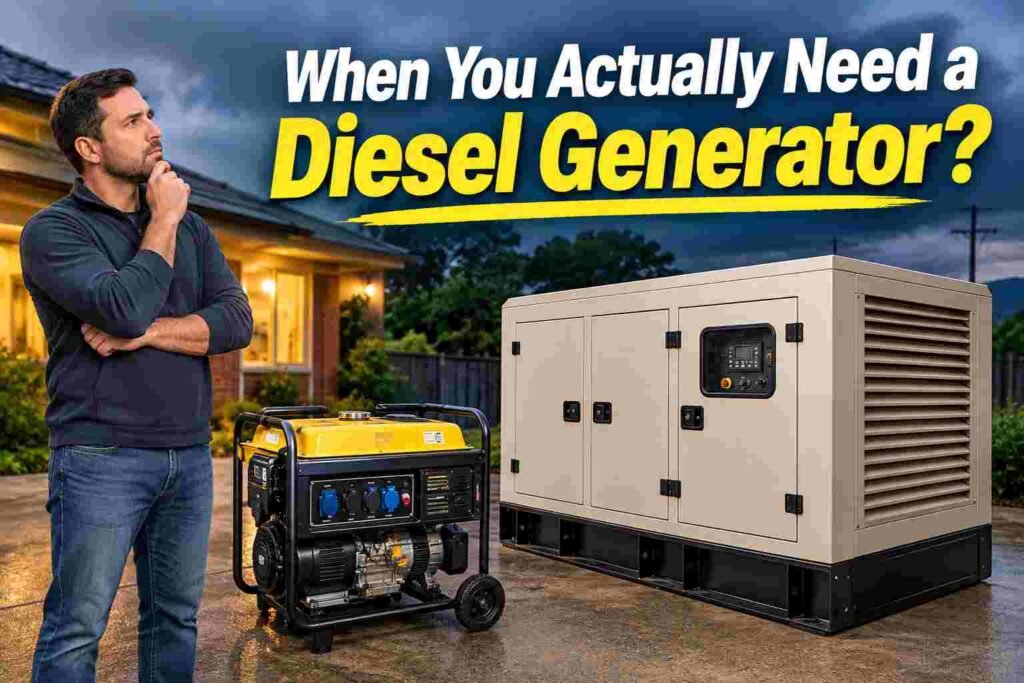
When people hear “emergency power,” they often picture the biggest generator they can afford. I do not think that is the right starting point. I start with the consequences of losing power. If the lights go out for two hours and you can live with it, your emergency-power plan may be simple. If a blackout can shut down refrigeration, stop a well pump, disable communications, interrupt medical equipment, flood a basement, halt production, or leave a remote property without heat or water, the situation is very different.
Diesel generators are strong emergency-power tools because they are built for high-load work, can run for long periods when properly sized and maintained, and are available across a very wide power range. But they also require fuel storage, maintenance, ventilation, exhaust management, and a proper electrical connection. In this guide, I’ll show you when I think diesel makes sense, when it does not, and how I decide what type and size of backup system you actually need.
When Do You Actually Need a Diesel Generator?
I consider a diesel generator justified when the outage risk is more expensive or dangerous than the cost and complexity of owning the generator. That is the core decision.



| Situation | Do I consider diesel? | Why |
|---|---|---|
| Short nuisance outage with only phones and internet affected | Usually no | A UPS, power station, or battery bank may be simpler |
| Home with refrigerator, well pump, sump pump, and HVAC that must stay available | Possibly | Depends on outage duration, load, and fuel options |
| Remote home or farm with frequent multi-day outages | Often yes | Long runtime and fuel storage can be valuable |
| Business losing revenue every hour utility power is down | Often yes | Downtime cost can justify permanent standby power |
| Cold storage, food service, pharmacy, or refrigerated inventory | Often yes | Temperature loss can become expensive quickly |
| Critical pumps, communications, security, or process controls | Often yes | The load may need continuous dependable power |
| Occasional camping or light tool use | Usually no | A smaller portable generator may be more practical |
The word “need” matters here. You may want a diesel generator because it feels more rugged, but that does not mean it is the best emergency-power solution for your load.
I Start With the Cost of Losing Power
For me, the first question is not “What generator should I buy?” It is “What happens if the power stays off?”
At home, that can mean spoiled food, a flooded basement, no well water, no heating controls, or no air conditioning during dangerous heat. In a business, it can mean lost production, ruined inventory, failed transactions, idle employees, or missed customer commitments. On a farm, it may affect ventilation, water pumps, refrigeration, milking systems, or animal welfare. At a remote site, power loss may stop communications, lighting, security, charging, or water treatment.
If the impact is minor, I would consider lower-cost backup first. If the impact is severe, a diesel generator moves much higher on my list.
How Long Does the Outage Need to Be Before Diesel Makes Sense?
There is no universal time threshold, but outage duration changes the economics. A battery system is excellent for seconds, minutes, and selected loads over several hours. A diesel generator becomes increasingly attractive when you need substantial power for an extended period and have a reliable fuel supply.
| Expected outage duration | Backup approach I would consider first | Where diesel fits |
|---|---|---|
| Seconds to 30 minutes | UPS or battery backup | Usually unnecessary unless the generator is part of an automatic critical system |
| 30 minutes to 4 hours | UPS, battery, portable generator, or standby system | Useful when loads are large or automatic backup is required |
| 4 to 12 hours | Generator becomes more valuable | Diesel can make sense for sustained essential loads |
| 12 to 24 hours | Fuel-based standby power is often practical | Strong use case if fuel storage and maintenance are in place |
| 1 to 3 days | Long-runtime generator strategy | Diesel becomes especially useful for high-load or remote applications |
| Several days or longer | Generator plus fuel-resupply plan | Diesel can be excellent, but fuel logistics become as important as generator size |
When Diesel Makes More Sense Than a Small Portable Generator
I move toward diesel when the load is too large, too important, or too long-running for a small portable gasoline generator to be comfortable.
A portable unit can be perfect for a refrigerator, lights, a few receptacles, and selected equipment. But once you are talking about large motors, pumps, HVAC, refrigeration racks, commercial equipment, multiple circuits, or long runtime, the system design becomes more serious.
That is where diesel often earns its place. Diesel engines are widely used in commercial and industrial generator sets because they are suited to sustained high-output operation when the generator is correctly rated for the duty.
If you are deciding between generator types, I also compare the tradeoffs in my guide to diesel vs. gasoline generators.
Emergency Power Loads I Treat as High Priority
Not every circuit needs backup. I separate loads into three groups: life and safety, property protection, and comfort/productivity. That keeps the generator from being oversized just because the building has a large electrical service.
| Priority | Examples | My approach |
|---|---|---|
| Critical / safety | Medical equipment, emergency lighting, alarms, communications, critical ventilation, selected security systems | Design for high reliability and fast transfer |
| Property protection | Sump pump, well pump, freeze protection, refrigeration, server/network equipment, drainage pumps | Keep available through the expected outage |
| Operational | Production equipment, point-of-sale systems, tools, office equipment, compressors | Back up if downtime cost justifies it |
| Comfort | General lighting, selected HVAC, kitchen loads, entertainment | Include after critical loads are covered |
For regulated facilities, emergency-power requirements can be much more specific. NFPA 110, for example, distinguishes emergency power systems based on the consequence of failure, including systems where failure could result in loss of life or serious injury. If your building falls under healthcare, life-safety, fire, elevator, or other code-driven requirements, I would have the system designed by qualified professionals rather than relying on a homeowner-style sizing rule.
When a Home Actually Needs a Diesel Generator
Most homes do not automatically need diesel. Many homeowners are better served by natural-gas or propane standby generators, battery systems, or portable units. I consider diesel for a home when one or more of the following are true:
- The property experiences frequent or extended outages.
- The home is remote and utility restoration can take a long time.
- You need to run a well pump, sump pump, large HVAC equipment, refrigeration, or other substantial loads.
- You already store diesel for tractors, equipment, or heating and can manage the fuel safely.
- You want a liquid-cooled standby generator in a larger capacity range.
- You need longer runtime and can maintain an on-site fuel supply.
A current Cummins sizing guide recommends listing the loads you need during an outage, adding their running watts, adding the single highest starting-watt requirement, and then multiplying the result by at least 1.25 as a rough sizing margin. I like that framework as a starting point, but I still check voltage, phase, motor-starting characteristics, and the generator manufacturer’s sizing data before making a final selection.
Example: Is a Diesel Generator Necessary for This House?
Suppose I have a rural house with a well pump, refrigerator, freezer, sump pump, furnace blower, lights, internet, and selected receptacles. I might build an essential-load estimate like this:
| Load | Illustrative running watts | Starting concern? |
|---|---|---|
| Refrigerator | 300–800 W | Yes |
| Freezer | 200–700 W | Yes |
| Well pump | 1,000–2,500 W | High motor-start surge |
| Sump pump | 800–1,500 W | High motor-start surge |
| Furnace blower | 400–1,000 W | Yes |
| Lights / internet / electronics | 500–1,500 W | Usually modest surge |
Those figures are examples, not appliance specifications. I would use the actual nameplates. The important point is that the home may not need a huge generator if the largest loads are managed. On the other hand, if the property also needs central air conditioning, electric water heating, an electric range, a large shop, and multiple pumps, the required capacity can climb quickly.
For a deeper sizing process, see my diesel generator sizing guide.


When a Business Needs Diesel Emergency Power
I find the diesel decision easier to justify for businesses because downtime has a measurable cost. If an outage stops revenue or damages inventory, I can compare that loss directly with the cost of a standby system.
For example, if a business loses $2,000 per hour when production stops and typical outages last four hours, a single event can represent $8,000 in lost output before I count cleanup, overtime, spoiled material, customer penalties, or restart delays.
| Downtime cost per hour | 4-hour outage | 12-hour outage | 24-hour outage |
|---|---|---|---|
| $500/hr | $2,000 | $6,000 | $12,000 |
| $1,000/hr | $4,000 | $12,000 | $24,000 |
| $2,000/hr | $8,000 | $24,000 | $48,000 |
| $5,000/hr | $20,000 | $60,000 | $120,000 |
Those are simple examples, but they show why commercial generator decisions are often financial risk decisions, not just equipment purchases.
Diesel Is Especially Useful for Refrigeration and Cold Storage
Refrigerated inventory changes the emergency-power calculation. A grocery store, restaurant, farm, pharmacy, warehouse, or food processor may not be able to wait for utility restoration without significant product loss.
Compressors also create starting loads, so I size refrigeration backup around both running kW and motor starting. In larger systems, I may stage compressors or use load management so the generator does not have to start every motor at once.
Pumps Are Another Major Reason I Choose Diesel
Pumps are common emergency loads because they often protect property or provide essential water. Well pumps, sewage lift pumps, sump pumps, irrigation pumps, process pumps, and drainage systems can all become critical during an outage.
The challenge is starting current. A pump motor may draw several times its normal running current for a short period during startup. That is why I do not size a generator from running watts alone.
If several pumps can start at the same time, I either increase generator capacity or use controls to sequence them.
When Medical or Health Needs Change the Decision
If someone depends on electrically powered medical equipment, I treat backup power as a preparedness issue rather than a convenience. CDC advises people to identify backup power sources for personal devices, appliances, and medical equipment before an emergency.
In that situation, I may use layers of backup: a UPS or battery for immediate uninterrupted power, plus a generator for longer outages. The exact design should match the medical equipment manufacturer’s requirements and the person’s care plan.
When You Do Not Need a Diesel Generator
I would not choose diesel just because it sounds more durable. There are many cases where it adds cost without adding much value.
If I only need to keep phones, internet, a laptop, and a few LED lights running, a battery system may be cleaner and easier. If I only need a refrigerator and a few circuits for occasional short outages, a portable generator may be enough. If natural gas service is extremely reliable at the property and the required standby capacity is moderate, a natural-gas generator may eliminate the need to manage stored diesel.
I also avoid buying a generator dramatically larger than the load. Oversizing increases purchase cost and can leave a diesel engine operating at very light load for long periods, which is not ideal for many diesel engines.
Portable Diesel vs. Standby Diesel for Emergency Power
| Feature | Portable diesel generator | Standby diesel generator |
|---|---|---|
| Startup | Usually manual | Can be automatic |
| Connection | Extension cords or approved transfer equipment | Permanent transfer switch |
| Typical use | Temporary, mobile, jobsite, selected loads | Home, business, facility, critical backup |
| Fuel tank | Smaller onboard tank | Often larger base or external tank |
| Runtime planning | Frequent refueling may be required | Can be designed around longer fuel autonomy |
| Weather / enclosure | Varies by model | Usually weather-protected installation |
| Best fit | Flexible backup where automatic power is not essential | Loads that must come back automatically |
I explain the differences in more detail in Portable vs. Standby Diesel Generators.
How Much Generator Capacity Do I Need for Emergency Power?
I size for the loads that must operate, not for the building’s utility service rating. A house with a 200-amp service does not automatically need a 48 kW generator, and a business with a 400-amp service may only need emergency power for a small subset of circuits.
My basic process is:
- List every emergency load that may run at the same time.
- Record running watts or kW.
- Identify motors, compressors, pumps, and other loads with starting surge.
- Add the single largest realistic starting event to the running load.
- Add reasonable headroom rather than planning to operate at the absolute limit.
- Check voltage, phase, power factor, duty rating, ambient temperature, and altitude.
For example, if my essential running load is 12 kW and the largest motor needs an additional 4 kW during startup, I have a 16 kW temporary requirement before headroom. Using a 1.25 planning multiplier gives 20 kW. That does not automatically mean a 20 kW generator is correct, but it tells me the range I should investigate.
| Example | Value |
|---|---|
| Essential running load | 12 kW |
| Largest additional starting requirement | 4 kW |
| Subtotal | 16 kW |
| Planning multiplier | 1.25 |
| Initial capacity target | 20 kW |
Fuel Storage Is Part of the Emergency-Power System
A diesel generator is only useful as long as it has clean fuel. I treat the tank as part of the generator, not as an afterthought.
I estimate runtime using the generator manufacturer’s fuel-consumption data at the expected load. If a generator consumes 1.5 gallons per hour at the load I expect and I want 24 hours of runtime, the simple fuel requirement is 36 gallons before I account for unusable tank volume, reserve, testing, and uncertainty.
| Fuel burn | 12 hours | 24 hours | 48 hours | 72 hours |
|---|---|---|---|---|
| 1.0 gal/hr | 12 gal | 24 gal | 48 gal | 72 gal |
| 1.5 gal/hr | 18 gal | 36 gal | 72 gal | 108 gal |
| 2.0 gal/hr | 24 gal | 48 gal | 96 gal | 144 gal |
| 3.0 gal/hr | 36 gal | 72 gal | 144 gal | 216 gal |
Those figures are simple arithmetic examples. Actual fuel consumption changes with engine design, generator efficiency, and load percentage. I always use the data sheet for the actual model.
Stored diesel also needs inspection because water, sediment, oxidation, and microbial contamination can cause emergency failures. My article on water in diesel fuel covers the warning signs.
Maintenance Determines Whether Emergency Power Is Really Emergency Power
A standby generator that does not start is just an expensive box. That is why I consider maintenance part of the emergency-power design.
I check batteries, fuel quality, oil, coolant, filters, belts, hoses, ventilation, alarms, and exercise performance. I keep records and test the transfer process rather than assuming the generator is ready because it started six months ago.
I have a complete guide to diesel generator maintenance and a separate explanation of diesel generator service intervals.
How Long Should an Emergency Diesel Generator Be Able to Run?
I design runtime around the outage scenario and refueling plan. A home may only need enough stored fuel to bridge the first day until fuel stations and roads reopen. A remote site may need several days. A critical facility may have code, insurance, or operational requirements that define the required duration.
The generator’s own duty rating also matters. Standby, prime, and continuous ratings are not interchangeable. If you expect the unit to operate for very long periods or serve as the primary power source, I would verify the rating with the manufacturer.
For a deeper explanation, see How Long Can a Diesel Generator Run Continuously?.
Emergency Generator Safety I Never Skip
Portable generators create serious carbon-monoxide risk if they are operated too close to occupied buildings. CDC guidance says to operate a generator outdoors at least 20 feet from doors, windows, and vents. CDC also recommends battery-powered or battery-backup carbon-monoxide detectors in the home.
I never run a portable generator in a house, garage, basement, shed, or enclosed porch. I also do not backfeed a building through a receptacle. For building connection, I use properly installed transfer equipment so the generator cannot energize utility lines and so the electrical system is protected correctly.
Standby installations have their own placement, exhaust, fuel, electrical, and permitting requirements. I use qualified installers and follow the generator manufacturer, electrical code, fuel code, and local authority requirements.
My Emergency-Power Decision Checklist
| Question | If the answer is yes… |
|---|---|
| Can an outage threaten health or safety? | I plan redundant, reliable backup rather than a casual portable setup |
| Can an outage damage the building or equipment? | I identify pumps, heat, ventilation, controls, and refrigeration as priority loads |
| Can downtime cost hundreds or thousands of dollars per hour? | I compare generator cost with expected outage losses |
| Do outages regularly last more than several hours? | I plan fuel autonomy and refueling logistics |
| Do I need automatic power restoration? | I look at a standby generator with transfer switch |
| Are my loads large, motor-heavy, or three-phase? | I consider commercial diesel equipment and professional sizing |
| Can a battery or small portable generator cover everything important? | I may not need diesel at all |
Frequently Asked Questions
Do I need a diesel generator for a normal power outage?
Not necessarily. If the outage is short and your essential loads are small, a UPS, battery system, or portable generator may be enough. I choose diesel when the load, runtime, reliability requirement, or financial risk is high enough to justify it.
Is diesel better for long power outages?
Diesel can be very effective for long outages because large fuel tanks can be installed and diesel generator sets are available for demanding duty. The advantage only works if you have clean stored fuel and a realistic refueling plan.
What size diesel generator do I need for emergency power?
I total the simultaneous running loads, identify the largest starting surge, add reasonable margin, and then verify voltage, phase, power factor, environmental derating, and duty rating. I do not size only from square footage or service-entrance amperage.
Is a 20 kW diesel generator enough for a house?
It can be. A 20 kW generator can cover many homes if large loads are controlled, but an all-electric home with multiple HVAC systems, electric heating, water heating, cooking, and pool equipment may need more. I recently covered this in my 20 kW diesel generator guide.
How much diesel should I store for emergencies?
I calculate it from the generator’s fuel-consumption specification at the expected load and the number of hours of autonomy I want. Then I include reserve and account for usable tank volume, testing, and refueling delays.
Can I use a diesel generator indoors if I vent the exhaust?
No. I would never operate a portable combustion generator inside an occupied building or garage. Carbon monoxide can accumulate quickly. Follow the generator manufacturer’s placement requirements and current safety guidance.
My Bottom Line
I think the best emergency generator is not the biggest generator—it is the system that matches the consequence of losing power. If all you need is a few electronics for a short outage, diesel may be unnecessary. If you need automatic backup, large motor starting, refrigeration, pumps, medical support, business continuity, or multi-day operation, a diesel generator can become a very practical choice.
I make the decision by defining the critical loads first, estimating outage duration, sizing the starting and running demand, planning fuel storage, and deciding how quickly the power must return. Then I choose portable or standby equipment and build maintenance into the plan from day one.
That approach gives you something more useful than a generator sitting beside the building: it gives you an emergency-power system you can reasonably expect to work when the utility fails.
Sources and Technical References
I used current guidance while preparing this article, including CDC generator safety guidance, CDC emergency power preparedness guidance, Cummins generator sizing guidance, and NFPA emergency/standby power-system guidance for critical installations.