
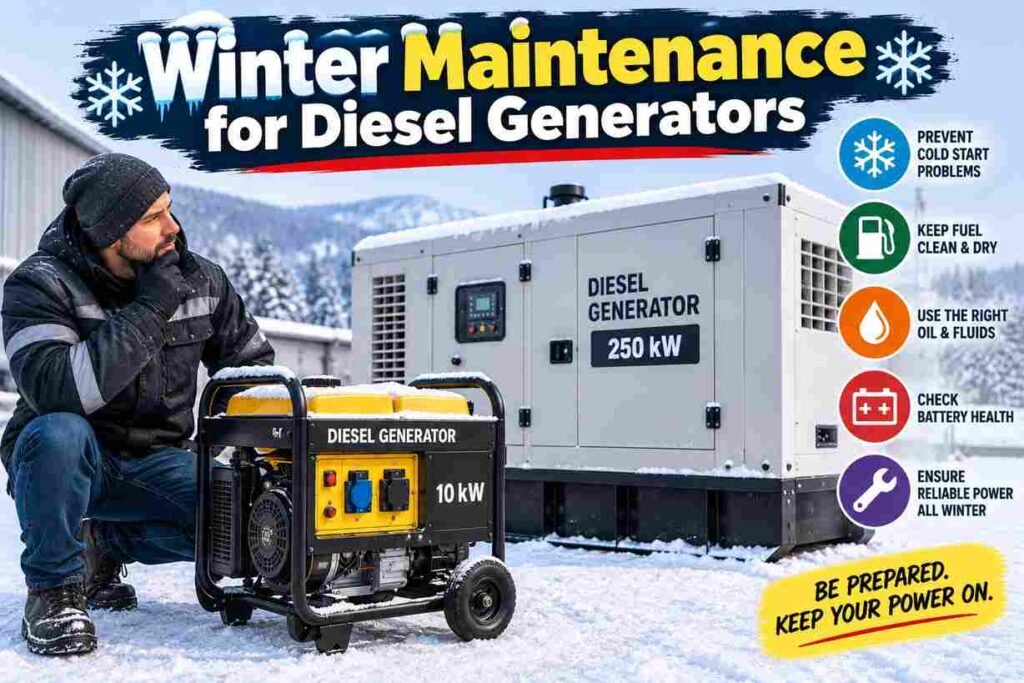
If you depend on a diesel generator for emergency power, winter is the season when small maintenance problems tend to become obvious. A battery that seemed acceptable in mild weather may crank too slowly. A small amount of water in the fuel system can freeze. A block heater that failed weeks ago may not be noticed until the utility goes down on the coldest night of the year.
In this guide, I’ll show you how I prepare a diesel generator for cold weather, what I check during winter, and which problems I treat as urgent. I’ll also point out where manufacturer instructions matter, because temperature limits, oil grades, coolant mixtures, heater packages, and starting procedures vary from one generator to another.
Winter Maintenance for Diesel Generators at a Glance
| System | What cold weather can do | What I check |
|---|---|---|
| Diesel fuel | Wax crystals can restrict filters and fuel flow | Winter-grade fuel, cloud/gel risk, tank condition, approved additive if required |
| Fuel/water separator | Water can freeze and block flow | Drain water, inspect bowl, replace restricted filter |
| Battery | Cold reduces available cranking power | Charge, terminals, cable condition, load test, heater if specified |
| Engine oil | Oil thickens and increases cranking resistance | Correct winter viscosity and specification |
| Coolant | Weak mixture can freeze; heater failure makes starting harder | Freeze protection, level, leaks, block heater operation |
| Air intake | Snow, ice, or debris can restrict airflow | Intake, louvers, air filter, enclosure openings |
| Exhaust | Snow or ice can obstruct discharge | Outlet clearance, leaks, safe routing |
| Belts and hoses | Rubber can become stiff and existing cracks may worsen | Cracks, glazing, tension, hardening, seepage |
| Controller / charger | Cold may expose weak batteries or failed shore power | Alarms, charger output, AUTO mode, heater power |
| Exercise system | Light or failed exercise can hide cold-start problems | Scheduled start, stable voltage/frequency, normal warm-up |
Why Cold Weather Is Hard on a Diesel Generator
A diesel engine does not use a spark plug to ignite the fuel. It depends on heat created by compressing air in the cylinder. When the engine, intake air, fuel, oil, and cylinder walls are very cold, it takes more effort to reach a temperature that supports reliable ignition.
At the same time, the starter motor has to turn an engine filled with thicker oil while the battery is producing less usable power. Generac notes in its cold-climate generator guidance that a fully charged lead-acid battery that has its full cranking capability around 80°F can have only about 40% of that available power at 0°F. I treat that as a reminder that a marginal battery in October can become a failed battery in January.
Fuel is another major issue. Caterpillar’s winter diesel guidance notes that diesel fuel can begin to gel in severe cold and recommends winter-blended fuel or an approved anti-gel product where required. The exact cloud point and cold-filter-plugging behavior vary with the fuel blend, so I do not rely on one universal temperature.
Cold-Weather Temperature Benchmarks I Pay Attention To
| Temperature | Why I pay attention | Important limitation |
|---|---|---|
| 40°F (4°C) | Cummins application guidance uses about 40°F as a minimum ambient target around some emergency generator installations | Installation-specific; not a universal engine requirement |
| 32°F (0°C) | Water freezes; Cummins guidance calls for battery heaters on certain installations below this point | Heater requirements depend on model and site design |
| About 10°F (-12°C) | Caterpillar notes fuel gelling can become a concern around this temperature | Actual diesel cold-flow properties vary by fuel formulation |
| 0°F (-18°C) | One current Generac mobile-generator manual treats this as a point where a stronger coolant blend may be recommended | Model-specific example, not a universal coolant rule |
| -13°F (-25°C) | Some Generac mobile sets call for additional cold-weather starting aids below this range | Exact package varies by generator |
1. Use Diesel Fuel That Matches Winter Conditions
If I expect freezing weather, I start with the fuel supplier. Winter diesel blends are designed to improve cold-flow performance compared with fuel intended for warm weather. In very cold regions, No. 1 diesel may be blended with No. 2 diesel, or the supplier may use other winter-treatment strategies.
I avoid guessing with additives. If an anti-gel additive is needed, I use one approved for the engine and fuel system and add it before the fuel has already gelled. Once wax crystals have plugged a filter, pouring additive into the tank may not instantly restore flow.
I also keep the tank reasonably full when practical. Caterpillar recommends filling equipment tanks at the end of the workday to help reduce condensation. For a standby generator, I apply the same logic while also respecting fuel-storage rules, tank capacity, turnover, and local fire requirements.
If you want to estimate how quickly your stored fuel may be consumed during an outage, see my guide on how much fuel a diesel generator uses.
2. Drain Water From the Fuel System Before It Freezes
Water is troublesome in diesel fuel at any time of year, but winter gives it another way to stop the generator: it can freeze in a separator, filter, or low point in the fuel system.
I inspect the fuel/water separator more often during winter and drain it according to the generator manufacturer’s procedure. Caterpillar’s cold-weather checklist specifically recommends draining the separator and fuel filter where applicable so water does not remain in the system overnight.
If I keep finding water, I do not treat the separator as the root problem. I inspect the storage tank, fill cap, venting, transfer system, and fuel source. Repeated water means the generator could fail even if I keep installing new filters.
For more troubleshooting detail, I cover this in Water in Diesel Fuel: Symptoms, Causes & What to Do.
3. Test the Starting Battery Before the First Freeze
The battery is one of the first components I check when winter approaches. I look for corrosion, loose terminals, damaged cables, swelling, leakage, and signs that the charger is not maintaining the battery correctly.
Voltage alone does not tell me everything. A weak battery can show a reasonable open-circuit voltage and still collapse when the starter demands high current. If the battery is old or the cranking speed is slowing, I would rather load-test it before winter than find out during an outage.
| Battery check | What I want to see | Why it matters in winter |
|---|---|---|
| State of charge | Fully charged according to battery specification | Cold already reduces available cranking output |
| Terminal condition | Clean, tight, corrosion-free | Extra resistance slows cranking |
| Charger | Correct output and no charger alarms | Standby battery must stay ready for weeks or months |
| Cables | No looseness, fraying, heat damage, or corrosion | High-current starting depends on low resistance |
| Load test | Passes battery/manufacturer test | Finds weak batteries before a cold no-start |
| Battery heater | Operational where specified | Can improve cold-weather starting on approved systems |
Some generator installations use thermostatically controlled battery heaters. Cummins application guidance calls for battery heaters on certain standby installations when the generator-room temperature can fall below 32°F (0°C). I do not add a heater unless it is appropriate for the battery and generator system.
4. Verify the Block Heater or Coolant Heater Actually Works
A block heater is one of the most important winter components on many standby diesel generators. Its job is not to make the enclosure comfortable. It keeps the engine coolant or block warm enough to improve starting and help the engine accept load quickly after startup.
Generac’s cold-climate guidance describes block heaters as a normal standby-generator accessory and notes that typical systems may need roughly one to two hours to bring an engine toward the desired starting temperature. In a standby installation, the heater is usually left connected to a normal power source and controlled automatically.
I do not assume a heater is working because it is plugged in. I check the circuit, thermostat, hose temperature where appropriate, alarms, breaker, and wiring. If the utility fails and the engine has been sitting at very low temperature with a dead heater, the generator is already at a disadvantage before it receives the start command.
5. Test Coolant Freeze Protection
I check both coolant level and freeze protection. Looking into the reservoir and seeing liquid is not enough. The mixture has to provide the protection required for the expected temperature and engine design.
Different manufacturers and generator models specify different coolant chemistries and concentrations. For example, some Generac mobile-generator documentation allows a standard 50/50 coolant mixture to a stated temperature and recommends a 60/40 blend for colder conditions on that particular machine. Caterpillar has separate guidance for its ELC systems. I do not copy those percentages to another engine without verifying the manual.
I use the correct test method—often a refractometer or manufacturer-approved coolant tester—and check coolant condition, pH or additive requirements where applicable, hose condition, clamps, radiator cap, expansion tank, and signs of leakage.
6. Use the Correct Engine Oil for the Expected Temperature
Cold oil creates drag. If the viscosity is too high for the ambient temperature, the starter has to work harder and oil may circulate more slowly during the first seconds after startup.
I use the viscosity grade and performance specification in the engine manual for the expected temperature range. I do not simply switch to the thinnest oil I can find. The correct oil must still meet the engine’s lubrication, emissions, and durability requirements.
Generac specifically notes in cold-weather manuals that the correct oil grade is critical to reaching adequate cranking speed and that synthetic oils can have improved low-temperature flow. That is useful guidance, but I still match the oil to the exact engine.
7. Check Fuel-Filter Heaters, Oil-Pan Heaters, and Other Cold-Weather Aids
Larger mobile and standby diesel generators may have several cold-weather aids rather than one block heater. Depending on the model, I may see fuel-filter heaters, oil-pan heaters, crankcase-ventilation heaters, battery warmers, glow plugs, intake-air heaters, and higher-CCA battery packages.
| Cold-weather aid | Purpose | What I verify |
|---|---|---|
| Block/coolant heater | Keeps engine warm for faster starting | Power, thermostat, heat output, leaks |
| Oil-pan heater | Reduces oil viscosity during cold start | Correct operation and wiring |
| Fuel-filter heater | Helps maintain fuel flow through filter | Thermostat, electrical supply, filter condition |
| Battery heater | Helps preserve battery performance | Correct fit and safe operation |
| Glow plugs/intake heater | Adds heat for combustion during starting | No controller faults; correct preheat operation |
| Battery charger | Maintains starting battery | Normal AC supply and charge output |
8. If the Generator Uses DEF, Prepare the DEF System Too
Newer diesel generator engines with SCR emissions systems may use diesel exhaust fluid. DEF contains a large percentage of water and freezes in cold conditions. That sounds alarming, but equipment-mounted DEF systems are commonly designed to tolerate freezing and thaw the fluid with built-in heaters.
Caterpillar specifically advises that engine-mounted DEF tanks are designed to freeze and thaw. I do not add antifreeze, fuel additive, or anything else to DEF. Contaminating DEF can damage the emissions system.
For bulk DEF stored separately, I follow the supplier’s storage-temperature guidance and keep it protected from contamination. I also make sure the generator has enough DEF for the expected emergency runtime.
9. Clear Snow and Ice From Intake, Radiator, and Exhaust Areas
Snow can create a problem even when the engine itself is perfectly winterized. A drift can block an air intake, radiator discharge, exhaust outlet, or enclosure louver. Ice can also form around louvers or doors.
Before a winter storm, I clear the area around the generator and make sure drainage is open. After heavy snow or freezing rain, I inspect it again before relying on the generator. I do not pile shoveled snow against the enclosure.
At the same time, I never enclose a portable generator in a makeshift box just to keep snow off it. It needs proper cooling and safe exhaust. Follow the model’s weather-protection instructions and never operate a portable combustion generator indoors or in an enclosed space.
10. Inspect Belts, Hoses, and Rubber Parts
Cold weather can make aged rubber noticeably stiffer. I inspect coolant hoses for hard spots, cracks, swelling, abrasion, and seepage. I inspect drive belts for cracking, glazing, fraying, missing ribs, and incorrect tension.
If a hose already looks questionable in mild weather, I do not expect winter to improve it. I replace marginal parts before cold season, especially on a generator that protects critical loads.
11. Exercise the Generator, but Follow the Correct Schedule
I want a standby generator to prove that it can start when it is cold. Scheduled exercise can reveal a weak battery, failed heater, fuel restriction, controller alarm, or charging problem before the next outage.
However, exercise schedules vary. Some standby generators run a short automatic cycle weekly, biweekly, or monthly. Larger commercial systems may be exercised under load for a specified duration. I use the manufacturer and facility requirements rather than inventing a universal schedule.
For general service planning, see my article on how often diesel generators should be serviced.
12. Do Not Let Winter Exercise Become Endless Low-Load Idling
I avoid running a diesel generator lightly loaded for long periods just because I want to “keep it warm.” Many diesel engines do not benefit from extended low-load operation, and some can develop carbon buildup or wet stacking if they never reach healthy operating temperature and load.
I follow the generator’s approved exercise routine. If a commercial set requires a loaded exercise or load-bank test, I schedule that rather than letting the engine idle for hours.
13. Use the Correct Cold-Start Procedure
When I start a cold diesel generator manually, I let the generator’s preheat system do its job. If the controller shows a preheat cycle, I do not bypass it by repeatedly hitting START.
I also avoid long, continuous cranking. Caterpillar’s winter checklist advises not cranking longer than 30 seconds at a time and allowing the starting components to cool afterward. Your generator may specify a different crank/rest sequence, so I use the manual.
If the engine still will not start, I stop and diagnose the cause rather than draining the battery. I check fuel flow, heater operation, battery voltage during crank, controller alarms, glow-plug or intake-heater function, and oil viscosity.
14. Do Not Use Ether Unless the Engine Is Specifically Designed for It
Starting fluid can be dangerous on diesel engines with glow plugs or intake heaters. Generac and Caterpillar both warn against uncontrolled use of ether or starting fluid on engines that are not designed for it.
If the generator has a factory-installed automatic starting-fluid system, I follow its instructions. Otherwise, I do not spray ether into the intake in an attempt to force a reluctant engine to start.
15. Give the Engine a Short Warm-Up Before Applying Heavy Load
Once the engine starts, I watch oil pressure, coolant temperature, voltage, frequency, smoke, and abnormal noise. I allow the engine a short manufacturer-approved warm-up before demanding a large load.
Caterpillar’s winter guidance recommends several minutes of warm-up so oil, coolant, and other systems can build some temperature before heavy work. With an automatic standby generator, the control system may handle the transfer timing for me, so I do not manually delay transfer unless the installation is designed for that.
16. Confirm the Generator Is Still in AUTO
This is simple but important. After maintenance, testing, fueling, or snow cleanup, I make sure a standby generator is returned to AUTO mode. A perfectly maintained generator left in OFF will not protect you during a utility failure.
I also check for controller warnings, low-fuel alarms, charger faults, heater faults, emergency-stop activation, and transfer-switch problems.
17. Plan Winter Fuel Runtime Before the Storm Arrives
Cold-weather outages can last much longer than a normal utility interruption, especially when roads are blocked and fuel delivery is delayed. I estimate fuel consumption from the actual generator data sheet and decide how many hours of autonomy I need.
| Example fuel burn | 12 hours | 24 hours | 48 hours | 72 hours |
|---|---|---|---|---|
| 1.0 gal/hr | 12 gal | 24 gal | 48 gal | 72 gal |
| 1.5 gal/hr | 18 gal | 36 gal | 72 gal | 108 gal |
| 2.0 gal/hr | 24 gal | 48 gal | 96 gal | 144 gal |
Those are arithmetic examples, not fuel-consumption specifications. Actual burn changes with generator size, load percentage, engine efficiency, temperature, and accessories. I use the manufacturer’s consumption table for the specific unit.
If you are preparing for prolonged outages, my guide to emergency diesel generator planning explains how I prioritize loads and fuel autonomy.
18. Winter Maintenance Schedule I Use as a Planning Guide
| Timing | Winter checks |
|---|---|
| Before winter begins | Battery test, coolant freeze protection, correct oil, winter fuel plan, heater inspection, belts, hoses, filters, service due items |
| Before a forecast severe storm | Fuel/DEF level, charger, AUTO mode, heater power, clear snow path, alarms, transfer system status |
| Weekly during severe cold | Leaks, battery/charger, heater operation, snow/ice clearance, fuel tank condition |
| During extended operation | Oil, coolant, fuel use, separator water, alarms, temperature, exhaust, ventilation |
| After the storm/outage | Refuel, inspect leaks, record hours, perform any hour-based maintenance now due |
This is my planning framework, but I still let the manufacturer’s service schedule control. If the generator crosses an oil, filter, coolant, or inspection interval during a long winter outage, I plan the service rather than waiting for spring.
Common Winter Diesel Generator Problems
| Symptom | Possible winter-related cause | What I check first |
|---|---|---|
| Slow cranking | Weak/cold battery, thick oil, poor cable connection | Battery test, charger, terminals, oil grade |
| Cranks but will not start | Gelled fuel, frozen water, failed preheat, low cranking speed | Fuel flow, separator, filter, heater system, battery |
| Starts then dies | Restricted fuel filter or fuel pickup | Fuel filter, gel/wax, water, tank supply |
| Low coolant-temperature alarm | Failed block heater or power supply | Heater circuit and coolant-heater operation |
| Black/white smoke at cold start | Poor combustion, low cylinder temperature, loading issue | Preheat system, fuel, compression, operating temperature |
| Overheating despite cold weather | Blocked radiator/discharge, low coolant, belt/fan problem | Snow/ice blockage, coolant, fan and belt |
If the generator begins showing repeated faults, I would not keep clearing alarms and hoping the next start works. My guide to common diesel generator problems goes deeper into troubleshooting.
Winter Storage vs. Winter Readiness
A generator that is being stored for the winter needs a different plan from a generator that must be ready to start automatically during winter. If I am putting a portable diesel generator away for months, I focus on fuel condition, corrosion prevention, battery storage/charging, oil, coolant, cleanliness, pest prevention, and proper ventilation of the storage location.
If I expect the generator to provide emergency power, I keep it in operational condition and verify its heaters, charger, fuel, transfer system, and exercise program. I do not “winterize” a standby unit in a way that makes it unavailable.
I cover long-term storage separately in Best Practices for Storing a Diesel Generator.
Winter Maintenance Checklist
| Check | Ready condition |
|---|---|
| Fuel | Correct winter blend/treatment for local temperature |
| Fuel/water separator | Water drained; filter not restricted |
| Battery | Fully charged, clean, tested, cables tight |
| Battery charger | Normal output and normal AC supply |
| Block heater | Operating and free of leaks |
| Coolant | Correct level, chemistry, and tested freeze protection |
| Oil | Correct viscosity/specification for expected temperature |
| Air intake/radiator | Clear of snow, ice, nests, and debris |
| Exhaust | Unobstructed and leak-free |
| Belts/hoses | No cracking, glazing, hardening, swelling, or leaks |
| Controller | No unresolved alarms; standby unit in AUTO |
| Exercise | Starts normally and reaches stable operating conditions |
Winter Maintenance for Diesel Generators: FAQs
Do diesel generators need block heaters in winter?
Many standby diesel generators do, especially in colder climates. The required heater size and activation temperature depend on the generator and site. I use the manufacturer’s cold-weather package recommendations rather than assuming every engine needs the same heater.
At what temperature does diesel fuel gel?
There is no single universal gelling temperature because diesel blends vary. Caterpillar notes gelling can become a concern around 10°F (-12°C), but the actual cloud point and cold-filter-plugging point depend on the fuel. I ask the fuel supplier for the winter specification.
Should I add anti-gel to generator fuel?
I use an anti-gel only when appropriate for the fuel, engine, and expected temperature. I prefer winter-grade fuel from a reliable supplier and follow manufacturer guidance. Additives work best as prevention, before the fuel has already waxed or plugged the filter.
How often should I run a diesel generator in winter?
I follow the generator’s programmed exercise schedule. Some systems exercise weekly, biweekly, or monthly, and commercial systems may have loaded-testing requirements. The goal is to verify readiness without unnecessary extended low-load operation.
Can DEF freeze in a diesel generator?
Yes. DEF can freeze, but engine-mounted DEF systems are generally designed to tolerate freezing and thaw the fluid with heaters. I do not add anything to DEF to lower its freezing point.
Can I cover a generator with a tarp during snow?
I would not cover or enclose a running generator in a way that blocks cooling or traps exhaust. I use the weather protection approved for the generator and keep the required intake, exhaust, and service clearances open.
Why does my diesel generator start in fall but not in winter?
The most common winter-related reasons I investigate are reduced battery cranking power, incorrect oil viscosity, fuel waxing or frozen water, failed block/preheat heaters, and poor electrical connections. Cold weather exposes weaknesses that may not appear at mild temperatures.
My Bottom Line
I do not wait for a blizzard to find out whether a diesel generator is ready for winter. Before freezing weather arrives, I verify the battery, fuel, fuel/water separator, oil, coolant, block heater, cold-start aids, belts, hoses, intake, exhaust, controller, and exercise system.
The exact winter package depends on the machine. One generator may only need good winter fuel and a healthy battery, while another may require coolant heaters, battery heaters, fuel-filter heaters, oil heaters, or a specific coolant concentration. I treat the owner’s manual as the final authority.
If you maintain those systems before temperatures fall, you give the generator a much better chance of doing what you bought it to do: start quickly, accept the required load, and keep running when winter weather takes the utility power down.
Sources and Technical References
I used current manufacturer guidance while preparing this article, including Caterpillar’s Winter Diesel Engine Checklist, Cat diesel engine winter maintenance guidance, Generac cold-climate generator guidance, current Generac mobile-generator manuals, and Cummins liquid-cooled generator application guidance.