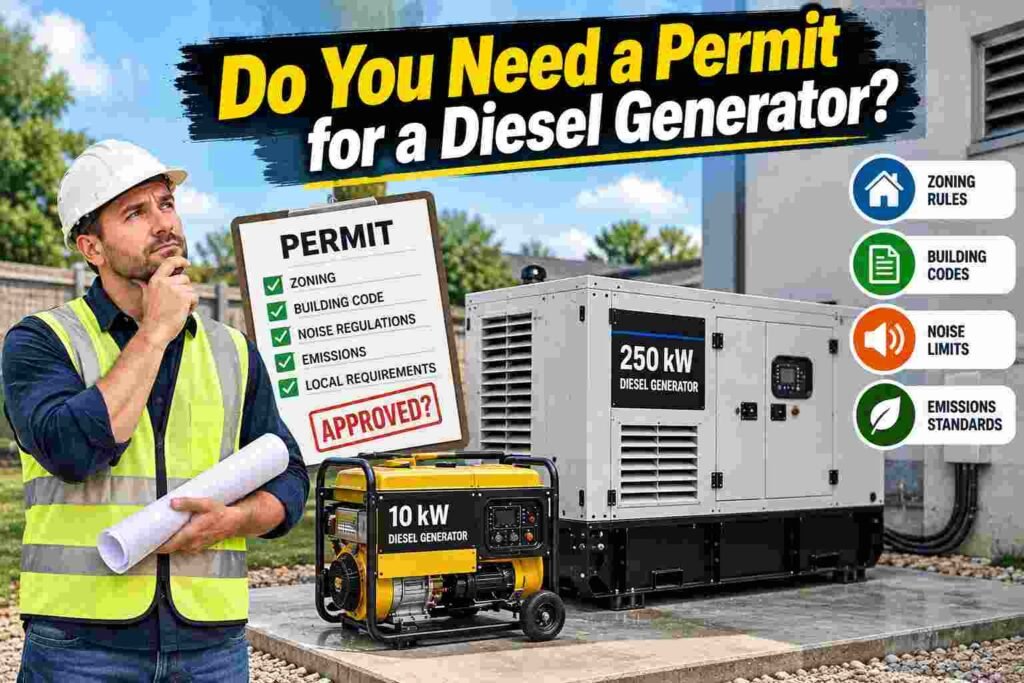
If you are asking, “Do you need a permit for a diesel generator?”, I would not buy the unit and pour a pad before checking. Generator permitting is highly local. Two homeowners with the same 20 kW diesel generator can face different requirements because one city may regulate setbacks, fuel tanks, noise, flood zones, and electrical work differently from another.
I look at the installation as several separate systems: the generator itself, the electrical connection, the fuel supply, the concrete or structural support, exhaust and ventilation, and the property location. Any one of those can trigger a permit or inspection.
Do I Need a Permit for a Diesel Generator?
For a permanently installed home standby diesel generator, I generally assume the answer is yes until the local building department tells me otherwise. A permanent generator is not just an appliance sitting outdoors. It becomes part of the electrical and fuel infrastructure of the property.


| Generator setup | Permit likelihood | What I would check |
|---|---|---|
| Portable generator powering appliances with extension cords | May not require a building permit in some jurisdictions | Local rules, safe outdoor placement, electrical safety |
| Portable generator connected to selected home circuits | Electrical permit commonly required | Transfer equipment, inlet, breaker/interlock rules, grounding and bonding |
| Permanent standby diesel generator | Usually requires permits | Electrical, building/zoning, structural pad, exhaust, clearances |
| Permanent diesel tank or sub-base fuel tank | May require fire/fuel-storage approval | Tank capacity, setbacks, containment, vents, fill location |
| Large commercial or industrial stationary diesel generator | Multiple permits may apply | Building, fire, electrical, mechanical, air-quality and environmental rules |
Miami-Dade County provides a useful real-world example. It says a portable generator used only to power a few appliances directly may not require a building permit, but connecting that generator to the building electrical system requires an electrical permit for the connection device. A permanently located generator requires a building permit and plan review. New York City is stricter: its Buildings Department states that permanent emergency, standby, and optional backup power system work cannot be performed without a permit and appropriately licensed contractors.
That is why I avoid saying “generators never need permits” or “every generator needs the same permit.” Both statements are too broad.
What Permits Might Be Required?
I break the permit question into categories because the word “generator permit” can hide several separate approvals.
| Permit or approval | What it typically covers | When I expect it to matter |
|---|---|---|
| Electrical permit | Transfer switch, inlet, breaker, conductors, grounding/bonding, service connection | Any hardwired connection to the home electrical system |
| Building permit | Permanent equipment installation, pad, anchoring, structural work | Fixed standby generators and some equipment pads |
| Zoning/site approval | Setbacks, location, visibility, lot coverage, neighborhood restrictions | Permanent outdoor installations |
| Fire/fuel permit | Diesel tank, vents, fill point, containment, separation distances | Permanent fuel storage |
| Mechanical permit | Exhaust, ventilation, louvers, penetrations, equipment rooms | Indoor or enclosed commercial installations; some local residential projects |
| Air-quality permit or registration | Emissions from stationary diesel engines | Larger stationary engines or locations with state/local air-district requirements |
| Floodplain approval | Elevation and flood protection | Properties in regulated flood hazard areas |
| HOA approval | Private community placement/noise/appearance rules | Homes governed by an association; not a government permit |
You may not need every item in that table. A typical residential generator might only involve building and electrical permits plus a fuel review, while a commercial installation can involve multiple agencies.
The Electrical Permit Is Usually the First One I Check
If you plan to connect the generator to house circuits, I check electrical requirements first. The transfer equipment has to prevent the utility source and generator source from energizing the same wiring in an unsafe way.
The plan reviewer may want the generator rating, voltage, transfer-switch rating, conductor sizes, overcurrent protection, grounding and bonding method, and a one-line diagram. Miami-Dade’s current generator guidance, for example, asks for the generator specifications, connected load, conduit and conductor sizes, overcurrent devices, switches, and a generator one-line diagram.
I also verify whether the local authority accepts a panel interlock for the particular setup or requires a dedicated transfer switch. That is a local code and equipment-listing question, not something I would guess.
What About a Portable Diesel Generator?
A portable generator is where the answer becomes more nuanced. If I place a portable diesel generator outdoors during an outage and power individual appliances directly with properly rated cords, some jurisdictions treat that differently from a permanent installation.
Miami-Dade, for example, specifically says a building permit is not required for a portable generator used to power a few appliances and lights directly. But the moment you connect the portable unit to the building’s electrical system, the county requires an electrical permit for the safe connection device.
Does a Diesel Fuel Tank Need a Separate Permit?
It can. Diesel storage is often regulated separately from the generator itself. I check the fire marshal or fire-prevention office when a project includes a permanent day tank, belly tank, sub-base tank, or separate above-ground storage tank.
Portland’s generator code guide provides a clear example: it says diesel tanks for generators require a separate permit from the Fire Marshal’s Office. Other cities may handle fuel storage through the building department, fire department, environmental office, or a combined permit process.
The review may consider the tank size, distance from buildings and property lines, fill and vent locations, spill containment, impact protection, and access for refueling. I do not choose a tank location based only on where the delivery truck can reach it.
Do Air-Quality Rules Apply to a Home Diesel Generator?
For a small residential standby generator, an individual homeowner may not face the same air-permitting process as a large commercial facility, but I still check state and local air-quality rules before assuming there is no requirement.
At the federal level, EPA regulates stationary compression-ignition engines under 40 CFR Part 60, Subpart IIII. EPA says a compression-ignition engine is subject to this NSPS when it was constructed after July 11, 2005 and manufactured after the applicable date, generally April 1, 2006 for most engines and July 1, 2006 for fire-pump engines.
| Federal stationary diesel rule item | Key date or requirement |
|---|---|
| Construction trigger referenced by EPA | After July 11, 2005 |
| Typical manufacturing applicability date | After April 1, 2006 |
| Fire-pump engine manufacturing applicability date | After July 1, 2006 |
| Rule | 40 CFR Part 60, Subpart IIII |
Federal emissions compliance is not the same thing as a local building permit. The practical point is that stationary diesel engines can fall under emissions rules, and state or regional air districts may add registration or permit requirements based on engine horsepower, use, emissions, and operating hours.
Diesel Generator Permit Requirements by State
The table below focuses primarily on state air-permitting and registration requirements for stationary diesel generators. It does not replace local review. Even when a generator is exempt from a state air permit, your city or county may still require electrical, building, fire, zoning, mechanical, floodplain, or fuel-storage permits.


| State | State air permit status | Important rule / practical interpretation |
|---|---|---|
| Alabama | Conditional | ADEM requires review of new or modified equipment capable of emitting air pollutants. Alabama does not provide a simple generator-size exemption applicable to every project, so applicability is determined case by case. (ADEM) |
| Alaska | Often exempt for smaller units | A facility with total stationary diesel capacity around 294 hp / 219 kW or less, and no other significant emitting activities, may fall below Alaska’s minor-source NOx permitting level. Larger installations should be evaluated for a permit or PAEL. (ADEC) |
| Arizona | Conditional | ADEQ has permitting mechanisms for generators, including general permits in qualifying situations. Larger or nonqualifying facilities can require an individual air permit. County air agencies may have jurisdiction in some areas. (ADEQ) |
| Arkansas | Emergency exemption possible | A qualifying emergency generator can be treated as an insignificant activity when specific emergency-use conditions are met. Residential backup generators are also treated as insignificant activities for state air purposes. Non-emergency/grid-support operation changes the analysis. (DEQ ePortal) |
| California | Often yes — local air district | California’s 35 air districts regulate stationary-source permits. CARB specifically tells owners of large emergency generators, particularly units over 50 bhp, to contact the local air district before purchase, rental, or use. Portable generators may qualify for CARB’s statewide PERP program instead. (CARB) |
| Colorado | Conditional | Generator projects must be screened under Colorado’s APEN/construction-permit system and Regulation No. 3. Major facilities have additional Title V requirements. There isn’t a simple statewide “all emergency generators are exempt” rule. (CDPHE) |
| Connecticut | Conditional / permit-by-rule available | An individual new-source permit generally becomes relevant around 15 tons/year for a regulated pollutant, but qualifying emergency engines can use Connecticut’s permit-by-rule provisions instead of a conventional individual permit. (Connecticut DEEP) |
| Delaware | Registration required | All stationary generators must be registered with Delaware’s Division of Air Quality. Non-emergency generators require a permit regardless of size; an emergency generator requires an air permit when rated over 450 kW. (DNREC) |
| Florida | Conditional / general permit route | Stationary RICE, including emergency generators, can qualify for Florida’s Air General Permit system. Other emitting equipment generally requires authorization unless specifically exempt. (FDEP) |
| Georgia | Often exempt for true emergency use | Georgia’s state air-permit exemptions include qualifying generators used exclusively for emergency purposes. Peak shaving or normal power generation should not automatically be treated as emergency operation. (Georgia EPD) |
| Hawaii | Conditional | Hawaii generally requires an Air Pollution Control Permit for stationary emission sources unless an exemption applies. Certain true standby/emergency generators can qualify as insignificant activities depending on their circumstances. (Hawaii Department of Health) |
| Idaho | Conditional — often PTC review | Idaho generally requires a Permit to Construct before constructing or modifying an installation that emits air pollutants unless an exemption applies. Generator size, emissions, and the overall facility determine applicability. (Idaho DEQ) |
| Illinois | Often exempt below 1,500 bhp | Illinois provides a state permit exemption for many stationary internal-combustion engines under 1,118 kW/1,500 bhp, although exceptions can apply—particularly to larger engines subject to specific NOx requirements. Federal engine standards remain applicable. (Illinois DCEO) |
| Indiana | Conditional based on emissions | IDEM evaluates generators as part of the facility’s potential-to-emit calculation. Relevant minor-source thresholds include 10 tpy NOx, 10 tpy SO₂, 10 tpy VOC, 5 tpy PM and 25 tpy CO. Multiple large emergency generators can therefore trigger permitting even when one small unit might not. (IDEM) |
| Iowa | Registration/permit depends on size | Iowa has a specific registration route for certain new engines below 400 hp. Larger engines and installations outside that registration provision need to be evaluated for construction-permit requirements. (Iowa DNR) |
| Kansas | Yes | Kansas’ Department of Health and Environment directly answers the question: emergency generators require permitting. The state provides an application process for these units. (KDHE) |
| Kentucky | Conditional | Stationary internal-combustion engines are included in Kentucky’s air-permit application system. Low-emission activities may qualify as insignificant, while larger generators/facilities can require permitting. (Kentucky Energy and Environment Cabinet) |
| Louisiana | Conditional | Louisiana generally requires an air permit for emission sources unless an exemption applies. Sources with PTE below roughly 5 tpy of an individual regulated pollutant and 15 tpy combined, while meeting toxic-air criteria, may qualify for an exemption. (Louisiana DEQ) |
| Maine | Conditional / registration or license | Maine DEP licenses air-emission sources and also has a Smaller Scale Electric Generating Resources registration program under Chapter 148. Generator size, use, and total facility emissions determine the appropriate route. (Maine DEP) |
| Maryland | Yes at 500 bhp and above | Maryland has a General Permit to Construct for qualifying emergency generators beginning at 500 bhp, extending to approximately 2,000 kW/2,681 bhp. A ≥500-bhp generator that does not qualify for the general permit generally needs a standard Permit to Construct. (Maryland Department of the Environment) |
| Massachusetts | Certification required at relatively small sizes | Emergency generators ≥37 kW generally require a MassDEP compliance certification within 60 days after installation. Non-emergency engines ≥50 kW have additional pre-installation requirements. For many emergency units, certification is used instead of traditional plan approval. (MassDEP) |
| Michigan | Conditional | Michigan’s Rule 201 generally requires a Permit to Install for an air-contaminant source unless a specific exemption applies. Some engines qualify for exemptions under Rules 278 and 285. (Michigan EGLE) |
| Minnesota | Conditional | MPCA evaluates the entire facility’s potential emissions and applicable federal engine standards when deciding whether an air permit is required. A small standalone standby generator may therefore have a different result than several generators at a large facility. (MPCA) |
| Mississippi | Conditional | Mississippi operates minor, synthetic-minor and Title V air-permitting programs through MDEQ. There is no simple generator horsepower cutoff applicable to every installation; applicability should be determined using MDEQ’s air-permit program. (MDEQ) |
| Missouri | Conditional | Construction permits are required for new or modified air-emission sources unless an insignificant-source exemption applies. Permit level—de minimis, minor, major or other authorization—depends on project and facility emissions. (Missouri DNR) |
| Montana | Conditional | A generator installation must be evaluated for a Montana Air Quality Permit (MAQP) based on emissions and facility applicability. There is no universal “diesel generator permit” threshold applicable to every installation. (Montana DEQ) |
| Nebraska | Conditional | A construction permit is required when the potential emissions of a new or modified source exceed Nebraska’s applicable permitting thresholds. (Nebraska DWEE) |
| Nevada | Conditional / jurisdiction dependent | Stationary and temporary sources capable of emitting regulated pollutants may require an air permit. Nevada also has separate air-quality jurisdictions, including Clark and Washoe counties, so location matters. (NDEP) |
| New Hampshire | Conditional | NHDES applies permitting thresholds under Env-A 600 and generator-specific NOx provisions under Env-A 1300. Emergency-generator operating limits can affect whether additional requirements apply. (NHDES) |
| New Jersey | Often permit/general permit | NJDEP requires permits for equipment that meets its definition of a significant source unless an exemption applies. New Jersey has specific general operating-permit provisions for emergency generators. (NJDEP) |
| New Mexico | True emergency units may be exempt | Under 20.2.72.202.B(3) NMAC, qualifying emergency generators can be exempt when used during the unavoidable loss of commercial utility power and operated less than 500 hours/year. Other operation can remove that exemption. (New Mexico Environment Department) |
| New York | Emergency exemption available | New York defines an emergency power generating engine as operating only when normal power is unavailable and for no more than 500 hours/year, including maintenance/testing. These true emergency engines have a permitting exemption; engines used for peak shaving or demand response are not exempt on that basis. (New York DEC) |
| North Carolina | Conditional / general permit available | NCDAQ has a general air permit specifically covering qualifying non-Title V emergency generators. Depending on size and emissions, other units may qualify for exemptions or need individual permitting. (NC DEQ) |
| North Dakota | Conditional | New stationary sources that meet North Dakota’s applicability provisions require a Permit to Construct unless an exemption applies. Generator emissions and overall facility status determine the result. (North Dakota DEQ) |
| Ohio | Small units can be exempt | Ohio provides an air-permit exemption for qualifying emergency electrical generators 50 hp or less. Larger limited-use units may qualify for a permit-by-rule; otherwise a conventional air permit may be needed. (Ohio EPA) |
| Oklahoma | Conditional | Oklahoma generally requires a construction permit before establishing or modifying a regulated stationary emission source unless an exemption applies. Minor/major source status affects the permit route. (Oklahoma DEQ) |
| Oregon | Conditional / emergency-engine permit mechanisms | Oregon DEQ has dedicated permitting provisions for stationary emergency engines, including general-permit attachments for certain installations. Aggregate horsepower and the facility’s existing ACDP status matter. (Oregon DEQ) |
| Pennsylvania | <100 bhp commonly exempt from plan approval | Pennsylvania’s exemption Category 4 provides a plan-approval exemption for internal-combustion engines rated below 100 bhp, although federal requirements and operating-permit conditions still apply. Larger engines may qualify under other emission-based exemptions or require DEP approval. (Pennsylvania DEP) |
| Rhode Island | Yes beginning around 50 hp | Rhode Island generally requires a minor-source permit for an emergency generator/internal-combustion engine 50 hp or larger with initial startup on or after November 15, 2007. A general-permit route is available. (Rhode Island Department of State) |
| South Carolina | Conditional | South Carolina requires construction permits for regulated stationary air sources unless exempt. Emergency generators can also be included under the state’s fuel-combustion registration/general-permit programs. (South Carolina DES) |
| South Dakota | May be required | South Dakota specifically advises that an emergency generator may require an air-quality construction permit and recommends an applicability determination. (South Dakota DANR) |
| Tennessee | Conditional — some engines definitely require one | TDEC notes that some stationary emergency engines require permits because of source-specific federal requirements. Jurisdiction may be with TDEC or local air programs in Davidson, Hamilton, Knox and Shelby counties. (TDEC) |
| Texas | Permit-by-rule for qualifying emergency units | Emergency/standby electric generator sets can operate under 30 TAC §106.511 Permit by Rule when its conditions and §106.4 are met. No PBR registration or fee is required, but compliance records must be maintained. (TCEQ) |
| Utah | Emergency exemption available for many units | Utah’s updated rules recognize emergency-engine exemptions. State analysis indicates emergency engines at non-major sources can fall under the state’s 5-tpy small-source exemption under qualifying circumstances; emergency engines at major sources must undergo NSR permitting. (Utah DEQ) |
| Vermont | Usually no air permit for true emergency unit | Vermont says that in most cases an air permit is not required for an emergency generator, although AQCD notification is required. The exemption generally applies where aggregate emergency-generator capacity at the facility is under 2,000 bhp and use is genuinely emergency-only. (Vermont DEC) |
| Virginia | Smaller emergency installations can be exempt | Virginia provides a size-based exemption where aggregate emergency-diesel capacity is generally below 1,675 bhp / approximately 1,125 kW, subject to the rule’s conditions. Larger qualifying installations may use a general permit or require source-specific permitting. (Virginia DEQ) |
| Washington | Conditional — Ecology or local clean-air agency | Washington’s Notice of Construction program generally covers installation of new air-pollution sources, although generator exemptions/alternative provisions can apply. The responsible agency is either Ecology or the applicable local clean-air agency. (Washington State Department of Ecology) |
| West Virginia | General permit available | West Virginia has a generator-specific General Permit G60-B for qualifying emergency generators. Some installations, including certain units close to residences/businesses, can require a Rule 13 construction permit instead. (West Virginia DEP) |
| Wisconsin | <3,000 kW emergency capacity may avoid individual air permit | Wisconsin indicates restricted-use emergency generator engines with combined capacity below 3,000 kW can qualify to be installed without an individual air construction permit under specified conditions. Larger installations require further permitting review. (Wisconsin DNR) |
| Wyoming | Generally construction-permit review required | Wyoming’s rule is unusually broad: a person planning a new facility/source that may emit air contaminants must obtain a construction permit before actual work begins, and Wyoming states that its permitting rules do not contain general de minimis emission levels below which projects are automatically exempt. (Wyoming DEQ) |
Does Generator Size Change the Permit Requirements?
Often, yes. A small residential standby unit is usually simpler than a large commercial set, but I would never use kW alone to decide whether a permit is required.
A larger generator may trigger engineered plans, structural review, larger fuel storage, fire access requirements, noise review, or air-quality rules. The same is true if the generator serves legally required emergency loads such as fire pumps, emergency lighting, elevators, healthcare systems, or life-safety equipment.
Portland’s guidance for emergency and required standby systems, for example, calls for appropriate building, fire, plumbing, and mechanical permits and recognizes NFPA 110 and NFPA 111 as installation standards for those systems.
Do I Need a Permit for a 20 kW Diesel Generator?
If I am permanently installing a 20 kW diesel generator at a house and connecting it through a transfer switch, I would expect to need at least an electrical permit in many jurisdictions and often a building or generator permit as well.
| Example 20 kW project item | What I would verify before installation |
|---|---|
| Generator | Approved location, listed equipment, manufacturer clearances |
| Electrical output | Voltage, phase, breaker rating, transfer-switch rating |
| House connection | Electrical permit and approved transfer method |
| Concrete pad | Whether building/structural approval is required |
| Diesel tank | Fire/fuel-storage permit requirements |
| Exhaust | Clearance from openings and local mechanical requirements |
| Property location | Setbacks, flood zone, noise and zoning rules |
If you are still deciding whether 20 kW is enough for your home, see my diesel generator sizing guide.
What Documents Will the Permit Office Ask For?
I like to gather the paperwork before I submit anything. It prevents repeated corrections and delays.
Typical submittals can include a site plan showing the generator and tank, manufacturer cut sheets, electrical one-line diagram, load calculation, transfer-switch information, fuel-tank specifications, exhaust location, pad or anchoring details, and distances to buildings, openings, and property lines.
Some jurisdictions require plans prepared or sealed by a licensed design professional for certain permanent installations. Miami-Dade, for example, requires signed and sealed plans for permanent generator applications, while allowing specified electrical portions to be prepared by a licensed contractor.
What Happens if I Install a Generator Without a Permit?
The consequences depend on the jurisdiction, but unpermitted permanent work can lead to a stop-work order, fines, required inspections, removal or correction of the installation, and problems when you sell the property.
New York City’s owner guidance specifically warns property owners not to begin permanent emergency backup power work without required permits and notes that unpermitted work can result in violations and penalties.
I also think about insurance. If a fire, electrical fault, fuel leak, or carbon-monoxide incident involves an unpermitted installation, I do not want to be explaining why the work skipped required review. I would rather have the permit, inspection, and contractor documentation in the property file.
Can I Pull the Permit Myself?
Sometimes, but contractor licensing rules vary. A homeowner permit does not always authorize you to perform licensed electrical or fuel-system work, so I check who is legally allowed to do each part before work begins.
What I Ask the Local Building Department
When I call the permitting office, I keep the questions specific. I tell them the generator fuel type, kW rating, whether it is portable or permanently installed, whether it connects to the house, what kind of transfer equipment I plan to use, and whether there is a permanent diesel tank.
I also ask which department handles generator placement, fuel storage, electrical work, noise, and floodplain review. That one conversation often reveals that the project needs more than one approval.
My Pre-Permit Generator Checklist
| Item | What I confirm |
|---|---|
| Generator size | Correct kW for running and starting loads |
| Location | Manufacturer clearances, local setbacks, drainage, flood risk |
| Electrical connection | Transfer switch or approved transfer method |
| Fuel supply | Tank type, capacity, venting, containment, fire approval |
| Exhaust | Direction and clearance from building openings |
| Noise | Local limits and neighbor exposure |
| Plans | Site plan, electrical diagram, equipment data sheets |
| Contractors | Required electrical, fuel, mechanical or design licenses |
| Inspections | Required rough/final or commissioning inspections |
For long-term ownership, I also plan maintenance before the generator is installed. My diesel generator maintenance guide covers the routine checks I use, and my article on diesel generator fuel consumption can help with fuel-storage planning.
Frequently Asked Questions
Do I need a permit for a portable diesel generator?
Not always if you are using it temporarily outdoors and plugging appliances directly into it, but local rules control. If you connect it to the home electrical system, I would expect an electrical permit for the transfer equipment in many jurisdictions.
Do I need a permit for a standby generator?
Usually, a permanently installed standby generator requires permits because it becomes part of the property’s electrical and fuel systems. The exact permit types depend on your local building department.
Does a generator transfer switch require a permit?
In many jurisdictions, yes. Installing a transfer switch changes the building electrical system, so I treat it as permitted electrical work unless the local authority specifically says otherwise.
Does a diesel tank require a permit?
It may. Permanent diesel storage can fall under fire, fuel-storage, environmental, or building rules. I always check the fire marshal or local fuel-storage authority before installing a tank.
Do generator permits include an inspection?
Typically, permitted work is inspected before final approval, but the number and type of inspections vary. Electrical, fuel, structural, and final inspections may be separate.
Can I install the generator first and get the permit later?
I would not plan on that. Some jurisdictions allow emergency work under narrow rules, but normal permanent generator projects should be permitted before work begins.
My Bottom Line
If you are permanently installing a diesel generator or connecting one to your home’s electrical system, I would assume you need a permit until your local authority tells you otherwise. A portable generator powering a few appliances directly may be treated differently, but once you add transfer equipment, permanent wiring, a concrete pad, or a diesel tank, the project becomes much more likely to require formal review.
I check the electrical permit first, then building/zoning, fuel and fire requirements, exhaust and mechanical rules, floodplain requirements, and any state or local air-quality regulations. I also ask whether a licensed contractor or design professional must submit the plans.
The permit process may feel like an extra step, but I would rather discover a setback, wiring, tank, or clearance problem on paper than after the generator has been delivered and bolted down.
Sources and Technical References
I used current public guidance while preparing this article, including Miami-Dade County generator permitting guidance, New York City emergency backup power requirements, Portland generator code guidance, and EPA stationary compression-ignition engine requirements.