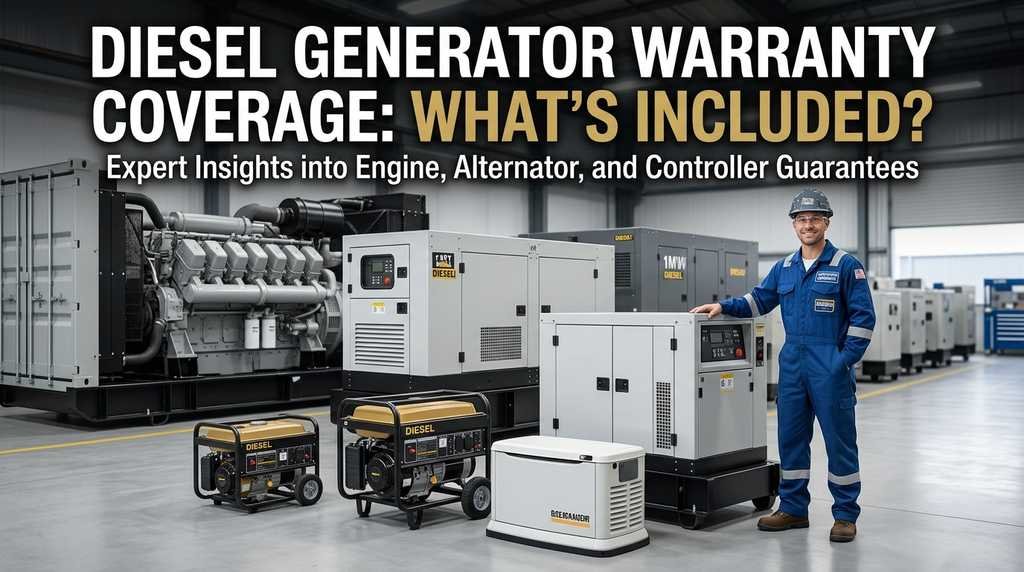
A diesel generator is a major investment, and I do not treat the warranty as an afterthought. A five-year warranty can sound excellent until you discover that the coverage changes after the first two years, travel is limited, labor is excluded later, or the hour limit is reached long before the calendar term ends.
In this guide, I’ll explain how diesel generator warranties usually work, what they commonly cover, what they often exclude, how standby and commercial use can change the terms, how extended warranties work, and what I do to avoid accidentally giving a manufacturer a reason to deny a claim.
Warranty Coverage for Diesel Generators: Quick Overview
| Warranty item | What I check | Why it matters |
|---|---|---|
| Calendar term | Years or months from start-up, purchase, or activation | Coverage may end by date even with low hours |
| Hour limit | Maximum operating hours | Commercial use can hit the hour cap early |
| Application | Standby, prime, continuous, rental, mobile | Coverage can change by duty type |
| Parts | Which components are covered | Some accessories have shorter terms |
| Labor | Whether diagnostic and repair labor is included | Parts-only coverage can still leave a large bill |
| Travel | Dealer mileage or time allowance | Remote sites may owe travel beyond the limit |
| Maintenance records | Proof of required service | Missing records can weaken a claim |
| Registration | Product registration or start-up activation | Some warranties require timely registration |
What Does a Diesel Generator Warranty Usually Cover?
At its core, a manufacturer warranty is usually designed to address defects in materials or workmanship during the warranty period. If a covered component fails because it was defective, the manufacturer may repair or replace the part according to the written terms.


I pay close attention to the words limited warranty. That phrase matters because the warranty is limited by conditions, time, hours, application, exclusions, and service procedures.
Typical covered areas may include the engine, alternator, control system, factory-installed wiring, enclosure components, cooling-system parts, and transfer equipment if it is specifically included in the same warranty. The exact list varies by product line.
What Is Usually Not Covered?
The exclusions are often more important than the headline term. I expect normal wear and routine maintenance to be excluded.
| Common exclusion | Example |
|---|---|
| Routine maintenance | Oil, filters, coolant service, belts, tune-ups |
| Consumables | Fuel, lubricants, batteries in some warranties, shop supplies |
| Neglect | Running low on oil, ignoring alarms, skipped maintenance |
| Improper installation | Wrong wiring, inadequate ventilation, poor fuel-system design |
| Contaminated fuel | Water, microbial growth, dirt, wrong fuel |
| Environmental damage | Flooding, lightning, corrosion, salt exposure, storm damage |
| Unauthorized repair | Repairs or modifications outside allowed service channels |
| Non-approved parts | Damage linked to incompatible aftermarket components |
I also remember that a warranty is not the same thing as an insurance policy. If a generator is damaged by flooding, impact, theft, vandalism, fire from an external source, or another event that is not a product defect, the warranty may not apply.
Years vs. Hours: Which Limit Controls?
Many generator warranties use both a calendar limit and an operating-hour limit, with coverage ending when the first one is reached.
For example, a warranty might be described as five years or 2,000 hours. That does not mean you automatically receive five years if the generator reaches 2,000 hours in year three.
| Example usage | Annual hours | Hours after 5 years |
|---|---|---|
| Occasional residential standby | 100 hours/year | 500 hours |
| Frequent outage / light commercial | 300 hours/year | 1,500 hours |
| Heavy standby use | 500 hours/year | 2,500 hours |
| Prime-power use | 2,000 hours/year | 10,000 hours |
This is one reason I never choose a warranty by years alone. If I expect heavy operation, the hour limit may be more important than the calendar term.
Standby Use vs. Prime or Continuous Use
The application classification can completely change coverage.
A standby generator is normally intended to supply power when the normal utility source is unavailable. Prime-rated equipment is expected to operate for far more hours as a main or frequent power source. Continuous-duty units may run at a consistent load for extended periods.
If a warranty says the product is covered only for standby use, I do not assume I can run it every day as my primary power plant and keep the same coverage.
| Application | Typical operating pattern | Warranty concern |
|---|---|---|
| Emergency standby | Runs during utility outages | Often the most favorable residential/commercial terms |
| Prime power | Runs regularly where utility power is limited | Different hour limits and service terms may apply |
| Continuous duty | Long-duration steady operation | Requires the correct equipment rating and warranty classification |
| Rental/mobile | Frequent transport and varied loads | Often covered under a separate commercial policy |
Current Manufacturer Warranty Examples
I like looking at actual current manufacturer terms because they show how much warranties can differ.
| Manufacturer / example | Published coverage example | Important limitation |
|---|---|---|
| Generac standby warranty example | 3 years | Years 1–2 include parts, labor, and limited travel; year 3 is parts only in the referenced policy |
| Cummins home generators 13, 17 and 20 kW | 5 years / 2,000 hours | Whichever limit applies under the published terms |
| Cummins home generators 25–125 kW | 2-year limited warranty | Exact terms depend on model and application |
| Cat portable generator example | 2 years / 1,000 hours | Can be extended to 3 years for eligible original purchasers who register within 30 days |
| Kohler stationary standby extended example | 5 years / 2,000 hours | Coverage is tied to the registered startup date and proper installation/maintenance |
What Generac’s Warranty Example Tells Me
One current Generac standby warranty document shows a three-year limited warranty structure. In that policy, years one and two include parts, labor, and limited travel, while year three becomes parts only. The policy also requires registration and proof of purchase and says warranty concerns must be handled through an authorized service dealer.


That difference between parts-and-labor coverage and parts-only coverage is exactly why I read the year-by-year table. A generator can still be “under warranty” while I remain responsible for labor.
Generac also notes that required maintenance records must be available. That is a good reminder that service documentation is not paperwork I throw away.
What Cummins Warranty Terms Show
Cummins currently states that its 13, 17, and 20 kW home standby models include a five-year/2,000-hour limited warranty, while 25–125 kW home models include a two-year limited warranty.
That size-based difference is another reason I do not assume every generator from the same manufacturer receives identical protection.
Cummins also publishes extended options for some generator sets. Depending on the program, extended coverage can add additional years and operating-hour limits. I look at the base warranty and extension separately because the covered components may not be identical.
What Caterpillar’s Warranty Approach Shows
Caterpillar currently publishes separate warranty and Extended Service Coverage information for electric-power equipment. For portable generators, Cat states that new products are covered for two years or 1,000 operating hours, whichever occurs first, and eligible original purchasers can extend that to three years by registering within 30 days.
Cat’s larger power systems also have extended service programs with different protection levels. I treat those service contracts as separate from the original factory warranty.
What About Transfer Switches?
I always ask whether the automatic transfer switch is covered under the same warranty as the generator.
Sometimes the generator and transfer switch are sold together and covered under one system policy. In other cases, they may have separate warranty terms. A transfer switch failure can leave you without backup power even when the engine itself is running perfectly.
For standby installations, I keep the warranty documents for the generator, ATS, fuel-system accessories, battery charger, remote monitor, and any load-management equipment together.
Are Batteries Covered?
Starting batteries are a common source of confusion. Some generator warranties treat the battery as a separate component with a shorter manufacturer warranty, while others may provide limited coverage through the battery supplier.
I never assume the starting battery gets the same five-year term as the generator.
| Component | Possible warranty treatment |
|---|---|
| Generator engine | Main generator warranty |
| Alternator | Main generator or separate component terms |
| Starting battery | Often shorter or separate coverage |
| Block heater | May have a shorter accessory term |
| Transfer switch | Same system warranty or separate policy |
| Fuel tank | Tank manufacturer or installer warranty |
Does the Warranty Cover Labor and Travel?
This is one of the first questions I ask a dealer.
A warranty that covers a $2,000 component but excludes technician labor and travel can still leave me with a meaningful bill. Remote generators can be especially expensive if the closest authorized technician is hours away.
Some warranties place mileage or travel-time caps on service calls. Generac’s referenced standby policy, for example, limits its travel allowance by distance and time from the nearest authorized dealer. Anything beyond the allowance can become the owner’s responsibility.
Why Installation Quality Matters to Warranty Coverage
Manufacturers commonly exclude failures caused by improper installation.
That is why I want the fuel supply, ventilation, exhaust, wiring, transfer switch, grounding, pad, clearances, and startup procedure done correctly from day one.
If a generator overheats because the air discharge was blocked by a wall, or a fuel system starves the engine because the piping was undersized, I would not expect the manufacturer to treat that as a defective generator.
For a home installation, see my guide on how to connect a diesel generator to your home.
Maintenance Records Can Protect Your Claim
If I own a diesel standby generator, I keep a maintenance log. I record the date, operating hours, work performed, parts used, fluid specifications, technician name, and any alarm or test results.
| Maintenance record | What I save |
|---|---|
| Oil service | Date, hours, oil grade, filter part number |
| Fuel-filter service | Date, hours, filter details, water-separator findings |
| Coolant service | Type, concentration, date, test results |
| Battery service | Test result, replacement date, charger status |
| Load test | kW load, duration, voltage/frequency observations |
| Dealer work | Invoice and technician report |
If a warranty requires maintenance at specific hour or calendar intervals, the log gives me evidence that I followed the schedule.
For maintenance planning, see Diesel Generator Maintenance: What You Need to Know and How Often Should Diesel Generators Be Serviced?.
Can Aftermarket Parts Void the Warranty?
I avoid making the broad claim that any aftermarket part automatically voids an entire warranty. The actual issue is usually whether the part or modification caused the failure or violated a written warranty requirement.
Still, I am cautious. If I install a non-approved fuel controller, wiring modification, sensor bypass, exhaust change, or incompatible filter and that modification damages the generator, I may have created a warranty problem.
When a unit is still under factory warranty, I usually use manufacturer-approved service parts for critical systems unless I have confirmed in writing that an alternative is acceptable.
What About Fuel Quality?
Poor fuel can create expensive problems that the generator warranty may not cover.
Water, microbial growth, sediment, wrong fuel, waxed fuel in cold weather, or long-term degradation can damage pumps, injectors, filters, and fuel-system components. If the root cause is contaminated fuel rather than a defective part, I would not assume the warranty will pay.
If you store diesel for backup power, also see Water in Diesel Fuel: Symptoms, Causes & What to Do.
What Is an Extended Warranty or Service Contract?
An extended plan can continue protection after the base warranty ends, but I read the contract carefully.
Some plans are true manufacturer-backed extended service coverage. Others are third-party service contracts. The covered parts, deductibles, labor, travel, maintenance requirements, and claim process can be very different.
| Question I ask | Why it matters |
|---|---|
| Who backs the plan? | Manufacturer, dealer, or third party |
| What components are covered? | Engine-only coverage is different from full generator coverage |
| Are labor and travel included? | Major effect on out-of-pocket cost |
| Is there a deductible? | Changes the value of small claims |
| What is the hour limit? | Heavy use can shorten the benefit |
| Is it transferable? | Can affect resale value |
Is Warranty Coverage Transferable?
Some generator warranties transfer to a new property owner; others are tied to the original purchaser or installation site.
This matters for permanently installed standby generators because the unit often stays with the building when the property is sold. I check the transfer provision before closing a sale or buying a home with an existing generator.
What I Do Before Filing a Warranty Claim
I do not start disassembling the generator before contacting the authorized service network.
First, I record the model, serial number, operating hours, fault code, date of failure, and what the generator was doing when it failed. I take photos of leaks, alarms, or visible damage. I gather the purchase receipt, startup record, registration confirmation, and maintenance history.
Then I contact the authorized dealer and ask whether they want the generator left untouched until inspection.
My Warranty Claim Checklist
| Item | Have it ready |
|---|---|
| Model and serial number | Yes |
| Proof of purchase | Yes |
| Warranty registration | Yes |
| Startup/commissioning record | Yes |
| Current operating hours | Yes |
| Maintenance log | Yes |
| Fault codes | Yes |
| Photos/video of failure | Useful |
| Dealer service history | Useful |
Common Reasons Warranty Claims Get Complicated
The claim process usually becomes harder when there are missing records, unauthorized repairs, evidence of neglect, contaminated fuel, improper installation, overdue maintenance, operation outside the rated application, or damage from an external event.
I also avoid clearing controller fault history before documenting it. The fault code can help establish what happened.
Does a Long Warranty Mean the Generator Will Last Longer?
Not necessarily. Warranty length and expected service life are different concepts.
A diesel generator may remain in service for many years after the factory warranty expires. My article on diesel generator lifespan explains how operating hours, maintenance, loading, environment, and fuel quality affect longevity.
I treat the warranty as financial protection during an early portion of ownership, not as the expected life of the equipment.
My Buying Checklist Before I Choose a Generator Warranty
Before I buy, I ask the dealer for the actual warranty document—not just the brochure summary. I want to know when coverage begins, whether registration is required, the year and hour limits, parts/labor/travel terms, the standby-use definition, accessory coverage, maintenance requirements, transfer rules, and available extended plans.
I also ask who will actually service the unit locally. A strong warranty is less useful if there is no authorized service provider nearby.
Frequently Asked Questions
How long is a typical diesel generator warranty?
There is no single standard. Depending on manufacturer, model, and application, coverage may be two, three, five, or more years and may also include an operating-hour limit. I verify the exact policy before buying.
Does warranty cover diesel generator maintenance?
Usually no. Routine oil changes, filters, coolant service, batteries, belts, adjustments, and other scheduled maintenance are generally the owner’s responsibility unless a separate maintenance plan says otherwise.
Will a warranty cover a generator damaged by bad diesel fuel?
Often not if contaminated or improper fuel caused the failure. I keep stored fuel clean and dry and maintain filters and water separators.
Can missing maintenance records cause a warranty problem?
Yes. Some manufacturers explicitly require proof that scheduled maintenance was completed. I keep invoices and my own service log.
Does the warranty include the transfer switch?
Sometimes, but not always. I check whether the ATS is included in the generator-system warranty or covered under its own policy.
Can I buy an extended warranty?
Often yes. Manufacturers such as Caterpillar and Cummins offer extended service or warranty options for selected generator products. Terms, hours, covered components, and application limits vary.
Does the warranty transfer when I sell my house?
It depends on the policy. Some standby-generator warranties are transferable at the original installation site, while others have different ownership conditions. I confirm transfer rules in writing.
My Bottom Line
When I evaluate warranty coverage for diesel generators, I look beyond the headline number of years. I want to know exactly what happens in each year, when the hour limit applies, whether the generator is classified for standby or prime use, who pays labor and travel, and which maintenance records I must keep.
I also pay close attention to exclusions. Contaminated fuel, improper installation, unauthorized modifications, flooding, neglected maintenance, and operating the generator outside its intended rating can all create expensive disputes.
The best way I protect my warranty is simple: I register the generator promptly, keep the purchase and startup documents, follow the exact maintenance schedule, keep detailed service records, use qualified technicians for major work, and call the authorized dealer before I make repairs that could affect a claim.
A warranty will not replace good maintenance, but when I understand the terms and keep my records in order, it can protect me from a major repair bill during the years when I expect the generator to be most reliable.
Sources and Technical References
I reviewed current manufacturer warranty information from Generac, Cummins, Caterpillar, and published Kohler standby warranty documentation. Warranty terms can change by model, serial number, country, application, and purchase date, so the current warranty document supplied with the specific generator should always control.