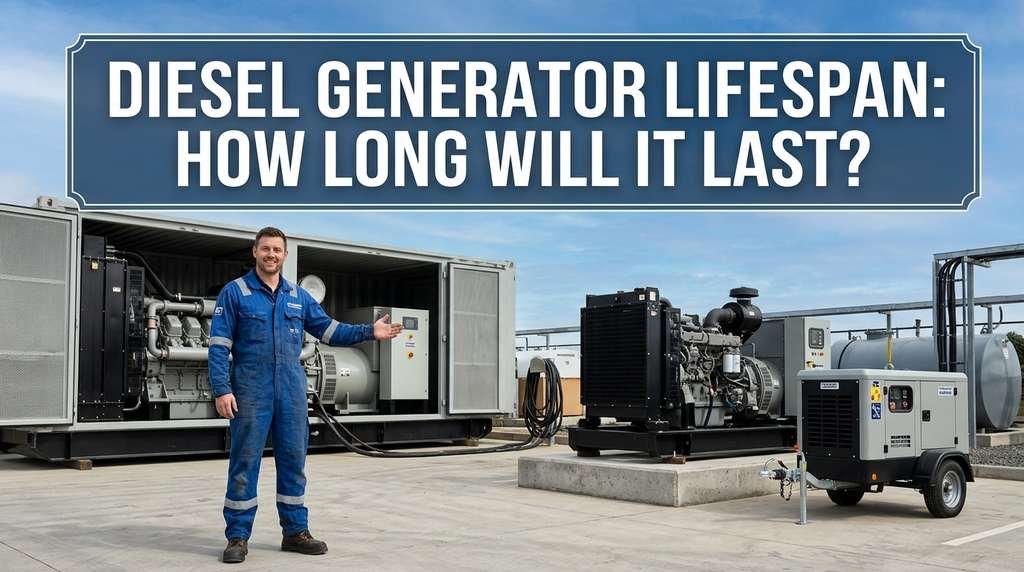


If you are asking, “How long will my diesel generator last?”, I look at two numbers: calendar age and operating hours. A lightly used standby generator may reach 20 years with surprisingly few engine hours, while a prime-power generator can accumulate thousands of hours every year and wear out much sooner in calendar time.
That distinction matters. I have seen people compare two generators by age alone even though one has spent most of its life waiting for outages and the other has powered a site every day. In this guide, I’ll explain the realistic lifespan of a diesel generator, what 20,000 to 30,000 hours really means, which components usually age first, and what I do to extend generator life.
Diesel Generator Lifespan: Quick Answer
| Generator use | Typical lifespan perspective | What matters most |
|---|---|---|
| Residential/light commercial standby | Often measured more by years than engine hours | Exercise, battery, fuel quality, corrosion, maintenance |
| Commercial standby | Can remain in service for decades when maintained | Testing under load, fuel storage, cooling system, controls |
| Prime power | Measured heavily by operating hours | Correct rating, load factor, oil/filter intervals, cooling |
| Continuous-duty application | High annual hours accelerate wear | Correct continuous rating and disciplined maintenance |
| Industrial diesel generator | 20,000–30,000 operating hours is a useful broad benchmark | Engine design, overhaul strategy, duty cycle, environment |
Caterpillar currently states that its diesel generator sets can last around 15 to 30 years and reach approximately 20,000 to 30,000 operating hours. Cummins has also published that standby diesel generators can commonly go 30,000 hours or more between major overhauls. I use those as broad industry references rather than a promise for every generator.
Years and Hours Tell Two Different Stories
I never estimate diesel generator lifespan from calendar age alone. A generator that is 15 years old but has only 600 hours can be mechanically younger than a five-year-old prime-power unit with 10,000 hours.
| Annual operating hours | Years to reach 20,000 hours | Years to reach 30,000 hours |
|---|---|---|
| 100 hours/year | 200 years | 300 years |
| 250 hours/year | 80 years | 120 years |
| 500 hours/year | 40 years | 60 years |
| 1,000 hours/year | 20 years | 30 years |
| 2,000 hours/year | 10 years | 15 years |
| 4,000 hours/year | 5 years | 7.5 years |
That table is simple arithmetic, not a forecast. A standby generator operating only 100 hours a year will probably age out from corrosion, electronics, seals, coolant issues, fuel-system problems, or obsolescence long before it reaches 20,000 hours. On the other hand, a properly rated prime-power generator may reach very high hours because it is specifically designed and maintained for that work.


Standby, Prime, and Continuous Ratings Affect Lifespan
One of the biggest mistakes I see is using a standby-rated generator like a continuous-power machine. The nameplate rating is not just a marketing label. It tells me how the manufacturer expects the set to be used.
Caterpillar’s published rating guidance gives a useful example. Its standby rating describes variable-load operation during normal-source outages, with typical use around 200 hours per year and a maximum expected use around 500 hours per year for that rating. Prime-rated equipment is designed for much higher annual use.
| Rating type | General use | Lifespan concern |
|---|---|---|
| Standby | Emergency outages and backup | Not intended to be the everyday main power source |
| Prime | Regular variable-load operation | Designed for much higher annual hours |
| Continuous | Long-duration operation at a defined load | Must be selected specifically for sustained duty |
If I routinely push a standby set beyond its intended duty cycle, I expect faster wear, shorter service intervals, higher temperatures, and a reduced useful life.
What Usually Determines How Long a Diesel Generator Lasts?
I think of generator lifespan as the result of several systems aging at the same time. The diesel engine is only one part of the generator set.
| System | What shortens its life | What I do about it |
|---|---|---|
| Diesel engine | Overload, poor lubrication, overheating, dirty intake air | Correct load, oil changes, cooling maintenance |
| Fuel system | Water, sludge, microbial contamination, stale diesel | Fuel testing, filtration, tank housekeeping |
| Cooling system | Low coolant, scale, old hoses, blocked radiator | Inspect coolant, hoses, radiator and airflow |
| Alternator | Moisture, heat, overload, dirt, insulation breakdown | Keep dry, clean and correctly loaded |
| Starting system | Weak battery, corroded terminals, failed charger | Battery testing and charger checks |
| Controller/ATS | Age, moisture, surges, neglected testing | Functional testing and electrical inspection |
| Enclosure/base | Salt, standing water, damaged paint, corrosion | Drainage, coatings, cleaning and repair |
This is why I do not say a generator is “good for 30,000 hours” and stop there. The engine may be capable of very high hours while the battery, transfer switch, coolant hoses, fuel tank, or electronic controller may need replacement much earlier.
Maintenance Is the Biggest Lifespan Multiplier
If I had to choose one factor that most consistently separates long-lived generators from neglected ones, it would be maintenance. Diesel engines are durable, but they still depend on clean oil, proper coolant, unrestricted airflow, clean fuel, and a healthy starting system.
Cummins describes periodic maintenance as essential to generator performance and long service life. Its published schedules commonly include daily or routine inspections, oil-level checks, monthly exercise, fuel-system inspection, battery checks, and longer-term service intervals.
| Maintenance item | Example interval from manufacturer guidance | Why it matters |
|---|---|---|
| Visual inspection | Daily / every 8 hours on some sets | Find leaks and damage early |
| Oil level | Daily / every 8 hours on some sets | Protect bearings, turbo and cylinder surfaces |
| Loaded exercise | Monthly in some standby programs | Confirms operation and helps prevent low-load issues |
| Oil/filter service | Often around 500 hours or annually in high-hour applications | Controls contamination and wear |
| Coolant, belts and hoses | Per model schedule | Prevents overheating and age-related failures |
Those are examples, not universal intervals. I always follow the manual for the exact engine and generator set. My separate diesel generator maintenance guide explains the full maintenance process.
Oil Change Discipline Matters More Than People Think
Engine oil carries heat away from critical parts, suspends contamination, protects bearings, and maintains the lubricating film between moving components. Stretching oil intervals because the engine “still sounds fine” is one of the easiest ways to shorten diesel engine life.
Caterpillar notes that higher-hour generator applications commonly use oil-change intervals around 500 hours or annually, although the exact interval depends on the engine, application, oil specification, environment, and operating conditions.


If I operate in heavy dust, extreme heat, high humidity, or other severe conditions, I expect maintenance needs to increase. Oil analysis can also be useful on expensive commercial sets because it can reveal fuel dilution, coolant contamination, soot loading, and abnormal metal wear before a failure is obvious.
Fuel Quality Can Add Years—or Take Them Away
Standby generators have a unique fuel problem: they often store diesel much longer than vehicles do. Water can enter the tank through condensation or poor tank management. Microbial growth can develop at the fuel-water interface. Sediment can accumulate, and oxidation can degrade stored fuel.
I do not want the generator to discover bad fuel during an outage. Cat specifically recommends regular fuel checking in backup applications because contaminated fuel can clog filters and shut the engine down.
If your generator uses stored diesel, I inspect the tank, water separator, filters, and fuel condition as part of the lifespan plan. My guide on water in diesel fuel symptoms explains what contamination can do to the system.
Running Too Lightly Can Also Shorten Useful Life
Oversizing a diesel generator can look conservative, but repeatedly running it at very light load can create its own problems. Some diesel engines can develop wet stacking and carbon buildup when they operate too cool and lightly loaded for extended periods.
That is one reason I prefer meaningful exercise under load rather than letting a large generator idle with almost nothing connected. Cummins maintenance guidance includes an example of exercising a standby generator for at least 30 minutes at not less than 30% of rated load, unless adequate exhaust temperature is achieved by another approved method.
I do not apply that exact number to every brand and model, but the principle is important: a diesel generator should be exercised the way its manufacturer expects.
Overloading Is Just as Bad
The other extreme is constantly operating at or beyond the generator’s intended rating. High load increases exhaust temperature, coolant temperature, cylinder pressure, and electrical heating. Repeated overload can shorten engine, alternator, cable, breaker, and insulation life.
I size the generator around realistic running load and motor-starting demand rather than buying too small and forcing it to operate at its limit. If you are unsure about sizing, see What Size Diesel Generator Do I Actually Need?.
Environment Can Matter as Much as Engine Hours
A generator near the ocean may age very differently from the same model installed indoors in a clean, climate-controlled room. Cummins specifically notes that weather exposure, salt water, dust, sand, and airborne contaminants may require a more aggressive maintenance schedule.
| Environment | Main lifespan risk | What I watch |
|---|---|---|
| Coastal/salt air | Corrosion | Enclosure, radiator, wiring, alternator, fasteners |
| Dusty construction site | Air restriction and abrasion | Air filters, radiator fins, alternator ventilation |
| Hot climate | Cooling stress and battery aging | Radiator, coolant, ventilation, battery |
| Cold climate | Hard starting and fuel problems | Block heaters, battery, winter fuel, oil viscosity |
| Flood-prone site | Water damage and corrosion | Elevation, drainage, electrical components |
If the generator is outdoors, I also make sure weather protection does not block ventilation. A generator needs airflow even when the enclosure is designed for outdoor use.
Standby Generators Can Age Even When They Barely Run
This is one of the most important points in the entire article. Low engine hours do not mean a standby generator is “like new.” Rubber hoses harden. Batteries age. Coolant degrades. Fuel tanks collect water. Wiring corrodes. Controllers become obsolete. Exhaust components rust. Seals can dry out.
A 20-year-old generator with 700 hours may still need major age-related work even though the engine has hardly been used.
| Low-hour aging item | Why it can fail despite low engine hours |
|---|---|
| Starting battery | Chemical aging occurs with calendar time |
| Coolant hoses | Rubber hardens and cracks |
| Fuel tank | Condensation and corrosion continue while sitting |
| Controller | Electronics age and parts may become obsolete |
| Seals and gaskets | Can shrink or harden |
| Exhaust system | Moisture and corrosion attack metal |
How I Estimate Remaining Diesel Generator Life
I do not rely on one number. I look at a combination of hours, age, service history, operating conditions, and test results.
I want to see maintenance records. I check whether the set reaches rated voltage and frequency, whether it accepts load cleanly, whether oil consumption is increasing, whether blow-by is excessive, whether coolant stays stable, and whether abnormal smoke appears under load.
I also look at the parts situation. A mechanically healthy 25-year-old generator can become expensive to own if the controller, voltage regulator, transfer-switch components, or proprietary electronic modules are no longer readily available.
Signs a Diesel Generator May Be Near the End of Its Useful Life
| Warning sign | What it may indicate |
|---|---|
| Increasing oil consumption | Ring, cylinder, turbo, or seal wear |
| Persistent blue smoke | Oil entering combustion |
| Heavy blow-by | Internal engine wear |
| Hard starting despite a good battery | Compression, fuel, injector, or timing problems |
| Unable to hold rated load | Engine, fuel, turbo, alternator, or control issue |
| Repeated overheating | Cooling-system deterioration or engine problems |
| Frequent electronic faults | Aging controls, wiring, sensors, or power-quality issues |
| Major corrosion | Structural, electrical, cooling, and fuel-system risk |
One symptom does not automatically mean replacement. Many generators are economically rebuildable. The question is whether repair, overhaul, or replacement gives the best reliability and lifecycle cost.
Rebuild vs. Replace
A high-quality industrial diesel generator is often designed so major components can be rebuilt. An engine overhaul can include cylinder work, pistons, rings, bearings, valves, injectors, and turbocharger service depending on condition.
I compare the cost of overhaul with the condition of everything around the engine. If the alternator, enclosure, tank, radiator, wiring, controller, and transfer switch are also near the end of life, a new generator can make more sense than rebuilding only the engine.
| Condition | I would consider |
|---|---|
| Engine worn but controls/enclosure/alternator are healthy | Overhaul may make sense |
| Low hours but obsolete controller and severe corrosion | Replacement may be more practical |
| Frequent breakdowns affecting critical operations | Replacement becomes more attractive |
| Parts support remains strong and maintenance history is excellent | Extended service life may be economical |
How I Extend Diesel Generator Lifespan
I focus on a few habits that give the biggest return: use the correct duty rating, avoid chronic overload and chronic low-load running, keep the fuel clean, maintain the cooling system, change oil and filters on schedule, exercise under meaningful load, keep the battery and charger healthy, and record everything.
I also test the generator under load. A no-load start tells me the engine can run; it does not prove the set can carry the building. My guide on how to test if your diesel generator is working properly explains the full process.
Frequently Asked Questions
How many hours will a diesel generator last?
I use 20,000 to 30,000 operating hours as a broad benchmark for many commercial diesel generator sets. Caterpillar publishes that range for diesel generator life, while Cummins has stated that standby diesels can commonly go 30,000 hours or more between major overhauls. Actual life varies by engine, rating, maintenance, load, and environment.
Can a diesel generator last 30 years?
Yes, especially in standby service, but age-related parts will need attention. A 30-year-old generator may have low engine hours and still need batteries, hoses, seals, controls, fuel-system work, cooling-system repairs, or electrical upgrades.
Is 10,000 hours a lot for a diesel generator?
It depends on the model and its history. For a well-maintained industrial diesel designed for high-hour service, 10,000 hours may still leave substantial useful life. For a neglected or misapplied unit, major problems can appear much earlier.
Which lasts longer: diesel or gasoline generators?
Commercial diesel generators are generally built for heavier duty and higher operating hours than small consumer gasoline generators. The correct comparison, though, is between specific models, ratings, speeds, and maintenance histories.
Does running a generator every week make it wear out faster?
Normal manufacturer-specified exercise is intended to support reliability, not unnecessarily consume engine life. A short planned exercise schedule contributes very little to total lifetime hours compared with prime-power use.
Can low hours be bad for a diesel generator?
Low hours themselves are not harmful, but long periods of inactivity combined with poor exercise, old fuel, moisture, weak batteries, and no loaded testing can create reliability problems.
How do I know when my diesel generator needs an overhaul?
I look for rising oil consumption, hard starting, low compression, excessive blow-by, abnormal smoke, poor load acceptance, repeated overheating, metal in oil analysis, and other condition indicators. A professional inspection and load test can help determine whether overhaul is justified.
My Bottom Line
When I think about diesel generator lifespan, I do not use one magic number. A realistic broad range for commercial diesel generator sets is about 15 to 30 years or 20,000 to 30,000 operating hours, with some standby diesel engines capable of going 30,000 hours or more between major overhauls.
But the generator that lasts the longest is usually not the one with the fewest hours. It is the one that was correctly sized, used within its rating, maintained on schedule, exercised properly, supplied with clean fuel, kept cool, protected from corrosion, and tested under real load.
If your generator is already older, I would look beyond the hour meter. I would evaluate the engine, alternator, controls, fuel system, cooling system, transfer equipment, corrosion, parts availability, and maintenance history together. That gives you a much more useful answer than age alone.
Sources and Technical References
I used current Caterpillar guidance stating that commercial and industrial diesel generator sets can last roughly 15–30 years and 20,000–30,000 operating hours, along with Cummins technical guidance noting that standby diesel generators can often reach 30,000 hours or more between major overhauls. I also referenced Cat generator rating and maintenance guidance and Cummins maintenance guidance. Exact service life and maintenance intervals depend on the specific generator model and application.