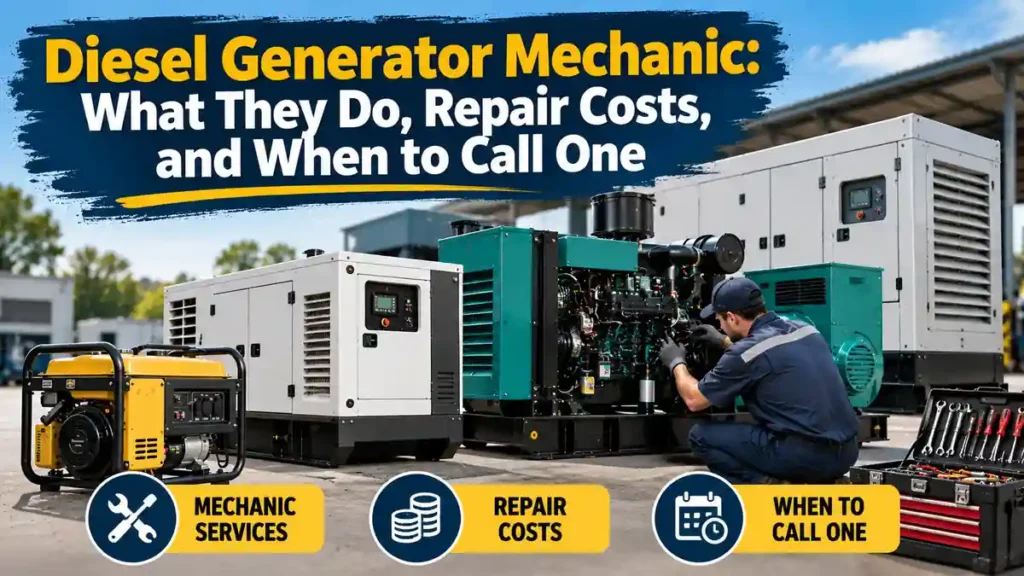


If your diesel generator will not start, shuts down under load, smokes, leaks fuel, produces unstable voltage, or makes a new mechanical noise, a qualified diesel generator mechanic is often the right person to call. I usually recommend professional help when the problem involves the injection system, internal engine parts, alternator, high-current wiring, controls, transfer equipment, or repeated safety shutdowns. A mechanic does more than replace parts: the real value is diagnosing whether the fault is mechanical, electrical, fuel-related, or caused by the load.
In this guide, I’ll explain what a diesel generator mechanic actually does, what repairs commonly cost, what skills and tools a good technician should have, which problems you can check yourself, and the warning signs that tell me it is time to stop troubleshooting and bring in a professional.
Quick Answer: What Does a Diesel Generator Mechanic Do?
A diesel generator mechanic diagnoses, services, and repairs the engine and generator set as a complete system. That can include the diesel fuel system, cooling system, lubrication system, starter and batteries, alternator, voltage regulator, wiring, control panel, sensors, and sometimes automatic transfer equipment. Depending on the shop, one technician may handle both engine and electrical work, while larger repairs may involve a diesel engine specialist and a licensed electrician.
| Area | What the Mechanic Checks | Common Problems |
|---|---|---|
| Diesel engine | Compression, timing, injectors, valves, oil pressure | Hard starting, smoke, knocking, low power |
| Fuel system | Tank, filters, lift pump, lines, injectors | Fuel starvation, air leaks, contamination |
| Cooling system | Radiator, thermostat, water pump, fan, coolant | Overheating, leaks, shutdowns |
| Starting system | Battery, starter, cables, relays, preheat | No crank, slow crank, weak cold starts |
| Alternator | Windings, bearings, excitation, insulation | No output, low voltage, overheating |
| Controls | Sensors, controller, alarms, shutdown history | False shutdowns, no-start commands |
| Load system | Voltage, frequency, current, load balance | Breaker trips, bogging, unstable output |
Diesel Generator Mechanic vs. Regular Auto Mechanic
A diesel generator engine may look similar to the diesel engine in a truck, tractor, or piece of construction equipment, but the operating environment is different. A generator engine is expected to hold a controlled speed so the alternator can maintain stable frequency. A mechanic therefore has to think about engine speed, governor response, electrical loading, voltage regulation, and protective shutdowns—not only whether the engine runs.
That difference matters. A truck mechanic may be excellent at injectors, cooling systems, and engine rebuilds, but may not have experience with generator controllers, excitation systems, load-bank testing, or automatic transfer switches. When I am hiring for a generator-specific problem, I look for someone who regularly works on gensets rather than assuming any diesel technician will be equally prepared.


What Repairs Does a Diesel Generator Mechanic Perform?
1. No-Start and Hard-Start Diagnosis
A no-start condition is one of the most common reasons owners call a mechanic. The technician will usually determine first whether the engine fails to crank or cranks normally but will not fire. Those two symptoms lead in very different directions.
A no-crank condition can involve batteries, terminals, starter solenoids, starter motors, fuses, relays, emergency-stop circuits, or controller interlocks. A crank-no-start condition points more toward fuel delivery, air in the system, low compression, glow plugs or intake heaters, injector problems, or a controller that is preventing fuel delivery.
If you want a detailed owner-level checklist before booking service, I also cover this in Why Won’t My Diesel Generator Start?.
2. Fuel-System Repairs
Diesel engines are very sensitive to fuel delivery. A generator mechanic may replace fuel filters, bleed air, repair leaking lines, test a lift pump, check tank vents, inspect water separators, test injectors, or investigate fuel contamination.
Modern common-rail systems operate at extremely high pressure. I do not recommend loosening high-pressure injector lines as a casual troubleshooting step. On those systems, a trained technician with the correct test equipment is the safer choice.
3. Injector and Injection-Pump Work
Bad injectors can cause hard starting, white smoke, black smoke, rough running, excessive fuel use, diesel knock, or low power. Mechanical injection pumps can also suffer wear, timing errors, internal leakage, or governor problems. Electronic systems may produce diagnostic codes that point to pressure sensors, actuators, or control circuits.
Injector work becomes especially important when the engine runs but one cylinder is clearly not contributing normally. A technician may use cylinder cut-out testing, return-flow testing, fuel-pressure measurement, exhaust-temperature comparison, or manufacturer diagnostic software.
4. Cooling-System Repairs
Overheating can destroy a diesel engine, so I treat repeated high-temperature alarms seriously. A mechanic may pressure-test the cooling system, inspect the radiator, test the thermostat, verify fan operation, check the belt, inspect the water pump, test the pressure cap, and look for combustion gases entering the coolant.
The repair could be simple, such as a loose belt, or serious, such as a damaged head gasket. The important point is that repeatedly resetting the shutdown without finding the cause can turn a manageable repair into major engine work.
5. Low Oil Pressure Diagnosis
Low oil pressure is another condition where I prefer a professional diagnosis when the obvious checks do not solve it. The cause could be low oil level, incorrect viscosity, a failed pressure sender, wiring, a clogged pickup, worn oil pump, stuck relief valve, fuel-diluted oil, or excessive bearing clearance.


A good mechanic does not automatically assume the engine is worn out because a controller shows low pressure. One common diagnostic step is verifying pressure with a known-good mechanical gauge before making major repair decisions.
6. Alternator and Electrical Output Repairs
A diesel engine can run perfectly while the generator produces no usable electricity. This is where generator-specific knowledge becomes critical.
The technician may test output voltage, frequency, excitation voltage, winding resistance, insulation resistance, diode condition, automatic voltage regulator operation, connections, and alternator bearings. Large alternators may require specialized insulation testing or rewinding by an electrical machine shop.
7. Governor, Frequency, and Load Problems
If your generator runs normally with no load but bogs down when equipment is connected, the mechanic has to determine whether the cause is engine power, fuel delivery, governor response, an oversized load, phase imbalance, or an alternator problem.
I explain many of those symptoms in Diesel Generator Bogs Down Under Load. A mechanic can go further by measuring current on each phase, checking engine speed, verifying frequency under load, and performing a controlled load-bank test.
Typical Diesel Generator Mechanic Repair Costs
Repair prices vary enormously by generator size, brand, access, location, parts availability, and whether the work is scheduled or emergency service. A 7 kW portable set is not priced like a 500 kW commercial standby unit.
As a broad 2026 U.S. benchmark, consumer cost guides report minor generator repairs commonly in the roughly $50 to $500 range, major repairs from around $100 to $2,500, and service-call minimums often around $150 to $300 or more. Diesel generator maintenance can also reach several hundred dollars per visit depending on size and scope. I use those numbers only as budgeting references—not fixed quotes.
| Service or Repair | Typical Budget Range | What Changes the Price |
|---|---|---|
| Basic service visit / inspection | $170–$400 | Location, generator size, travel |
| Minimum diagnostic/service call | $150–$300+ | Travel, minimum labor charge |
| Minor repair | $50–$500 | Part cost and accessibility |
| Engine-related repair | $150–$2,000+ | Internal damage, labor hours |
| Voltage regulator repair/replacement | $100–$800 | Generator model and AVR type |
| Stator/rotor repair | $250–$2,500+ | Rewinding vs. replacement, size |
| Annual diesel-generator maintenance | $200–$1,000+ | Capacity, fluids, filters, testing |
For context, current 2026 cost data from Angi puts professional whole-house generator maintenance at about $171 to $395 per scheduled service, while HomeGuide lists many generator service calls with minimum charges around $150 to $300+. Larger commercial diesel sets can cost substantially more because of travel time, specialized diagnostic tools, oil capacity, filter quantity, coolant volume, and load-bank requirements.
Example Repair-Cost Calculation
Suppose a technician charges a $175 service-call fee that includes the first hour. The diagnosis finds a failed fuel lift pump. The pump costs $220, an additional 1.5 hours of labor costs $225, and shop supplies add $25.
| Item | Example Cost |
|---|---|
| Service call / first-hour diagnosis | $175 |
| Fuel lift pump | $220 |
| Additional labor | $225 |
| Supplies | $25 |
| Estimated total | $645 |
This example shows why I prefer getting a written estimate after diagnosis. The service-call fee may be only a fraction of the final invoice if the repair requires expensive components or several labor hours.
Why Diesel Generator Repair Costs Vary So Much
Generator Size
Larger generators generally have larger engines, more oil and coolant, more expensive starters, larger batteries, heavier alternators, and more complex controls. A technician may also need lifting equipment or additional personnel.
Portable vs. Standby vs. Commercial
Portable generators are usually easier to access and transport. Standby systems add transfer controls and permanent electrical connections. Commercial and industrial sets may use remote monitoring, paralleling switchgear, multiple fuel tanks, sophisticated controllers, and high-voltage systems.
Parts Availability
A common filter or relay may be inexpensive. A discontinued controller, specialty AVR, proprietary sensor, or obsolete alternator component can be much harder to source.
Emergency Service
If you need a mechanic during an outage at night, on a weekend, or during a storm, expect the labor rate or callout fee to increase. Commercial operations may still consider that worthwhile if downtime costs more than emergency service.
Travel
Remote generators on farms, towers, construction sites, mines, or off-grid properties may incur mileage and travel-time charges. Ask whether travel is billed one way, round trip, or included within a service radius.
What Should a Diesel Generator Mechanic Check During a Service?
| Check | Why It Matters | Typical Action |
|---|---|---|
| Engine oil | Lubrication and wear control | Level, condition, change if due |
| Oil filter | Protects bearings and oil passages | Replace at service interval |
| Fuel filters | Protect pumps and injectors | Replace/drain separator |
| Air filter | Maintains combustion airflow | Inspect restriction, replace if needed |
| Coolant | Prevents overheating and corrosion | Check level, concentration, leaks |
| Battery | Reliable starting | Voltage, terminals, load/conductance test |
| Belts and hoses | Cooling and accessory drive | Inspect tension, cracks, leaks |
| Controller alarms | Shows fault history | Read and document active/history codes |
| Voltage/frequency | Protects connected loads | Measure no-load and loaded output |
| Leaks | Safety and reliability | Inspect fuel, oil, coolant |
Regular servicing is usually cheaper than waiting for an emergency failure. I cover service scheduling in How Often Should Diesel Generators Be Serviced?.
When Should I Call a Diesel Generator Mechanic?
I would call a professional when any of the following happens:
- The generator repeatedly shuts down on low oil pressure or high temperature.
- The engine knocks, clanks, grinds, or suddenly sounds mechanically different.
- The generator produces no voltage even though the engine runs.
- Voltage or frequency is unstable under a steady load.
- There is diesel fuel leaking from a pump, injector, or high-pressure line.
- The engine produces persistent white, blue, or heavy black smoke.
- The generator starts but repeatedly dies after a few seconds or minutes.
- You smell burning insulation or see overheated electrical connections.
- A breaker keeps tripping after you confirm the connected load is reasonable.
- The controller shows a recurring fault code you cannot resolve from the manual.
- You suspect internal engine damage, low compression, worn bearings, or a head-gasket problem.
- You need alternator insulation testing, winding repair, or load-bank testing.
When Should I Shut the Generator Down Immediately?
Some symptoms are not “watch and see” problems. If I hear a sudden deep knock, see a major fuel leak, notice rapidly falling oil pressure, see severe overheating, smell burning wiring, or find smoke coming from the alternator or control panel, I shut the unit down and isolate it before troubleshooting further.
Continuing to run a generator with a serious lubrication, cooling, fuel, or electrical fault can turn a smaller problem into an engine seizure, fire, damaged alternator, or destroyed load.
What Can I Check Before Calling a Mechanic?
You can often save diagnostic time by doing a few safe, non-invasive checks first.
- Read the controller: Write down the exact alarm or shutdown code before clearing it.
- Check fuel level: Do not trust only the gauge if the generator has been sitting.
- Check engine oil: Use the procedure in the owner’s manual and confirm the level is within range.
- Check coolant: Only open a pressurized cooling system after it is safe and cool.
- Inspect the battery: Look for loose terminals, corrosion, and obvious damage.
- Inspect for leaks: Check underneath and around the engine for fuel, oil, or coolant.
- Check the emergency stop: Make sure it is reset.
- Check breakers: Confirm the main breaker and control fuses are in the correct position.
- Remove unnecessary load: If appropriate, test whether the engine can run unloaded.
- Record symptoms: Note whether the fault occurs cold, hot, immediately, or only under load.
If you want a broader DIY diagnostic sequence, see 17 Common Problems With Diesel Generators and How to Test If Your Diesel Generator Is Working Properly.
What Should I Avoid Doing Myself?
I would not recommend opening high-pressure common-rail fuel lines, bypassing protective shutdowns, working on energized high-current terminals, defeating an automatic transfer system, disassembling an alternator, or adjusting injection timing without the required tools and specifications.
The fact that a generator is “only 120/240 volts” does not make it harmless. A generator can deliver very high fault current, and a permanently connected standby system can create backfeed hazards if the transfer equipment is not handled correctly.
How to Choose a Good Diesel Generator Mechanic
I ask a few direct questions before authorizing work:
- Do you regularly repair diesel generator sets, not just diesel vehicles?
- Do you service my engine and generator brand?
- Can you read the controller’s fault history and manufacturer diagnostic codes?
- Can you test voltage, frequency, phase current, and insulation resistance?
- Do you have access to a load bank if needed?
- Are you insured, and are electrical repairs performed by appropriately qualified personnel?
- Do you provide a written diagnostic report or estimate?
- What is your callout charge, hourly labor rate, and travel charge?
- Is the repair covered by any workmanship or parts warranty?
Should I Use a Dealer or an Independent Mechanic?
| Option | Advantages | Possible Drawbacks |
|---|---|---|
| Authorized dealer | Factory tools, software, parts access, warranty knowledge | Often higher labor/callout rates |
| Independent generator specialist | Often flexible, multi-brand experience, competitive pricing | May lack proprietary software for some models |
| General diesel shop | Strong engine-repair capability | May have limited alternator/control experience |
| Electrician | Strong wiring, transfer switch, breaker expertise | May not handle diesel-engine faults |
If the generator is under warranty, I would check the warranty terms before choosing an independent shop. Certain repairs or non-approved parts can complicate warranty coverage.
How Long Does a Generator Repair Take?
Many straightforward repairs can be completed in one visit. A battery replacement, sensor repair, hose replacement, filter service, or minor wiring repair may take only a few hours. Major engine or alternator work can take much longer, especially when parts must be ordered.
| Job | Typical Shop/Field Time |
|---|---|
| Basic diagnosis | 1–2 hours |
| Routine service | 1–3 hours |
| Battery/starter circuit repair | 1–4 hours |
| Fuel-system diagnosis | 2–6+ hours |
| Alternator/AVR diagnosis | 2–6+ hours |
| Major engine repair | 1–several days |
| Stator/rotor rewind or replacement | Several days or longer |
Those are planning ranges only. Access, generator size, fault complexity, and parts availability can change the timeline substantially.
Repair or Replace the Generator?
A mechanic’s diagnosis can also help you decide whether a repair is financially sensible. I look at the age of the unit, total engine hours, service history, availability of parts, overall condition, and the cost of the proposed repair compared with replacement.
If the engine is healthy and the problem is a replaceable starter, sensor, radiator, controller, or AVR, repair can make good sense. If an old generator has major engine wear, a damaged alternator, obsolete controls, and repeated failures, replacement may be easier to justify.
Before buying a used replacement, I recommend reading Used Diesel Generators: Risks and Benefits.
How to Reduce Diesel Generator Repair Costs
The cheapest emergency repair is often the one you prevent. I focus on a few basic habits:
- Follow the engine manufacturer’s oil and filter intervals.
- Keep fuel clean and control water contamination.
- Exercise standby generators regularly according to the manufacturer’s instructions.
- Keep starting batteries charged and replace weak batteries before they fail.
- Repair coolant, fuel, and oil leaks early.
- Keep the radiator and ventilation paths clear.
- Record hours and maintenance dates.
- Investigate new alarms instead of repeatedly resetting them.
- Test the generator under meaningful load periodically.
- Keep model, serial number, engine model, and controller information available for the technician.
Questions to Ask Before Approving a Repair
Before I approve a large repair, I want the diagnosis in plain language. What failed? What test proved it? Is the quoted part new, rebuilt, or aftermarket? What other components should be inspected while the generator is apart? Is the repair likely to restore normal service, or are there signs of additional wear?
I also ask for the “repair versus replace” number on older units. A $1,500 repair may be perfectly sensible on a valuable commercial generator but hard to justify on a small, worn portable unit.
Frequently Asked Questions
How much does a diesel generator mechanic charge?
For U.S. residential and light-commercial work, service-call minimums often start around $150 to $300+, while scheduled generator maintenance commonly falls around $170 to $400 per visit. Actual diesel-generator repair bills can range from a small service charge to several thousand dollars for major engine or alternator work. Current 2026 consumer cost guides show that generator repair prices vary widely by unit type and fault.
Can a regular diesel mechanic repair a generator?
For engine-only work, sometimes yes. But if the problem involves alternator output, AVR, governor/frequency behavior, generator controls, transfer equipment, or load testing, I prefer a technician with generator-specific experience.
Who fixes a diesel generator that runs but produces no power?
A generator technician or generator electrician is usually the better fit because the diagnosis may involve excitation, AVR, rotor/stator windings, breakers, wiring, or control circuits rather than the diesel engine itself.
Should I call a mechanic if my generator smokes?
Brief smoke at cold start can sometimes be normal, depending on the engine and conditions. Persistent heavy black, blue, or white smoke—especially with rough running, coolant loss, high oil use, or low power—deserves diagnosis.
Can a mechanic load-test my generator?
Many generator service companies can perform load-bank testing or arrange it. This is especially useful when you need to verify that a standby or commercial generator can carry its rated or expected load without overheating, bogging, or producing unstable voltage.
Is annual generator maintenance worth paying for?
For standby and business-critical generators, I generally consider scheduled maintenance worthwhile because batteries, fluids, filters, coolant, belts, hoses, and alarm history can be checked before an outage. Current consumer cost data places professional diesel-generator service in the several-hundred-dollar range in many U.S. applications, although larger commercial units cost more.
Final Thoughts
A diesel generator mechanic is part diesel technician, part electrical troubleshooter, and part reliability specialist. The best ones do not simply replace the first component that looks suspicious. They measure, test, reproduce the fault, and work from the engine and controller data.
If your generator has a simple maintenance issue, there are plenty of safe checks you can do yourself. But when you have high-pressure fuel problems, persistent shutdowns, unstable electrical output, major leaks, internal engine noise, overheating, low oil pressure, or alternator faults, professional diagnosis can prevent a much more expensive failure.
When I compare quotes, I look beyond the hourly rate. I want generator-specific experience, proper test equipment, clear documentation, realistic parts pricing, and a technician who can explain exactly why the repair is needed. That is usually more valuable than choosing the cheapest service call.