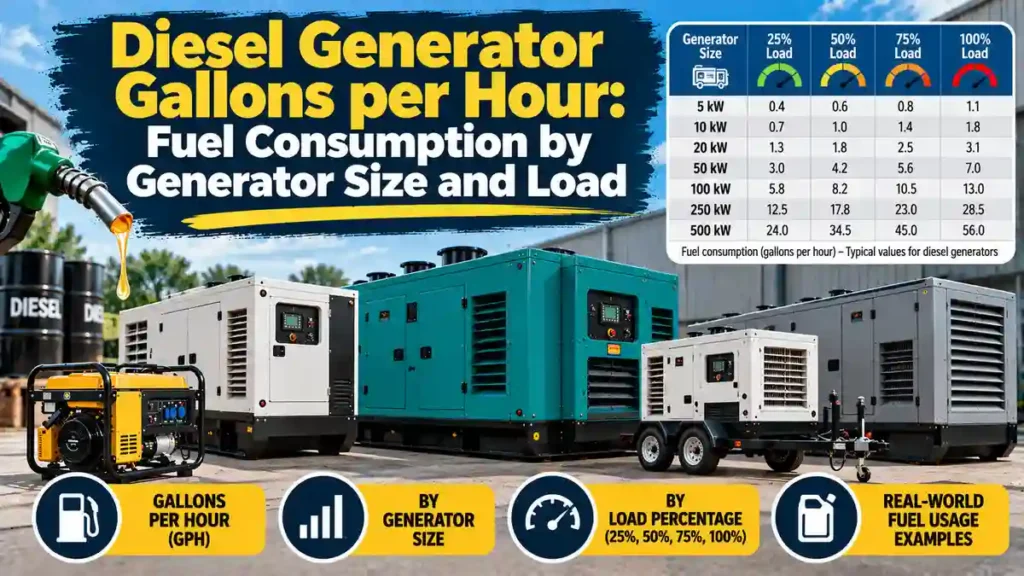


Quick answer: Diesel generator gallons per hour depends mainly on generator size and electrical load. A small 10–20 kW diesel generator may use well under 2 gallons per hour, while a 500 kW unit can use several dozen gallons per hour near full load. The most important thing I want you to remember is that fuel consumption is not fixed: a generator at 25% load normally burns much less fuel per hour than the same generator at 100% load, but it is also usually less fuel-efficient per kWh at very light load.
If you are trying to estimate diesel generator gallons per hour, I do not recommend using one generic number. Generator size, load percentage, engine design, emissions equipment, altitude, temperature, fuel quality, and maintenance condition all affect the answer. What I do instead is start with the generator’s rated kW, estimate the actual percentage of load, then use the manufacturer’s fuel-consumption chart whenever it is available.
In this guide, I will show you practical fuel-consumption ranges by generator size, explain how load changes gallons per hour, and walk through the calculations I use for runtime, fuel cost, and tank sizing. The figures below are planning estimates, not substitutes for the fuel curve for your exact make, model, and engine.
Diesel Generator Gallons per Hour by Size and Load
The table below gives a practical planning range for common diesel generator sizes. I use it for preliminary estimates only. Two generators with the same kW rating can have different fuel burn because the engines, emissions systems, alternators, governors, and efficiency maps may not be the same.
| Generator Size | 25% Load | 50% Load | 75% Load | 100% Load |
|---|---|---|---|---|
| 10 kW | 0.25–0.35 gal/hr | 0.40–0.50 gal/hr | 0.55–0.65 gal/hr | 0.65–0.80 gal/hr |
| 20 kW | 0.45–0.60 gal/hr | 0.75–0.90 gal/hr | 1.05–1.20 gal/hr | 1.25–1.45 gal/hr |
| 30 kW | 0.60–0.80 gal/hr | 1.00–1.20 gal/hr | 1.45–1.70 gal/hr | 1.85–2.10 gal/hr |
| 50 kW | 0.95–1.20 gal/hr | 1.65–1.95 gal/hr | 2.40–2.75 gal/hr | 3.10–3.50 gal/hr |
| 75 kW | 1.35–1.70 gal/hr | 2.45–2.85 gal/hr | 3.60–4.10 gal/hr | 4.70–5.20 gal/hr |
| 100 kW | 1.80–2.20 gal/hr | 3.20–3.70 gal/hr | 4.80–5.40 gal/hr | 6.20–6.90 gal/hr |
| 150 kW | 2.70–3.20 gal/hr | 4.80–5.50 gal/hr | 7.20–7.90 gal/hr | 9.20–10.20 gal/hr |
| 200 kW | 3.40–4.10 gal/hr | 6.30–7.10 gal/hr | 9.40–10.40 gal/hr | 12.2–13.5 gal/hr |
| 300 kW | 5.0–6.0 gal/hr | 9.2–10.5 gal/hr | 13.8–15.5 gal/hr | 18.0–20.0 gal/hr |
| 500 kW | 8.5–10.5 gal/hr | 15.5–18.5 gal/hr | 23.5–27.0 gal/hr | 30.0–35.0 gal/hr |
| 1,000 kW | 17–21 gal/hr | 31–37 gal/hr | 47–54 gal/hr | 61–70 gal/hr |
Again, these are broad planning ranges. When I need a number for purchasing fuel, sizing a day tank, or estimating operating cost, I look for the manufacturer’s published consumption table for the exact rating. For example, one Caterpillar XQ570 prime-rated rental generator is published at about 19 gallons per hour at 50% load, 26.2 gallons per hour at 75% load, and 33.2 gallons per hour at 100% prime load. That is a useful real-world example of why the load percentage matters.


Why Generator Load Changes Fuel Consumption
A diesel engine does not consume the same amount of fuel at every load. If you connect only a small electrical load, the engine still has to overcome internal friction, drive cooling fans and pumps, maintain speed, and keep the alternator energized. That means a lightly loaded generator may burn less fuel per hour but more fuel for every kilowatt-hour it actually produces.
As load increases, fuel consumption per hour increases. However, the engine can become more efficient per unit of useful electricity as it moves away from very light load. This is why I separate two questions:
- How many gallons per hour am I burning?
- How much fuel am I using per kWh of electricity?
They are related, but they are not the same thing. If your main concern is operating cost, I recommend reading my guide on diesel generator cost per kWh after you calculate your gallons per hour.
Technical Details That Affect Diesel Generator Fuel Burn
| Technical Factor | Why It Matters | What I Check |
|---|---|---|
| Rated kW | Larger engines and higher electrical capacity require more fuel at a given load percentage. | Standby, prime, or continuous rating on the nameplate/spec sheet. |
| Actual kW load | Fuel burn follows real electrical demand, not only the generator’s maximum rating. | Controller kW reading or a properly measured load. |
| Load percentage | A 200 kW set carrying 50 kW is at 25% load; carrying 150 kW is at 75%. | Actual kW ÷ rated kW × 100. |
| Engine efficiency | Modern engines can differ in brake-specific fuel consumption and operating map. | Manufacturer fuel-consumption curve. |
| Altitude | Thin air can reduce available engine power and may change operating efficiency. | Manufacturer altitude derating instructions. |
| Ambient temperature | High temperature can reduce air density and cooling margin. | Site temperature and manufacturer rating conditions. |
| Fuel condition | Water, microbial contamination, poor-quality fuel, or restricted filters can hurt combustion and performance. | Fuel quality, filters, water separator, tank condition. |
| Air restriction | A clogged air filter can reduce available oxygen and increase smoke/fuel waste. | Air-filter restriction indicator and service history. |
| Exhaust restriction | Excessive backpressure can reduce power and efficiency. | Exhaust system condition and model-specific backpressure limits. |
| Maintenance condition | Injector, turbo, cooling, sensor, or governor problems can change fuel use. | Service records, fault codes, load-test data. |
How I Calculate Generator Load Percentage
The easiest way to estimate fuel use is to know how much of the generator’s capacity you are actually using. I calculate load percentage like this:
Load percentage = actual electrical load (kW) ÷ generator rated kW × 100
| Generator Rating | Actual Load | Calculated Load |
|---|---|---|
| 20 kW | 5 kW | 25% |
| 20 kW | 10 kW | 50% |
| 50 kW | 37.5 kW | 75% |
| 100 kW | 80 kW | 80% |
| 500 kW | 250 kW | 50% |
If the controller already displays percent load or real kW, I use that rather than guessing from the connected equipment. Motor loads, compressors, pumps, welders, HVAC systems, and electronic equipment can draw different power as operating conditions change.
Gallons per Hour vs. Liters per Hour
Many generator data sheets outside the United States list fuel consumption in liters per hour instead of gallons per hour. The conversion I use is:
US gallons per hour = liters per hour ÷ 3.785
| Liters per Hour | Approx. US Gallons per Hour |
|---|---|
| 5 L/hr | 1.32 gal/hr |
| 10 L/hr | 2.64 gal/hr |
| 20 L/hr | 5.28 gal/hr |
| 50 L/hr | 13.21 gal/hr |
| 100 L/hr | 26.42 gal/hr |
| 150 L/hr | 39.63 gal/hr |
This conversion is especially useful when you compare imported generator sets or manufacturer documents that publish only metric fuel consumption.
How Much Diesel Will a Generator Use in 8, 12, or 24 Hours?
Once I know the hourly consumption, estimating daily fuel demand is straightforward:


Total fuel = gallons per hour × operating hours
| Burn Rate | 8 Hours | 12 Hours | 24 Hours |
|---|---|---|---|
| 1 gal/hr | 8 gal | 12 gal | 24 gal |
| 2 gal/hr | 16 gal | 24 gal | 48 gal |
| 5 gal/hr | 40 gal | 60 gal | 120 gal |
| 10 gal/hr | 80 gal | 120 gal | 240 gal |
| 20 gal/hr | 160 gal | 240 gal | 480 gal |
| 30 gal/hr | 240 gal | 360 gal | 720 gal |
I treat this as a theoretical consumption estimate. A real fuel system needs usable reserve, and the full geometric capacity of a tank is not always the same as usable operating capacity. If you are planning emergency runtime, do not size your fuel inventory with zero margin.
How Long Will a Diesel Generator Run on a Tank?
For a simple first estimate, I use:
Runtime in hours = usable fuel in gallons ÷ gallons per hour
| Usable Fuel | 1 gal/hr | 3 gal/hr | 5 gal/hr | 10 gal/hr |
|---|---|---|---|---|
| 25 gal | 25 hr | 8.3 hr | 5 hr | 2.5 hr |
| 50 gal | 50 hr | 16.7 hr | 10 hr | 5 hr |
| 100 gal | 100 hr | 33.3 hr | 20 hr | 10 hr |
| 250 gal | 250 hr | 83.3 hr | 50 hr | 25 hr |
| 500 gal | 500 hr | 166.7 hr | 100 hr | 50 hr |
| 1,000 gal | 1,000 hr | 333.3 hr | 200 hr | 100 hr |
If you are planning backup power for a facility, I also recommend checking delivery access during outages, minimum supplier delivery quantities, tank regulations, fuel turnover, water control, and stored-fuel maintenance. My article on generator storage covers additional storage considerations, while my diesel fuel quality standards guide explains the fuel side in more detail.
Why an Oversized Generator Can Waste Fuel
One of the most common mistakes I see in fuel estimates is assuming that a much larger generator is automatically safer or better. If you install a 200 kW set but routinely use only 20 or 30 kW, the engine spends much of its life at very light load.
That can create two problems. First, your gallons per hour may be unnecessarily high for the useful electricity you are producing. Second, prolonged low-load operation can contribute to incomplete combustion, carbon deposits, and wet-stacking problems on some diesel engines.
I do not recommend deliberately undersizing a generator either. It still needs enough capacity for steady loads, motor starting, compressors, pumps, HVAC equipment, and any future load you genuinely plan to add. The goal is a correctly sized system, not the smallest possible machine. If you are still choosing a set, see my diesel generator sizing guide.
25% Load vs. 50% vs. 75% vs. 100%
People often assume that if a generator burns 10 gallons per hour at full load, it will burn exactly 5 gallons per hour at half load. In practice, fuel consumption usually does not scale perfectly in a straight line because the engine has fixed losses and its efficiency changes with operating point.
| Load Level | What It Means | Typical Fuel-Efficiency Pattern |
|---|---|---|
| 25% | Generator carries one-quarter of rated kW. | Low hourly burn, but often relatively poor gallons-per-kWh efficiency. |
| 50% | Generator carries half its rated kW. | Often a more efficient operating region than very light load. |
| 75% | Generator carries three-quarters of rated kW. | Commonly an efficient region for many diesel sets, subject to model data. |
| 100% | Generator carries its rated load for the applicable rating. | Highest gallons per hour; verify duty rating and allowable duration. |
I always distinguish between standby, prime, and continuous ratings. A generator’s 100% standby rating is not automatically the same duty condition as 100% prime load. The engine manufacturer’s rating definition matters.
Standby vs. Prime Fuel Consumption
Some generator data sheets list separate fuel-consumption figures for standby and prime ratings. This happens because the available kW and permissible duty cycle can be different.
| Rating | Typical Use | Fuel-Consumption Implication |
|---|---|---|
| Standby | Emergency power during utility failure. | Fuel figures may be listed at 25%, 50%, 75%, and 100% of standby rating. |
| Prime | Variable-load operation where generator is a primary power source. | Prime kW can be lower than standby kW, so the same engine may show different load-point fuel figures. |
| Continuous | Constant-load service where specifically rated for it. | Use the manufacturer’s continuous-rating data rather than applying standby figures. |
If you operate a generator for business, construction, mining, events, remote power, or long-duration off-grid service, I would not estimate fuel solely from a standby spec sheet.
How Much Does Diesel Cost per Hour to Run?
Once you know gallons per hour, you can estimate the fuel-only cost:
Fuel cost per hour = gallons per hour × diesel price per gallon
| Fuel Burn | At $3.00/gal | At $4.00/gal | At $5.00/gal |
|---|---|---|---|
| 1 gal/hr | $3/hr | $4/hr | $5/hr |
| 3 gal/hr | $9/hr | $12/hr | $15/hr |
| 5 gal/hr | $15/hr | $20/hr | $25/hr |
| 10 gal/hr | $30/hr | $40/hr | $50/hr |
| 20 gal/hr | $60/hr | $80/hr | $100/hr |
| 30 gal/hr | $90/hr | $120/hr | $150/hr |
That is only the fuel cost. It does not include oil, filters, maintenance, repairs, depreciation, rental, transport, labor, insurance, or emissions-related service. For a full operating-cost calculation, use my true cost-per-kWh guide.
How I Estimate Fuel for an Emergency Outage
Suppose you have a 100 kW generator and expect it to average about 75% load. Using a planning figure around 5 gallons per hour, a 24-hour outage would require roughly 120 gallons. A 72-hour event would require around 360 gallons.
| Example Burn Rate | 24 Hours | 48 Hours | 72 Hours |
|---|---|---|---|
| 2 gal/hr | 48 gal | 96 gal | 144 gal |
| 5 gal/hr | 120 gal | 240 gal | 360 gal |
| 10 gal/hr | 240 gal | 480 gal | 720 gal |
| 20 gal/hr | 480 gal | 960 gal | 1,440 gal |
I would then add a practical reserve based on the site, expected outage duration, fuel-delivery reliability, and tank configuration. Emergency planning is not just arithmetic; it is logistics.
Why Your Actual Gallons per Hour May Be Higher Than Expected
If your real fuel consumption is noticeably above the manufacturer’s expected range at a similar load, I would investigate before assuming the estimate was wrong. Common causes include overloaded operation, dirty air filters, restricted fuel filters, poor fuel quality, injector issues, turbocharger or charge-air problems, excessive exhaust restriction, incorrect sensor data, or a load that is higher than you think.
Black smoke under load is especially important because it can point toward excessive fueling, insufficient air, or overload. If the engine also slows or struggles when load is applied, see my troubleshooting guide on a diesel generator that bogs down under load.
Why Your Actual Fuel Burn May Be Lower Than the Table
Lower consumption is not necessarily a problem. Your generator may simply be carrying less load than you estimated, or the specific engine may be more efficient than the generic planning range. Measurement error also matters. Fuel-tank gauges are not precision flow meters, and short test periods can produce misleading results.
For accurate fleet or commercial tracking, I prefer fuel-meter data, controller load data, delivered-fuel records, and operating-hour logs over visual tank-gauge estimates.
How to Measure Your Generator’s Real Fuel Consumption
For an owner who wants a practical number, I suggest tracking fuel over a long enough operating period that small gauge errors do not dominate the result. Record the starting fuel quantity, ending quantity, total run hours, and average electrical load.
The calculation is:
Gallons per hour = gallons consumed ÷ engine run hours
| Fuel Used | Run Time | Calculated Burn Rate |
|---|---|---|
| 10 gal | 5 hr | 2.0 gal/hr |
| 24 gal | 8 hr | 3.0 gal/hr |
| 45 gal | 9 hr | 5.0 gal/hr |
| 120 gal | 12 hr | 10.0 gal/hr |
When I compare that number with a spec sheet, I make sure the generator was operating at a similar load percentage. Comparing your 30% real-world load against a manufacturer’s 100% fuel figure does not tell you anything useful.
Does a Diesel Generator Use Fuel When There Is No Load?
Yes. A diesel generator still burns fuel at no load because the engine must remain running at the required speed, overcome friction, drive accessories, circulate coolant and oil, and maintain the alternator’s magnetic field. No-load consumption varies significantly by engine size and design.
This is another reason I avoid leaving a large diesel generator idling unloaded for long periods unless the manufacturer or operating procedure specifically requires it. Regular exercise and load testing should follow the generator maker’s instructions rather than an arbitrary rule.
Can I Reduce Diesel Generator Fuel Consumption?
Usually, the biggest opportunity is not a magic additive or adjustment. It is operating the right-size generator at an appropriate load and keeping it in good condition. I focus on load management, clean filters, sound fuel quality, proper cooling, correct maintenance, and fixing performance faults promptly.
- Match generator size to realistic load rather than grossly oversizing.
- Use load management where practical so large loads do not all start together.
- Maintain air and fuel filters according to the service schedule.
- Keep stored diesel clean and dry.
- Investigate smoke, surging, loss of power, and abnormal fuel consumption.
- Use the manufacturer’s published fuel curve for budgeting.
- For long-duration light loads, consider whether a smaller set, staged generators, or a hybrid battery system is more appropriate.
Fuel Consumption for Homes, RVs, Construction, and Commercial Sites
The same gallons-per-hour principle applies across applications, but the operating pattern changes. A home standby generator may run at varying load as HVAC and appliances cycle. An RV generator may spend long periods at modest load. A construction generator may experience motor-starting surges and changing tool loads. A commercial standby set can pick up a much larger block of load when the transfer switch operates.
| Application | Common Load Pattern | Fuel-Planning Priority |
|---|---|---|
| Home standby | Variable load as appliances cycle. | 24–72 hour outage planning and fuel-delivery access. |
| Camper/RV | Small base load with A/C and appliance surges. | Portable tank capacity, noise, weight, and runtime. |
| Construction | Intermittent tools, compressors, pumps, welders. | Daily refueling schedule and load peaks. |
| Events | Lighting, HVAC, audio, food service, vendor loads. | Continuous runtime and backup fuel logistics. |
| Commercial standby | Large emergency load transferred quickly. | Code, fuel reserve, critical-load duration, maintenance. |
| Prime/off-grid | Long operating hours with variable load. | Efficiency, service intervals, fuel storage, and cost per kWh. |
Frequently Asked Questions
How many gallons per hour does a 20 kW diesel generator use?
As a planning range, I would expect roughly 0.75–0.90 gallon per hour near 50% load and around 1.25–1.45 gallons per hour near full load. Your exact model may differ, so use its fuel-consumption chart whenever possible.
How many gallons per hour does a 50 kW diesel generator use?
A broad planning estimate is about 1.65–1.95 gallons per hour at 50% load and about 3.1–3.5 gallons per hour near full load. The engine and rating determine the actual figure.
How many gallons per hour does a 100 kW generator use?
For preliminary planning, I would use roughly 3.2–3.7 gallons per hour at 50% load, 4.8–5.4 at 75%, and about 6.2–6.9 gallons per hour near full load.
How many gallons per hour does a 500 kW diesel generator use?
A 500 kW set can use roughly 15.5–18.5 gallons per hour around 50% load and about 30–35 gallons per hour near full load, depending on the engine and rating. Actual manufacturer data should control purchasing and tank-sizing decisions.
Is diesel consumption proportional to load?
Not perfectly. The engine has fixed losses and does not have identical efficiency at every operating point. Half load usually uses much less fuel per hour than full load, but it may consume more than exactly half the full-load fuel rate.
What is the best load for fuel efficiency?
There is no universal percentage that applies to every generator. Many diesel engines are more efficient per kWh at moderate-to-high load than at very light load, but the correct answer comes from the manufacturer’s fuel-efficiency map and operating guidance.
Can I estimate fuel from generator kW alone?
You can create a rough planning estimate, but I would not use kW rating alone for final budgeting. You also need actual load percentage, rating type, operating conditions, and model-specific fuel data.
How do I know whether my generator is burning too much diesel?
Measure gallons consumed over a known period, record the average kW load, and compare the result with the manufacturer’s fuel table at the same load. If fuel use is materially higher, inspect load, air intake, fuel system, exhaust restriction, engine condition, and maintenance history.
Bottom Line
If you want to know diesel generator gallons per hour, start with generator size and actual load. Small units may burn fractions of a gallon per hour, while large commercial sets can burn tens of gallons per hour. The table in this article is useful for early planning, but the manufacturer’s fuel curve for your exact generator is the number I would trust for purchasing fuel, designing storage, and estimating operating cost.
Once you know gallons per hour, you can quickly estimate runtime, outage fuel requirements, and fuel-only operating cost. For deeper planning, I recommend combining this information with my guides to diesel generator burn rate, generator cost per kWh, and diesel generator fuel consumption.
Note: Fuel-consumption figures in this article are general planning ranges. Generator manufacturers publish model-specific values under defined test conditions. Use the exact manufacturer data, applicable codes, and a qualified generator professional when sizing critical fuel systems or designing commercial installations.