
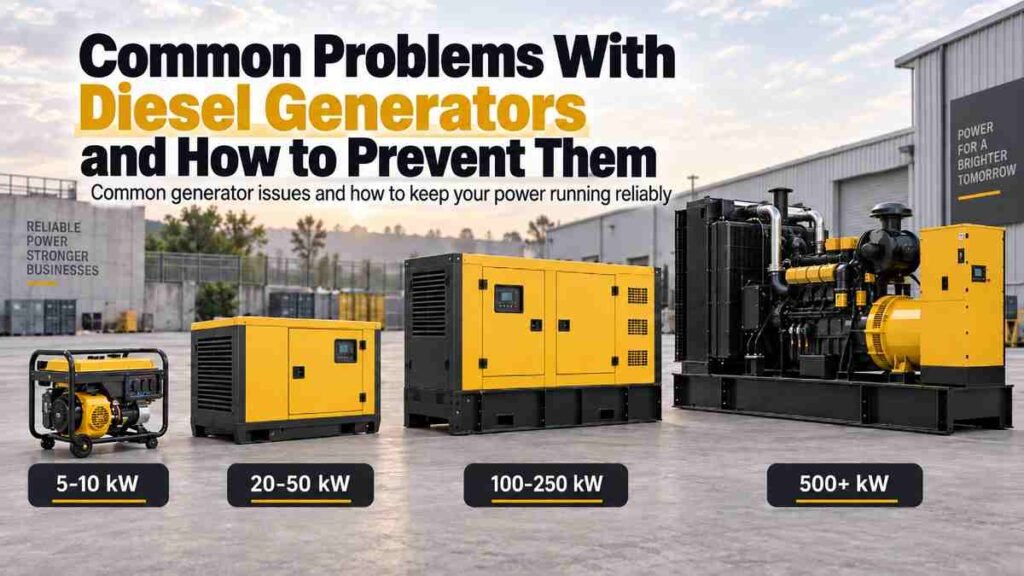
If you depend on a diesel generator for home backup, a business, a farm, a construction site, or emergency power, I do not want you to think of maintenance as something you do only after a fault light appears. A generator may sit quietly for weeks or months and still be expected to start within seconds when utility power disappears. That is exactly why small maintenance problems can become big reliability problems.
In this guide, I will walk you through the most common problems with diesel generators, what causes them, the warning signs I look for, and the practical steps I would use to prevent them. I will also show you which issues you can usually inspect yourself and which ones should be handled by a qualified generator technician.
Common Diesel Generator Problems at a Glance
| Problem | Typical Warning Signs | Common Cause | Best Prevention |
|---|---|---|---|
| Generator will not start | Slow or no cranking, clicking, overcrank alarm | Weak battery, low fuel, control issue, air in fuel | Maintain battery/charger, exercise set, check fuel and controls |
| Contaminated diesel fuel | Rough running, plugged filters, smoke, loss of power | Water, sediment, microbial growth, aged fuel | Keep tank dry, drain water, inspect/polish stored fuel |
| Clogged fuel filter | Hard starting, surging, power loss | Dirt, water, degraded fuel | Replace filter at specified interval; use clean fuel |
| Overheating | High coolant temperature alarm, shutdown | Low coolant, clogged radiator, loose belt, poor airflow | Check coolant, radiator, belts, louvers, ventilation |
| Low oil pressure | Low-oil alarm, shutdown, abnormal engine noise | Low oil, leak, wrong viscosity, filter or lubrication fault | Check oil level and leaks; service with specified oil/filter |
| Wet stacking | Black exhaust residue, smoke, deposits, poor performance | Long periods at very light load | Exercise under adequate load; use load-bank testing when appropriate |
| Battery/charging failure | Slow crank, battery alarm, no crank | Old battery, loose terminals, failed charger | Inspect charger, cables, terminals and battery condition |
| Voltage/frequency problems | Trips, unstable output, equipment complaints | Overload, governor/AVR issue, wiring fault | Correct sizing, load management and professional testing |
| Automatic transfer failure | Generator runs but building remains without power | ATS, breaker, control or sensing issue | Exercise the complete transfer system periodically |
| Exhaust or CO hazard | Exhaust smell, visible leak, CO alarm | Exhaust leak or unsafe portable-generator placement | Repair leaks immediately and follow outdoor-placement rules |
1. Weak or Dead Starting Battery
If a standby diesel generator fails to start during an outage, the battery is one of the first things I check. A diesel engine needs considerable cranking power because of its high compression ratio. A battery that is only marginally weak may turn a small gasoline engine but fail to spin a diesel fast enough to start.
Standby generators add another complication: the battery spends most of its life waiting. That means the battery charger, terminals, cables, and battery condition are just as important as the battery itself. Cummins specifically recommends checking battery connections for cleanliness and tightness because loose or corroded connections create electrical resistance and make starting harder.
How I prevent battery-related no-starts
- I verify that the generator’s battery charger is powered and functioning.
- I inspect terminals for corrosion, looseness, swelling, damaged cables, or heat damage.
- I pay attention to cranking speed during exercise. A noticeably slower crank is an early warning.
- I replace a battery based on condition and the manufacturer’s guidance rather than waiting for it to fail during an emergency.
For critical installations, I also want the starting system tested under load rather than relying only on an open-circuit voltage reading. A battery can show acceptable voltage and still collapse when the starter demands high current.
2. Water, Dirt, and Microbial Contamination in Diesel Fuel
Fuel quality is one of the biggest differences between a generator that is used regularly and a standby unit that may store the same diesel for a long time. Diesel fuel can collect water from condensation, tank leaks, handling, or contaminated deliveries. Water then creates corrosion problems and can support microbial growth at the fuel-water interface.
If you see repeated fuel-filter plugging, dark slime, sediment, erratic engine performance, or water in the separator, I would treat that as a fuel-storage problem rather than simply installing filter after filter. I covered the warning signs in more detail in my guide to water in diesel fuel.
Cummins notes that stored diesel is subject to contamination and deterioration over time, while Yanmar explains that contaminated fuel can load the fuel filter with foreign matter and reduce combustion efficiency and engine performance.
How I prevent fuel contamination
I start with the tank. I keep water out, drain water separators or tank drains where the system provides them, and investigate any recurring water instead of treating it as normal. For large standby tanks, periodic fuel sampling and fuel polishing can make sense, especially when the fuel turnover is low.
3. Clogged Fuel Filters and Fuel Starvation
A diesel generator can have plenty of fuel in the tank and still behave as if it is running out. A restricted filter, blocked pickup, failed transfer pump, plugged vent, air leak, or water separator full of contamination can starve the engine.
The common symptoms are hard starting, unstable speed, loss of power as electrical load increases, or a generator that starts but dies after a short period. Before I blame injectors or the engine itself, I look at the basic supply side.
Filter intervals vary by engine. For example, Yanmar publishes a recommended 500-hour replacement time for certain fuel filters in its maintenance guidance, while current Cummins manuals show maintenance schedules that can include daily/8-hour checks and longer service intervals depending on the model. I never transfer one model’s interval to another generator; I use the exact engine and generator manual.
4. Air in the Diesel Fuel System
Diesel engines do not tolerate air in the low-pressure fuel supply very well. Air can enter after a filter change, if the unit runs out of fuel, through a cracked hose, loose fitting, faulty seal, or suction-side leak.
If the generator cranks normally but will not fire after fuel-system service, I consider lost prime. Some sets have an electric priming pump; others use a manual priming procedure. Follow the manufacturer’s bleed or prime procedure exactly. On modern common-rail engines, I do not recommend randomly cracking injector lines.
5. Overheating
A high coolant temperature shutdown is doing you a favor: it is protecting the engine. The mistake is repeatedly resetting the alarm without finding the cause.
I look for low coolant, coolant leaks, a dirty radiator, blocked ventilation louvers, damaged hoses, a loose or broken fan belt, failed fan drive, bad thermostat, failed coolant pump, or unusually high ambient temperature. Yanmar specifically warns that insufficient V-belt tension can prevent proper cooling and lead to overheating.
| Cooling-System Check | What I Look For | Why It Matters |
|---|---|---|
| Coolant level | Correct level when engine is cool; no unexplained loss | Low coolant reduces heat-removal capacity |
| Radiator | No dirt, insects, oil film, leaves, or blocked fins | Restricted airflow raises coolant temperature |
| Belts | Correct tension and condition | Loose/broken belts can reduce fan or pump operation |
| Hoses | No cracks, swelling, leaks, soft spots | Hose failure can dump coolant quickly |
| Ventilation | Intake and discharge openings clear | Hot-air recirculation can cause repeated shutdowns |
| Coolant concentration | Per engine maker specification | Protects against freezing, boiling and corrosion |
I never remove a radiator or pressure cap from a hot engine. A pressurized hot cooling system can discharge scalding coolant.
6. Low Oil Level or Low Oil Pressure
Most modern generator controls will shut the engine down when oil pressure becomes dangerously low. If I see a low-oil-pressure alarm, I do not simply add oil and restart until I understand why the level or pressure was low.
The simple causes include an oil leak, improper oil level, wrong viscosity, overdue oil/filter service, or a sensor problem. More serious causes can involve the oil pump, bearings, internal leakage, or lubrication-system damage.
Check the dipstick according to the engine manufacturer’s procedure, because the required shutdown/wait time and reading method can vary. If the oil level is normal but the generator reports low pressure, I would stop operating it until the pressure signal is verified. Continuing to run an engine with genuinely low oil pressure can turn a manageable repair into an engine replacement.
7. Dirty Air Filter and Restricted Intake
A diesel engine needs a large amount of clean air, especially under load. A severely restricted air cleaner can reduce power and increase smoke. Dusty construction sites, farm environments, dry climates, and poorly sealed generator rooms can shorten air-filter life dramatically.
I inspect the air-cleaner restriction indicator where fitted and follow the manufacturer’s service method. I do not automatically replace an expensive heavy-duty element every time I see surface dust; some engines are designed around restriction indicators and specified service intervals. At the same time, I never ignore a torn, wet, collapsed, or heavily restricted element.
8. Wet Stacking From Too Much Light-Load Operation
Wet stacking is one of the diesel-specific problems I want every generator owner to understand. It can develop when a diesel engine runs for extended periods at insufficient load and fails to reach an efficient operating condition. Unburned fuel and combustion deposits can accumulate in the exhaust system, and performance can suffer.
Cummins describes wet stacking as a common problem in diesel engines operated for extended periods with little or no load and recommends periodic load-bank use where appropriate. A load bank applies a controlled electrical load so the generator can be tested without risking the building’s critical load.
This is also why I do not like “exercise” that consists of starting a large diesel generator, letting it idle lightly for a few minutes, and shutting it off. The correct exercise routine depends on the generator manufacturer, emissions system, duty and installation. Some Cummins application guidance calls for monthly exercise for at least 30 minutes at not less than 30% rated load, while also noting that manufacturer-specific requirements control.
If you want a deeper explanation of load, duty rating and runtime, see my guide on how long a diesel generator can run continuously.
9. Generator Overload
An undersized generator may start normally and then trip, bog down, smoke, or show unstable voltage when large loads come online. Motors, compressors, pumps, and air conditioners can draw much more current during starting than during normal operation.
I size the generator around simultaneous running load plus the largest relevant starting demand, not by simply adding appliance nameplate watts and hoping for the best. My diesel generator sizing guide explains the process in more detail.
| Load Condition | What You May See | Prevention |
|---|---|---|
| Normal load | Stable voltage/frequency, normal exhaust, normal temperature | Correct sizing and balanced loading |
| Large motor starts | Brief voltage/frequency dip | Allow for motor starting kVA/surge |
| Repeated overload | Breaker trips, alarms, high exhaust temperature, smoke | Shed nonessential loads or increase generator capacity |
| Very light diesel load | Low exhaust temperature, deposits over time | Appropriate loaded exercise/load-bank testing |
10. Unstable Voltage or Frequency
If lights flicker, sensitive equipment complains, or the generator shows unstable output, the problem may be mechanical, electrical, or load-related. Frequency is closely tied to engine speed. Voltage regulation depends on the alternator, excitation system and automatic voltage regulator (AVR), along with wiring and load conditions.
I first check whether the generator is overloaded or whether one large load is cycling on and off. I also look for obvious loose connections and alarm history. Beyond that, voltage-regulator, alternator, governor, sensor and control troubleshooting should usually be handled by someone trained to work around live generator voltages. Generator terminals can be lethal even when the engine itself seems straightforward to service.
11. Automatic Transfer Switch Problems
A standby generator can run perfectly while the house or building remains dark if the automatic transfer switch (ATS) does not transfer the load. That is why I test the backup-power system as a system, not just the engine.
ATS problems can involve utility-voltage sensing, control wiring, a tripped generator breaker, failed actuating components, interlocks, or a generator that is not actually in AUTO mode. Cummins maintenance guidance specifically includes checking that switchgear is in the automatic position and the generator breaker is closed where applicable.
For a clear explanation of how portable and permanently installed systems differ, see my comparison of portable vs. standby diesel generators.
12. Coolant, Oil, Fuel, or Exhaust Leaks
I take every leak seriously because small leaks tend to become larger under heat, vibration and pressure. A small fuel seep is also a fire risk. An exhaust leak can expose people to carbon monoxide and hot exhaust gases.
Cummins recommends inspecting the fuel supply lines and flexible hose sections for leaks, cuts, cracks and abrasion, and inspecting the exhaust system for leaks while the generator runs. If I find a leaking exhaust joint or damaged fuel hose, I shut down the unit and repair it rather than waiting for the next service visit.
13. Carbon Monoxide and Unsafe Generator Placement
This is not just a generator “problem”; it is a life-safety issue. Diesel exhaust contains carbon monoxide (CO), which is colorless and odorless. Portable generators should never be operated inside a home, garage, carport or other enclosed or semi-enclosed space.
The CDC currently advises operating portable generators outdoors more than 20 feet from windows, doors and vents and using battery-powered or battery-backup CO detectors in the home. Permanently installed standby generators have their own manufacturer and code-required placement clearances, so I follow the approved installation instructions for that specific unit.
14. Cold-Weather Starting Problems
Cold temperatures expose marginal batteries, thick oil, fuel-flow problems and failed block heaters. Diesel fuel can also develop cold-flow problems when the temperature falls far enough for wax crystals to restrict filters.
Caterpillar recommends keeping batteries charged, using approved battery/coolant/oil heaters where appropriate, checking coolant freeze protection, and draining the fuel-water separator before cold-weather operation. If you operate in a cold climate, winter preparation should happen before the first severe freeze.
15. Failed Sensors, Alarms, and Control Electronics
Modern generator sets monitor oil pressure, coolant temperature, battery voltage, speed, frequency, voltage, overcurrent and other conditions. Large Caterpillar generator sets, for example, provide protective functions for low oil pressure, high coolant temperature, overcurrent, over/under-voltage and failure to start.
A bad sensor or loose connector can sometimes create an alarm even when the mechanical system is healthy, but I never assume an alarm is “just the sensor.” I verify the actual condition first. If the controller says high coolant temperature, confirm coolant temperature. If it reports low oil pressure, verify oil level and actual pressure using the manufacturer’s diagnostic procedure.
16. DEF and Aftertreatment Problems on Newer Diesel Generators
Some newer mobile and larger diesel generator packages use emissions aftertreatment and may require diesel exhaust fluid (DEF). Problems can include poor-quality DEF, crystallization, plugged filters, failed sensors, dosing faults or regeneration issues.
If your generator has an emissions system, do not treat DEF warnings as optional. Follow the engine manufacturer’s fluid specification and maintenance schedule. Emissions-related derates can reduce available generator power or prevent normal operation.
17. Excessive Vibration, Loose Hardware, and Mounting Problems
Generators vibrate by design, but abnormal vibration deserves attention. I look for loose mounts, cracked exhaust supports, misaligned components, damaged isolators, fan contact, bearing noise, or loose sheet metal. Cummins recommends looking, listening and feeling for unusual noises and vibration during inspection.
A small vibration issue can become an electrical, exhaust, fuel-line or coolant-hose failure if it is ignored long enough.
A Practical Preventive Maintenance Schedule
The table below is a planning guide, not a replacement for your generator’s operation and maintenance manual. Service intervals vary by engine family, generator duty, oil specification, environment, emissions system and manufacturer. Current Cummins manuals, for example, use schedules that may reference daily/8-hour, monthly/100-hour, 250-hour and 500-hour service points, while Yanmar publishes 250- and 500-hour examples for specific components.
| Interval | Checks I Would Plan | Why |
|---|---|---|
| Before operation / daily during continuous use | Walk-around inspection; oil, coolant and fuel levels; leaks; alarms; visible damage | Catches low fluids and leaks before they become shutdowns |
| Weekly | Battery charger status; air intake condition; water separator/tank water where required | Improves starting reliability and fuel quality |
| Monthly | Exercise complete system; inspect belts, radiator/ventilation, batteries, gauges and ATS operation | Finds failures before an outage |
| 250 hours / 6 months (example interval on some engines) | Model-specific oil/filter, belt, cooling and fuel-system tasks | Scheduled preventive maintenance |
| 500 hours / yearly (example interval on some engines) | Model-specific fuel/air filters and additional engine service | Maintains airflow, fuel delivery and engine protection |
| As operating conditions require | Fuel sampling/polishing, load-bank testing, radiator cleaning, shortened filter intervals | Dust, heat, humidity, low load and long fuel storage can require more service |
The Five Checks I Prioritize Before Storm Season
If you only remember a few things from this article, I would prioritize starting reliability, fuel quality, cooling, load testing and transfer operation.
- Start the generator and observe it. Listen to the crank speed, engine sound and exhaust. Check the controller for active or stored alarms.
- Check the diesel fuel. Look for water in separators, sediment, unusual odor or recurring filter contamination. If fuel has been stored for a long time, consider professional sampling.
- Inspect the cooling system. Verify coolant level when cold, inspect hoses and belts, and make sure radiator airflow is not blocked.
- Exercise it under an appropriate load. A standby diesel that only idles lightly is not being proven under real conditions.
- Test the actual transfer system. For a standby unit, I want to know that the generator starts, the ATS transfers, the building load is carried, and the system returns to utility power correctly.
When I Would Call a Generator Technician
I am comfortable recommending basic owner inspections such as fluid levels, visible leaks, battery charger status and keeping air openings clear. I would call a qualified technician for high-pressure fuel-system work, internal engine repairs, alternator or AVR diagnosis, live electrical measurements, ATS internal repairs, repeated protective shutdowns, emissions-system faults, or unexplained overheating and low oil pressure.
I would also use professional load-bank testing for critical standby systems. Cummins notes that load-bank testing verifies generator performance under load and can help address the effects of wet stacking without risking the facility’s normal critical load.
How Generator Size Affects Reliability
Bigger is not automatically better. An undersized generator may be overloaded and suffer voltage/frequency problems. A grossly oversized diesel generator may spend too much time at low load. I want the generator sized to the real electrical demand, including motor starting requirements and expected load growth.
If you are still choosing equipment, my guide to the best diesel generators for home backup power and my article on diesel generator brands and reliability can help you narrow the options.
Frequently Asked Questions
What is the most common reason a diesel generator will not start?
I would check the starting battery and charging system first, followed by fuel level/quality, control position, alarms, fuel-system prime and obvious fluid-level problems. The exact order depends on the generator model and the controller’s alarm history.
How often should I run a standby diesel generator?
Follow the manufacturer’s programmed exercise schedule. More important than simply “running it” is making sure the exercise method meets the manufacturer’s requirements and periodically proves the generator under meaningful load. Some manufacturer guidance calls for monthly loaded exercise, but your exact generator manual controls.
Can old diesel fuel damage a generator?
Degraded or contaminated fuel can plug filters, contribute to injector problems and cause poor engine performance. Long-stored fuel should be inspected and managed rather than assumed to be good simply because the tank is full.
Why does my diesel generator shut down after a few minutes?
Possible causes include overheating, low oil pressure, fuel starvation, a clogged filter, low coolant, an electrical overload, a sensor/control fault or an emissions-related derate. Check the controller’s fault code before repeatedly resetting it.
Why is my diesel generator smoking?
Smoke color and operating condition matter. Black smoke can point to excessive fueling, overload, restricted air or poor combustion. White smoke can occur with incomplete combustion or cold starting, while blue smoke can indicate oil burning. Persistent abnormal smoke should be diagnosed rather than treated as normal diesel behavior.
Is it okay to run a diesel generator with very little load?
Short periods may be unavoidable, but extended light-load operation can contribute to wet stacking on diesel engines. Follow the manufacturer’s exercise recommendations and consider periodic load-bank testing for standby equipment that rarely sees meaningful load.
Should I add diesel additives to prevent generator problems?
I do not automatically add chemicals to every tank. Start with clean, dry, specification-compliant diesel and proper storage. If you have a specific cold-flow, lubricity, storage-stability or microbial-control problem, use an appropriate product in accordance with the engine maker’s fuel requirements and the additive instructions.
Final Thoughts
The best time to discover a diesel generator problem is during a planned inspection, not during a storm, outage or emergency. I focus on the basics because those basics prevent a large percentage of real-world failures: a healthy battery, clean and dry fuel, open airflow, proper coolant and oil levels, realistic loaded exercise, correct generator sizing and a complete test of the automatic transfer system.
I also keep a maintenance log with the date, engine hours, tests performed, fluids added, filters changed, alarms found and repairs completed. A good log makes patterns visible. If a fuel filter starts plugging sooner every service, if coolant keeps disappearing, or if cranking speed is declining, you can act before the generator fails.
Your generator is a system, not just an engine. Fuel storage, batteries, controls, cooling, exhaust, switchgear and transfer equipment all have to work together. Maintain the whole system and you dramatically improve the odds that the generator will do the one job that matters: start and carry the load when you actually need it.
Sources and Technical References
I used current manufacturer and safety guidance while preparing this article, including Cummins standby generator maintenance guidance, Cummins load-bank testing guidance, Yanmar maintenance guidance, Caterpillar cold-weather diesel guidance, and CDC carbon monoxide safety guidance. Always use the operation and maintenance manual for your exact generator model because service intervals and procedures vary.