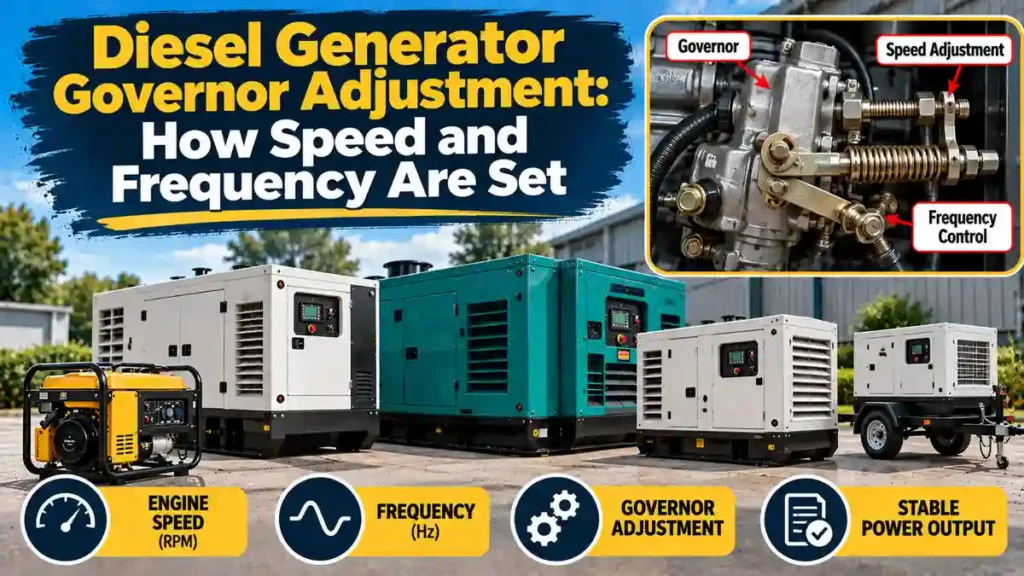


Meta description: Diesel generator governor adjustment explained: learn how engine speed controls frequency, how mechanical and electronic governors work, and how droop, gain, and speed settings are adjusted safely.
Quick answer: A diesel generator governor controls engine speed by increasing or reducing fuel as electrical load changes. Because alternator frequency is directly tied to engine RPM and the number of poles in the generator head, governor adjustment is how I set and stabilize 50 Hz or 60 Hz output on many conventional diesel gensets. A typical 4-pole generator runs at about 1,500 RPM for 50 Hz or 1,800 RPM for 60 Hz. Mechanical governors usually use speed, droop, and sensitivity adjustments, while electronic governors use controller parameters such as speed reference, gain, stability, and droop. I never treat governor adjustment as a simple turn-the-screw repair, because the wrong setting can cause hunting, low frequency, overspeed, unstable load sharing, or equipment damage.
What Does the Governor Do on a Diesel Generator?
When I explain a diesel generator governor, I usually describe it as the system that keeps the engine running at the speed required to make the correct electrical frequency.
A diesel engine naturally slows down when you add load. If the governor did nothing, switching on a large motor, pump, air conditioner, or heater would pull the engine RPM down. Frequency would fall with it. When the load was removed, the engine could speed up and frequency could rise.
The governor constantly reacts to these changes. It senses speed, compares actual speed with the desired speed, and changes fuel delivery. More load requires more torque, so the governor commands more fuel. Less load requires less fuel.


| Governor Function | What It Controls | What You See at the Generator |
|---|---|---|
| Maintain engine speed | Fuel quantity or throttle/fuel-rack position | Stable frequency |
| Respond to added load | Increases fuel | Limits frequency sag |
| Respond to removed load | Reduces fuel | Limits overspeed/frequency rise |
| Control droop | Speed change with load | Intentional frequency change used in some systems |
| Control stability | Response speed and damping | Prevents hunting or oscillation |
How Engine Speed Determines Generator Frequency
The basic relationship between generator speed and electrical frequency is:
RPM = (120 × Frequency) ÷ Number of poles
This formula is one of the most useful things to know when troubleshooting frequency problems. If I know the alternator pole count and desired frequency, I can calculate the synchronous speed immediately.
| Alternator Poles | 50 Hz Speed | 60 Hz Speed | Typical Use |
|---|---|---|---|
| 2 pole | 3,000 RPM | 3,600 RPM | Some small/high-speed generator designs |
| 4 pole | 1,500 RPM | 1,800 RPM | Very common diesel generator configuration |
| 6 pole | 1,000 RPM | 1,200 RPM | Lower-speed specialized sets |
| 8 pole | 750 RPM | 900 RPM | Large low-speed applications |
If you have a 4-pole 60 Hz generator and the engine is running at only 1,710 RPM, the frequency will be approximately 57 Hz. If the same engine reaches 1,890 RPM, frequency will be about 63 Hz. That is why engine-speed problems and frequency problems are often the same problem viewed from two sides.
How Much RPM Equals One Hertz?
On a 4-pole generator, 60 Hz corresponds to 1,800 RPM, so each hertz represents about 30 RPM. On a 2-pole generator, each hertz represents about 60 RPM.
| 4-Pole Frequency | Approximate RPM |
|---|---|
| 55 Hz | 1,650 RPM |
| 57 Hz | 1,710 RPM |
| 58 Hz | 1,740 RPM |
| 59 Hz | 1,770 RPM |
| 60 Hz | 1,800 RPM |
| 61 Hz | 1,830 RPM |
| 62 Hz | 1,860 RPM |
| 63 Hz | 1,890 RPM |
| 65 Hz | 1,950 RPM |
I use these relationships as diagnostic references, not as permission to bypass the manufacturer’s rated-speed instructions.
Mechanical vs. Electronic Diesel Generator Governors
Before I adjust anything, I identify which type of governor the generator uses. The procedure can be completely different.
Mechanical or Hydromechanical Governor
A mechanical governor commonly uses flyweights, springs, levers, and a fuel rack or injection-pump linkage. As RPM rises, centrifugal force moves the flyweights. As load pulls RPM down, the spring and linkage command more fuel.
Common mechanical adjustments can include a rated-speed screw, high-idle setting, droop adjustment, buffer or sensitivity adjustment, and linkage length. The names vary by engine.
Electronic Governor
An electronic governor normally uses a magnetic pickup or engine speed signal, an electronic controller, and an actuator or engine ECM. The controller compares measured speed with the programmed reference and corrects fuel delivery electronically.


Settings may include rated speed, frequency trim, governor gain, stability, damping, ramp rate, droop percentage, load sharing, and idle speed.
| Feature | Mechanical Governor | Electronic Governor |
|---|---|---|
| Speed sensing | Flyweights/mechanical mechanism | Magnetic pickup, crank sensor, ECM |
| Fuel control | Mechanical linkage/fuel rack | Actuator or electronic engine control |
| Adjustment | Screws, springs, linkage | Controller parameters/software |
| Typical precision | Good, but often more droop | Potentially very precise |
| Load sharing | Possible with droop systems | Advanced isochronous/load-sharing control possible |
What Is Governor Droop?
Droop is the intentional reduction in engine speed as load increases. It sounds undesirable, but it is useful in many generator applications, especially when multiple generators operate in parallel.
The basic governor droop equation is:
Droop % = ((No-load speed − Full-load speed) ÷ Full-load speed) × 100
For example, suppose a 60 Hz generator is adjusted to 61.8 Hz at no load and reaches 60.0 Hz at full load. The difference is 1.8 Hz, which equals 3% of 60 Hz. That is approximately 3% droop.
| Droop Setting | Example No-Load Frequency | Example Full-Load Frequency | General Behavior |
|---|---|---|---|
| 0% | 60.0 Hz | 60.0 Hz | Isochronous/constant speed |
| 2% | 61.2 Hz | 60.0 Hz | Small intentional decrease |
| 3% | 61.8 Hz | 60.0 Hz | Common illustrative droop example |
| 5% | 63.0 Hz | 60.0 Hz | Greater load-frequency slope |
The exact way a controller defines and references droop varies, so I never assume this table is the setup procedure for a particular machine.
What Is Isochronous Governing?
Isochronous governing means the governor attempts to hold essentially the same speed as load changes. In simple terms, a 60 Hz machine is commanded to stay close to 60 Hz from no load through rated load rather than intentionally falling along a droop curve.
Cummins describes isochronous control on some PowerCommand systems as maintaining engine speed within tight limits over steady-state load. Caterpillar likewise defines isochronous governing as zero droop—constant engine speed from no load to full load.
Isochronous control is valuable where frequency-sensitive loads are present, but the control system has to be stable and properly tuned. If several generators are paralleled, load-sharing logic becomes important; simply putting several independent machines into isochronous control without proper sharing can make them fight each other.
Governor Gain and Stability: Why a Generator Hunts
If a diesel generator repeatedly speeds up and slows down, you may hear a rhythmic rise and fall in engine sound and see frequency move up and down. This is commonly called hunting or surging.
Governor gain determines how aggressively the controller reacts to a speed error. If gain is too low, the engine may respond sluggishly and show excessive frequency dip when load is added. If gain is too high, the governor can overcorrect, then correct its correction, producing oscillation.
| Governor Behavior | Possible Setting/Problem | What I Check |
|---|---|---|
| Slow recovery after load is added | Gain too low, weak fuel response, overload | Load, fuel system, controller settings |
| Repeated RPM oscillation | Gain too high or poor damping | Governor gain/stability and mechanical linkage |
| Frequency remains low under load | Excess droop, overload, fuel restriction | Rated load, droop, filters, fuel supply |
| Frequency high at all loads | Speed reference too high | Rated-speed setting |
| Frequency unstable only with changing load | Tuning or engine response problem | Governor response, actuator, fuel, load steps |
Cummins specifically warns that governor gain settings should normally be left at their default and adjusted only by experienced personnel. That is sensible advice: if I see hunting, I first rule out fuel restrictions, sticking linkage, air in the fuel, overloaded conditions, actuator problems, and unstable loads before changing control parameters.
Before I Adjust a Diesel Generator Governor
I do not begin with the governor screw or software setting. I first verify that the generator actually has a governor-adjustment problem.
My pre-adjustment checklist is:
- Confirm the generator is supposed to be 50 Hz or 60 Hz.
- Check the nameplate for rated RPM and alternator pole configuration.
- Warm the engine to normal operating temperature.
- Confirm fuel filters are clean and the fuel supply is unrestricted.
- Check air filter condition.
- Make sure the engine is not overloaded.
- Inspect mechanical linkages for binding, looseness, wear, or incorrect spring installation.
- Read controller fault codes before clearing them.
- Measure frequency with a reliable meter or the calibrated generator controller.
- Measure frequency both at no load and under a controlled load.
If your generator bogs down only when a large load is applied, I would also review my guide to diesel generators bogging down under load before assuming the governor is misadjusted.
How I Approach a Mechanical Governor Adjustment
The exact procedure depends on the engine, injection pump, and governor model. I therefore use the service manual for the specific machine. Still, the general diagnostic sequence is useful.
1. Record the Existing Settings
Before touching any adjustment, I photograph screw positions, count exposed threads where practical, and record no-load and loaded frequency. If something becomes worse, I want a reliable baseline.
2. Verify Rated Speed
For a typical 4-pole 60 Hz set, rated synchronous speed is 1,800 RPM. For a typical 4-pole 50 Hz set, it is 1,500 RPM. I confirm the nameplate rather than assuming.
3. Identify the Correct Speed Adjustment
A mechanical injection pump may have several screws. One may set idle, another rated speed, another maximum fuel, and another droop or buffer. Turning the wrong screw can cause smoke, overload, overspeed, or engine damage. I never use a generic online diagram as a substitute for the pump manual.
4. Make Only Small, Documented Changes
If the service manual calls for a speed adjustment, I make very small changes and recheck frequency. I do not make large turns or chase the meter rapidly.
5. Test Under Load
No-load frequency alone does not tell me whether governor performance is correct. I apply load in controlled steps and observe frequency dip, recovery, smoke, engine sound, voltage, and current.
6. Recheck Overspeed Protection
I never defeat or bypass an overspeed shutdown to make governor tuning easier. Overspeed protection is an important independent safety layer.
Electronic Governor Adjustment
Electronic systems can look easier because the settings appear on a controller screen or laptop, but they can be less forgiving because several parameters interact.
Typical electronic parameters include:
| Parameter | Purpose | Risk If Incorrect |
|---|---|---|
| Rated speed/frequency reference | Sets target speed | Constant high or low frequency |
| Gain | Controls response strength | Hunting or sluggish response |
| Stability/damping | Controls oscillation | Slow recovery or instability |
| Droop | Sets load-speed slope | Poor frequency control/load sharing |
| Ramp rate | Controls acceleration/load transition | Slow or abrupt transitions |
| Load-share parameters | Coordinates parallel machines | Uneven load or reverse power |
On full-authority electronic engines, the generator controller may not directly move the fuel rack at all. Instead, it sends a speed reference and governor information to the engine ECM over a communications network. This is another reason I avoid changing parameters without the correct service documentation.
What Frequency Should I Set at No Load?
There is no single universal answer because it depends on governor mode.
With an isochronous electronic governor, the target may simply be 60.0 Hz or 50.0 Hz. With a droop governor, no-load frequency may intentionally be higher so that frequency falls toward nominal as load increases.
For example, a system designed for approximately 3% droop with 60 Hz at rated load may operate near 61.8 Hz at no load. That does not mean every 60 Hz generator should be adjusted to 61.8 Hz. A portable or standby generator with isochronous control may be intended to remain very close to 60 Hz throughout the load range.
How Much Frequency Variation Is Acceptable?
I use the manufacturer’s published regulation specification as the controlling limit because generator designs differ. Some electronically governed sets hold steady-state frequency very tightly, while older mechanical governors may have several percent droop.
I also care about transient behavior. A generator can be perfectly adjusted at steady load and still experience a brief frequency dip when a large motor starts. The important questions are how far frequency falls, how quickly it recovers, whether voltage remains acceptable, and whether the engine is overloaded.
If you want to verify general generator performance before tuning, see how to test whether a diesel generator is working properly.
Low Frequency Under Load Does Not Always Mean the Governor Needs Adjustment
This is one of the most common mistakes I see in troubleshooting. If frequency falls under load, someone turns up the governor. But the real problem may be that the engine cannot produce enough power.
Possible causes include:
- Clogged fuel filters
- Air in the fuel system
- Restricted fuel pickup or tank vent
- Dirty air filter
- Weak turbocharger
- Injector problems
- Excessive electrical load
- Incorrectly sized generator
- Engine mechanical wear
- Hot fuel or poor fuel quality
Turning up the governor does not create horsepower. It may simply command more fuel and create smoke while the engine still fails to hold speed.
High Frequency: Why It Happens
If frequency is consistently too high, I check the speed reference, throttle/fuel linkage, actuator position, governor spring setup, and controller configuration. A sticking linkage or failed actuator can also prevent the governor from reducing fuel properly.
A sudden uncontrolled speed increase is different from a small adjustment error. If the engine is accelerating unexpectedly or approaching overspeed, I shut it down using the normal or emergency procedure as appropriate and do not continue experimenting with the governor.
Governor Hunting After Maintenance
If hunting begins immediately after service, I look for something that changed. A spring may have been installed in the wrong hole, a linkage may be binding, a fuel filter may contain trapped air, an actuator connector may be loose, or a controller parameter may have been reset.
General generator problems can overlap, so I also use the troubleshooting framework in common diesel generator problems and prevention.
Governor Adjustment and Generator Voltage Are Different
Governor adjustment primarily controls engine speed and therefore frequency. Voltage is primarily controlled by the alternator excitation system and automatic voltage regulator (AVR).
| Problem | Primary System to Check |
|---|---|
| Frequency too low/high | Engine speed/governor |
| Frequency hunts | Governor, engine fuel response, load |
| Voltage too low/high with correct frequency | AVR/excitation/alternator |
| Voltage and frequency both collapse under load | Overload or engine power problem first |
| Voltage fluctuates while frequency is steady | AVR/excitation/load issue |
This distinction helps prevent unnecessary governor changes when the real fault is electrical.
Governor Adjustment on Paralleled Generators
Paralleled generators are where I become much more conservative. Governor settings affect real-power sharing between machines. Droop, isochronous load sharing, import/export control, synchronization, and reverse-power protection all interact.
Caterpillar explains that droop machines follow a speed/load relationship, while isochronous machines maintain system frequency and absorb load changes. Poor configuration can result in unstable loading, frequency changes, or one generator carrying far more than its share.
If a generator is connected to a utility, microgrid, or another generator, I do not recommend changing droop, gain, or load-sharing parameters without a qualified generator controls technician.
Common Governor Symptoms and What They Usually Mean
| Symptom | Likely Areas to Inspect |
|---|---|
| Steady 57 Hz on a 60 Hz set | Speed reference, overload, fuel restriction, excessive droop |
| Steady 63 Hz | Speed reference too high, linkage/actuator problem |
| 58–62 Hz repeatedly | Hunting, excessive gain, fuel/actuator instability |
| 60 Hz no load, 54 Hz full load | Excess droop, overload, insufficient engine power |
| Frequency falls only when motor starts | Transient response, motor starting load, generator sizing |
| Frequency correct but voltage low | AVR/excitation rather than governor |
| Generator shuts down on overfrequency | Overspeed, incorrect setpoint, actuator/governor fault |
Tools I Use to Check Governor Performance
For a basic check, I want a trustworthy frequency display. For professional setup, additional instruments make diagnosis much safer and more accurate.
| Tool | Purpose |
|---|---|
| True-RMS multimeter with Hz function | Measure output frequency and voltage |
| Optical/contact tachometer | Verify engine RPM independently |
| Clamp meter | Measure load current |
| Load bank | Apply controlled generator load |
| Generator controller/service software | Read speed references, faults, and governor parameters |
| Service manual | Identify correct adjustment and limits |
A Safe Governor Troubleshooting Sequence
If I am faced with incorrect diesel-generator frequency, I work in this order:
- Read the nameplate and manual.
- Confirm 50 Hz or 60 Hz rating.
- Confirm rated engine RPM.
- Warm the engine.
- Measure no-load frequency.
- Inspect fuel and air systems.
- Check linkage or electronic actuator operation.
- Apply a known load in controlled steps.
- Record RPM and frequency at each load.
- Determine whether the pattern looks like normal droop, overload, poor engine response, or governor instability.
- Only then consider a documented governor adjustment.
- Re-test from no load through the required load range.
If the engine will not start reliably in the first place, governor adjustment is premature. See why a diesel generator will not start.
When I Would Stop and Call a Generator Technician
I would bring in an experienced generator technician if the machine is paralleled, the governor requires proprietary software, the engine repeatedly overspeeds, frequency oscillation is severe, the linkage has been altered, the generator serves critical life-safety loads, or adjustment requires working around exposed energized equipment.
I would also call a technician if frequency remains wrong after the fuel, air, load, and linkage checks are completed. Continued adjustment can hide a failing actuator, injection-pump problem, ECM fault, speed-sensor problem, or worn governor.
Regular maintenance helps prevent many of these problems; see how often diesel generators should be serviced.
Frequently Asked Questions
What RPM should a diesel generator run at?
It depends on frequency and alternator pole count. A common 4-pole generator operates at approximately 1,800 RPM for 60 Hz or 1,500 RPM for 50 Hz. A 2-pole machine operates at approximately 3,600 RPM for 60 Hz or 3,000 RPM for 50 Hz.
Does the governor control generator voltage?
Not directly. The governor controls engine speed and therefore frequency. The AVR primarily controls voltage by adjusting alternator excitation.
Can I turn up the governor if frequency is low?
I first determine why frequency is low. If the engine is overloaded or starved for fuel, turning up the speed setting may not fix the underlying problem and can create new problems at no load.
Why does my generator frequency drop when I add load?
Some drop can be normal on a droop-governed machine. Excessive drop can come from overload, incorrect droop settings, clogged filters, poor engine performance, weak governor response, or an undersized generator.
What is governor droop?
Droop is the intentional reduction in governed speed as load increases. It can help generators share load in parallel systems.
What does isochronous mean?
Isochronous governing means the controller attempts to maintain essentially constant speed and frequency as steady-state load changes.
Why does my diesel generator hunt?
Possible causes include excessive governor gain, poor damping, binding linkage, an unstable actuator, air in the fuel, fuel restrictions, injector problems, or rapidly changing loads.
Should I adjust governor gain myself?
I would be cautious. Manufacturer guidance such as Cummins’ PowerCommand documentation states that governor gain should normally be adjusted only by experienced personnel. Incorrect gain can make the generator unstable.
Final Thoughts
When I adjust or diagnose a diesel generator governor, I remember one fundamental relationship: engine speed determines electrical frequency. On a typical 4-pole set, 1,500 RPM corresponds to 50 Hz and 1,800 RPM corresponds to 60 Hz.
But frequency adjustment is not simply about turning an engine-speed screw. I first determine whether the generator uses a mechanical or electronic governor, whether it is intended to run in droop or isochronous mode, whether the engine can actually carry the connected load, and whether fuel, air, linkage, sensors, and actuators are working correctly.
For a standalone genset with a documented mechanical speed adjustment, a careful frequency check and small manufacturer-approved adjustment may be straightforward. For electronic controls, severe hunting, repeated overspeed, or paralleled generators, I would have an experienced generator technician perform the tuning. That approach protects both the engine and the equipment depending on the electricity it produces.