
Quick Answer
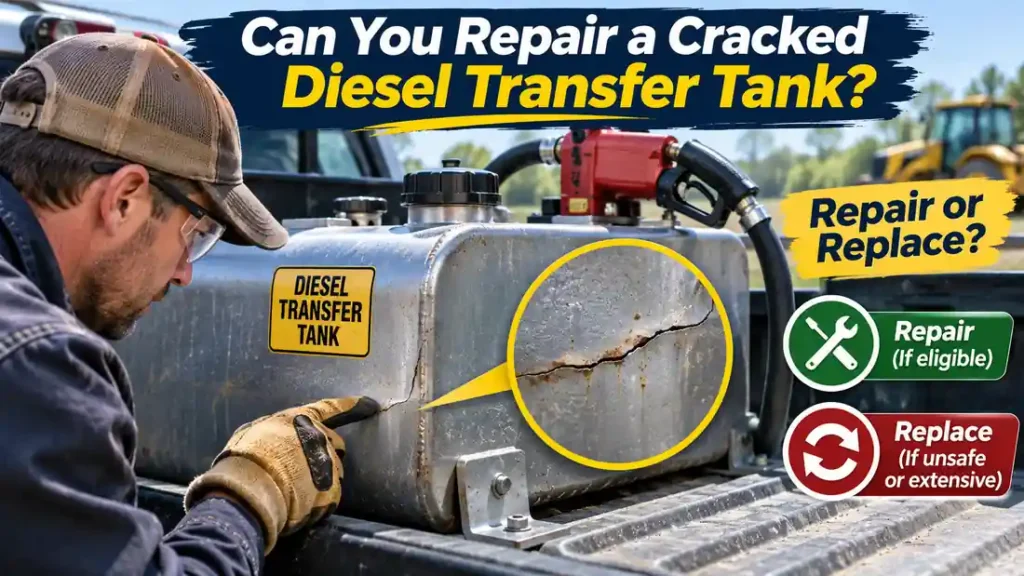
Yes, some cracked diesel transfer tanks can be repaired, but not every crack should be repaired. A qualified tank-repair specialist may be able to restore a localized crack in a sound steel or aluminum tank if the manufacturer permits it, the applicable rules allow it, and the tank passes the required inspections and tests afterward. If the crack is near a mounting bracket, crosses a weld, sits in corroded or fatigued metal, or appears on a plastic tank, replacement is usually my preferred choice. Stop using a leaking tank immediately. Never weld, grind, or torch-cut a tank that has held fuel yourself: an “empty” tank can still contain ignitable vapor.
First, Make Sure You’re Looking at a Crack
A diesel transfer tank is the auxiliary container used to carry and dispense diesel to equipment, tractors, generators, or other machinery. It isn’t necessarily the same as a vehicle’s engine-supply fuel tank or a DOT specification cargo tank. Their construction standards and repair rules can differ, so I begin by identifying the actual tank and its markings.
I then look for the origin of the wet area. A failed gasket, loose hose connection, bad pump seal, or damaged threaded fitting can make a perfectly sound tank look cracked. Diesel also travels along seams and mounting rails before dripping, which makes the visible drip point misleading.
If diesel is actively escaping, I first follow the emergency steps in What to Do if Diesel Leaks from Your Transfer Tank before considering any inspection or repair.
My first step is non-invasive: shut down fuel transfer, isolate the equipment, keep ignition sources away, and use appropriate spill containment. I don’t operate the tank again until the leak’s cause is confirmed. If fuel is escaping rapidly or the spill is beyond safe control, I move people away and contact the appropriate emergency or spill-response service.
Quick-reference table: What the damage tells you
| Finding | Likely issue | My recommended action |
|---|---|---|
| Wet around a threaded fitting | Damaged thread seal or fitting | Have the fitting and sealing method inspected; replace approved parts |
| Drip at pump or hose | Failed hose, connector, or gasket | Isolate and service the component; inspect the tank separately |
| Fine line in steel shell | Possible metal-fatigue crack | Remove from service; obtain professional structural assessment |
| Crack through a welded seam | Weld or adjacent-metal failure | Specialist evaluation; replacement often makes more sense |
| Rust pits near a leak | Loss of wall thickness | Usually replace rather than cover weakened metal |
| Split beside mounting foot | Repeated flexing or poor support | Replace unless an engineered repair is expressly approved |
| Cracked molded plastic | Damaged fuel-container wall | Replace the certified container; avoid improvised patches |
Diesel Transfer Tank Materials and Technical Details
Before deciding whether to repair a diesel transfer tank, I want to know what it’s made from. The same-looking crack can behave quite differently in steel, aluminum, and high-density polyethylene (HDPE).
| Technical factor | Steel transfer tank | Aluminum transfer tank | Fuel-rated HDPE container |
|---|---|---|---|
| Typical strengths | Tough, widely available | Lighter, resists red rust | Lightweight, corrosion-resistant |
| Common damage mechanisms | Corrosion, vibration fatigue, impact | Fatigue at welds or brackets, impact | UV aging, stress cracking, impact |
| Structural crack repair | Sometimes by qualified specialist | Sometimes by qualified aluminum specialist | Generally replace unless manufacturer has a certified repair program |
| Welding/hot-work concern | Extreme fire/explosion hazard without professional preparation | Same fuel-vapor hazard plus material-specific welding needs | Hot work is not an acceptable DIY fix |
| Warning signs | Pitting, thinning, spreading rust | Hairline cracks near weld toes | Whitening, brittle surface, split corners |
| Return-to-service requirement | Manufacturer-approved assessment and testing | Manufacturer-approved assessment and testing | Manufacturer-approved replacement or certified process |
Important: There is no universal “safe crack length,” welding setting, wall thickness, or test pressure for all transfer tanks. Those details depend on the tank’s design, markings, service conditions, and applicable requirements. I would not select a procedure just because another tank owner posted a successful repair.
For broader container-material guidance, see Can You Store Diesel in Plastic Containers?.
What Causes a Diesel Transfer Tank to Crack?
1. Vibration and metal fatigue
A truck-mounted transfer tank sees continuous movement. Rough roads make the tank, brackets, pump, hoses, and diesel load move at slightly different rates. Over time, repeated flexing can concentrate stress around welds, mounting points, or sharp corners. A crack that is barely visible today may grow without another obvious impact.
2. Loose or uneven mounting
I pay special attention to how the tank sits in the bed. If one mounting point carries more load than the others, the shell can twist. A repaired crack may reopen if the original mounting problem remains. Repairing the metal without fixing the cause is like replacing a worn tire without correcting the alignment.
3. Corrosion and trapped moisture
Steel tanks can corrode beneath mounting feet and in locations that collect water. Inside the tank, water can settle beneath diesel and contribute to corrosion. A small leak surrounded by pits is not an isolated crack; it is evidence that the surrounding metal may be weak too. For the fuel side of this problem, I recommend How Long Can Diesel Be Stored in a Container?.
Can You Weld a Cracked Diesel Transfer Tank?
A qualified professional may be able to weld certain metal tanks, but welding a used fuel tank is never an ordinary DIY welding job. Diesel burns less readily than gasoline under many conditions, yet residues and vapor inside a tank can still ignite or explode. Emptying a tank is not the same as making it safe for hot work.
OSHA’s welding rules prohibit hot work on used tanks until they’re thoroughly cleaned of hazardous materials, and require appropriate disconnection, venting, and preparation. A competent facility must evaluate cleaning, vapor hazards, confined spaces, materials, fire prevention, the repair design, and any required inspection or certification. I would not try to achieve those conditions with an open cap, a garden hose, or a household fan.
A specialist should also confirm which rules apply. A pickup-bed transfer tank used to dispense diesel is not automatically subject to every rule governing a commercial vehicle’s engine fuel tank or a DOT cargo tank. For regulated tanks, an unauthorized structural repair may jeopardize compliance. The correct answer comes from the tank’s intended use, rating, labels, manufacturer, and the rules for that configuration.
What about epoxy, putty, or a rubber patch?
I see the appeal: a small tube costs much less than a new tank. But an adhesive patch may seal a visible opening without restoring the original strength of a cracked structural wall. Diesel compatibility alone does not prove that a product can survive vibration, changing fuel levels, or loading at a mounting bracket.


I would treat a sealant only as a temporary leak-containment measure if its manufacturer specifically allows that use, never as permission to keep transporting diesel in a structurally cracked tank. I would not rely on generic silicone, tape, sheet-metal screws, or a patch over rust. For a gasket or replaceable fitting, the right fuel-rated replacement part is a different matter: it may solve the leak without modifying the tank body.
What to Do When You Discover a Crack
Here’s the order I recommend. These are owner-level safety and decision steps—not welding or tank-gas-freeing instructions.
- Stop transferring or transporting fuel. Turn off the pump and engine where safe, and prevent further use.
- Control the area. Keep heat, smoking, sparks, and unauthorized people away. Use suitable absorbents or containment without putting yourself at risk.
- Arrange safe fuel removal. Have trained personnel transfer recoverable fuel into an appropriate, labeled diesel container. Don’t improvise a drain or empty fuel onto the ground.
- Document the problem. Photograph the leak, tank identification plate, mounting arrangement, and nearby damage without disturbing the crack.
- Contact the manufacturer or a qualified tank shop. Ask whether the tank design permits repair and which inspection and post-repair tests are required.
- Correct the underlying cause. Have damaged mounting hardware, hoses, supports, or corrosion conditions corrected before any approved return to service.
- Keep a record. Save the inspection results, repair authorization, test report, and any updated certification or service limitations.
I would never pressurize a suspect tank with shop air to “see where it bubbles.” An unapproved pressure test can introduce serious hazards or damage the tank. Leak testing belongs with the qualified shop using the appropriate manufacturer-approved procedure.
Repair or Replace? My Three-Question Decision Guide
I use three questions that make the choice more practical: Is the damage localized? Is the tank structurally sound? And is an approved repair worth the total cost?
| Your situation | Repair candidate? | My decision |
|---|---|---|
| Replaceable gasket leaks; shell intact | Yes, component service | Replace the faulty seal or fitting |
| One localized steel crack; sound surrounding metal | Possibly | Seek manufacturer approval and qualified assessment |
| Small aluminum crack away from mounting loads | Possibly | Ask an aluminum tank specialist to evaluate |
| Crack at bracket, corner, or weld with visible distortion | Unfavorable | Lean toward replacement |
| Multiple cracks, widespread pitting, or repeated failure | Poor | Replace the tank |
| Molded plastic wall is cracked | Generally no | Replace with a suitable fuel-rated container |
| Tank lacks identification or required compliance evidence | Uncertain | Do not return to service without resolving status |
My personal threshold is conservative: if the shop cannot explain why the crack formed, how the repaired structure will remain reliable, and what testing proves that reliability, I’d replace the tank even when the proposed weld looks tidy.
Worked Example: Does Repairing a 75-Gallon Tank Save Money?
Imagine you have a 75-gallon steel diesel transfer tank with a fine crack near a mounting foot. A shop says it might be repairable, but the tank needs cleaning, an assessment, and controlled testing. All prices below are illustrative estimates, not current market quotations.
| Cost item | Example amount |
|---|---|
| Professional cleaning and preparation | $200 |
| Structural inspection and approved repair | $325 |
| Required post-repair testing/documentation | $125 |
| Total potential repair bill | $650 |
| Comparable replacement tank | $900 |
| Initial apparent savings | $250 |
The arithmetic looks simple: $900 − $650 = $250 saved. But repair costs 72% of replacement ($650 ÷ $900 × 100). That’s before downtime, possible reinstallation work, or a second failure. Because the crack is near a mounting foot, I would lean toward replacement rather than spend most of a new tank’s price on an uncertain structural repair.
There’s a second number I consider: a full 75-gallon load of diesel weighs roughly 533 pounds (75 × 7.1 pounds per gallon), not including the tank, pump, or hardware. That substantial moving load helps explain why mounting-related cracks deserve scrutiny. The 7.1-pound figure is an approximate fuel weight; actual density varies with formulation and temperature.
I don’t use a universal repair-cost cutoff. For a valuable specialty tank with factory support, an approved repair could still make sense. But for an ordinary transfer tank, the combination of structural uncertainty and high repair cost often changes my answer.
How I Would Help Prevent the Next Crack
Prevention begins with the supports. I would check that mounts are suited to the model, the tank cannot rub against the truck bed, and pump and hose arrangements don’t pull on the wall. I also want a regular inspection routine—especially after a hard impact, an unusual rattle, or a change in how the tank is secured.
| Inspection point | When I’d check it | What I’m looking for |
|---|---|---|
| Tank underside and mounting feet | Before regular use; after rough travel | Cracks, corrosion, looseness |
| Weld seams and corners | During routine visual inspection | New lines, stains, distortion |
| Pump, hose, and fittings | Before dispensing | Wetness, chafing, damaged seals |
| Cap, vent, and labels | At routine service | Damage, obstruction, missing information |
| Fuel condition | During maintenance or extended storage | Water, sediment, unusual appearance |
I would never block a designed vent or modify brackets without checking the manufacturer’s instructions. Good fuel handling also matters: the more often a tank is contaminated or left in wet conditions, the harder it is to keep its interior healthy. My related guide to What Color Container Should Diesel Be Stored In? covers clear fuel identification when you move diesel into another suitable container.
Frequently Asked Questions
Can I repair a small hairline crack myself?
I wouldn’t. A hairline crack in the tank shell can indicate fatigue or thinning beyond what you can see. It’s reasonable to document it and contact the manufacturer; it isn’t reasonable to grind, weld, or keep transporting fuel until it gets worse.
Can I use diesel-resistant epoxy on a transfer tank?
I would not use an adhesive as a substitute for structural integrity or required certification. A product intended for a minor leak is not automatically approved for a moving, fuel-carrying tank. Follow the tank and repair-product manufacturers’ limitations.
Can I keep using the tank if the crack isn’t leaking yet?
No—that isn’t my recommendation. A visible structural crack means the tank may fail under vibration or a full fuel load even before fuel escapes. Remove it from service and have it evaluated.
Final Verdict
A cracked diesel transfer tank is sometimes repairable, but it should never be treated as a routine patch job. I’d consider a professional repair only for a limited defect in otherwise sound metal, where the manufacturer and applicable rules permit it and the qualified shop can document safe return to service. I would replace tanks with fatigue around mounts, widespread corrosion, repeated cracking, or damaged plastic walls.
A sound tank, properly supported, is cheaper than a fuel spill or an avoidable shutdown.
Pingback: Choosing Between Manual and Automatic Diesel Transfer: Which Works Best?
Pingback: Cost of Operating a Diesel Transfer Tank vs. Fuel Delivery Services -