
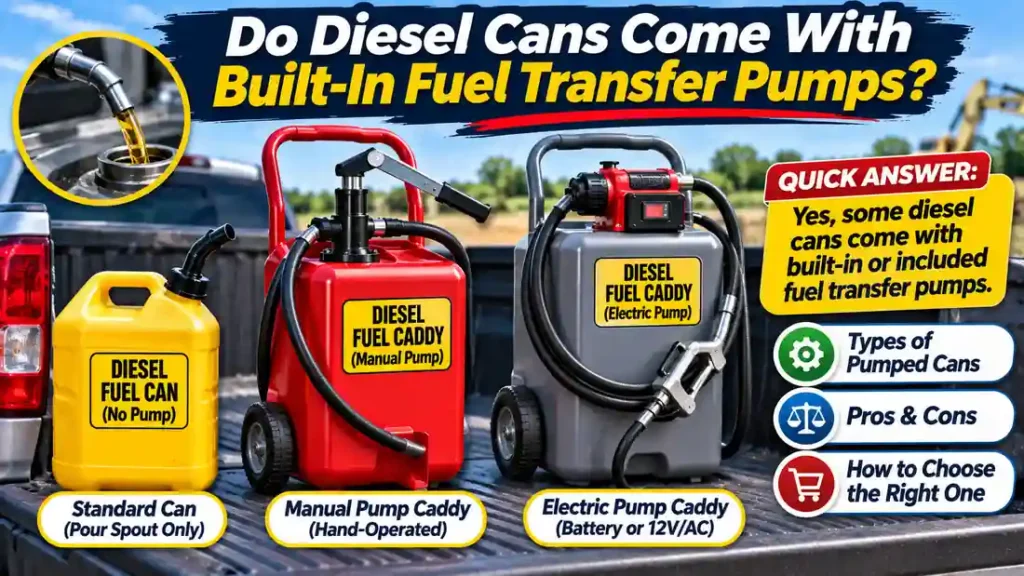
QUICK ANSWER
Yes, some diesel fuel containers come with a built-in or factory-included fuel transfer pump, but most ordinary 1- to 5-gallon diesel cans do not.
Standard portable cans typically use a controlled pouring spout. Larger wheeled fuel caddies may include a hand-operated siphon pump, while certain powered fuel stations include a battery-powered or cord-powered electric pump.
My recommendation: For an occasional 2- to 5-gallon fill, a properly rated diesel can may be all you need. If you regularly move 10 gallons or more, or have to fuel a machine with an awkward filler neck, a purpose-built diesel-rated caddy with an included pump can make the job easier and more controlled. Always confirm whether the product actually includes the pump; pump-ready and pump included are not the same thing.
What Does “Built-In Pump” Mean on a Diesel Can?
When I see the phrase diesel can with pump , the first thing I check is whether the pump is really part of the purchase. Online listings sometimes mix three products that look similar in photos: a plain fuel can, a wheeled container sold with a removable pump-and-hose assembly, and a powered fueling station that arrives with its own pumping system.
A pouring nozzle isn’t a fuel transfer pump. A gravity-fed hose isn’t necessarily an electric pump either. The distinction matters because it affects how quickly you can fill a tractor, generator, skid steer, or other diesel-powered machine—and whether the container can sit below the machine’s filler opening.
I divide them into four practical groups.
| Container or fueling setup | How diesel moves | Pump normally included? | Best use |
|---|---|---|---|
| Standard 1–5 gal diesel can | Tip and pour through approved spout | No | Occasional small refills |
| Safety can with controlled spout | Hand-operated dispensing or pouring mechanism | Usually no separate transfer pump | Workplaces requiring approved safety cans |
| 10–15 gal wheeled manual-pump caddy | Hand pump and/or gravity-assisted siphon | On selected models, yes | Tractor, mower, generator, or equipment refills |
| Powered 10–15 gal fuel station | Electric pump, hose, and nozzle | On selected models, yes | Repeated filling without lifting a heavy can |
| Larger transfer tank with mounted pump | Separately specified 12V, 24V, or AC system | Varies by package | Frequent field fueling and higher volumes |
For more on container material, see my guide to storing diesel in plastic containers .
Do Regular 5-Gallon Diesel Cans Have Pumps?
Usually, no. A typical yellow 5-gallon diesel can is designed for safe carrying, storage, and controlled pouring. The spout may have a valve, safety mechanism, or child-resistant feature, but that doesn’t make it a pumping system.
That’s not a drawback if you only refill a small tank occasionally. A simple can has fewer components to maintain, costs less than a powered fuel station in many product ranges, and doesn’t require batteries or electrical connections. However, five gallons of diesel alone weighs roughly 35.5 pounds , using an illustrative density of 7.1 pounds per gallon. Add the can’s weight and lifting becomes less convenient, particularly when the machine’s filler is high.
I would not improvise by fitting a random pump through the cap. A pump, hose, seal, or adapter must be compatible with both diesel and the specific container. It also must not defeat the container’s approved closure, spill-control features, or vent arrangement.
If choosing a color-coded container is part of your shopping process, read what color container diesel should be stored in . Yellow is common for diesel identification, but the actual diesel rating and required markings matter more than color alone.
The Three Pump Systems You Are Most Likely to Find
1. Hand-operated pump or siphon caddy
A manual-pump caddy usually combines a larger wheeled fuel container with a long hose and hand-operated nozzle assembly. Depending on the design, pumping the handle may start a siphon when the fuel container is positioned higher than the receiving tank. If the receiving fill point is higher, the user may need to keep operating the handle, and fuel transfer may be slower.
This is a useful distinction because advertisements sometimes describe the same product as a pump and a gravity-feed dispenser . Both descriptions can be correct for a hybrid system. But I would not expect the advertised gravity-assisted flow rate when trying to push fuel uphill.
2. Battery-powered integrated fuel pump
A powered caddy moves fuel using its own motor. Some portable units use replaceable batteries, which can be convenient if you fuel equipment away from an outlet. They avoid repeated handle squeezing, but batteries eventually need replacing and transfer speed can depend on the power source.
I check the required batteries and whether they are included. I would never substitute a household water-transfer pump.
3. Cord-powered or vehicle-powered fuel station
Other powered stations accept AC power or an approved vehicle power connection. These can deliver higher flow than hand pumping, but the faster rate means I pay closer attention to the receiving tank’s fill level, nozzle control, hose condition, and the fuel station’s operating instructions.


Power-source options are model-specific ; not every version includes a 12V connection.
Real-World Examples: What Comes in the Box?
To make the differences concrete, I looked at two types of 14-gallon diesel fuel caddies currently described by manufacturer specifications. These are examples of product configurations, not a ranking of the best models or a guarantee that every store stocks them.
| Manufacturer example | Fuel capacity | Pump arrangement | Published flow | Important detail |
|---|---|---|---|---|
| Scepter Duramax wheeled diesel container, FDMD140/141 | 14 gal | Included manual pump/siphon hose arrangement | Up to 2 GPM in siphon mode | Gravity works best with caddy outlet above receiving tank |
| Scepter Powered Fueling Station diesel , PFSD1411 | 14 gal | Included electric dispensing pump | 4.5 GPM using 8 AA batteries; approximately 5.5–6 GPM using power cable | AC cord is listed; some 12V connection options require a different model |
| Scepter Powered Fueling Station diesel , PFSD1421 | 14 gal | Included electric dispensing pump | 4.5 GPM on AA batteries; approximately 5.5–6 GPM using power cable | This version lists additional vehicle/DC power options |
A practical warning: published flow ratings are not guaranteed flow at your machine . Hose routing, available head, nozzle restriction, power supply, fuel level, and operating conditions can change real performance. Check the exact model and instructions before purchase.
Notice that these examples are 14-gallon caddies , not standard 5-gallon hand-carry cans. That’s why I prefer to search for diesel fuel caddy with pump when a buyer wants a wheeled, pump-equipped container.
How Fast Can You Transfer Diesel? A Worked Example
Let’s say you need to put 10 gallons into a tractor. You can either pour from smaller cans, use a wheeled manual caddy, or use a powered fuel station.
The basic planning equation is simple:
Transfer time (minutes) = gallons transferred ÷ effective flow rate (GPM).
For a fair first comparison, I’ll calculate only the time diesel is moving. These figures exclude moving the container, preparing the hose, positioning the nozzle, and cleaning up. The 1 GPM pouring case is an assumed illustration, not an industry-standard pouring rate.
| Transfer method | Assumed or published rate | Time for 10 gal | What to remember |
|---|---|---|---|
| Controlled manual pouring (illustrative) | 1.0 GPM | 10.0 min | May require lifting and swapping cans |
| Siphon-style manual caddy (published maximum) | 2.0 GPM | 5.0 min | Depends on correct height and flow conditions |
| Powered caddy using AA batteries (published) | 4.5 GPM | 2.2 min | Battery and nozzle conditions matter |
| Powered caddy using cable (published range) | 5.5–6.0 GPM | 1.7–1.8 min | Faster transfer increases need for close supervision |
Here’s my more useful observation: the quickest pump isn’t always the quickest refueling routine .
Suppose a hand caddy takes 5 minutes to move the diesel and 2 minutes to get ready and put away. Its total task time is 7 minutes . Suppose the powered station moves fuel in 2.2 minutes but takes 4 minutes to move, connect, check, and stow. Its total is 6.2 minutes . The headline flow-rate difference looks dramatic, but the task-time difference is just 48 seconds .
That example is deliberately hypothetical. The takeaway is the method: compare whole-job time , not just gallons per minute. If the caddy stays near the tractor and you dispense every day, setup time can shrink and the powered unit may offer a larger benefit.
A Second Calculation: How Heavy Is a Full Diesel Caddy?
Fuel weight is often more important than pump horsepower. Using the same approximate 7.1 lb per gallon assumption:
| Diesel volume | Approximate diesel-only weight | Handling implication |
|---|---|---|
| 2 gal | 14.2 lb | Usually manageable in a suitable small container |
| 5 gal | 35.5 lb | Lifting to shoulder or filler height can be awkward |
| 10 gal | 71.0 lb | A wheeled setup becomes attractive |
| 14 gal | 99.4 lb | Add the caddy’s empty weight; follow its handling instructions |
| 20 gal | 142.0 lb | Not something I’d plan to lift manually |
These weights are approximate and exclude container, pump, hose, and accessories . The listed capacity also does not override the manufacturer’s maximum permissible filling level.
This is why I don’t dismiss a slower wheeled manual caddy. Eliminating a difficult lift may be more valuable than shaving two minutes off a fill.
Which Diesel Container Should You Buy? My Decision Guide
I choose by the actual fueling situation, not by the largest advertised flow rate.
| Your fueling situation | My first option | Why |
|---|---|---|
| Emergency or infrequent 2–5 gal refill | Approved diesel can with controlled spout | Simple and portable |
| Occasional 5–10 gal refill with awkward filler | Compatible manual-pump wheeled caddy | Reduces lifting and offers better reach |
| Weekly 10–14 gal equipment fueling | Purpose-built diesel caddy with included pump | More convenient routine dispensing |
| Repeated fills where power is available | Approved electric fuel station | Faster transfer with less manual pumping |
| Frequent high-volume field fueling | Suitable diesel transfer tank and matched pump package | Better scale than numerous handheld cans |
| Fuel storage only, seldom dispensed | Properly rated storage container | A pump may add unnecessary expense and upkeep |
I ask three questions before paying: How many gallons per visit? How high is the filler neck? How often will you do it? Those determine the format surprisingly well.
For a generator that only needs a few gallons once or twice each season, I wouldn’t buy a powered caddy purely to save a minute. For a tractor that needs a measured top-up every few days, the pump-and-hose arrangement becomes much easier to justify.
What Features Matter More Than a Big Flow-Rate Number?
I look beyond advertised GPM and check diesel compatibility , including approval for the particular biodiesel blend; hose reach and a reliable operator-controlled nozzle; and a manufacturer-approved vent that works during dispensing without allowing contamination during storage. Never modify a cap or vent to make an aftermarket pump fit.
I also check the availability of replacement seals, hoses, and nozzles. Wheeled caddies need suitable tie-down provisions, and you should never assume that wheels or a convenient handle make a full container safe to transport without securing it. Check the model’s instructions and applicable rules.
Safety: What I Would Never Do With a Pump-Equipped Diesel Can
Diesel is less volatile than gasoline in many normal conditions, but fuel transfer still creates fire, spill, and contamination hazards. I treat a portable pumping setup as fuel-handling equipment, not a household dispenser.
- Never use a non-fuel-rated water pump. Materials, electrical parts, seals, and electrical protection may be wrong for petroleum fuel.
- Never transfer fuel into a running or hot machine contrary to its manufacturer’s instructions. Shut equipment down and allow any required cooling period.
- Never fill a portable container while it sits in a vehicle bed if the product instructions require ground-level filling. Follow the model’s static-control instructions.
- Never leave a flowing nozzle unattended. A small tank can overfill quickly, especially with an electric pump.
- Never alter a cap, vent, or safety valve. Use only approved replacement parts and operate the vent according to instructions.
- Never carry an unsecured caddy. Prevent rolling, tipping, abrasion, and impact during approved transport.
- Never siphon by mouth or use compressed air to force diesel out. Both introduce unnecessary health and safety risks.
Worksites can face additional container, dispensing, bonding/grounding, fire-code, and transport requirements. Product marketing language alone does not establish compliance for a particular jobsite or road journey. Follow local rules and the specific manufacturer’s instructions.
Can You Add an Electric Pump to an Existing Diesel Can?
Sometimes a purpose-built transfer container supports a compatible pump kit, but I wouldn’t assume a common 5-gallon safety can does. Its closure and spout are part of its protective design. Replacing them with an improvised electric hose fitting may defeat the very features that make it suitable for transporting or dispensing fuel.
The safer route is to buy a manufacturer-approved pump attachment for an explicitly compatible tank—or choose a complete pump-equipped container. If an approved conversion exists, follow its instructions and the rules that apply to the actual use.
I make one additional distinction here: a pump that fits the opening is not proof that it is approved for the container . Thread diameter is only one requirement. Fuel compatibility, leak-tight connection, venting, static management, motor ratings, and structural support also matter.
Are Built-In Pumps Worth the Extra Money?
I would decide based on total ownership, not just checkout price. The added cost buys convenience, but it also introduces parts that can wear or fail: a hose, pump mechanism, motor or batteries, seals, and a dispensing handle.
My simple test is to estimate how many times I’ll fuel during a normal month and how much lifting the system eliminates. If I dispense 10 gallons only once every several months, the extra mechanism may not earn its space. If I dispense 10 gallons three times each week, that’s about 120 gallons over a four-week period . In that situation, an appropriate pump can make a repetitive task more manageable.
I also include cleanup in the value calculation. A slow, controlled transfer with fewer awkward lifts may reduce drips, but no device makes a spill impossible. Better control is a benefit, not permission to walk away during fueling. For fuel that will sit unused, see how long diesel can be stored in a container .
For a complementary fuel-quality checklist, read how to keep diesel fresh .
Frequently Asked Questions
Do all yellow diesel cans include pumps?
No. Yellow commonly identifies diesel fuel, but most ordinary handheld diesel cans use a spout rather than a pump. Check the exact product description and included accessories.
Can I buy a 5-gallon diesel can with an electric pump?
Pump-equipped portable products exist, but they are not the default configuration for standard 5-gallon diesel cans. Check that the complete assembly , not just the pump, is designed and rated for diesel and the intended use.
Is a manual-pump diesel caddy better than an electric one?
Neither is always better. I’d favor a manual system when power access is inconvenient and moderate flow is acceptable. I’d consider an electric system for frequent transfers where the extra speed and reduced hand effort matter.
Will a built-in pump work if my machine’s fuel tank is higher than the caddy?
A powered pump may be suitable within its manufacturer’s operating limits. A siphon-style manual unit can behave very differently when pumping uphill, sometimes requiring continuous handle operation. Check the allowed lift and flow requirements before purchasing.
Final Verdict: Should You Choose a Diesel Can With a Pump?
Yes, diesel containers with built-in or included transfer pumps are available—but you generally find them in purpose-built fuel caddies and powered fueling stations, not ordinary handheld cans.
My buying rule is simple. For small, occasional refills, choose a compliant diesel can with a good controlled spout. For regular medium-volume fueling, consider a wheeled caddy with a factory-matched manual or electric pump. If you’re moving much larger quantities, evaluate a properly rated transfer-tank system instead.
I would choose the safest and easiest complete fueling routine , not the highest GPM printed on the box. Start by matching the container to your diesel volume, filler height, handling conditions, and frequency of use. That decision usually tells you whether a pump is genuinely worth having.
Pingback: Are There Any Child Safety Features on Diesel Can Lids? (What to Look For) -
Pingback: Are Diesel Cans Designed to Be Stackable for Storage? -
Pingback: Choosing Between Manual and Automatic Diesel Transfer: Which Works Best? -
Pingback: Cost of Operating a Diesel Transfer Tank vs. Fuel Delivery Services -