
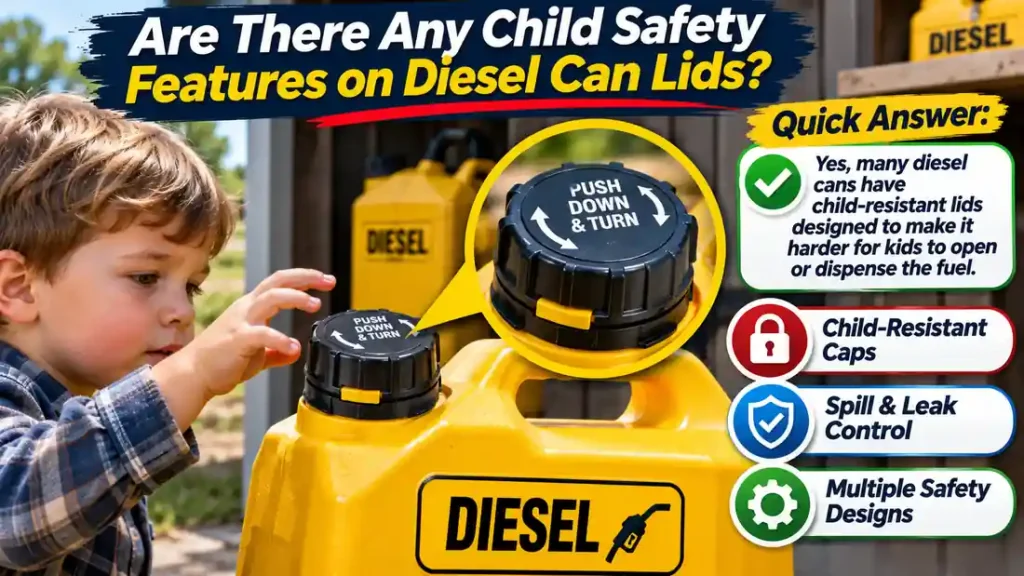
QUICK ANSWER — Yes, many modern diesel fuel cans have child-resistant caps, spouts, or release mechanisms designed to make it harder for young children to open or dispense the contents. Features may include push-and-turn closures, coordinated release buttons, or locking spout controls. However, a self-closing lid, yellow can, flame-mitigation device, or tight-fitting cap is not automatically child-resistant. In the United States, qualifying consumer portable diesel, gasoline, and kerosene containers up to 8.45 gallons (32 liters) must meet applicable child-resistance requirements under ASTM F2517. A child-resistant lid is an additional safeguard—not a replacement for keeping diesel in an appropriate, secured location that children cannot access.
I want you to be able to answer that question without getting lost in product labels. This guide explains the mechanisms you may encounter, the U.S. requirements, how to evaluate an older can, and how to build a storage routine that does not depend on a lid alone.
What Counts as a Child-Safety Feature on a Diesel Can?
| Feature | Main purpose | Child-resistant by itself? | What I would check |
|---|---|---|---|
| Certified child-resistant cap or closure | Resists opening by young children while remaining usable by adults | Yes, when properly tested and fitted | Manufacturer’s stated compliance and instructions |
| Push-and-turn or multi-action release | Requires coordinated actions to open | Not automatically | Whether the complete assembly is certified |
| Locking spout/trigger control | Helps prevent unintended dispensing | Only if specifically rated as such | Correct release and automatic return |
| Self-closing safety-can lid | Closes opening when released; controls spills and vapor | Not automatically | Closure, gasket, and applicable safety-can listing |
| Flame-mitigation device | Impedes flame propagation into a container | No | Compliance with applicable fuel-container rule |
| Tamper-evident seal | Indicates whether a seal may have been opened | No | Integrity of seal; not a substitute for a lock |
| Yellow color and DIESEL label | Identifies the intended fuel | No | Clear, legible fuel identification |
| Locked storage cabinet or secured storage area | Restricts physical access to the entire can | Not a lid feature, but essential | Appropriate location and controlled access |
The point I want to emphasize: “child-resistant,” “spill-resistant,” and “flame-resistant” are three different claims. A container might have all three features, but one does not prove the others.
How Do Child-Resistant Diesel Can Lids Work?
A child-resistant closure adds a step or combination of steps that is harder for a young child to perform accidentally. The exact sequence varies by manufacturer, so I always follow the directions printed on the can. Never force a cap or bypass its release mechanism.
1. Push-and-turn caps
A cap can require pushing and turning simultaneously, but that appearance alone does not establish a compliant design.
2. Coordinated buttons or locking spouts
Some cans require a button and spout control to operate together; verify the manufacturer calls the complete assembly child-resistant rather than only spill-resistant.
3. Controlled-release mechanisms
Some lids are designed to close or return to a safe position after the user lets go. This can reduce the time the spout remains open. It does not, by itself, mean a child cannot activate the release. I check the safety rating instead of guessing from the feel of the handle.
4. Approved replacement caps and spouts
A cap sold separately can matter just as much as the original lid. If the can was designed around a tested closure, replacing that closure with a basic threaded cap may remove its protective features. Even when the new cap fits the threads, I would not call it an equivalent replacement unless the manufacturer confirms compatibility and the required performance.
For a practical next question, see Do Diesel Cans Come With Built-In Fuel Transfer Pumps? to compare standard pouring cans with pump-equipped fuel caddies and their handling considerations.
Are Child-Resistant Diesel Can Lids Required by Law?
For U.S. consumer fuel cans, this is more than an optional marketing claim. The U.S. Consumer Product Safety Commission (CPSC) explains that the Children’s Gasoline Burn Prevention Act, as amended, covers applicable portable gasoline, kerosene, and diesel containers with a maximum capacity of 8.45 gallons (32 liters). The closure requirements refer to ASTM F2517, the standard for determining child resistance of portable fuel containers for consumer use.
I separate this from another federal safety requirement: applicable portable fuel containers of 5 gallons or less used with specified liquid fuels may also need a flame-mitigation device. The two rules address different dangers and have different scopes. In particular, a flame-mitigation insert does not make a cap child-resistant.
| Requirement or standard | What it addresses | Capacity figure relevant to this guide | What it does not mean |
|---|---|---|---|
| ASTM F2517 / applicable U.S. child-resistance rule | Child-resistant and adult-friendly closures for qualifying consumer portable fuel containers | Up to 8.45 gal / 32 L | Every old, imported, industrial, or modified can is automatically compliant |
| Federal flame-mitigation rule (16 CFR Part 1461) | Impeding flame propagation into qualifying portable fuel containers | Generally 5 gal or less within the rule’s fuel/product scope | Flame protection equals a child lock |
| OSHA safety-can definitions in relevant workplaces | Self-closing lids, controlled spouts, and other workplace safety features | OSHA’s safety-can definitions commonly refer to 5 gal or less | Self-closing always means child-resistant |
| Manufacturer’s approved container design | Correct cap, gasket, spout, fuel compatibility and use | Model-specific | Any same-size aftermarket lid is acceptable |
A useful caution: Those are U.S. consumer and workplace distinctions, not a universal international rule. Occupational use, larger transfer tanks, shipping configurations, older containers, and other countries may involve different requirements. Always confirm what applies to your particular container and location.
Does a Yellow Diesel Can Automatically Have a Child-Proof Lid?
No. Yellow is a useful identification convention, but color cannot tell you how the closure was tested. You can have a yellow can with a well-designed child-resistant mechanism, a yellow industrial container with a different type of safety lid, or an older yellow can whose original spout is missing.
The words child-proof can also create false confidence. Child-resistant does not mean child-proof. These systems are intended to reduce access, not promise that every child will be unable to operate them. That is why I consider storage location the most important line of defense.
When you organize fuel containers in a shed, clear identification matters, but a yellow color does not prove the lid is child-resistant. If you also use a truck-bed tank, read Do Diesel Transfer Tanks Need to Be Vented? to understand why a tank’s vent cap and a portable can’s child-resistant lid serve different purposes.


How I Inspect a Diesel Can Lid Before Buying
I use this practical inspection checklist when comparing models. I would follow the product’s printed demonstration instructions rather than opening a fuel-filled can in a store or trying to defeat the closure.
- Look for a clear compliance claim. I want the product or manufacturer documentation to identify applicable child-resistant closure compliance, not merely say “safe” or “easy pour.”
- Check that the lid and spout belong to that can. A loose replacement spout, missing spring, or incompatible adapter could defeat the original design.
- Read the opening and closing instructions. A safe design must still be operable by the intended adult user; if I cannot close it correctly, I choose a different model.
- Inspect the gasket and threads. I look for cuts, deformation, missing seals, cracks, rust, or signs of leakage.
- Confirm diesel compatibility. I want a container designed for diesel, not a beverage jug, water bottle, or generic storage bin.
- Check the intended capacity and use. A 5-gallon handheld can and a 25-gallon equipment caddy may have different applicable rules and safety systems.
- Plan where it will live. I won’t buy a can without already knowing a suitable secure location for it.
Technical Comparison: Different Diesel Container Lids
Here’s how I think about the common configurations. These are broad design categories, not a guarantee of features for every model.
| Diesel container type | Typical lid/spout design | Likely child-safety considerations | My recommendation |
|---|---|---|---|
| Small consumer fuel can, 1–2 gal | Integrated closure and pouring spout | Check for current child-resistant compliance | Good for occasional small refills when stored securely |
| Standard consumer fuel can, 5 gal | Controlled-flow spout or cap assembly | Verify tested closure and all required components | Practical choice for home equipment |
| Listed metal safety can | Spring-closing lid and spout cover | Self-closing is not the same as child-resistant | Appropriate where the application requires a listed safety can |
| Larger wheeled diesel caddy | Pump/nozzle access or separate fill cap | Consumer small-can rules may not apply identically | Check manufacturer-specific safeguards and secure access |
| Stationary or vehicle-mounted transfer tank | Fill cap, vent, and dispensing system | Not simply a handheld can with a bigger lid | Follow equipment design, mounting and access controls |
| Older can with generic replacement spout | Mixed or unknown closure | Original child-resistant design may be lost | Verify parts or replace with a compliant complete can |
Worked Example: A Three-Can Shed Safety Audit
Imagine you store three 5-gallon diesel cans in an outdoor utility shed to refuel a generator and a compact tractor. A family member has noticed that one cap no longer clicks into place, and the spout on another can was replaced several years ago.
The total rated capacity is 3 × 5 = 15 gallons. Assuming diesel weighs approximately 7.1 pounds per gallon, 15 gallons of fuel would weigh about 106.5 pounds, not counting the cans themselves. I use that figure to remind myself not to pile full containers high on a shelf where they could fall.
Here’s my three-can assessment:
| Can | What I find | My decision | Why |
|---|---|---|---|
| A: 5-gallon newer can | Original cap, intact seal, maker confirms child-resistant closure | Retain if otherwise sound | Complete designed system appears intact |
| B: 5-gallon can | Lid will not latch or close as intended | Remove from use; follow safe fuel-handling procedure | A damaged closure cannot be trusted |
| C: 5-gallon older can | Unknown aftermarket spout | Verify with manufacturer; replace if compatibility cannot be established | Fit alone does not prove protection |
I’d then move to storage conditions. Is the shed lockable? Are the cans upright? Are they away from heaters and ignition sources? Can rain reach the lids? Is there a suitable spill plan? A certified cap on can A does not make an unlocked, accessible shed safe for a child.
My Decision Guide: Keep, Replace the Lid, or Replace the Can?
When a lid is questionable, I don’t start by searching for the cheapest replacement. I decide whether the protective design can be restored with approved parts.
| Condition | What I’d do | What I’d avoid |
|---|---|---|
| Closure works and documentation verifies the design | Maintain and inspect regularly | Assuming the can can be left accessible |
| Seal or cap looks worn | Contact manufacturer for exact replacement procedure/parts | Substituting an untested universal cap |
| Child-resistant release has broken | Remove from service; repair only as manufacturer permits | Tape, glued mechanisms, removed springs |
| Can wall or handle is cracked | Replace the container | Repairing an unsafe fuel vessel with household adhesives |
| No model number or reliable parts information | Consider replacing the complete container | Guessing from a seller’s generic “universal fit” claim |
| Larger dispensing tank without a consumer-style lid | Check its approved equipment and access-control design | Applying handheld-can rules without checking scope |
My preference is simple: replace a questionable complete container rather than mix and match unknown safety parts. ## Why a Child-Resistant Cap Is Only One Layer of Protection
I use what I call a three-boundary approach. First, the closure makes opening harder. Second, the can is stored in a secure, appropriate place. Third, the adult handling routine prevents the can from being left unattended or accessible during use.
A child might be unable to open a cap yet still be injured if a can leaks, falls, is left open, or becomes accessible during refueling. The best fuel-container lid cannot compensate for storage in a living room, basement, play area, or beside a heat source.
The condition of the container matters as much as its lid. If you also handle fuel in larger tanks, read Can You Repair a Cracked Diesel Transfer Tank? for repair-versus-replacement decisions, and Do Diesel Transfer Tanks Need to Be Vented? for vent-cap checks.
A practical storage checklist
- Store diesel in an appropriate, approved fuel container with its cap secured according to instructions.
- Use a cool, dry, well-ventilated storage location permitted by local rules—not a living area or a child’s play space.
- Keep the entire storage area inaccessible to children; use suitable locks and controlled access where appropriate.
- Keep fuel away from flames, pilot lights, electrical ignition sources, and excessive heat.
- Store containers upright on a stable surface, away from edges and traffic paths.
- Never leave an open can or dispensing nozzle unattended during a fueling task.
- Return the approved spout/cap to its secured condition immediately after use.
- Keep products in their original labeled fuel containers; never use drink bottles or food containers.
The 20-Second Closing Audit I Recommend
My most useful habit is not a complicated inspection tool. It’s a short pause after dispensing fuel. I call it a closing audit. The 20 seconds is a reminder to be deliberate, not a tested safety threshold.
- Close: Follow the specific cap or spout instructions until the mechanism is fully secured.
- Check: Look for visible wetness, a loose component, a damaged gasket, or fuel running down the side.
- Clear: Put the hose, spout, and any accessories back in their proper positions.
- Contain: Return the can to its designated safe, secure storage location immediately.
I like this habit because it addresses a real human problem: even good equipment becomes less useful when people are rushed and leave it partially open. I would rather have a modestly priced, compliant can that is always closed and properly stored than an elaborate lid that is routinely bypassed for convenience.
What If a Child May Have Swallowed or Breathed in Diesel?
Treat possible diesel ingestion or aspiration as an urgent poisoning exposure. Do not induce vomiting. Diesel entering the lungs can cause serious chemical lung injury, and coughing or breathing problems can develop or worsen after exposure.
Move the child away from the source without exposing yourself, contact your local poison-control service or emergency medical services immediately, and follow their directions. If the child has trouble breathing, is unconscious, or is having a seizure, call emergency services right away. Do not give food, drink, or home remedies unless a medical professional specifically directs you.
Don’t wait for obvious symptoms to decide whether to seek advice. In a safety article like this, I think this point deserves to be visible rather than hidden in a small warning label.
Frequently Asked Questions
Are all modern diesel can caps child-resistant?
Qualifying U.S. consumer portable diesel containers are subject to child-resistant closure requirements, but I would still verify the specific product’s markings, model, intended use, and manufacturing context. A vague online listing does not establish compliance, especially for imported, old, modified, or larger equipment containers.
Is a push-and-turn cap enough to meet the requirement?
Not by appearance alone. The entire closure design needs to meet applicable testing and fit the intended container. A household-style push-and-turn cap fitted to a diesel jug is not automatically an approved solution.
Are metal safety cans safer than plastic diesel cans around children?
A listed metal safety can may provide important spill, flame, and pressure protections. But metal construction does not automatically prove child resistance. Compare the actual child-resistant features and keep both types secured away from children.
Does a flame arrestor stop children from opening the can?
No. A flame-mitigation or flame-arresting feature is meant to address flame hazards, not the act of opening the lid. Treat those as separate safety claims.
Can I add a lock to an existing fuel cap?
Only use locking accessories or replacement closures that the manufacturer approves for that particular can and application. An improvised lock can interfere with venting, sealing, or required dispensing functions. Securing the storage area is often the better solution.
What if my old diesel can has no child-safety instructions?
Check the manufacturer and model. If its closure is damaged, missing, modified, or impossible to verify, I would replace the can with an appropriate currently compliant product rather than assume the old mechanism is safe.
Final Verdict: Are Diesel Can Lids Child-Safe?
Yes—many diesel cans have child-resistant lids, spouts, and release mechanisms, and qualifying U.S. consumer containers are subject to child-resistance rules. But the words child-resistant mean the opening is designed to be more difficult for a young child, not that the fuel becomes harmless or that the can is safe to leave within reach.
My buying priorities are an approved complete container, a verified closure, clear instructions, a reliable seal, and a storage place children cannot access. The last step is just as important as the first four.
Next read: Do Diesel Cans Come With Built-In Fuel Transfer Pumps? to compare standard cans with pump-equipped diesel caddies before choosing your fueling setup.
Pingback: Do Diesel Cans Meet Transportation Regulations? (DOT Rules Explained) -