How does temperature affect diesel storage?
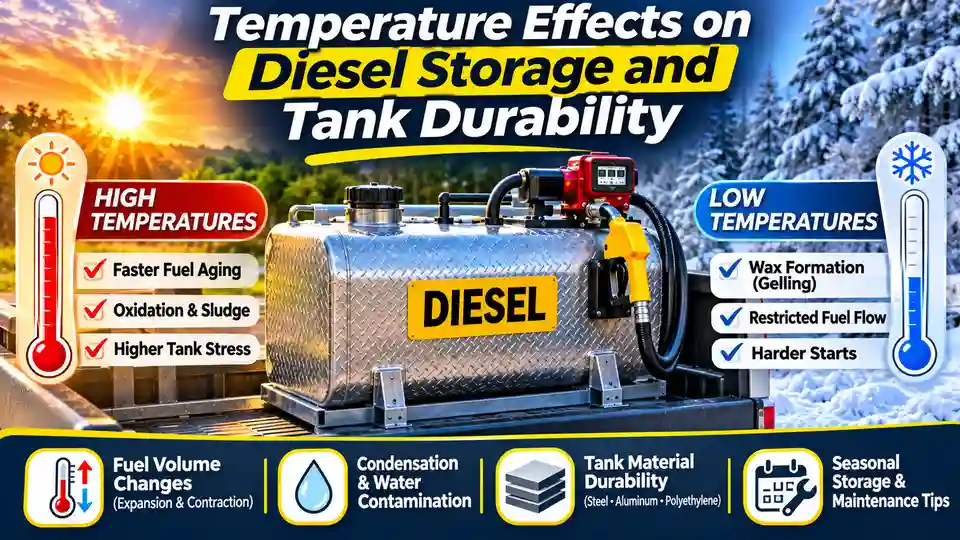
Heat accelerates diesel aging and can increase pressure-management and leakage concerns; cold temperatures can cause wax crystals to restrict filters; and repeated temperature swings can help introduce or concentrate water in a tank. High heat, low temperatures, and moisture also affect tank seals, fittings, coatings, and long-term durability. I recommend storing diesel in a compatible, properly vented and secured container, out of unnecessary direct sun, and monitoring the actual fuel temperature, not just the weather report. A 100-gallon tank holding 80 gallons of diesel could see roughly 1.62 gallons of thermal volume increase when its fuel warms from 59°F to 104°F (15°C to 40°C), using an illustrative expansion coefficient. That is not a recommended fill limit—use the manufacturer’s filling instructions and applicable rules.
If you keep diesel for a generator, tractor, excavator, pickup truck, or emergency equipment, temperature is quietly affecting your fuel even when the engine isn’t running. A tank can look perfectly sound while the diesel inside gradually oxidizes, collects water, or develops cold-weather flow problems.
When I think about storage life, I don’t ask only how many months the diesel has been sitting. I also ask what temperatures the fuel experienced, how often those temperatures changed, and whether the tank remained dry. Those three questions are more useful than a calendar date by itself.
In this guide, I’ll explain the differences between hot-weather storage and winter storage, compare steel, aluminum, and polyethylene tanks, calculate diesel’s thermal expansion, and build a practical inspection plan. I’ll also show you how I decide whether to use shade, winterized fuel, a different tank, or professional fuel testing.
How Temperature Changes Diesel Fuel and Its Storage Tank
Diesel and the container holding it respond to temperature in different ways. Fuel changes density, volume, viscosity, and cold-flow behavior. The tank responds through expansion and contraction, material movement, coating stress, and changes around seams or seals. Meanwhile, air entering through normal vents can bring moisture with it.
I separate the risks into four mechanisms rather than calling every problem “bad fuel.” This makes troubleshooting easier.
| Temperature condition | What can happen to the fuel | What I check on the tank | Practical response |
|---|---|---|---|
| Sustained heat | Faster oxidation and aging; potential sediment formation | Sun exposure, seals, vent, coatings | Provide shade, rotate fuel, sample it |
| Repeated warm/cool cycles | Volume changes; moisture can collect | Vent condition, fill cap, water at low point | Inspect and remove water appropriately |
| Low temperatures | Wax crystals can plug filters; water can freeze | Strainers, piping, hose flexibility | Use climate-appropriate diesel, protect equipment |
| Rapid temperature changes | Changing liquid level and headspace pressure | Appropriate pressure/vacuum venting | Follow tank design and vent instructions |
| Long outdoor exposure | Fuel aging plus weather damage | UV resistance, corrosion, mounting | Maintain compatible tank and protective finish |
Notice that the most important variable is not always the day’s maximum air temperature. A black tank in afternoon sunshine can be much hotter at its surface than shaded air, while a large tank of fuel warms and cools more slowly. A small portable can left on a truck bed may change temperature faster.
Does Hot Weather Make Diesel Fuel Go Bad Faster?
Yes, sustained warmth generally speeds up chemical reactions that cause stored fuel to degrade. Oxygen exposure, fuel composition, contamination, and time also influence the outcome, so heat is not a switch that makes diesel spoil at a particular temperature.
As diesel ages, oxidation can contribute to gums, sediments, or other insoluble materials. Those deposits may accumulate at the bottom of a tank or plug filters when you eventually dispense the fuel. Biodiesel blends can require extra attention because their storage stability and response to water or oxidation can differ from petroleum diesel.
I would not promise that diesel will last exactly six months, twelve months, or two years. Those numbers circulate widely, but the actual life depends on the supply and storage conditions. If your backup generator only runs occasionally, sampling and fuel rotation are much more defensible than trusting an expiration-date guess.
What counts as “too hot” for diesel storage?
There is no single universal outdoor temperature at which all diesel suddenly becomes unusable. The answer depends on fuel composition, the tank specification, exposure time, and other conditions. My practical goal is to avoid unnecessary heating and minimize prolonged temperature extremes.
I favor a shaded, ventilated, manufacturer-approved storage location over one that receives direct afternoon sunshine. I would not wrap a tank with improvised insulation, obstruct its vent, or put it inside an unapproved enclosure simply to keep it cool.
| Scenario | My assessment | First action |
|---|---|---|
| Indoor approved storage with stable moderate temperatures | Less environmental exposure | Continue scheduled fuel inspection |
| Outdoor tank in direct summer sun | Higher heat exposure | Explore shade or a suitable reflective finish |
| Tank beside generator exhaust or hot equipment | Avoidable local heat exposure | Restore proper equipment clearances |
| Long-term stored biodiesel blend | Greater need to check quality and turnover | Confirm supplier guidance and sample fuel |
| Small can in a parked vehicle | Fast temperature swings and unsafe storage potential | Move to an approved storage location |
For a business operating a mobile tank, temperature-related fuel losses should also be included in the ownership calculation. I discuss the broader financial comparison in Cost of Operating a Diesel Transfer Tank vs. Fuel Delivery Services.
Why Cold Weather Can Stop Diesel From Flowing
Cold temperatures create a different set of problems. Diesel contains wax-like paraffin components that can begin forming crystals as fuel cools. This doesn’t mean the entire tank freezes solid like water. Often the first problem is restricted flow through a fine fuel filter, even while much of the diesel still looks liquid.


There are three terms I would understand before storing diesel for winter:
- Cloud point: The temperature where wax crystals first become visibly apparent under a standard test. It’s a useful early warning for cold-weather suitability.
- Cold filter plugging point (CFPP): A standardized laboratory indication of the temperature where fuel stops passing through a specified test filter under defined conditions. Actual equipment performance can differ.
- Pour point: A low-temperature laboratory measure at which fuel stops flowing under the test conditions. It does not tell you that engine filters will remain clear down to that temperature.
| Fuel property | What it tells you | Test commonly referenced | Storage decision |
|---|---|---|---|
| Cloud point | When visible wax crystals begin forming | ASTM D2500 | Compare with expected cold exposure |
| CFPP | Standardized filterability at low temperature | ASTM D6371 | Check cold-flow suitability with supplier |
| Pour point | Lower-end bulk flow characteristic | ASTM D97 | Don’t use it alone to predict engine starting |
| Water contamination | Water may collect and freeze in lines or filters | Sampling and water detection | Keep tank dry, remove water safely |
| Viscosity | Fuel becomes harder to pump as it cools | Product specification | Check pump and equipment limits |
Don’t rely on a fixed “diesel gels at 15°F” rule. Summer-grade fuel, winter-blended fuel, and biodiesel blends can behave differently. The fuel’s actual test results and the supplier’s seasonal specification matter much more than a number printed in a general article.
When temperatures are expected to drop, I ask the supplier whether the diesel is already winterized and what cold-flow properties apply. If an additive is appropriate, I follow both the fuel and equipment manufacturer’s instructions. Pouring in extra anti-gel is not a guaranteed fix and can make problems worse.
If fuel has already waxed up or filters are plugged, don’t try to heat the tank with a torch, open flame, or improvised heater. Use a suitable maintenance procedure or professional help.
Diesel Thermal Expansion: How Much Can the Volume Change?
This is the calculation I consider especially useful for people managing tank headspace. Diesel expands as it warms and contracts as it cools. The exact expansion coefficient varies by fuel, but 0.00081 per °C is a reasonable illustrative value used in some diesel temperature-compensation systems.
For a simple small-range estimate:
Estimated volume change = starting fuel volume × 0.00081 × temperature change in °C
This estimates the liquid’s expansion, not the tank’s structural movement. The value should not be used as a regulatory fill calculation, and it does not account for all real-world density and temperature effects.
Worked example: an 80-gallon fill in a 100-gallon diesel tank
Suppose you have a manufacturer-approved, properly installed 100-gallon diesel tank. It contains 80 gallons of diesel when the liquid is at 59°F (15°C). Later, the fuel itself reaches 104°F (40°C).
- Starting volume: 80 gallons.
- Fuel temperature change: 40°C − 15°C = 25°C.
- Expansion estimate: 80 × 0.00081 × 25 = 1.62 gallons.
- Estimated warmer liquid volume: 80 + 1.62 = 81.62 gallons.
The calculated change isn’t negligible. If the tank were nearly full, the situation would require even closer attention to the manufacturer’s allowable filling procedure and venting provisions. I do not interpret this example as permission to fill any tank to 80%, 90%, or some other universal percentage.
| Fuel temperature | Change from 15°C | Estimated diesel volume | Difference from starting fill |
|---|---|---|---|
| 5°C (41°F) | −10°C | 79.35 gal | −0.65 gal |
| 15°C (59°F) | 0°C | 80.00 gal | 0.00 gal |
| 25°C (77°F) | +10°C | 80.65 gal | +0.65 gal |
| 35°C (95°F) | +20°C | 81.30 gal | +1.30 gal |
| 40°C (104°F) | +25°C | 81.62 gal | +1.62 gal |
Illustrative figures use a constant 0.00081/°C coefficient and round to two decimals. The tank capacity is nominal; fuel temperature is not necessarily ambient air temperature.
What this means for a fuel gauge
A tank’s observed liquid level can move with temperature even when nobody has added or removed diesel. Before investigating a suspected inventory discrepancy, I compare measurements taken at similar fuel temperatures or use suitable temperature compensation when available.
This is a practical reason to record the date and temperature with volume readings rather than comparing two unlabeled numbers.
Can a temperature change damage a sealed tank?
Temperature changes can contribute to internal pressure or vacuum as fuel and headspace conditions change. Tanks designed for atmospheric storage must have appropriate venting as specified for their use. Never block a required vent to prevent moisture, odor, or evaporation. A damaged vent, incorrect cap, or incompatible modification can turn ordinary temperature movement into a safety problem.
If you are unsure about the vent on your equipment, my next recommended reading is Do Diesel Transfer Tanks Need to Be Vented?.
Temperature Swings, Condensation, and Water Contamination
Moisture is one of the most expensive indirect consequences of poor diesel storage. As temperatures and atmospheric conditions change, a vented tank can exchange air with its surroundings. Moist air may cool, allowing water to condense on surfaces. Rain entering through a damaged cap or fitting can introduce even more water. The relative contribution of each source depends on the storage system.
Free water tends to settle in low points, where it can contribute to corrosion and support microbial growth at the fuel-water interface. In cold conditions that water may freeze, adding another route to blocked filters or lines.
I don’t assume every cloudy sample means wax. In cold conditions it could be wax crystallization; at other times it could point to suspended water or other contamination. The correct response depends on the cause.
My two-temperature, one-water-check method
For better records, I’d note three things during routine inspection:
- Ambient air temperature: The conditions around the installation.
- Actual fuel temperature: The liquid temperature, if the tank has suitable instrumentation.
- Water status: A properly performed tank-bottom water check, where safe and permitted by the system design.
That three-part record helps identify whether a level shift came from expansion, whether a filter issue followed a cold night, or whether water is gradually accumulating. It’s my suggested management framework, not a formal industry test standard.
For a small portable can with no sampling point, do not open it casually for repeated temperature checks. Use the approved inspection procedure, keep closures secure, and look for external damage or leakage. For practical container design options, see Which Diesel Can Brands Offer Spill-Proof Designs?.
Steel, Aluminum, and Polyethylene Tanks: Which Handles Temperature Best?
No material wins every application. Steel is robust but requires corrosion management; aluminum resists red rust but still needs compatible fittings and sound construction; polyethylene can resist many kinds of corrosion but has product-specific temperature, UV, and mounting limitations.
A big mistake is assuming that because a plastic tank is diesel-compatible, it is automatically suitable for outdoor summer exposure, a mobile installation, or long-term storage. Compatibility, design approval, UV protection, and permitted operating temperature are separate questions.
| Tank material | Heat and sun considerations | Cold-weather considerations | Durability concern |
|---|---|---|---|
| Coated steel | Surface can absorb solar heat; reflective finish may help | Strong, but water can collect and freeze at fittings | Interior/exterior corrosion, coating damage |
| Aluminum | Transfers heat readily; finish and exposure matter | Performance depends on design and fittings | Fatigue, connection compatibility, impact |
| Approved HDPE/polymer | Confirm temperature rating and UV stabilization | Impact resistance and stiffness vary with grade and temperature | UV aging, creep, deformation, connection stress |
| Double-wall tank system | Depends on exact materials and design | Inspect both primary and secondary containment | Hidden leakage, trapped water, inspection access |
I would ask for the manufacturer’s approved fuel types, allowed temperature range, outdoor-use suitability, mounting method, vent specification, and inspection guidance. For tanks carried on roads, transportation approval also matters. See Do Diesel Cans Meet Transportation Regulations? for that distinction.
Why fittings deserve attention
A tank may be sound while a hose or gasket fails first. Different materials expand and contract at different rates. Repeated temperature cycling, vibration, and weather exposure can stress seals and joints, particularly on mobile installations.
I inspect connection points after seasonal transitions and after unusual hot or cold weather. If I see wetness, staining, an unexplained smell, or cracking, I stop using the system until the fault is assessed. A damaged tank should not be patched or heated casually. Can You Repair a Cracked Diesel Transfer Tank? covers the repair-versus-replacement decision.
Aboveground vs. Underground Diesel Storage Temperatures
A properly designed underground tank generally experiences smaller short-term temperature swings than a sun-exposed aboveground tank because surrounding soil moderates temperature changes. That can benefit fuel stability, although underground systems introduce other inspection, installation, leak-detection, and environmental requirements.
For a homeowner or small contractor, burying a portable transfer tank is not an acceptable shortcut. A tank must be specifically designed and approved for the installation type.
A shaded aboveground tank can be a practical compromise when it is correctly positioned and has appropriate protection from impact, water entry, and heat sources. Whether using a canopy, reflective coating, or enclosure, I would preserve required access, ventilation, spacing, and fire-safety features.
How Hot and Cold Weather Change the Maintenance Schedule
My preferred approach is to schedule inspections around both usage and weather exposure. A generator tank that rarely turns over fuel needs more attention to fuel age and water, while a mobile refueling tank needs additional checks for fittings, mounting, and day-to-day damage.
| When | What to inspect | Why it matters |
|---|---|---|
| Before each dispensing session | Leaks, cap, hose, nozzle, pump, mounting | Detect obvious hazards |
| After a heat wave | Fuel temperature history, vent, seals, abnormal odors | Check heat-related stress or quality concerns |
| Before the cold season | Supplier’s cloud point/CFPP guidance, water, filters | Reduce winter flow problems |
| After severe temperature cycling | Water collection, exterior condensation, fittings | Identify moisture and seal trouble |
| At scheduled service | Fuel sample, water management, filters, tank condition | Catch slow-moving degradation |
| After any suspected contamination | Stop dispensing and assess fuel professionally | Avoid spreading contamination into engines |
The frequency should follow manufacturer instructions, local requirements, fuel turnover, and operational risk. Large commercial tanks may use formal water-level monitoring and periodic testing rather than informal visual checks.
A useful cost question is whether your maintenance workload changes enough to affect the economics of owning a tank. If it does, revisit Cost of Operating a Diesel Transfer Tank vs. Fuel Delivery Services and account for sampling, filters, water removal, and inspection labor.
Can You Store Diesel Outdoors Through Summer and Winter?
Yes, provided the fuel and tank are suited to outdoor storage and the installation follows the applicable safety and environmental requirements. The answer is not simply “diesel is tough enough.” You need a compatible container, suitable ventilation, weather-resistant connections, appropriate temperature ratings, and a fuel-grade plan for the seasons.
Summer storage checklist
- Place the tank in a compliant location that avoids unnecessary direct sunlight and nearby heat sources.
- Confirm caps, gaskets, vents, and fittings are intact and correctly installed.
- Keep rainwater and wash water away from fill openings.
- Track fuel age and rotate stock rather than repeatedly topping off old fuel without testing.
- Inspect tank-bottom water using an approved method.
- Investigate unexplained changes in fuel appearance or filter performance.
Winter storage checklist
- Ask the fuel supplier for the actual cloud-point or other cold-flow information applicable to your climate.
- Change to an appropriate winter grade before sustained cold weather arrives.
- Check for water before freezing conditions; ice can restrict filters and lines.
- Protect pumps, filters, and hoses according to their rated temperatures.
- Use manufacturer-approved heating systems only when required; never use open flames.
- Review emergency fueling plans for generators or critical equipment.
A Temperature-Risk Decision Guide for Your Diesel Tank
I use this simple decision guide instead of trying to apply one ideal temperature to every diesel tank.
| If your biggest problem is… | Most useful first move | What I would avoid |
|---|---|---|
| Afternoon sun heating the tank | Suitable shade and fuel-turnover review | Blocking vents or enclosing tank improperly |
| Diesel clouding in winter | Check actual cloud point and supplier winter blend | Assuming all diesel has one gel temperature |
| Water appearing after temperature changes | Inspect openings, vents, and water management | Using biocide without confirming the cause |
| Tank seams or hoses showing damage | Stop use, inspect or replace approved parts | Improvised repairs to fuel equipment |
| Changing gauge readings | Compare fuel temperature and measurements | Calling every variation theft or leakage |
| Backup diesel stored many months | Sample and test fuel; develop a rotation plan | Guessing shelf life from age alone |
The best solution usually starts with the first failure mechanism you can actually verify. For example, changing a filter repeatedly without addressing contaminated fuel will likely repeat the same problem.
Frequently Asked Questions
What is the best temperature for storing diesel?
There is no one mandatory storage temperature for every fuel or tank. I prefer cool, stable conditions and protection from unnecessary heat. Follow the manufacturer’s approved operating range, keep the system dry, and choose a fuel suitable for the expected coldest temperatures.
Does diesel expand in summer?
Yes. Diesel becomes less dense and occupies more volume as it warms. For example, 80 gallons warming by 25°C expands by approximately 1.62 gallons using the illustrative coefficient above. That number is not a permitted filling allowance.
At what temperature does diesel gel?
There is no single answer for every diesel grade. Wax formation and filterability depend on fuel composition, winter blending, additives, and the specific cold-flow tests. Ask your supplier about the actual fuel you have.
Can heat crack a plastic diesel tank?
Heat exposure can contribute to material creep, deformation, or accelerated aging in a polymer tank when it exceeds the tank’s intended conditions. Whether a particular tank can tolerate the exposure depends on its material formulation and design. Look for a specific manufacturer temperature and outdoor-use rating.
Can I stop condensation by sealing the vent?
No. A required tank vent must not be blocked. Instead, maintain compatible vent components, keep openings watertight, follow approved water-removal procedures, and reduce avoidable moisture entry.
Should I always keep a diesel tank full?
Reducing excessive air space can help limit some oxidation and moisture exchange, but never fill beyond the tank manufacturer’s allowable capacity or leave insufficient expansion space. Follow design limits and local rules, and balance inventory against the risk of storing fuel too long.
Final Thoughts: Protect the Fuel and the Tank Together
My central recommendation is to stop treating diesel temperature as only an engine-starting concern. Temperature affects fuel quality, measurable volume, water management, and the mechanical life of the storage system. Heat can speed up degradation. Cold can expose poor fuel-grade selection. Temperature swings can reveal weaknesses in vents, seals, and moisture control.
Start with three practical questions: What temperature does the fuel actually reach? Is the tank staying dry? Is the equipment approved for those conditions? Then use the answers to choose shading, winter-grade diesel, sampling, repairs, or a different storage arrangement.
For the next step in your diesel-storage setup, read Do Diesel Transfer Tanks Need to Be Vented? and Choosing Between Manual and Automatic Diesel Transfer. Both help you move from fuel-storage theory to equipment that works reliably in the field.