
Quick Answer
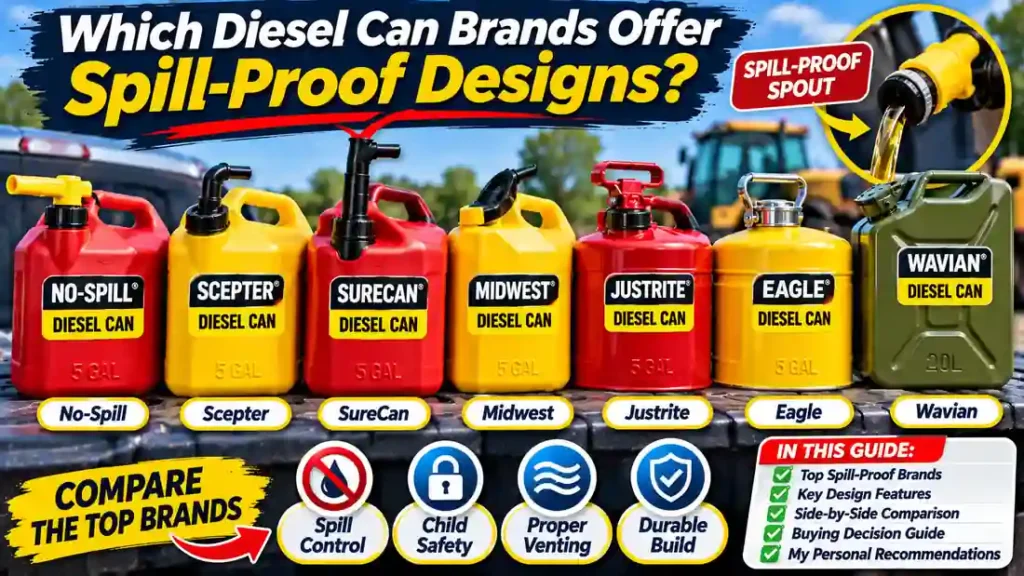
Yes. Several well-known diesel-can brands offer spill-resistant or advertised “spill-proof” designs, including No-Spill, Scepter, SureCan, Midwest Can, Justrite, Eagle, and Wavian. However, they do not all prevent spills in the same way. No-Spill emphasizes push-button dispensing and automatic flow stop; Scepter uses controlled-flow spouts; SureCan dispenses through a rotating lower spout operated by a thumb trigger; Justrite and Eagle offer self-closing safety-can lids; and Wavian focuses on a tightly sealed metal jerry-can closure.
My practical choice: For a small machine with an easy-to-reach filler, I would first compare No-Spill and Scepter. For a tractor with a high or awkward fuel inlet, SureCan deserves a closer look. For a workplace that needs a listed safety can, I would compare the exact Justrite and Eagle models. For secure, rugged transport and storage, I would consider a compatible Wavian jerry can—but not mistake a leak-resistant cap for an automatic-stop pouring spout.
Important: “Spill-proof” is often marketing language, not a promise that a can cannot leak or overflow. A damaged gasket, incorrect spout position, full receiving tank, or unsecured container can defeat even a thoughtfully designed system.
What Does Spill-Proof Actually Mean for a Diesel Can?
When I compare diesel cans, I start by asking which spill the design is meant to prevent. The answer is surprisingly important. A can that seals tightly during storage might be inconvenient when pouring into a narrow generator opening. Another can might deliver a smooth, controlled flow but still require careful transportation and a properly tightened cap.
I separate the claim into four different jobs: avoiding leaks while the can is closed, reducing dribbles when pouring begins or ends, preventing overflow at the receiving tank, and helping the operator keep the can steady. Very few products excel at every job equally.
| Spill-control feature | What it is designed to help with | What it cannot guarantee |
|---|---|---|
| Automatic-stop spout | Reduces overfilling when the intended shutoff condition is reached | No spills from incorrect use or a damaged spout |
| Thumb or squeeze control | Lets you start, slow, and stop fuel flow deliberately | No spills if you release too late or miss the filler |
| Rotating or flexible nozzle | Makes awkward filler necks easier to reach | No leaks if a seal or hose is damaged |
| Self-closing safety-can lid | Closes an opening when the operating lever is released | Automatic shutoff at the receiving tank |
| Sealed cam-lock or bayonet cap | Helps prevent fuel escaping during approved closed-container handling | Drip-free pouring through a separate spout |
| Wide base and suitable handles | Improves stability and control | Protection against every tip, fall, or impact |
I do not use “spill-proof” to mean “safe to leave on its side” or “safe to transport loose in a pickup bed.” Always follow the manufacturer’s storage, filling, transport, and dispensing instructions.
At a Glance: Seven Diesel Can Brands With Spill-Control Features
These are specific examples, not a claim that every product sold under a brand has the same mechanism. Match the model number, fuel rating, size, and supplied spout before purchasing.
| Brand and example | Capacity | Main spill-control design | My best-fit use |
|---|---|---|---|
| No-Spill diesel can, model 1457 | 5 gal | Push-button spout with automatic flow stop | Routine small-equipment refilling |
| Scepter SmartControl diesel, FSCD571 | 5 gal | Palm/squeeze-controlled spout; rear handle | Everyday controlled pouring |
| SureCan diesel, SUR5SFD2 | 5 gal | Lower rotating spout, thumb trigger, self-venting | High or awkward tractor/equipment fill points |
| Midwest Can diesel, model 8610 | 5 gal | Auto-shutoff quick-flow spout | Conventional can with anti-overfill features |
| Justrite AccuFlow Type II diesel, 7250220 | 5 gal | Safe-Squeeze trigger and dedicated flexible metal hose | Workshops and managed industrial use |
| Eagle Type II diesel, U251SY | 5 gal | Actuated pour valve, spring-closing lid, flexible metal spout | Listed safety-can applications |
| Wavian steel jerry can | 20 L (about 5.3 gal) | Cam-lever closure and fuel-resistant gasket | Rugged sealed storage/approved transport |
The different capacities and configurations matter. Wavian’s 20-liter can is not a direct 5-gallon consumer-can substitute for every regulatory or jobsite purpose. Likewise, a Type II safety can is not automatically interchangeable with a consumer portable fuel container merely because both hold five gallons.
1. No-Spill: Strong Choice When Overfilling Is the Problem
No-Spill’s yellow 5-gallon diesel can, model 1457, is one of the clearer examples of a brand built around reducing dispensing mistakes. Its push-button design gives the operator control of the nozzle, while the published automatic flow-stop feature is intended to stop flow when the receiving fuel reaches the specified point at the spout.
What I like about the idea is that it targets a very particular accident: watching the filler neck, trying not to slosh fuel, and discovering that the tank is already full. The user still needs to position the nozzle correctly and remain attentive. Auto-stop is a protection layer, not permission to leave a filling can unattended.
Retail product information also identifies a 3-gallon-per-minute flow rate for this model. That is a useful reference for comparing transfer time, but real flow can differ because of position and conditions. I would verify the exact included nozzle and replacement-part availability before buying.
Where I would use it: generators, tractors, small diesel machinery, and other applications with an accessible filler neck. Where I would hesitate: a deep or unusually shaped opening that prevents the nozzle from sitting as intended.
2. Scepter SmartControl: Spill Reduction Through Flow Control
Scepter’s 5-gallon SmartControl Diesel Can with Rear Handle, model FSCD571, uses a palm-driven squeeze mechanism. Instead of tipping a standard can and letting fuel rush out uncontrolled, you operate the control to dispense.
Scepter lists a flow rate of up to 3 GPM, an integrated flame-mitigation device, and a rear handle to assist positioning. Those details make the model interesting for anyone who wants a familiar handheld can with more deliberate pouring.
I particularly like the rear-handle concept. A full five-gallon can contains approximately 35.5 pounds of diesel, before adding the container’s own weight. More control over that weight may matter more than a slightly faster flow rate.


This is not the same mechanism as No-Spill’s automatic flow stop. I would not assume SmartControl senses when a receiving tank is full. You must remain in control of the pour and stop before overflowing.
Scepter also lists an RV-oriented SmartControl diesel version and an EasyFlo diesel design. The exact mechanism depends on the product line, so I would compare model numbers, not just the Scepter name.
3. SureCan: Useful for High and Awkward Fill Points
The SureCan SUR5SFD2 diesel can takes a different approach. Its flexible spout rotates down from the lower part of the can, and the thumb-operated trigger controls the fuel flow from above. The point is to avoid having to lift and tip the whole can at a steep angle while aiming into an awkward inlet.
SureCan identifies self-venting, a safety fill cap, and a rotating spout among its features. The manufacturer says its fuel cans flow at an average of about 2 GPM. That may be less than the advertised maximum on some conventional spouts, but speed is not the only consideration.
If I were refilling a tractor with a filler beside a cab, or a generator with a recessed inlet, I would pay special attention to SureCan’s positioning. Being able to place the nozzle before starting flow is a meaningful advantage.
There is an important operating distinction: the SureCan design gives manual flow control, not an automatic tank-full sensor. I would watch the fuel level, release the thumb trigger early, allow the remaining fuel in the spout to drain as instructed, and return the nozzle to its secured position.
4. Midwest Can: A Conventional Shape With an Auto-Shutoff Spout
Midwest Can’s 5-gallon diesel model 8610 uses a familiar upright plastic fuel-can shape. Its published product description identifies an auto-shutoff quick-flow spout and calls the included spout spill-proof.
That is attractive if you already like traditional fuel-can handling but want something beyond a simple open pouring tube. The product is a diesel-specific yellow can, although I would still verify the fuel designation and current configuration before purchasing.
A spill claim in a retailer description does not tell me everything about the user’s experience. I still want to know how to unlock and position the nozzle, whether the receiving tank opening is compatible, and whether the original parts are easy to obtain.
My take: Midwest is a practical comparison against No-Spill when automatic shutoff is your priority. I would decide between them based on the actual spout motion, accessibility of the filler, handling comfort, and the exact model supplied—not the strength of a marketing phrase.
5. Justrite AccuFlow: Controlled Dispensing for Workplaces
For industrial use, I would look at Justrite’s 5-gallon AccuFlow Type II diesel safety can, model 7250220. This is a metal safety-can system rather than a simple household-style jerry can.
Its Safe-Squeeze trigger provides proportional flow control, and the separate dispensing opening uses a flexible metal hose. Type II generally means distinct filling and dispensing openings, a useful arrangement where users want a controlled stream into equipment.
Justrite specifies a steel body, flame arrester, and the stated approvals for this particular model. Those features can matter in shops where the container must meet applicable workplace requirements. However, a listed safety can and a spill-proof consumer spout are not identical claims.
I would choose this kind of can when safety-can specifications and controlled dispensing outweigh concerns about weight or price. I would also check whether the model fits the workplace’s actual fuel storage and transport rules; I wouldn’t assume every yellow metal can meets them.
6. Eagle: Self-Closing Lids and a Separate Controlled-Pour Valve
Eagle offers Type I and Type II diesel safety cans. For this comparison, the U251SY 5-gallon Type II diesel can is particularly relevant because it has a spring-closing fill opening and a separate actuated pouring valve with a flexible metal spout.
What interests me is the way the lid and dispensing valve share the work. A lid that returns to a closed position helps limit the chance of leaving an opening exposed. A separate flexible spout gives the operator a more targeted pour than simply tipping a broad open mouth.
The U251SY’s specifications include a galvanized steel construction and a 7/8-inch metal spout, as well as model-specific safety approvals. Those details are worth checking against your own application. A narrow, recessed opening may require a different spout size, and workplace compliance involves more than color.
My comparison: Eagle and Justrite belong on the same shortlist for a shop that needs a proper safety can; I would focus on the difference in dispensing control, nozzle size, service parts, and applicable approval labels.
7. Wavian: Sealed Jerry-Can Design, Not Auto-Stop Pouring
Wavian’s steel jerry cans are designed differently from most five-gallon plastic fuel cans. Its 20-liter steel can uses a cam-lever closure and fuel-resistant gasket, supported by welded seams and a heavy-duty metal body.
That design makes me think first about closed-can integrity: a sound gasket and properly secured closure are valuable when handling a can within its approved conditions. Wavian’s product information emphasizes the positive-lock cap and its sealing system.
However, that does not mean the can will automatically stop dispensing when the receiving tank is full. Pouring is a separate task, usually involving a compatible spout and the manufacturer’s procedure. A secure cap does not prevent you from missing a tractor’s filler neck.
I would consider Wavian if rugged construction and a secure closed container are priorities. For frequent fueling of small equipment, I would compare the convenience of its spout with No-Spill, Scepter, or SureCan before deciding. And I would verify what its approval markings permit for the particular country and transportation purpose.
Technical Details I Check Before Buying
If I were inspecting two diesel cans side by side, I would compare the following specifications rather than just read the front-label claim.
| Detail | Why it matters | What I check |
|---|---|---|
| Nominal capacity | Affects handling and maximum fuel load | 5 gal or other rated volume; fill instructions |
| Fuel compatibility | Prevents using a can with the wrong fuel or seal materials | Explicit diesel rating and permitted blends |
| Spout shutoff | Determines how deliberately you can stop the stream | Push-button, squeeze, trigger, auto-stop, or separate valve |
| Flow-rate claim | Helps estimate time, not actual measured performance | Published GPM and operating conditions |
| Spout dimensions | Matters for narrow and recessed inlets | Length, diameter, flexibility, compatibility |
| Closure and gasket | Limits closed-can leakage | Correct seal, tight fitting, approved replacements |
| Venting system | Helps fuel flow as designed | Manufacturer-approved vent; never modify |
| Child resistance | Reduces access by young children | Applicable tested closure; complete working assembly |
| Flame mitigation | Addresses flame-propagation hazards | Compliance for the container’s applicable category |
| Product approval | Matters especially for worksites or transport | Actual UL/FM/DOT/other markings where required |
A manufacturer’s safety designation applies to an exact product and use. I wouldn’t transfer that claim automatically to an older model, an aftermarket spout, or another can from the same brand.
Worked Example: Is a Faster Spout Actually Better?
Let’s say I need to move four gallons of diesel into a compact tractor. I’m comparing a No-Spill can advertised at 3 GPM, a SureCan with an average published rate of about 2 GPM, and a basic can that I estimate pours at 1 GPM in my illustrative scenario.
The basic equation is:
Fuel-transfer time (minutes) = gallons dispensed ÷ actual flow rate (GPM)
| Example pouring method | Rate used | Time for 4 gallons | Rate source |
|---|---|---|---|
| Basic controlled pour | 1 GPM | 4.0 min | Assumed for this example |
| SureCan style | 2 GPM | 2.0 min | Approximate manufacturer average |
| No-Spill style | 3 GPM | 1.3 min | Published model figure |
At first glance, the three-GPM option is easily the fastest. But suppose I spend an extra minute carefully reaching a narrow filler, repositioning my arms, and wiping the nozzle after each transfer. Another can with a rotating nozzle may give me an easier overall routine despite the slower published flow rate.
That is why my purchase test includes setup time, the position of the filler, the effort of handling the full can, and how predictably flow stops. These calculations are planning illustrations, not laboratory performance measurements; I have not independently timed these models.
For more on larger dispensing systems, see Do Diesel Cans Come With Built-In Fuel Transfer Pumps?. A pump-equipped caddy becomes a different option when lifting a heavy can is the main problem.
Original Spill-Loss Calculation: The Little Drips Add Up
A helpful calculation I don’t often see in buying guides is the cumulative effect of small spills. I would not use it to make an exaggerated fuel-savings claim. I use it to remind myself that many tiny drips are still a handling problem.
Suppose a poorly controlled pouring routine leaves 15 milliliters of diesel around the fill area on average. Assume it happens 200 times per year.
15 mL × 200 = 3,000 mL = 3.0 liters, equivalent to about 0.79 U.S. gallon.
At an example diesel price of $4 per gallon, the direct fuel loss is only about $3.17 annually. That is not enough by itself to justify buying an expensive safety can. The more important concerns are slip hazards, stained equipment, environmental contamination, cleanup time, and exposing skin or clothing to fuel.
The scenario is original arithmetic based on stated assumptions—not measured spill data or a claim about any specific brand. Actual spills could be much smaller, larger, or zero.
My Five-Question Buying Decision Guide
Here is how I narrow the choices before buying. First I identify what I am fueling and whether the nozzle can reach the machine without forcing an unstable pour. Second, I estimate how many gallons I carry: five gallons of diesel weighs roughly 35.5 pounds before the can. Third, I ask what actually causes the mess—overfilling, awkward tipping, or a leaky closure. Fourth, I confirm where the can will be used and whether the site has specific safety-can or transport requirements. Finally, I check replacement parts for the model’s original safety system.
| If I mainly need… | My starting shortlist | Why |
|---|---|---|
| Automatic overfill protection | No-Spill, Midwest | Their specified models advertise auto-stop spouts |
| Controlled everyday pouring | Scepter, SureCan | Their designed controls let me regulate dispensing |
| Access to difficult filler necks | SureCan | Lower rotating spout changes handling position |
| Listed workplace safety-can design | Justrite, Eagle | Purpose-built safety-can features and model-specific approvals |
| Rugged sealed jerry-can closure | Wavian | Positive-lock cap and gasketed metal construction |
This is a decision guide, not an independently tested brand ranking. I would also check child-resistant closure features—see Are There Any Child Safety Features on Diesel Can Lids?—and keep the can secured away from children. For larger fuel systems, Do Diesel Transfer Tanks Need to Be Vented? explains why you should never improvise a vent or closure.
Frequently Asked Questions
Which diesel can brand has an automatic-stop spout?
No-Spill’s 5-gallon model 1457 and Midwest Can’s 5-gallon model 8610 advertise automatic-flow-stop or auto-shutoff spouts. I would verify the current model and ensure the receiving tank opening allows proper operation.
Are Justrite and Eagle suitable for workplaces?
They sell specified listed safety cans used in workplace settings. The correct choice depends on the can’s exact approvals and your jobsite’s requirements. I would never assume a particular model satisfies every storage or transport rule without checking.
Will a Wavian jerry can automatically prevent overfilling?
No. Its gasketed cam-lever closure addresses secure sealing when closed. Pouring into another tank still requires the correct spout, positioning, and operator attention.
Can I replace a diesel can’s nozzle with a universal spill-proof spout?
Only if the manufacturer approves that exact replacement for the can. A similar-looking threaded fitting may interfere with sealing, venting, child resistance, or flame protection.
Final Verdict: Which Brand Would I Choose?
If I wanted automatic stopping for a conventional five-gallon can, I would start with No-Spill and compare Midwest Can. If I wanted a familiar can with deliberate squeeze-controlled pouring, I would look at Scepter SmartControl. For a high or awkward filler, I’d evaluate SureCan. When the application specifically requires a listed workplace safety can, I would compare Justrite AccuFlow and Eagle Type II. For a rugged gasketed steel jerry can, I’d consider Wavian.
The biggest improvement may come from choosing the spout that fits your receiving tank, keeping the complete safety system intact, and following a consistent closing routine. A can that makes careful pouring easy is more valuable to me than one that merely calls itself “100% spill-proof.”
Pingback: Choosing Between Manual and Automatic Diesel Transfer: Which Works Best?