Auxiliary Fuel Tank vs. Diesel Transfer Tank: What’s the Difference?
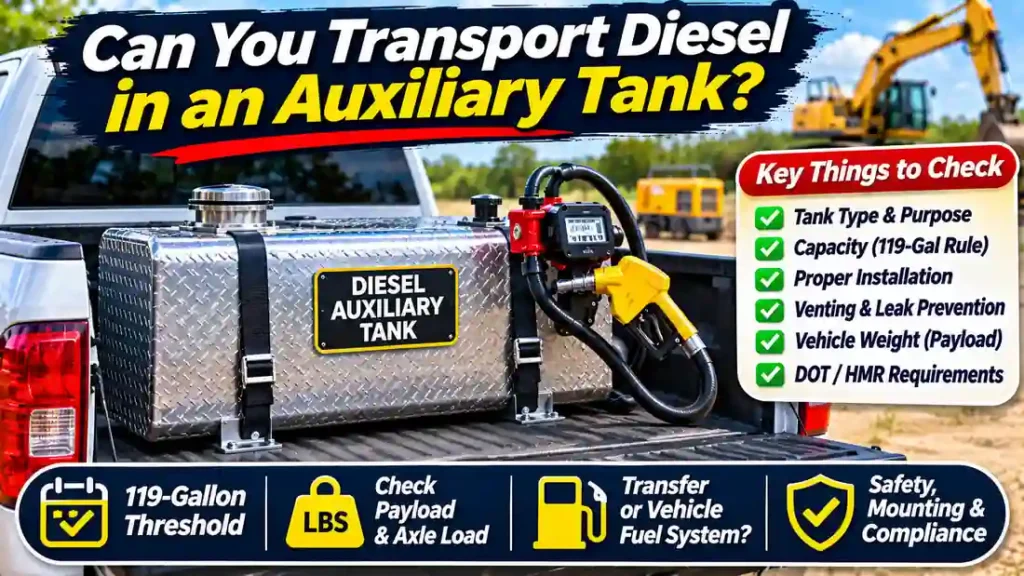
I use the term auxiliary tank carefully because sellers and owners use it for two different systems. An auxiliary vehicle fuel tank is connected through an approved system to supply the truck or approved onboard auxiliary equipment. A diesel transfer tank is a separate container used to carry and dispense fuel to another machine. Some products may be marketed as combination tanks, but I would never assume a tank can perform both jobs without documented approval.
| Tank arrangement | Main purpose | Main question before transport |
|---|---|---|
| Original vehicle diesel tank | Powers the truck | Is the existing fuel system sound and compliant? |
| Properly installed auxiliary fuel-system tank | Extends vehicle fuel supply | Does the complete system meet applicable vehicle fuel-system standards? |
| Pickup-bed diesel transfer tank with pump | Refuels other equipment | Is the diesel/package eligible for an HMR exception or otherwise compliant? |
| Stationary storage tank placed on a truck | Normally stays at a fixed site | Is it actually rated and approved for transportation? |
| Trailer-mounted diesel dispensing tank | Refuels equipment at jobsites | How is it classified, secured, isolated, and transported? |
That last distinction is especially important. A stationary tank designed to remain on a concrete pad is not automatically roadworthy because it has lifting lugs or fits the trailer. I want the manufacturer’s intended-use statement and applicable documentation before anything else.
What Do U.S. DOT Rules Say About Transporting Diesel?
I begin with 49 CFR 171.8 and 49 CFR 173.150(f) for a transfer tank, then look at the vehicle fuel-system rules when the tank feeds the vehicle. Diesel’s classification is critical: qualifying fuel with a flash point of at least 100°F (38°C) that meets the other conditions may be treated as a combustible liquid for relevant domestic transportation provisions. Do not assume all blends, contaminated fuels, or mixtures qualify without checking the actual material.
For eligible highway or rail shipments of combustible liquid in qualifying non-bulk packaging, the federal Hazardous Materials Regulations (HMR) exception can mean the usual HMR marking, shipping-paper, and placarding provisions do not apply. But other rules—including vehicle securement, workplace safety, applicable state requirements, and the manufacturer’s restrictions—still matter.
| Question | Key U.S. reference | Practical interpretation |
|---|---|---|
| Is a package non-bulk? | 49 CFR 171.8 | For liquids, maximum package capacity of 119 gallons or less |
| Can the diesel qualify as a combustible liquid? | 49 CFR 173.150(f)(1) | Depends on flash point and whether it meets another hazard class |
| Is there a non-bulk combustible-liquid exception? | 49 CFR 173.150(f)(2) | Can apply in qualifying highway/rail circumstances; exceptions have conditions |
| Does the tank supply a commercial vehicle or its equipment? | 49 CFR 393.65 and 393.67 | Vehicle fuel-system rules may control the installation |
| Must equipment be secured on a commercial vehicle? | 49 CFR 393.100 | Cargo must be immobilized or secured against leaks, falls, and dangerous shifting |
| Is the package larger than 119 gallons? | 49 CFR 171.8 and relevant HMR | Bulk rules may apply; determine compliant equipment and procedures |
Important: The 119-gallon figure refers to the container’s maximum rated capacity, not how much diesel happens to be inside on the day of travel. A 150-gallon tank containing 60 gallons does not become a non-bulk package.
For a deeper discussion of transporting smaller fuel containers, I recommend Do Diesel Cans Meet Transportation Regulations?.
Is a 100-Gallon Diesel Transfer Tank Legal on a Pickup Truck?
A purpose-built 100-gallon transfer tank carrying qualifying combustible diesel may be eligible for the federal non-bulk exception. PHMSA has interpreted that exception as applicable to certain diesel transfer tanks with pumps and hoses, including tanks mounted on trucks and trailers. However, that is not a blanket certificate of roadworthiness.
I still want evidence that the tank is suited to highway transport and the dispensing equipment is properly secured. I also check whether local fire codes, workplace requirements, carrier policies, or insurance conditions impose additional restrictions. The truck must have enough available payload, and the rear axle must not be overloaded.
I would be particularly cautious if someone says, “It’s under 119 gallons, so you don’t need to check anything else.” That shortcut confuses one exception from certain hazardous-materials rules with the complete safety and compliance picture.
What about two 100-gallon tanks?
This is a useful example because two separate tanks do not always count as one package. PHMSA has stated that genuinely separate, self-contained, non-bulk tanks carrying qualifying combustible liquid can use the exception, including multiple units on a vehicle. If interconnected tanks allow fuel to flow between them during transport, the unit may instead be regarded as one bulk packaging. Isolation by properly closed valves and the actual design matter.
I would ask a qualified transport-compliance specialist to review any manifolded or interconnected system rather than assume that two tank labels settle the issue.
Can an Auxiliary Tank Feed the Truck While You Drive?
A properly approved vehicle fuel system may be designed to supply the engine, but a gravity-feed hose from a pickup-bed tank is not automatically a compliant conversion. Commercial vehicle fuel systems are subject to requirements involving secure attachment, fill locations, vents, leakage performance, and other details under 49 CFR 393.65 and 393.67.


FMCSA’s February 2026 final rule created a narrow exception for certain trailer-mounted auxiliary pumps with nominal tanks of not more than five gallons, serving a non-propulsion purpose and operating only when the vehicle is stopped. It did not create general permission to gravity-feed large pickup auxiliary tanks into truck engines.
I would use a vehicle-specific engineered auxiliary fuel kit installed according to both the tank and truck manufacturers’ instructions. I would never bypass a rollover valve, disable the OEM vent, splice unknown fittings into the fuel system, or assume a gravity kit is acceptable because it is sold online.
For a separate transfer tank that you use with an electric pump, continue to Diesel Transfer Pump Options and Selection to compare suitable dispensing arrangements.
How Much Does Diesel Weigh in an Auxiliary Tank?
This is the calculation I think gets overlooked most often. A tank can appear to fit beautifully in a pickup bed and still push the truck over its allowable loaded weight or rear-axle rating.
For easy planning, I use 7.1 pounds per U.S. gallon of diesel as an approximate figure. Real density varies by blend and temperature. The table below counts the fuel alone—not the empty tank, pump, hose, mounting brackets, passengers, or tools.
| Diesel carried | Approximate fuel weight | What that means |
|---|---|---|
| 30 gallons | 213 lb | Add container and other payload |
| 50 gallons | 355 lb | Material load even in a small pickup |
| 60 gallons | 426 lb | Check axle loading and mounting |
| 90 gallons | 639 lb | Large share of many pickups’ payload |
| 100 gallons | 710 lb | Tank and hardware can push total much higher |
| 110 gallons | 781 lb | Review full truck loading carefully |
| 119 gallons | 845 lb | Non-bulk threshold does not solve weight constraints |
Do not use advertised towing capacity in place of payload capacity. I check the driver’s-door payload information, GVWR, front and rear GAWR, actual occupants, bed equipment, and any trailer tongue weight. A certified scale measurement is more reliable than guessing how the load distributes.
Worked Example: Can a Pickup Safely Carry a 90-Gallon Tank?
Suppose I have a diesel pickup with an illustrative 2,000-pound available payload rating before accounting for the people and equipment I plan to carry. I want to add a 90-gallon transfer tank and travel to several construction sites.
I write the numbers down before buying the tank:
| Load item | Planning weight |
|---|---|
| Diesel: 90 gal × 7.1 lb | 639 lb |
| Empty tank | 145 lb |
| Pump, hose, fittings, brackets | 35 lb |
| Tools and supplies | 250 lb |
| Driver and additional passenger/cargo | 400 lb |
| Estimated combined payload | 1,469 lb |
| Illustrative available payload | 2,000 lb |
| Estimated remaining allowance | 531 lb |
The arithmetic is straightforward: 639 + 145 + 35 + 250 + 400 = 1,469 pounds, leaving 531 pounds under the assumed payload limit.
But I would not declare the installation approved from that calculation alone. The empty-tank weight could differ, additional accessories may already consume payload, and the tank’s position can overload the rear axle even if overall payload appears acceptable. The truck may tow a trailer, adding tongue weight. I would check the actual door placard, the manufacturer’s upfitter guidance, and measured axle weights with the complete load.
There is a second practical insight: reducing fuel volume is a legitimate load-management tool. If the job needs only 50 gallons rather than 90, the fuel difference is 40 × 7.1 = 284 pounds. That extra margin may be more useful than buying the largest tank that physically fits.
How Should a Diesel Auxiliary Tank Be Mounted?
A road-going tank needs more than a few hardware-store straps. I want a mounting system explicitly approved for the specific tank and vehicle application, secured to appropriate structural points with the correct fasteners and allowances for the vehicle bed or frame.
The manufacturer’s instructions should govern mounting position, clearance, anti-chafe material, hose routing, and access to fill and vent components. For commercial cargo, securement rules generally require that the load cannot fall, leak, or shift enough to impair vehicle stability.
I pay attention to where the weight is placed. A heavy tank behind the rear axle can place more demand on that axle than the same tank positioned nearer the axle or as directed by the manufacturer. I also check that the tank and hardware cannot rub against brake lines, exhaust components, wiring, or sharp bed edges.
If the tank looks twisted, the bolts loosen repeatedly, or the welds show fresh staining, I remove it from service. My Diesel Tank Inspection Checklist for Fleet Managers explains how to document these faults and decide what needs urgent attention.
Do Auxiliary Diesel Tanks Need Vents and Spill Protection?
Yes—they need the venting arrangement specified by their design, not a loose filler cap or a drilled hole. Diesel is displaced during pumping and refilling, and changing temperature can affect internal pressure. A blocked or incorrect vent may damage the tank or disrupt dispensing.
Road transport adds the need to prevent leaks if the vehicle brakes, corners, vibrates, or encounters a rollover. I look for the manufacturer-approved cap, protected vent assembly, compatible hose and pump seals, and required rollover or shutoff components.
I would never alter a vent just to make a pump work faster. For details, read Do Diesel Transfer Tanks Need to Be Vented?.
On the dispensing side, an automatic shutoff nozzle may help reduce overfill, but it never makes unattended fueling acceptable. See Which Diesel Can Brands Offer Spill-Proof Designs? for the same principle applied to portable cans.
My Pre-Trip Checklist Before Transporting Diesel
I use a short check before leaving the yard. It is meant to flag obvious problems; it does not replace any required formal inspection or professional approval.
- Identify the tank. Confirm its model, rated capacity, fuel type, and whether it is a vehicle fuel system or a dispensing tank.
- Check the legal pathway. Verify the fuel’s classification, applicable federal exception or compliance requirements, and state/local restrictions.
- Confirm vehicle weights. Include fuel, tank, equipment, occupants, tools, and trailer tongue weight when relevant.
- Inspect mounts and supports. Look for loose hardware, stress cracks, movement, abrasion, and damaged structural attachment points.
- Check caps, vents, and valves. Use the approved components in the required travel condition; do not improvise seals.
- Secure dispensing parts. Stow and protect hoses, nozzles, electrical leads, and pumps so they cannot swing or leak during driving.
- Look for leaks. If you see wetness, a crack, bulging, or an unexplained odor, isolate and arrange qualified evaluation.
- Review emergency readiness. Have the appropriate spill-response procedure and equipment, and ensure trained people know what to do.
- Record the check. Note the tank ID and unresolved defects if it is part of a fleet or commercial operation.
I never recommend driving with a suspected leak just because the next stop is nearby. If fuel escapes, follow the applicable spill-response and reporting requirements rather than attempting an unsafe roadside fix.
How I Decide: Auxiliary Fuel Tank, Transfer Tank, or Delivery Service
Here is my buying and operations decision guide.
| Your main job | Better starting option | Why |
|---|---|---|
| Extend diesel driving range | Vehicle-specific approved auxiliary fuel-system kit | Integrates with the vehicle under relevant fuel-system rules |
| Refill a tractor or generator at jobsites | Proper diesel transfer/refueling tank | Separate pump and hose suit off-vehicle equipment |
| Carry a small emergency quantity | Approved portable diesel cans | Lower weight and simpler handling |
| Fuel multiple machines every day | Engineered mobile refueling arrangement | Helps manage repeated dispensing and volume |
| Need more than a non-bulk tank’s capacity | Compliant bulk transport solution or delivery service | Higher capacity can trigger a different regulatory framework |
| Rarely need diesel at the site | Scheduled supplier delivery | Avoids owning and maintaining a mobile fueling setup |
My personal rule is to buy for the actual job, not the biggest advertised gallon number. A properly fitted 60-gallon tank can be more useful than a 110-gallon tank that restricts passengers, tools, and safe load distribution.
If you’re comparing owning and operating a tank against bringing fuel to the jobsite, the next useful article is Cost of Operating a Diesel Transfer Tank vs. Fuel Delivery Services.
Common Mistakes I Would Avoid
Treating 119 gallons as a universal legal limit. It is a packaging-classification threshold, not a blanket approval or ban. A larger tank may be legally transported through the appropriate regulated framework, and a smaller one can still be unsafe.
Confusing truck fuel and cargo fuel. An auxiliary tank feeding the engine can be regulated as part of the vehicle fuel system; diesel held for transfer to other equipment raises a different question. The label auxiliary by itself does not resolve it.
Using a stationary tank as a road tank. A product intended for fixed storage should not be driven around merely because it has a sturdy shape.
Ignoring axle weights. Fuel weight accumulates rapidly, and where the tank is mounted changes axle loading.
Assuming a gravity hose is always acceptable. A direct gravity feed to an engine has different safety and regulatory issues from dispensing fuel into another machine while parked.
Skipping an inspection because the tank is new. New tanks still need correct fittings, approved mounting, secured hoses, and confirmation that all parts match the application.
Frequently Asked Questions
Can I carry diesel in a 100-gallon transfer tank without a hazmat endorsement?
Possibly, depending on whether the diesel qualifies for the non-bulk combustible-liquid HMR exception and the vehicle/operation’s other requirements. A qualifying excepted shipment may not require HMR placarding or a hazmat endorsement on that basis. But don’t conclude that you can ignore CDL, weight, securement, state, or other rules. Verify your specific operation.
Is a 150-gallon tank legal if I only fill it halfway?
Half-filling does not change a 150-gallon tank’s maximum rated capacity, so it remains a bulk packaging under the liquid-capacity definition when the HMR applies. It may still be transportable under the appropriate requirements; do not rely on the non-bulk exception.
Can I transport two separate auxiliary diesel tanks?
Potentially. PHMSA has said that separate non-bulk packages carrying qualifying combustible diesel may use the exception, but tanks connected in a way that permits free flow can be treated as a single bulk packaging. Review isolation, installation, and vehicle loading.
Can I leave the pump connected while driving?
Only when the tank and pump manufacturer approve that travel configuration and hoses, nozzles, wiring, valves, and closures are properly secured. The pump should not operate during transport unless the system is specifically designed and legally permitted to do so.
Does every auxiliary tank need a DOT specification stamp?
No single answer applies to every tank. A vehicle fuel-system tank, an eligible non-bulk transfer package, and a regulated bulk cargo tank follow different paths. Look for the required markings and approvals for your specific tank and use, rather than expecting one label to cover all situations.
Is it safer to transport diesel in the truck bed or in a trailer?
Neither location is automatically safer. It depends on tank design, approved mounting, axle and trailer ratings, braking, protection from impact, and legal classification. I would start with engineered equipment and a verified loaded-weight plan in either case.
Final Verdict: Can You Transport Diesel in an Auxiliary Tank?
Yes—transporting diesel in an auxiliary or transfer tank is often possible, but legality and safety depend on the tank’s purpose, capacity, classification, installation, and the vehicle carrying it. I would not base the decision on a retailer’s “DOT compliant” claim or the 119-gallon number alone.
My sequence is simple: identify whether the tank feeds the truck or dispenses to equipment, confirm the relevant transportation rules, calculate loaded weight and axle loads, verify the correct mounting and venting system, and inspect before travel. That gives you a repeatable answer instead of guessing at every jobsite.
Next read: Diesel Tank Inspection Checklist for Fleet Managers for a practical inspection routine, or Diesel Transfer Pump Options and Selection if the next decision is how to dispense the fuel.