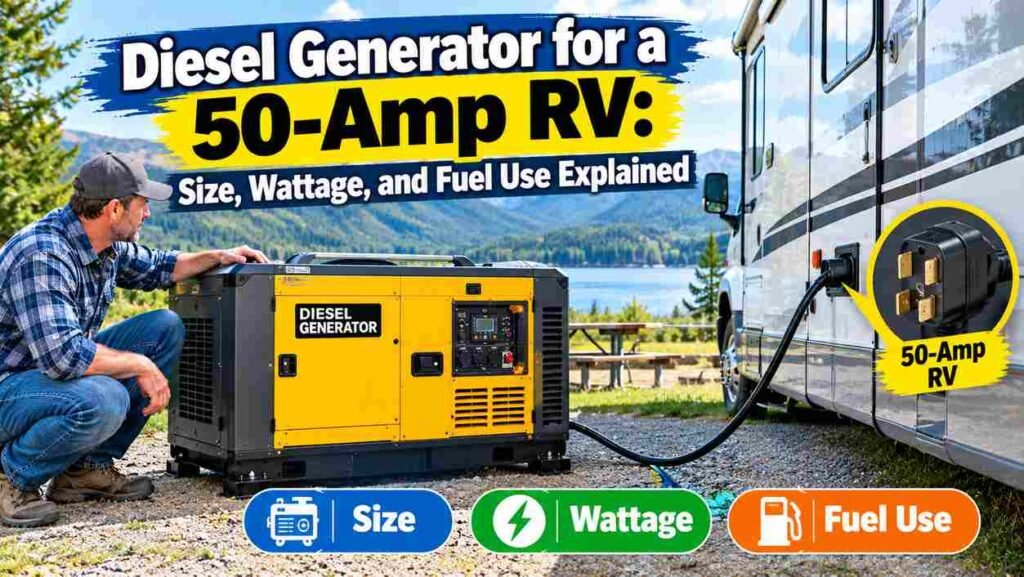
Quick answer: If you have a 50-amp RV, I would usually look at a diesel generator in the 6,000- to 10,000-watt range, depending on how many air conditioners and high-draw appliances you expect to run at the same time. A 50-amp RV shore-power connection can theoretically provide up to 12,000 watts, but you normally do not need a 12 kW generator unless you want to reproduce nearly the full capability of a 50-amp pedestal or you have three air conditioners and a heavy electrical load.
For many large fifth wheels and Class A motorhomes with two rooftop air conditioners, I consider about 7,000 to 8,000 watts a very useful target. If your RV has three air conditioners, an electric water heater, residential refrigerator, microwave, battery charger, and other major loads, I would move toward 10,000 to 12,500 watts.
What Does 50-Amp RV Service Actually Mean?
One of the biggest mistakes I see is treating a 50-amp RV connection as if it were simply 120 volts multiplied by 50 amps. A standard 50-amp RV service in North America normally uses a four-wire 120/240-volt split-phase connection with two 120-volt hot legs.



Each leg can supply up to 50 amps. That means the theoretical maximum power available from the pedestal is:
120 volts × 50 amps × 2 legs = 12,000 watts
| RV Service | Voltage | Maximum Current | Approx. Maximum Power |
|---|---|---|---|
| 15 amp | 120 V | 15 A | 1,800 W |
| 30 amp RV | 120 V | 30 A | 3,600 W |
| 50 amp RV | 120/240 V split phase | 50 A per leg | 12,000 W |
That 12,000-watt number tells me the maximum capacity of the shore-power connection. It does not automatically tell me what generator you need. Generator sizing is based on the equipment you actually operate.
What Size Diesel Generator Do I Recommend for a 50-Amp RV?
For most 50-amp RV owners, I would divide generator sizing into four practical groups.
| RV Setup | Suggested Generator Range | Typical Use |
|---|---|---|
| Light 50-amp RV, one A/C | 4,000–5,500 W | One A/C plus basic appliances |
| Two-A/C fifth wheel or Class A | 5,500–8,000 W | Two A/C units plus normal household loads |
| Large two-A/C all-electric RV | 8,000–10,000 W | A/C, microwave, charger, refrigerator and other loads |
| Three-A/C luxury coach | 10,000–12,500 W | Three A/C units and heavy simultaneous loads |
Cummins gives a similar general sizing range for onboard RV generators. Its guidance lists roughly 5,500 to 8,000 watts for a Class A RV with two 15,000-BTU air conditioners, and about 10,000 to 12,500 watts for a Class A coach with three 15,000-BTU units. I use those numbers as a useful starting point, but I still calculate the loads in the actual RV before choosing a generator.
Why Air Conditioners Usually Determine Generator Size
When I size a generator for an RV, rooftop air conditioners are usually the first loads I look at. They draw substantial power while running and can demand considerably more current for a short time when the compressor starts.
A typical 13,500- or 15,000-BTU rooftop air conditioner may use roughly 1,300 to 1,800 running watts under normal conditions. Starting demand can be much higher, particularly on an older unit without a soft-start device.
| RV Appliance | Typical Running Watts | Possible Starting / Peak Watts |
|---|---|---|
| 13,500-BTU rooftop A/C | 1,300–1,600 W | 2,500–3,500+ W |
| 15,000-BTU rooftop A/C | 1,500–1,800 W | 3,000–4,000+ W |
| Microwave | 1,000–1,500 W | Usually modest surge |
| Electric water heater | 1,200–1,500 W | Little starting surge |
| Converter / battery charger | 300–1,500+ W | Varies with battery state |
| Residential refrigerator | 100–500 W | Higher compressor start |
| Coffee maker | 800–1,500 W | Minimal surge |
| Hair dryer | 1,200–1,800 W | Minimal surge |
These are planning ranges rather than nameplate specifications. I always recommend checking the actual data label or manual for the appliances installed in your RV.
Example: Two-Air-Conditioner 50-Amp RV
Suppose I have a fifth wheel with two 15,000-BTU rooftop air conditioners. Assume each one uses about 1,600 watts while running. Together they need around 3,200 watts.
Now I add a residential refrigerator at 300 watts, a battery charger drawing 700 watts, lighting and electronics at 300 watts, and perhaps a microwave using 1,400 watts.
| Load | Example Running Watts |
|---|---|
| A/C #1 | 1,600 W |
| A/C #2 | 1,600 W |
| Refrigerator | 300 W |
| Battery charger | 700 W |
| Lights/electronics | 300 W |
| Microwave | 1,400 W |
| Total | 5,900 W |
On paper, that is already close to 6,000 watts. If one air conditioner cycles on while the microwave is running, the starting surge can briefly push the demand much higher. That is why I would be more comfortable with a 7,000- or 8,000-watt generator for this setup than with a generator sized exactly to the calculated running watts.
Can a 6,000-Watt Diesel Generator Run a 50-Amp RV?
Yes, in many cases it can. A 6,000-watt generator does not provide the full 12,000-watt capacity of a 50-amp pedestal, but your RV does not need the full 12 kW simply because it has a 50-amp plug.


A 6 kW generator can be a reasonable choice if you have two air conditioners but are willing to manage loads. For example, you may avoid operating the microwave, electric water heater, and both air conditioners at the same time.
Cummins has offered a 6 kW RV diesel generator rated around 50 amps at 120 volts. That gives me a useful real-world reference: 6 kW is enough for many RV loads, but it is not equivalent to unrestricted 50-amp shore power.
Is an 8,000-Watt Generator a Good Size?
For a large 50-amp RV with two air conditioners, 8,000 watts is one of the sizes I like most. It gives considerably more breathing room than 5.5 or 6 kW while remaining smaller and generally more fuel-efficient than a 10- or 12-kW set.
Cummins rates its Onan QD 8000 RV generator at 8 kW and states that it can run two 15,000-BTU air conditioners with power to spare. That lines up well with the type of load I typically expect in a two-A/C Class A motorhome.
I would still check how the generator output is connected to the RV distribution panel. Some onboard generators deliver 120 volts rather than a full 120/240-volt split-phase output, so the electrical arrangement matters just as much as the wattage number.
When I Would Choose a 10,000-Watt Diesel Generator
I would look seriously at a 10 kW generator when the RV has two or three air conditioners and several high-draw electric appliances. A large Class A coach may also have hydronic heating components, induction cooking, washer/dryer equipment, a residential refrigerator, multiple chargers, and entertainment systems.
A 10 kW RV generator gives you much more freedom to run those loads without constantly deciding which appliance has to be turned off first. Cummins lists its Onan QD 10000 at 10 kW with 120/240-volt output and describes it as suitable for running two or three rooftop air conditioners with power to spare.
Do I Need a 12,000-Watt Generator to Match 50-Amp Service?
If your goal is to come close to the full theoretical capacity of a 50-amp RV pedestal, then yes, around 12 kW is the electrical target. But for generator selection, I rarely start with the shore-power maximum. I start with actual simultaneous loads.
A 12- or 12.5-kW diesel generator makes sense for a large luxury motorhome where you want to operate three air conditioners and multiple electric appliances with minimal load management. For a smaller fifth wheel with two rooftop units, it may be unnecessary extra weight, cost, fuel consumption, and space.
Running Watts vs. Starting Watts
This distinction is critical. Running watts are what the appliance uses after it is operating normally. Starting watts are the short surge needed to start a motor or compressor.
If my RV has two air conditioners with a combined running load of 3,200 watts, I cannot automatically assume a 3,500-watt generator will handle them. The compressor starting surge may trip the generator breaker or cause voltage to sag badly.
This is also why soft-start devices have become popular in RVs. A properly installed soft-start device can reduce compressor starting demand, which may let a smaller generator start an air conditioner more reliably. I would still size the generator around the overall load rather than using a soft start as an excuse to undersize everything.
How Much Diesel Fuel Does an RV Generator Use?
Diesel consumption depends on generator size and electrical load. The generator burns much less fuel at a light load than at full rated output.
As a real manufacturer reference, published Cummins data for larger Quiet Diesel sets shows approximately 0.11 gallon per hour at no load, about 0.43 gallon per hour at half load and roughly 1.01 gallon per hour at full load for a 10 kW model. A 12 kW model in the same data is around 0.48 gallon per hour at half load and 1.20 gallons per hour at full load.
| Generator Example | No Load | Approx. Half Load | Approx. Full Load |
|---|---|---|---|
| 10 kW Quiet Diesel | 0.11 gal/hr | 0.43 gal/hr | 1.01 gal/hr |
| 12 kW Quiet Diesel | 0.11 gal/hr | 0.48 gal/hr | 1.20 gal/hr |
I treat these as model-specific reference numbers, not universal fuel-consumption figures. Your actual burn rate depends on the engine, generator design, altitude, temperature, maintenance condition, and load.
Estimated Diesel Use Over 8 Hours
If I use the example fuel rates above, I can estimate how much diesel an extended generator run may require.
| Fuel Rate | 4 Hours | 8 Hours | 12 Hours |
|---|---|---|---|
| 0.4 gal/hr | 1.6 gal | 3.2 gal | 4.8 gal |
| 0.5 gal/hr | 2.0 gal | 4.0 gal | 6.0 gal |
| 0.75 gal/hr | 3.0 gal | 6.0 gal | 9.0 gal |
| 1.0 gal/hr | 4.0 gal | 8.0 gal | 12.0 gal |
This calculation is simple: fuel rate multiplied by operating hours. I use it when planning boondocking time because it gives me a more realistic idea of how quickly generator operation can consume the RV’s diesel supply.
Portable Diesel Generator vs. Built-In RV Diesel Generator
If I own a diesel motorhome, I generally prefer a purpose-built onboard RV diesel generator when the coach is designed for one. It can draw from the main fuel tank, connect through the RV’s transfer system, use an enclosed installation designed for the coach, and often start from inside the RV.
A portable diesel generator can still be useful for a trailer or fifth wheel, but I have to think much more carefully about weight, storage, exhaust, weather exposure, grounding/bonding configuration, cord capacity, and safe placement.
| Feature | Built-In RV Diesel Generator | Portable Diesel Generator |
|---|---|---|
| Fuel supply | Often tied to RV fuel tank | Separate tank or external setup |
| Starting | Usually interior remote start | At generator or remote depending on model |
| Installation | Integrated | Must be placed outside safely |
| Noise control | Purpose-built enclosure | Varies widely |
| Portability | Fixed | Movable, but often very heavy |
120 Volts vs. 120/240 Volts Matters
Before buying a generator, I check more than the wattage. I also check the output voltage and how the RV is wired.
A 50-amp RV shore cord normally expects two hot legs. Some generators provide true 120/240-volt split-phase output. Others are 120-volt generators that feed an RV through a transfer arrangement designed by the RV manufacturer.
I never assume that a generator with a 50-amp-looking receptacle automatically provides the same electrical service as a campground pedestal. I confirm voltage, breaker arrangement, receptacle configuration, neutral/ground design, transfer-switch compatibility, and the generator manufacturer’s instructions.
How I Calculate the Generator Size for Your RV
If you want to calculate the size rather than rely on a rule of thumb, I use this process.
1. List every appliance you expect to run. I include air conditioners, microwave, water heater, refrigerator, converter/charger, washer/dryer, coffee maker, hair dryer, entertainment equipment and any other meaningful loads.
2. Record running watts. I use the nameplate or manual whenever possible. If the appliance lists amps instead of watts, I calculate watts approximately as volts multiplied by amps.
3. Decide what really runs at the same time. I do not add every appliance in the RV if I would never operate them simultaneously.
4. Allow for starting surge. Air conditioners, refrigerators and other motors may need extra starting power.
5. Add reasonable headroom. I do not like operating a generator at its absolute maximum for every normal situation. Some reserve capacity gives better flexibility when loads change.
Should I Oversize the Generator?
A little headroom is useful, but bigger is not automatically better. A larger diesel generator costs more, weighs more, occupies more space, and may burn more fuel at comparable operating conditions.
I try to choose a generator that comfortably carries the normal load and handles the expected motor-starting demand without jumping several size classes beyond what the RV actually needs.
If your calculated normal load is around 5,000 watts and you have two air conditioners, I might choose roughly 7 or 8 kW rather than a 12.5 kW generator. If your normal load is already 8,000 watts and you regularly use three air conditioners, then 10 to 12.5 kW becomes much more reasonable.
Can Load Management Let Me Use a Smaller Generator?
Yes. Load management can make a major difference. If I avoid running the microwave while both air conditioners are starting, switch the water heater to propane, delay the washer/dryer, and control battery-charger demand, I can operate comfortably on less generator capacity.
Some RVs include energy-management systems that automatically shed certain loads when demand gets too high. That can make a 6- or 8-kW generator work very well even though the RV has a 50-amp shore-power connection.
Altitude and Hot Weather Can Change the Answer
Generator output can be affected by operating conditions. High altitude reduces the amount of oxygen available to the engine, while very hot weather raises cooling demands and also increases the workload on air conditioners.
If I frequently camp at high elevation in summer, I give generator sizing more margin than I would for moderate conditions at low altitude. I also follow the derating information in the generator manufacturer’s manual because the exact reduction varies by engine and model.
Diesel Generator Advantages for Large RVs
For a diesel-powered Class A motorhome, a diesel generator makes practical sense. I can often use the same fuel already carried by the coach. Diesel generators are also well suited to long-duration operation and large electrical loads when they are properly sized and maintained.
Another advantage is that large onboard diesel RV generators are available in the power range that big 50-amp coaches actually need. Units around 8, 10 and 12.5 kW are common enough in the Class A market because those coaches can have two or three air conditioners and substantial household-style electrical equipment.
Safety: Never Run a Portable Generator in or Near an Enclosed RV Space
Generator exhaust contains carbon monoxide. I never operate a portable generator inside an RV, storage compartment, garage, enclosed trailer, or other confined space. I position portable equipment outdoors according to the manufacturer’s safety instructions and pay close attention to exhaust direction so fumes cannot enter doors, windows, roof vents, or neighboring RVs.
For a built-in generator, I keep the exhaust system in good condition and follow the RV and generator manufacturers’ inspection and maintenance requirements. A working carbon-monoxide alarm inside the RV is essential.
My Practical Sizing Recommendation
If you ask me what diesel generator I would choose for a 50-amp RV without giving me any other information, I would start around 7,000 to 8,000 watts for a typical two-air-conditioner RV. That range gives a good balance between usable capacity and generator size.
If the RV has only one air conditioner and you are comfortable managing loads, 4,000 to 5,500 watts may be enough. If you have three air conditioners or a luxury all-electric coach, I would look around 10,000 to 12,500 watts.
| Number of Rooftop A/C Units | Practical Diesel Generator Range | My Comment |
|---|---|---|
| 1 | 4–5.5 kW | Usually enough with sensible load management |
| 2 | 5.5–8 kW | Best range for many 50-amp RVs |
| 2 plus heavy electric loads | 8–10 kW | More freedom to run appliances simultaneously |
| 3 | 10–12.5 kW | Typical luxury-coach territory |
Frequently Asked Questions
Will a 7,500-watt generator run a 50-amp RV?
Yes, a 7,500-watt generator can run many 50-amp RVs, especially models with two air conditioners. It will not reproduce the full 12,000-watt capacity of shore power, so you may still need to manage high-draw appliances.
Can I plug my 50-amp RV into a 30-amp generator?
You may be able to connect through an appropriate adapter if the electrical configuration is correct, but the RV will be limited by the generator’s available power and breaker rating. A 30-amp, 120-volt source provides only about 3,600 watts, far below the full capacity of 50-amp RV service.
What generator size will run two RV air conditioners?
I generally look at about 5,500 to 8,000 watts for two rooftop air conditioners, depending on their size, starting characteristics, soft-start equipment, and what other loads you want to operate at the same time.
What generator size will run three RV air conditioners?
For three 15,000-BTU rooftop air conditioners in a large Class A coach, I would typically look at roughly 10,000 to 12,500 watts. The exact requirement depends on starting surge and the other electric loads in the coach.
How many amps does an 8,000-watt generator produce?
At 120 volts, 8,000 watts divided by 120 volts is about 66.7 amps. If a generator is configured for 120/240-volt split phase, the current available on each leg depends on the generator’s specific winding and breaker arrangement. I always use the manufacturer’s rated output instead of assuming the connection from wattage alone.
How long can an RV diesel generator run?
Runtime depends on fuel supply, load, maintenance condition, and the generator manufacturer’s operating requirements. Fuel consumption often becomes the practical limit. For example, a generator burning 0.5 gallon per hour would use about 4 gallons during an eight-hour run.
Final Answer
A 50-amp RV can theoretically receive up to 12,000 watts from shore power, but you do not automatically need a 12 kW diesel generator. I size the generator according to the loads you actually intend to operate.
For one air conditioner, around 4 to 5.5 kW may be enough. For most 50-amp RVs with two air conditioners, I would focus on approximately 5.5 to 8 kW, with 7 to 8 kW being a comfortable target for many owners. For heavy all-electric coaches or three-air-conditioner Class A motorhomes, I would move toward 10 to 12.5 kW.
The best choice comes from adding your simultaneous running loads, allowing for compressor starting demand, checking the generator’s voltage and outlet configuration, and leaving reasonable headroom. That gives you a generator that is large enough to run the RV reliably without paying for far more capacity than you actually use.
Meta description: What size diesel generator do you need for a 50-amp RV? I explain wattage, 120/240-volt service, air-conditioner loads, fuel use, and practical sizing.