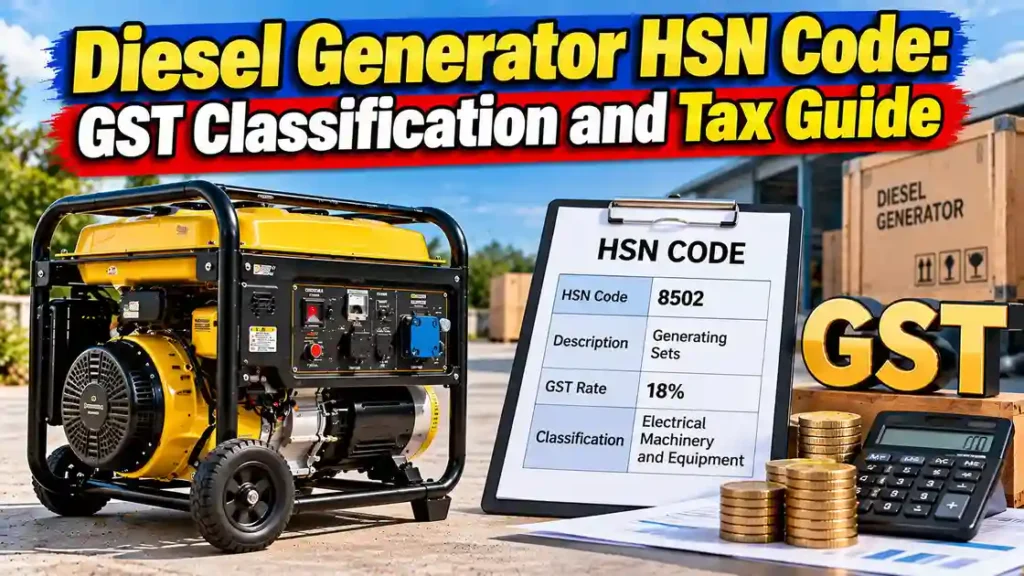


Quick answer: In India, a diesel generator set is generally classified under HSN heading 8502, which covers electric generating sets and rotary converters. Diesel or semi-diesel generator sets then fall into subheadings based mainly on rated output in kVA. As of October 2026, CBIC’s GST rate schedule lists heading 8502 at 18% GST—normally 9% CGST + 9% SGST for an intra-state sale, or 18% IGST for an inter-state sale. The exact 6- or 8-digit code depends on the generator’s nameplate output, so I always verify the rating before using a tariff code on an invoice.
If you are buying, selling, importing, installing, or accounting for a diesel generator in India, the phrase diesel generator HSN code can quickly become confusing. You may see 8502, 85021100, 85021200, or one of several 850213xx codes. You may also see a supplier quote GST separately, combine a generator with an ATS and installation, or describe the same machine in kW instead of kVA.
In this guide, I’ll show you how I work through the classification logically. I’ll explain which HSN heading normally applies, how output changes the subheading, how GST is calculated, how HSN reporting works on GST returns and invoices, and where businesses commonly make mistakes. I’ll also explain input tax credit, capital-goods treatment, parts, installation, and rental situations.
Important: This is a practical classification guide, not tax or legal advice. GST notifications, tariff entries, exemptions, and reporting rules can change. Before filing a return, issuing a high-value invoice, or clearing an import, I recommend checking the current CBIC/GST/Customs tariff data and confirming unusual transactions with a GST professional or customs broker.
What Is the HSN Code for a Diesel Generator?
The starting point is HSN 8502. This heading covers electric generating sets and rotary converters. A complete diesel genset—meaning an engine mechanically coupled to an electrical generator and supplied as a generating set—normally belongs under this heading rather than under the separate engine or alternator headings.


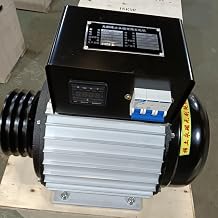
For a diesel or semi-diesel generating set, the next part of the code depends primarily on rated output. Indian tariff nomenclature separates compression-ignition generating sets into ranges measured in kVA.
| HSN / tariff code | General description | Rated output |
|---|---|---|
| 8502 | Electric generating sets and rotary converters | Heading level |
| 85021100 | Diesel or semi-diesel generating set | Not exceeding 75 kVA |
| 85021200 | Diesel or semi-diesel generating set | Exceeding 75 kVA but not exceeding 375 kVA |
| 85021310 | Diesel or semi-diesel generating set | Exceeding 375 kVA but not exceeding 1,000 kVA |
| 85021320 | Diesel or semi-diesel generating set | Exceeding 1,000 kVA but not exceeding 1,500 kVA |
| 85021330 | Diesel or semi-diesel generating set | Exceeding 1,500 kVA but not exceeding 2,000 kVA |
| 85021340 | Diesel or semi-diesel generating set | Exceeding 2,000 kVA but not exceeding 5,000 kVA |
| 85021350 | Diesel or semi-diesel generating set | Exceeding 5,000 kVA but not exceeding 10,000 kVA |
| 85021360 | Diesel or semi-diesel generating set | Exceeding 10,000 kVA |
These output brackets matter. If I have a 62.5 kVA genset, for example, I would look at 85021100. A 125 kVA or 250 kVA machine fits the 85021200 output band. A 500 kVA machine moves into the 850213 family and, under the current Indian tariff breakdown, falls within 85021310.
Diesel Generator HSN Code by Common Generator Size
Most buyers think in familiar sizes such as 10 kVA, 25 kVA, 82.5 kVA, 125 kVA, 250 kVA, 500 kVA, or 1,000 kVA. The following table shows how I would map those ratings to the tariff ranges above. I still check the actual nameplate because manufacturers may market models by approximate kW, standby rating, or prime rating.
| Example generator rating | Likely HSN code | Why |
|---|---|---|
| 10 kVA | 85021100 | Does not exceed 75 kVA |
| 25 kVA | 85021100 | Does not exceed 75 kVA |
| 62.5 kVA | 85021100 | Does not exceed 75 kVA |
| 82.5 kVA | 85021200 | Above 75 kVA and not above 375 kVA |
| 125 kVA | 85021200 | Above 75 kVA and not above 375 kVA |
| 250 kVA | 85021200 | Above 75 kVA and not above 375 kVA |
| 375 kVA | 85021200 | The band includes output up to 375 kVA |
| 500 kVA | 85021310 | Above 375 kVA and not above 1,000 kVA |
| 1,000 kVA | 85021310 | The band includes output up to 1,000 kVA |
| 1,250 kVA | 85021320 | Above 1,000 kVA and not above 1,500 kVA |
| 1,750 kVA | 85021330 | Above 1,500 kVA and not above 2,000 kVA |
| 2,500 kVA | 85021340 | Above 2,000 kVA and not above 5,000 kVA |
What GST Rate Applies to Diesel Generators?
As of October 2026, CBIC’s published GST rate schedule places heading 8502 in the 18% GST bracket. For a normal domestic taxable sale, that generally means one of the following structures:
| Transaction type | Tax structure | Total GST |
|---|---|---|
| Intra-state taxable sale | 9% CGST + 9% SGST | 18% |
| Inter-state taxable sale | 18% IGST | 18% |
I do not change the HSN simply because the sale is interstate. HSN classifies the goods; the place-of-supply and GST mechanism determine whether the tax is split into CGST/SGST or charged as IGST.
GST Calculation Example for a Diesel Generator
Suppose a business buys a diesel generator with a taxable value of ₹5,00,000 before GST.
| Item | Amount |
|---|---|
| Taxable value | ₹5,00,000 |
| GST at 18% | ₹90,000 |
| Total invoice value | ₹5,90,000 |
For an intra-state sale, that ₹90,000 would normally be split into ₹45,000 CGST and ₹45,000 SGST. For an inter-state sale, the invoice would normally show ₹90,000 IGST.
The calculation itself is simple:
GST = Taxable value × GST rate
₹5,00,000 × 18% = ₹90,000.


If the taxable value were ₹10,00,000, GST at 18% would be ₹1,80,000, making the total ₹11,80,000. I use this arithmetic only after I have confirmed what belongs in the taxable value, because freight, installation, accessories, or bundled services can affect how a particular contract is treated.
Why kVA Matters More Than kW for the HSN Subheading
One of the easiest mistakes is to classify a genset from a kW marketing description when the tariff output bands are written in kVA. kW is real power. kVA is apparent power. On many three-phase generator sets, a 0.8 power factor is commonly used for the rating, but I do not assume that when the nameplate already gives me kVA.
The basic relationship is:
kW = kVA × power factor
and therefore:
kVA = kW ÷ power factor
| Real power | Assumed PF | Calculated apparent power | Tariff observation |
|---|---|---|---|
| 50 kW | 0.8 | 62.5 kVA | Falls below 75 kVA |
| 60 kW | 0.8 | 75 kVA | At the 75 kVA upper boundary |
| 100 kW | 0.8 | 125 kVA | Above 75 kVA, within the 375 kVA band |
| 200 kW | 0.8 | 250 kVA | Within the 75–375 kVA band |
| 400 kW | 0.8 | 500 kVA | Above 375 kVA |
These are mathematical examples, not a substitute for the manufacturer’s rating plate. If a machine has separate standby and prime ratings, I would verify which rating is used for tariff classification with the relevant customs or tax professional instead of choosing whichever number produces the more convenient code.
Technical Details I Check Before Assigning an HSN Code
| Technical detail | Why I check it |
|---|---|
| Fuel/engine type | Confirms the set uses a compression-ignition diesel or semi-diesel engine rather than a spark-ignition engine |
| Complete genset vs separate components | A complete generating set and separate engine/alternator/parts may classify differently |
| Rated kVA | Determines the diesel-generator output subheading |
| Standby vs prime rating | Prevents me from using an ambiguous marketing number without checking the documentation |
| Model and serial number | Links the invoice to the actual equipment supplied |
| Alternator voltage and phase | Useful technical identification even though it usually does not replace the output-based subheading logic |
| Whether ATS, fuel tank, enclosure, batteries, or installation are included | Bundled items can create separate or composite-supply classification questions |
| Country of origin for imports | Import duties, concessions, trade remedies, and documentation can depend on origin in addition to the tariff code |
HSN 8502 vs HSN 8501: What Is the Difference?
I see this confusion often because heading 8501 also refers to generators. The important distinction is that 8501 covers electric motors and generators, excluding generating sets, while 8502 covers electric generating sets and rotary converters.
A diesel genset is more than a bare alternator. It is the engine-and-generator combination arranged to produce electrical power. If you are buying only a replacement alternator, classification may be different from buying the complete diesel genset. That is why I never copy a code from an old invoice without checking what was actually supplied.
What About Generator Parts?
Parts suitable solely or principally for machines of heading 8501 or 8502 can fall under heading 8503, and CBIC’s rate schedule also shows heading 8503 at 18%. However, I would not label every generator-related item 8503 automatically.
A starting battery, diesel engine, fuel filter, controller, breaker, radiator component, or separately supplied transfer switch can have its own classification. The correct code depends on the actual product and tariff notes. The fact that an item is used with a generator does not automatically turn it into an 8503 part.
Is Installation Included in HSN 8502?
HSN is a goods classification. Installation is a service. If a supplier sells a diesel generator and separately charges for installation, commissioning, cabling, civil work, or testing, you need to look at the contract and GST treatment rather than assuming the entire job is simply HSN 8502.
Some transactions may be structured as separate supplies. Others may raise composite-supply or works-contract questions depending on what is being installed, whether the equipment becomes immovable property, and how the agreement is written. I would not make that determination from the generator model alone.
For a straightforward equipment purchase, 8502 is the goods heading. For a large turnkey project, I would have the invoice structure reviewed before issuing it.
Does a Generator Rental Use HSN 8502?
Not in the same way. When you buy a generator, you are receiving goods. When you rent or hire a generator, the transaction is primarily a service and normally uses a service classification/SAC rather than treating the rental invoice as a sale of goods under HSN 8502.
If you are trying to estimate the economics of renting rather than buying, I have a separate guide on diesel generator rental costs. The tax classification of the rental service should still be checked against the current GST service-rate notification and your specific contract.
Can a Business Claim Input Tax Credit on a Diesel Generator?
Potentially, yes. Under Section 16 of the CGST Act, a registered person can generally claim input tax credit on eligible goods or services used or intended to be used in the course or furtherance of business, subject to the Act’s conditions and restrictions.
A diesel generator used for business operations may therefore qualify as capital goods for GST purposes when it is capitalized in the books and used for business. But eligibility is not automatic in every situation. Private use, exempt supplies, documentation problems, payment/return conditions, or other restrictions can reduce or block credit.
There is another detail I pay close attention to: Section 16(3) states that if a registered person claims depreciation under the Income-tax Act on the GST tax component of the cost of capital goods, input tax credit on that same tax component is not allowed. In practical terms, you do not get to both add the GST component to the depreciable cost and claim ITC on that same GST amount.
For the broader income-tax side of generator ownership, see my guide to tax deductions for business generator purchases.
Input Tax Credit Example
Assume a GST-registered business purchases a qualifying generator for ₹10,00,000 plus ₹1,80,000 GST and uses it entirely for taxable business operations. If all ITC conditions are satisfied and no restriction applies, the business may be able to claim eligible input tax credit on the ₹1,80,000 rather than treating that GST amount as part of the capital cost.
| Example item | Amount |
|---|---|
| Generator taxable price | ₹10,00,000 |
| GST at 18% | ₹1,80,000 |
| Invoice total | ₹11,80,000 |
| Potential GST ITC | Up to ₹1,80,000 if fully eligible |
I deliberately call that last line potential credit because the actual claim depends on the recipient, business use, supplier compliance, invoice data, returns, and the current GST rules.
How Many HSN Digits Do You Need to Report?
India’s GST reporting does not always require every taxpayer to use the same number of HSN digits. GSTN’s current Table 12 reporting rules use Aggregate Annual Turnover (AATO) in the preceding financial year to determine the minimum level.
| AATO in preceding financial year | Current minimum HSN reporting level in Table 12 |
|---|---|
| Up to ₹5 crore | 4-digit HSN |
| More than ₹5 crore | 6-digit HSN |
GSTN’s Phase 3 implementation, effective from the May 2025 return period, requires taxpayers to select HSN codes from the portal drop-down rather than manually typing arbitrary codes into Table 12. The portal also applies 4-digit or 6-digit requirements based on AATO.
For invoices, CBIC has stated that taxpayers with turnover above ₹5 crore in the preceding financial year must furnish 6-digit HSN, while taxpayers up to ₹5 crore must furnish 4-digit HSN on B2B invoices. If your accounting system stores the full 8-digit tariff code, that can make product master data more precise, but your invoice and return still need to follow the current GST rules.
Why the 4-Digit Code Is Not Always Enough
If you enter only 8502, you have identified the general family of electric generating sets. You have not yet identified the diesel output range. That can be enough for some high-level discussions, but not for every compliance task.
For example, an importer, customs broker, large GST taxpayer, procurement team, or ERP administrator may need the 6- or 8-digit level. That is where the nameplate becomes essential.
| Level | Example | What it tells me |
|---|---|---|
| 4-digit heading | 8502 | Electric generating sets and rotary converters |
| 6-digit subheading | 850211 | Compression-ignition generating set not exceeding 75 kVA |
| 8-digit tariff item | 85021100 | Indian tariff item used for that output band |
What HSN Code Should I Put on a 100 kVA Diesel Generator?
A 100 kVA diesel generating set is above 75 kVA but does not exceed 375 kVA, so it normally falls under 85021200.
The same code range would generally cover common ratings such as 82.5 kVA, 100 kVA, 125 kVA, 160 kVA, 200 kVA, 250 kVA, and 320 kVA, provided the rated output stays within the tariff limits.
What HSN Code Should I Put on a 500 kVA Diesel Generator?
A 500 kVA diesel generating set exceeds 375 kVA but does not exceed 1,000 kVA, so under the current Indian tariff subdivision I would look at 85021310.
Again, I would verify the current tariff master before using that code on an import declaration or tax document because tariff structures can be amended.
Do Standby and Prime Ratings Affect the Code?
This is one area where I avoid casual assumptions. Generator data sheets often show both standby and prime power. A set might be marketed as 500 kVA standby and have a lower prime rating. HSN subheadings are output-based, but a tariff classification question involving multiple published ratings should be resolved from the technical documentation and current customs interpretation rather than by simply choosing the lower or higher number yourself.
For operating purposes, standby and prime ratings are very different. If you are selecting a generator rather than classifying it for tax, see my guide on what size diesel generator you need.
Does GST Change With Generator Size?
Under the current CBIC goods-rate schedule, heading 8502 is listed at 18% GST. The kVA bands change the detailed HSN code, but they do not by themselves create a different standard GST rate within heading 8502.
| Example | Likely tariff item | Current heading-level GST rate |
|---|---|---|
| 25 kVA diesel genset | 85021100 | 18% |
| 125 kVA diesel genset | 85021200 | 18% |
| 500 kVA diesel genset | 85021310 | 18% |
| 1,250 kVA diesel genset | 85021320 | 18% |
What About Imports?
For imports, the HSN/Customs Tariff classification becomes even more important because the tariff item is used to determine customs duties, IGST, exemptions, trade-policy conditions, and other requirements. GST at domestic sale level is only one part of the import-cost picture.
I would check the ICEGATE Trade Guide using the exact tariff item and country of origin before estimating landed cost. Basic Customs Duty, Social Welfare Surcharge, IGST, exemptions, and any product-specific conditions should be calculated from the current customs data, not copied from an old shipment.
Common Diesel Generator HSN Mistakes I Would Avoid
- Using 8501 for a complete genset. Heading 8501 excludes generating sets; a complete engine-generator combination normally points me to 8502.
- Classifying from kW without checking kVA. The diesel genset subheadings use kVA output bands.
- Using 85021100 for every small-to-medium generator. Once output exceeds 75 kVA, the next subheading applies.
- Treating every accessory as part of the generator HSN. Batteries, ATS units, breakers, engines, filters, and other separately supplied goods may have their own headings.
- Using HSN 8502 for generator rental. Rental is a service transaction and needs service classification analysis.
- Claiming both GST ITC and depreciation on the GST tax component. Section 16(3) prevents that double benefit on the same tax component.
- Copying an old invoice without checking the tariff master. Codes and compliance rules can be amended.
- Ignoring the turnover-based HSN digit requirement. GSTR-1 Table 12 currently applies different minimum digit levels based on AATO.
Simple HSN Classification Checklist
- Confirm that I am dealing with a complete generating set, not just an engine or alternator.
- Confirm that the prime mover is a compression-ignition diesel or semi-diesel engine.
- Read the rated output in kVA from the manufacturer’s nameplate or specification sheet.
- Match the kVA rating to the 850211, 850212, or 850213 output bracket.
- Use the relevant Indian 8-digit tariff item when my compliance task requires that level.
- Check the current CBIC GST rate schedule rather than relying on an old invoice.
- For imports, confirm the tariff item and current duties in ICEGATE.
- For bundled installation, ATS, civil work, or rental, review whether separate goods/service classification issues arise.
- For ITC, confirm business use and all Section 16 conditions with the accounting/tax team.
- Keep the manufacturer data sheet, PO, invoice, and classification support in the records.
Frequently Asked Questions
What is the 4-digit HSN code for a diesel generator?
The general 4-digit heading is 8502, covering electric generating sets and rotary converters.
What is the HSN code for a diesel generator below 75 kVA?
A compression-ignition diesel or semi-diesel generating set with output not exceeding 75 kVA is generally classified under 85021100 in the Indian tariff.
What is the HSN code for a 125 kVA diesel generator?
A 125 kVA set is above 75 kVA but not above 375 kVA, so the usual Indian tariff item is 85021200.
What is the HSN code for a 500 kVA diesel generator?
A 500 kVA set falls above 375 kVA and not above 1,000 kVA, which corresponds to 85021310 under the current Indian tariff subdivision.
What is the GST rate on a diesel generator?
As of October 2026, CBIC’s GST goods-rate schedule lists heading 8502 at 18%. For a typical intra-state taxable sale that is 9% CGST plus 9% SGST; an inter-state taxable sale generally uses 18% IGST.
Are diesel generator parts also taxed at 18%?
Heading 8503 is currently listed at 18%, but not every item used on a generator belongs to 8503. Separately supplied batteries, engines, filters, switchgear, controllers, and other components can have different classifications. Identify the actual item first.
Can I claim GST input tax credit on a generator?
A GST-registered business may be able to claim eligible ITC when the generator is used in the course or furtherance of business and all statutory conditions are met. Credit can be restricted for non-business or exempt use. Also, if you claim depreciation on the GST tax component, Section 16(3) says ITC on that same tax component is not allowed.
Do I need 4, 6, or 8 HSN digits?
Current GSTN Table 12 reporting requires at least 4 digits for taxpayers with AATO up to ₹5 crore and at least 6 digits for taxpayers above ₹5 crore. Customs and detailed product masters may use the full 8-digit Indian tariff item.
Is HSN 8502 used for a generator rental invoice?
A rental is a service, so I would not treat the rental charge simply as a goods sale under HSN 8502. The appropriate SAC and GST treatment should be checked for the rental contract.
Bottom Line
If you only remember one thing, remember this: diesel generator sets generally start at HSN heading 8502, but the detailed code depends on the rated kVA output. Under the current Indian tariff, 85021100 covers diesel sets up to 75 kVA, 85021200 covers above 75 kVA through 375 kVA, and the 850213 family covers sets above 375 kVA in progressively larger output bands.
As of October 2026, CBIC lists heading 8502 at 18% GST. The HSN code, however, is only one part of the tax picture. You still need to determine whether the transaction is intra-state or inter-state, whether accessories and installation are separate or bundled, whether ITC is available, and how many HSN digits your GST reporting requires.
For a normal equipment purchase, I would start with the generator nameplate, confirm the kVA rating, match it to the tariff output band, and then verify the current GST and Customs databases before filing. That simple process prevents most classification errors.
Official References
- CBIC GST Goods and Services Rates: https://cbic-gst.gov.in/hindi/gst-goods-services-rates.html
- GSTN HSN reporting advisory for GSTR-1/1A Table 12: https://tutorial.gst.gov.in/downloads/news/updated_advisory_hsn_table12_25042025.pdf
- ICEGATE Trade Guide on Imports: https://www.icegate.gov.in/Webappl/index_imp.jsp
- CBIC CGST Act, Section 16 – Input Tax Credit: https://cbic-gst.gov.in/hindi/CGST-bill-e.html