Quick answer: A diesel generator may be able to run for many hours or even days without stopping, but the safe run time depends on the generator’s duty rating, fuel supply, load, cooling, oil condition, maintenance schedule, and manufacturer limits. Prime- and continuous-rated generator sets can be designed for unlimited annual operating hours under specified conditions, while standby-rated sets are intended for outage use and normally have load-factor and annual-hour limits. I never treat “the engine still runs” as proof that a generator should keep running indefinitely.
If you are asking, “How long can a diesel generator run continuously?”, I first separate two different questions. One is how long the generator can physically stay running before it runs out of fuel or needs service. The other is how long the manufacturer actually rates that generator to operate in your application.
Those two answers can be very different. A large diesel generator with a bulk tank may have enough fuel for several days, but if it is a standby-rated machine, that does not automatically make it a continuous-duty generator. On the other hand, a prime-rated generator may be designed for long-duration operation, yet a small day tank, a clogged filter, a missed oil service, or a cooling problem can stop it long before the rating becomes the limitation.



In this guide, I’ll show you how I think about diesel generator run time, how standby, prime, and continuous ratings differ, how to calculate tank runtime, what happens at 24, 48, and 72 hours, and what you should inspect if you expect the generator to run for an extended outage.
How Long Can a Diesel Generator Run Continuously?
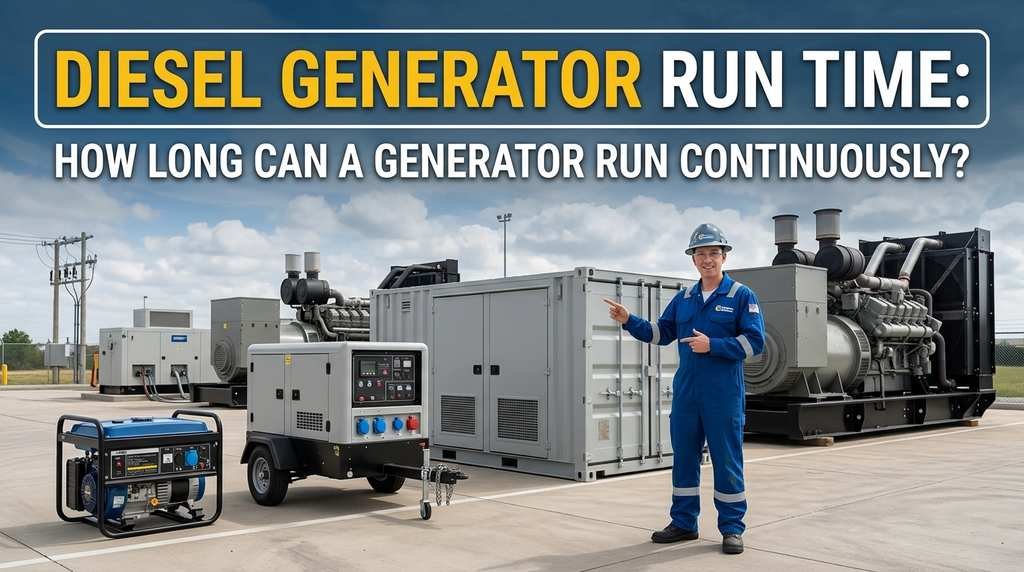
There is no single number that applies to every diesel generator. A portable or RV diesel unit may be limited by a relatively small tank and frequent service requirements. A commercial standby generator may run through a long utility outage, but its rating is still intended for emergency operation. A prime or continuous-rated industrial generator can be suitable for much longer schedules when it is correctly loaded, maintained, and supplied with fuel.
The rating plate, specification sheet, and operator’s manual are more important than a generic rule such as “8 hours,” “24 hours,” or “three days.” If I am planning for a critical facility, I use the exact model’s duty rating and maintenance schedule rather than assuming that every diesel engine can run around the clock.
Standby vs. Prime vs. Continuous Generator Ratings
The word continuous is often used casually to mean “running without shutting off,” but generator manufacturers also use it as a formal rating. That distinction matters.
Caterpillar’s current generator-rating guidance is a good example of how duty classes are separated. The table below summarizes Cat’s published rating definitions. These are manufacturer-specific examples, not universal limits for every generator brand or model.
| Rating example | Typical operating pattern | Published annual-hours guidance | Average-load guidance |
|---|---|---|---|
| Emergency Standby Power (ESP) | Variable load during utility outage or testing | Typical 50 hours/year; maximum expected 200 hours/year | About 70% of standby-rated kW |
| Standby | Variable load for duration of normal-source interruption | Typical 200 hours/year; maximum expected 500 hours/year | About 70% of standby-rated kW |
| Prime | Variable load for extended or primary-power use | Unlimited time under the rating conditions | About 70% average of prime-rated kW |
| Continuous | Non-varying or relatively steady load | Unlimited time under the rating conditions | About 70%–100% of continuous-rated kW |
Cat also notes that prime applications may allow a limited overload capability under specific conditions, while continuous ratings are intended for steady loading. The important lesson I take from this is simple: run time is inseparable from load profile and rating. If you want to run a generator as the main source of power every day, I would not size or select it as though it were only an emergency standby unit.
You can read Cat’s current rating explanation here: Understanding Generator Set Ratings.
The Main Factors That Limit Diesel Generator Run Time
Even when the rating permits extended operation, several practical limits determine how long the generator will actually stay online.
| Run-time factor | What I watch | How it can stop a long run |
|---|---|---|
| Fuel supply | Tank level, usable volume, fuel transfer system, leaks | Generator runs out of fuel or pulls air into the fuel system |
| Load | Average kW, peak kW, motor starting, phase balance | Overload, overheating, low frequency, breaker trip, protective shutdown |
| Cooling | Coolant level, radiator airflow, fan/belt condition, ambient temperature | High coolant temperature and shutdown |
| Lubrication | Oil level, pressure, leaks, oil condition | Low-oil-pressure alarm or engine damage |
| Fuel quality | Water, sediment, microbial growth, filter restriction | Power loss, unstable running, plugged filters, shutdown |
| Air/exhaust | Air-filter restriction, exhaust restriction, enclosure airflow | High exhaust temperature, smoke, power loss, overheating |
| Maintenance interval | Hours since oil, filter, coolant, and inspection service | Required service becomes due during the outage |
| Environment | Heat, altitude, dust, snow, flooding, salt air | Derating, blocked cooling, contamination, accelerated wear |
This is why I do not plan long generator operation around fuel capacity alone. A tank that provides 60 hours of fuel does not guarantee 60 trouble-free operating hours.
How to Calculate Diesel Generator Run Time From Fuel Capacity
For a basic estimate, I use this formula:
Theoretical run time (hours) = usable fuel in gallons ÷ fuel consumption in gallons per hour
The word usable matters. A tank’s nameplate capacity may not equal the amount you should plan to consume. Fuel systems may require a reserve, and tank geometry can leave fuel that is not practically usable at the pickup. I therefore use the manufacturer’s usable-fuel figure when one is available.


Here are simple mathematical examples. These are not fuel-burn specifications for a particular generator.
| Usable diesel | Average burn rate | Theoretical run time | Calculation |
|---|---|---|---|
| 20 gal | 0.8 gal/hr | 25.0 hr | 20 ÷ 0.8 |
| 50 gal | 1.5 gal/hr | 33.3 hr | 50 ÷ 1.5 |
| 100 gal | 3.0 gal/hr | 33.3 hr | 100 ÷ 3.0 |
| 200 gal | 6.0 gal/hr | 33.3 hr | 200 ÷ 6.0 |
| 500 gal | 12.0 gal/hr | 41.7 hr | 500 ÷ 12.0 |
For a much deeper fuel-use table by generator size and load, I would use the data and calculation method in my guide to diesel generator gallons per hour. I also explain the difference between full-load burn rate and real-world average consumption in my diesel generator burn-rate guide.
Why Load Changes Run Time So Much
A generator normally burns more fuel as electrical load rises. That means the same tank may provide dramatically different runtime at light load and heavy load.
For illustration, imagine a generator with 100 gallons of usable fuel. The fuel-consumption numbers below are hypothetical, but they show why I always base runtime on the expected load rather than just the generator’s rated kW.
| Operating condition | Example burn rate | 100-gal theoretical runtime |
|---|---|---|
| Light load | 2.0 gal/hr | 50.0 hr |
| Moderate load | 3.5 gal/hr | 28.6 hr |
| Higher load | 5.0 gal/hr | 20.0 hr |
| Near full rated load | 6.5 gal/hr | 15.4 hr |
I would replace those example burn rates with the manufacturer’s fuel-consumption curve for the actual generator. If the site load changes throughout the day, I use an average consumption based on the expected load profile, not a single full-load number.
Can a Diesel Generator Run for 24 Hours Straight?
Many correctly installed diesel generators can run for 24 hours if the model and rating permit it, but I still treat a 24-hour run as an operating period that needs inspection. I check fuel, oil, coolant, leaks, airflow, alarms, load, and the hour meter. The generator does not become maintenance-free simply because it was designed for long-duration operation.
| At 24 hours, I check | Why it matters |
|---|---|
| Fuel remaining | Confirms whether the original burn-rate estimate was accurate |
| Engine oil level | Long runs can reveal leaks or oil consumption that short exercises do not |
| Coolant level and temperature trend | Helps identify cooling-system deterioration before shutdown |
| Voltage and frequency | Confirms the set is carrying the load normally |
| Controller alarms and event log | May reveal warnings before an automatic shutdown occurs |
| Fuel-water separator/filter condition | Long fuel flow can expose contaminated stored diesel |
Can It Run for 48 or 72 Hours?
It may be possible, particularly with a prime- or properly applied commercial generator, but 48- and 72-hour operation changes the planning problem. At that point I start thinking about refueling logistics, service intervals, staff coverage, replacement filters, oil inventory, and whether critical loads need redundancy.
| Continuous elapsed time | Planning issue that becomes more important |
|---|---|
| 24 hr | Fuel estimate, daily inspection, oil/coolant checks, alarm review |
| 48 hr | Refueling schedule, fuel quality, filter restriction, operator handoff |
| 72 hr | Service-hour accumulation, spare consumables, maintenance window, redundancy |
| 168 hr (7 days) | Multiple inspections, possible scheduled service, large fuel logistics, site staffing |
A critical hospital, data center, water facility, communications site, or industrial operation should not plan a multi-day outage around “the generator should probably keep running.” The plan should include the exact rating, expected load, fuel autonomy, maintenance triggers, and a contingency if the primary set becomes unavailable.
Maintenance Can Be the Real Run-Time Limit
When a generator runs continuously, maintenance hours accumulate surprisingly fast. A service item due every 100 hours arrives in just over four days. A 250-hour item arrives in a little over ten days. A 500-hour item arrives in about three weeks.
| Service interval | Equivalent continuous elapsed time |
|---|---|
| 8 hr | Three checks per 24-hour day |
| 50 hr | 2.1 days |
| 100 hr | 4.2 days |
| 150 hr | 6.25 days |
| 250 hr | 10.4 days |
| 500 hr | 20.8 days |
| 1,000 hr | 41.7 days |
Cummins manuals show why I insist on checking the exact model. In one current Onan diesel manual, general inspection and oil-level checks are scheduled every day or every 8 operating hours, while other maintenance falls at model-specific hour intervals. Another Cummins diesel manual shows oil and filter service at a different interval. Those differences are enough that I would never tell you “all diesel generators need an oil change every X hours.”
You can see one current Cummins maintenance example in the HDKAX operator manual. For broader maintenance planning, see my diesel generator maintenance guide.
Model-Specific Maintenance Example
The table below summarizes selected items from one Cummins HDKAX operator manual. I am showing it only to demonstrate how quickly maintenance intervals can arrive during continuous operation. It is not a universal schedule.
| Maintenance item | Example interval in the referenced manual |
|---|---|
| Inspect generator set | Every day / 8 hours |
| Check engine oil level | Every day / 8 hours |
| Check coolant level | Every day / 8 hours |
| Check fuel level | Every day / 8 hours |
| Change engine oil and oil filter | Every month / 100 hours after initial service |
| Change fuel filter | Every 6 months / 250 hours in the referenced schedule |
| Change air-cleaner element | Every year / 500 hours in the referenced schedule |
Hot, dusty, high-load, contaminated-fuel, or other severe-service conditions can require more frequent attention. I always follow the exact operator manual and site maintenance program.
How Oil Pressure Affects Long Run Time
During a long run, I pay attention to oil pressure as a trend, not just a single number. Pressure normally changes as oil warms, and acceptable values are model-specific. A gradual drop, a low-oil-pressure alarm, or a sudden change from the generator’s normal trend deserves attention.
If you need help interpreting the reading, see my guide to diesel generator oil pressure range. If a genuine low-oil-pressure shutdown occurs, I would not keep restarting the set until the cause is understood.
Cooling Is Often the Difference Between a Short Run and a Long Run
Long operation turns small cooling problems into big ones. A partially blocked radiator, weak belt, low coolant level, dirty enclosure intake, high ambient temperature, or recirculation of hot discharge air may not cause trouble during a 20-minute exercise. After hours at meaningful load, the same issue can push coolant temperature high enough to derate or shut down the engine.
I watch coolant temperature trends and make sure the radiator discharge air has a clear path away from the intake. I also keep combustible debris away from the exhaust and hot engine surfaces.
Low Load Can Also Be a Problem
Running a diesel generator for a long time at very light load is not automatically “easier” on the engine. Some diesel engines can develop incomplete-combustion deposits and wet-stacking problems when operated too lightly for too long. The exact acceptable load range depends on the engine and manufacturer.
If your backup generator spends most of its time at a small fraction of its capacity, I would review the manufacturer’s minimum-load guidance and consider periodic professional load-bank testing when appropriate. My diesel generator load-testing guide explains what a load-bank test is intended to prove.
Fuel Quality Matters More During Extended Operation
Stored diesel may sit for months before an outage. Once the generator starts, contaminated fuel that was quiet in the bottom of a tank begins moving through filters and separators. Water, sediment, microbial growth, and degraded fuel can shorten filter life and cause a generator to lose power or shut down during exactly the outage you bought it for.
Before hurricane season, winter storms, or another predictable high-risk period, I would rather discover a fuel-quality problem during maintenance than after 18 hours of emergency operation.
Should You Shut a Diesel Generator Down to Refuel It?
For a small portable or manually fueled generator, I shut it down and follow the manufacturer’s cooling and refueling procedure. Fuel around a hot engine or exhaust is an obvious fire hazard, and I do not improvise a “hot refueling” method.
Large permanently installed systems can use engineered bulk tanks, day tanks, transfer pumps, return-fuel systems, and automatic controls that support long-duration operation. If a commercial installation is designed to receive fuel while the generator remains online, that procedure should come from the approved fuel-system design, site safety rules, and manufacturer instructions—not from a portable-generator refueling habit.
What Happens If the Generator Runs Out of Diesel?
Running dry can introduce air into the fuel system. The restart procedure depends on engine design, and modern high-pressure common-rail systems deserve special caution. I do not loosen high-pressure injector lines to bleed a modern diesel system; high-pressure fuel can penetrate skin and cause severe injury.
Use the priming procedure in the exact engine or generator manual. I cover the broader problem in what happens when a diesel generator runs out of fuel.
How I Plan Fuel for a Multi-Day Outage
For a long outage, I start with measured or manufacturer-published fuel consumption at the expected load. Then I multiply by expected operating hours and add a planning reserve appropriate to the site.
Here is a simple arithmetic example using an assumed average burn rate of 4 gallons per hour.
| Operating period | Example burn rate | Calculated fuel use |
|---|---|---|
| 12 hr | 4 gal/hr | 48 gal |
| 24 hr | 4 gal/hr | 96 gal |
| 48 hr | 4 gal/hr | 192 gal |
| 72 hr | 4 gal/hr | 288 gal |
| 168 hr | 4 gal/hr | 672 gal |
Those numbers are only arithmetic. Your actual generator can burn considerably more or less depending on size, load, ambient conditions, engine efficiency, and fuel specification.
Signs I Would Stop the Generator Instead of “Letting It Run”
Long runtime is never worth ignoring a protective warning. I would stop and investigate, or let the controller shut the set down, if I see evidence of a genuine mechanical or electrical problem.
| Warning sign | Why I take it seriously |
|---|---|
| Low oil-pressure alarm | Continuing to run can cause severe engine damage |
| High coolant temperature | May indicate cooling failure, overload, blocked airflow, or low coolant |
| Heavy abnormal smoke | Can point to fueling, air, turbo, oil, or combustion problems |
| Fuel or oil leak | Creates fire risk and may lead to fluid starvation |
| Repeated breaker trip | May indicate overload, short circuit, or downstream electrical fault |
| Unstable frequency or voltage | Can damage loads and indicates the generator is not carrying power normally |
| New knocking, grinding, or severe vibration | May indicate mechanical failure |
If your generator stops unexpectedly during a long outage, see my guide on what to do when a diesel generator stops mid-run.
Can a Standby Generator Be Used as a 24/7 Prime Generator?
I would not assume so. Standby, prime, and continuous ratings are different because the expected load factor, annual hours, thermal duty, maintenance assumptions, and application are different.
If you need 24/7 power for an off-grid site, construction operation, remote facility, mine, telecom installation, or other primary-power application, I would specify a generator with an appropriate prime or continuous rating rather than buying a standby unit based only on the largest kW number on the brochure.
Does a Larger Generator Run Longer?
Not necessarily. A larger generator usually consumes more fuel at a given percentage of rated load, but it may also be paired with a larger tank. Run time is the relationship between usable fuel and actual consumption, not generator kW alone.
Oversizing can also create poor loading. If your actual load is only a small fraction of the generator’s capacity, a smaller properly sized unit may be a better application. That does not mean I would intentionally undersize the generator; motors, compressors, pumps, HVAC equipment, and other loads can have significant starting demand.
Does a Diesel Generator Need Rest?
A properly rated prime or continuous generator does not need “rest” in the same way a person does, but it absolutely needs inspections and scheduled maintenance. Depending on the installation, maintenance may require a planned shutdown, a redundant generator, load transfer, or service while another source carries the facility.
For critical operations, redundancy is how I solve the maintenance problem. A second generator or another power source can carry the load while one unit is inspected or serviced.
FAQ: Diesel Generator Run Time
How many hours can a diesel generator run without stopping?
It depends on the generator’s duty rating, fuel supply, load, maintenance interval, and operating conditions. Prime- and continuous-rated sets may be approved for unlimited annual operating hours under their rating conditions, while standby units have different application limits.
Can I run a diesel generator 24 hours a day?
Yes, some diesel generators are designed for around-the-clock operation, especially prime and continuous-duty sets. I would verify the exact rating, perform the required inspections, maintain adequate fuel, and follow all service intervals.
Can a diesel generator run for a week?
Some properly applied generators can, but one week equals 168 operating hours. That is enough time for multiple inspections and, on some models, scheduled maintenance to become due. Fuel logistics and redundancy also become important.
How do I calculate generator runtime from a fuel tank?
Divide usable fuel capacity by average fuel consumption per hour. For example, 100 usable gallons at 4 gallons per hour gives a theoretical 25 hours. Real planning should allow for reserve fuel and changing loads.
Should I shut the generator down every 8 hours?
Not simply because 8 hours have passed. Some manuals call for inspections or fluid checks at 8-hour intervals, but that does not necessarily mean the generator must be shut down for eight-hour cycles. Follow the exact operator manual and safe inspection procedure for your model.
Why does my generator stop after running for several hours?
Common possibilities include fuel starvation, a restricted fuel filter, blocked tank vent, overheating, low oil pressure, overload, controller protection, or another fault that appears only after the machine is hot. Record fault codes before clearing them.
Does running at half load make the generator last twice as long on fuel?
Not exactly. Fuel consumption does fall as load falls, but the relationship is not perfectly linear. Use the manufacturer’s fuel-consumption data or measured site data rather than dividing full-load consumption by two.
Is continuous rating the same as prime rating?
No. Both can support unlimited annual operating hours under defined conditions, but prime power is generally intended for varying loads, while continuous power is intended for steadier loads. Manufacturer definitions and permitted load factors must be checked for the actual generator.
Bottom Line
When you ask me how long a diesel generator can run continuously, I do not start with a universal hour limit. I start with the rating, load profile, fuel supply, maintenance schedule, cooling system, and site conditions.
A small generator may be tank-limited to a matter of hours. A commercial standby generator may run through a long outage but still be governed by standby-duty limits. A prime- or continuous-rated industrial generator can be designed for prolonged operation, but it still needs fuel, inspections, filters, oil, coolant, and scheduled service.
If you plan for a multi-day outage, calculate fuel from the expected load, check the hour-based maintenance schedule before the outage begins, keep service supplies available, and decide in advance how you will handle maintenance or a generator failure. That is a much safer and more reliable plan than simply assuming a diesel engine will run forever as long as the tank is full.