

Meta description: Learn how to start a diesel generator manually step by step, including pre-start checks, preheat, cranking, warm-up, breaker operation, loading, shutdown, and troubleshooting.
Quick answer: To start a diesel generator manually, I first make sure the generator is outdoors or properly ventilated, check fuel, oil, coolant, battery condition, leaks, and the emergency stop, and make sure the output breaker is open or the load is disconnected. I then place the control in manual mode, use the preheat function if the engine requires it, crank the engine only for the time allowed by the manufacturer, verify oil pressure and charging voltage after it starts, let it stabilize briefly, and only then close the breaker or connect loads. The exact switch positions, preheat time, cranking limit, and warm-up procedure vary by model, so I always treat the owner’s manual as the final authority.
How to Start a Diesel Generator Manually
If you have only used an automatic standby generator, manually starting a diesel generator can seem more complicated than it really is. The basic process is straightforward, but the order matters. I do not simply turn the key or press START and immediately apply a heavy load. A diesel generator combines a diesel engine, starting battery, fuel system, cooling system, alternator, control panel, protection system, and circuit breaker. I want all of those systems ready before I ask the generator to carry a load.
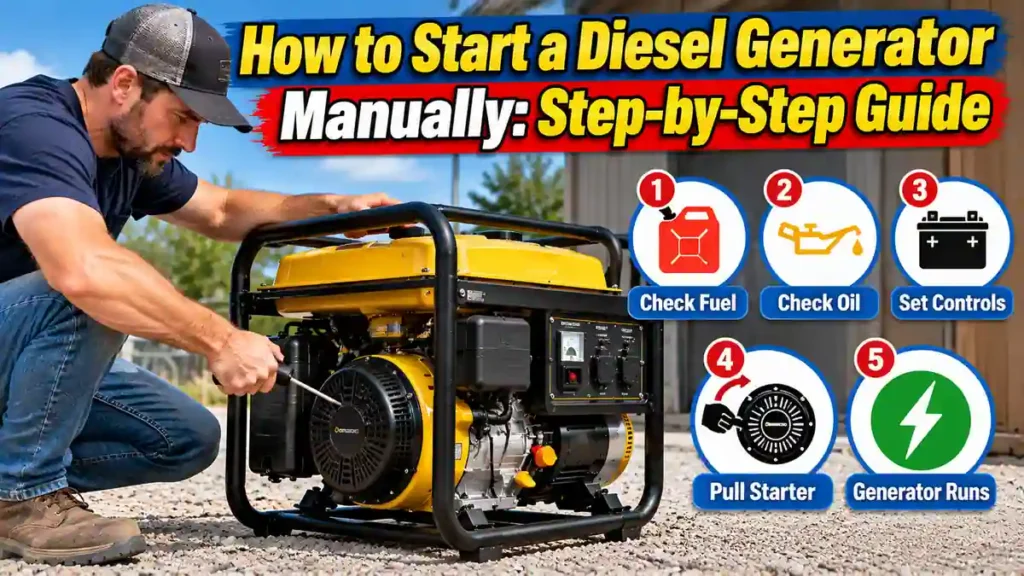
My basic sequence is: inspect, isolate the load, verify fluids and battery, select manual mode, preheat if required, start, verify gauges and alarms, warm up, connect the load, monitor operation, unload, cool down, and stop.
| Stage | What I Check or Do | Why It Matters |
|---|---|---|
| 1. Safety check | Ventilation, exhaust, leaks, surroundings | Reduces fire, carbon monoxide, and mechanical hazards |
| 2. Fluids | Fuel, engine oil, coolant | Prevents no-starts and protective shutdowns |
| 3. Battery | Voltage, cables, terminals | Ensures adequate cranking speed |
| 4. Electrical load | Open output breaker/disconnect load | Allows the engine to start unloaded |
| 5. Controls | Manual mode, reset alarms, E-stop released | Allows local starting |
| 6. Preheat | Glow plugs/intake heater if equipped | Improves cold starting |
| 7. Crank | Press START or turn key | Starts engine |
| 8. Verify | Oil pressure, voltage, frequency, charging | Confirms healthy operation |
| 9. Load | Close breaker/connect loads gradually | Avoids sudden overload |
| 10. Shutdown | Remove load, cool down, stop | Reduces heat stress |
Before You Start: Know What “Manual Start” Means
On many standby and commercial diesel generators, “manual start” means starting the set locally from its controller instead of waiting for an automatic transfer switch to send a start signal. You may see a selector labeled OFF–MANUAL–AUTO, STOP–RUN–AUTO, or separate START and STOP buttons.


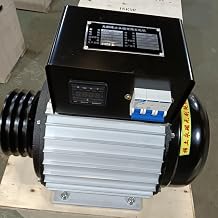
On a smaller portable diesel generator, manual operation may be as simple as opening the fuel valve, switching the engine control to RUN, preheating the engine, and turning the key to START.
I do not assume that every generator uses the same procedure. Some controllers handle preheat automatically. Some require me to hold a preheat switch. Some have a fuel-prime function. Some will refuse to crank if a previous fault has not been reset.
Step 1: Put Safety First
Before touching the start controls, I make sure the generator can be operated safely. A diesel engine produces carbon monoxide and other exhaust gases. I never run a portable generator inside a house, garage, basement, enclosed trailer, or other occupied enclosed space. A permanently installed generator must have a correctly designed exhaust and ventilation system.
I also look for fuel leaks, oil leaks, coolant leaks, damaged wiring, loose battery cables, nesting material, debris near the radiator, and anything touching the exhaust system.
If I smell raw fuel, see a significant leak, find damaged conductors, or notice an obvious mechanical problem, I do not start the generator until the issue is corrected.
Step 2: Make Sure the Generator Is Not Connected to an Unexpected Load
I prefer to start a diesel generator unloaded unless the manufacturer specifically instructs otherwise. On a portable generator, that means unplugging appliances or turning off downstream loads. On a standby or commercial set, that often means leaving the generator circuit breaker open while the engine starts and stabilizes.
If the generator is connected through an automatic transfer switch, I make sure I understand the system before manually operating breakers. Transfer equipment can involve utility voltage, and I do not defeat interlocks or backfeed a building. If I am not qualified to operate the switchgear, I leave that part to an electrician or generator technician.
Step 3: Check the Fuel Supply
I verify that there is enough clean diesel fuel in the tank for the planned run time. I also make sure any manual shutoff valve is open.
If the generator recently ran out of diesel fuel, I do not assume that simply adding fuel is enough. Air may have entered the low-pressure side of the fuel system. The generator may need to be primed according to its manual before it will start normally.
| Fuel-System Check | What I Look For | Possible Problem |
|---|---|---|
| Tank level | Enough fuel for expected runtime | Empty/low tank |
| Shutoff valve | Fully open | No fuel flow |
| Fuel filter | No overdue service or visible contamination | Restricted flow |
| Water separator | No excessive water | Contaminated fuel |
| Fuel lines | No cracks, kinks, wet fittings | Air leak or restriction |
| Prime condition | Fuel system fully primed | Cranks but does not start |
Step 4: Check the Engine Oil
I check the engine oil with the generator level and according to the manufacturer’s dipstick procedure. Low oil can prevent starting or trigger a low-oil-pressure shutdown shortly after the engine starts.


I also avoid overfilling. Too much oil can create foaming, crankcase pressure, oil consumption, or smoke on some engines. I use the viscosity and specification listed for the engine rather than choosing oil based only on brand.
If you are unsure about maintenance timing, I cover the subject in detail in my guide to diesel generator oil-change hours.
Step 5: Check Coolant on Liquid-Cooled Generators
For a liquid-cooled generator, I check coolant only when the engine is cool. I never open a hot pressurized cooling system. I look at the expansion tank or recovery bottle and inspect hoses, clamps, the radiator area, and the floor under the generator for leaks.
Low coolant may trigger a fault, and an engine that starts with a cooling-system problem can quickly overheat. My separate guide on diesel generator overheating explains those warning signs in more detail.
Step 6: Check the Starting Battery
A diesel engine needs strong cranking speed because of its high compression ratio. I inspect the battery terminals for corrosion and make sure the cable connections are tight.
For a conventional 12-volt lead-acid starting battery, a fully charged resting voltage is commonly around 12.6 volts. A reading close to 12.2 volts means the battery is substantially discharged, and a battery near 12.0 volts is usually too low for dependable diesel starting. Larger generator sets may use a 24-volt starting system.
| Battery System | Approx. Fully Charged Resting Voltage | What I Watch During Starting |
|---|---|---|
| 12 V | About 12.6–12.8 V | Excessive voltage collapse or slow cranking |
| 24 V | About 25.2–25.6 V | Weak bank, unequal batteries, loose cables |
These are general reference figures for lead-acid batteries, not pass/fail specifications for every battery chemistry. A proper load test gives me more information than resting voltage alone.
Step 7: Reset the Emergency Stop and Check for Stored Faults
I confirm that the emergency-stop button is released. On many sets, an activated E-stop prevents cranking even though the control panel still has power.
I then check the controller for alarms. If I see low oil pressure, high coolant temperature, overspeed, underspeed, overcrank, low fuel, or another fault, I record it before resetting anything. A stored alarm can tell me why the generator last shut down.
Step 8: Place the Generator in Manual or Run Mode
Once the safety and pre-start checks are complete, I move the controller from OFF or AUTO to MANUAL/RUN, depending on the design.
On some digital controllers, selecting MANUAL only enables local operation; I still need to press START. On other systems, moving the switch to RUN immediately begins the start sequence.
I keep hands, clothing, tools, and cables away from the fan, belts, pulleys, and other rotating parts because they may begin moving as soon as the engine cranks.
Step 9: Preheat the Diesel Engine if Required
Cold diesel engines may use glow plugs or an intake-air heater. Some modern controllers calculate preheat automatically based on temperature. Other sets require me to hold a PREHEAT or STOP/PREHEAT switch manually.
As one real-world example, a current Cummins Onan diesel manual specifies the following preheat schedule. I treat this as an example only—the manual for your generator controls.
| Ambient Temperature | Example Preheat Time |
|---|---|
| Above 86°F (30°C) | 10 seconds |
| 50–86°F (10–30°C) | 15 seconds |
| 32–50°F (0–10°C) | 20 seconds |
| Below 32°F (0°C) | 30 seconds |
I do not hold a manual glow-plug circuit longer than the manufacturer allows. Excessive preheat can shorten glow-plug life or damage the circuit.
Step 10: Start the Engine
Now I press START or turn the key to START. I release the switch as soon as the engine starts and reaches self-sustaining speed.
If it does not start, I do not hold the starter indefinitely. Starter motors produce a great deal of heat during cranking. Many generator manuals limit one cranking attempt to somewhere around 20–30 seconds, but the exact rule varies by model. One current Cummins manual, for example, limits continuous cranking to 30 seconds and calls for a two-minute cooling period before another attempt.
| Starting Behavior | What It Suggests | My Next Check |
|---|---|---|
| No crank, no click | Control/battery/interlock problem | Battery, E-stop, fuse, controller |
| Click but no crank | Low voltage, solenoid, starter cable | Battery and voltage drop |
| Slow crank | Weak battery, cold oil, starter problem | Battery, cables, temperature |
| Normal crank, no start | Fuel or preheat problem | Fuel supply, priming, glow plugs |
| Starts then dies | Fuel starvation or shutdown fault | Controller code, oil, coolant, fuel |
If the engine repeatedly cranks but does not start, I stop instead of draining the battery and overheating the starter. My article on diesel generator not starting goes deeper into that diagnosis.
Step 11: Check Oil Pressure Immediately
Once the engine is running, oil pressure is one of the first things I want to confirm. Some sets show a gauge; others only show an alarm status. A current Cummins Onan manual gives an example operating-temperature oil-pressure range of 40–60 psi for one particular model family. That is not a universal diesel-generator specification.
If the low-oil-pressure warning remains on, pressure fails to rise, or the engine makes abnormal mechanical noise, I shut it down rather than hoping the warning clears.
Step 12: Check Battery Charging, Coolant Temperature, Voltage, and Frequency
I let the generator stabilize at no load and watch the gauges. Depending on the set, I may have oil pressure, coolant temperature, DC charging voltage, AC output voltage, frequency, engine speed, and alarm status.
For a conventional AC generator, frequency is closely tied to engine speed. Common synchronous speed relationships are shown below.
| Frequency | 4-Pole Generator Speed | 2-Pole Generator Speed |
|---|---|---|
| 50 Hz | 1,500 rpm | 3,000 rpm |
| 60 Hz | 1,800 rpm | 3,600 rpm |
If you want a deeper explanation of this electrical side, see my guide Is a Diesel Generator AC or DC?
Step 13: Let the Generator Warm Up Briefly
I give the engine a short period to stabilize before applying a major load. The goal is not to idle a lightly loaded diesel indefinitely. I simply want oil circulating, temperature beginning to rise, and voltage and frequency stable.
The correct warm-up period varies by engine size, temperature, control strategy, and manufacturer. In very cold conditions, the engine may need more time. In normal temperatures, many modern sets are designed to accept load relatively quickly.
Step 14: Close the Generator Breaker or Connect Loads
Once the generator is running smoothly and its electrical output is stable, I can connect the load using the correct transfer equipment or close the generator output breaker if the system is designed for manual breaker operation.
I do not improvise a connection to a home electrical panel. A building generator needs an approved transfer switch or interlock arrangement that prevents dangerous backfeeding into the utility system.
For portable generators, I add loads gradually when possible. Large motors, pumps, compressors, and air conditioners can draw several times their running current during startup.
| Example Load | Typical Running Watts | Possible Starting Watts |
|---|---|---|
| Refrigerator | 150–800 W | 600–2,000 W |
| Sump pump | 800–1,500 W | 1,500–4,000 W |
| Window air conditioner | 700–1,500 W | 1,500–3,500 W |
| Well pump | 750–2,000+ W | 2,000–6,000+ W |
These are broad examples, so I use the appliance nameplate or manufacturer’s data for real load calculations.
What I Watch During the First Few Minutes
After applying load, I monitor the generator rather than walking away immediately. I watch for unstable frequency, voltage sag, black smoke, abnormal vibration, fuel leaks, coolant leaks, high temperature, low oil pressure, and unusual noises.
A generator that runs perfectly with no load but struggles as soon as equipment is connected may have an overload, fuel restriction, air restriction, governor issue, or engine-power problem. I cover that failure separately in Diesel Generator Bogs Down Under Load.
Typical Manual-Start Measurements
| Measurement | Typical Reference | Important Limitation |
|---|---|---|
| 12 V battery resting | About 12.6–12.8 V fully charged | Battery chemistry and condition matter |
| 24 V battery bank resting | About 25.2–25.6 V fully charged | Both batteries should be healthy |
| Residential AC output | 120/240 V in many North American systems | Depends on generator configuration |
| Frequency | 50 or 60 Hz | Depends on country/system |
| 4-pole speed | 1,500 rpm at 50 Hz; 1,800 rpm at 60 Hz | Applies to synchronous-speed relationship |
| Manual preheat example | 10–30 seconds on one Cummins family | Follow your exact manual |
| Continuous cranking example | Up to 30 seconds on some models | Model-specific starter limit |
How to Shut Down a Diesel Generator Manually
A good shutdown procedure is just as important as a good start. I do not normally stop a heavily loaded generator instantly unless there is an emergency.
- Remove or transfer the load. Open the generator breaker or use the proper transfer equipment.
- Let the engine run unloaded briefly. This allows oil and coolant to carry heat away from hot components.
- Press STOP or move the selector to OFF.
- Confirm the engine has stopped completely.
- Return the controller to AUTO if the generator normally serves as an automatic standby unit.
- Record any alarm or maintenance issue you noticed during operation.
One current Cummins manual recommends three to five minutes of no-load running before shutdown for the model covered by that manual. Again, I use the exact cooldown procedure specified for the engine and generator I am operating.
What If the Diesel Generator Will Not Start Manually?
If I press START and nothing happens, I divide the problem into two categories: no-crank and crank-but-no-start.
No Crank
- Emergency stop still pressed
- Weak or disconnected battery
- Blown control fuse or tripped DC breaker
- Loose ground cable
- Starter relay or solenoid failure
- Controller not actually in manual mode
- Safety interlock preventing crank
Cranks but Does Not Start
- Fuel tank empty or shutoff valve closed
- Air in the fuel system
- Fuel filter restricted
- Water or contaminated diesel
- Glow-plug or intake-heater fault
- Fuel-solenoid problem
- Insufficient cranking speed
- Low compression or injector fault
Should I Use Starting Fluid?
I do not use ether or starting fluid unless the engine manufacturer specifically approves it and provides a procedure. Starting fluid can be dangerous on engines equipped with glow plugs or intake heaters because ignition can occur at the wrong time. Excessive starting fluid can also cause severe cylinder pressure and engine damage.
Can I Manually Start an Automatic Standby Diesel Generator?
Usually, yes. Most standby controllers provide a MANUAL or RUN mode for maintenance and testing. However, manually starting the engine and manually transferring a building load are two different tasks.
I can often start the engine locally without transferring the building. Operating a transfer switch or paralleling equipment may require additional procedures and qualified personnel.
How Long Should I Crank a Diesel Generator?
I follow the generator manual rather than using one universal number. Many sets automatically stop cranking after a programmed period. As a model-specific example, current Cummins documentation for certain Onan diesel sets uses about a 30-second crank limit. Another Cummins control sequence calls for a cooling period after repeated attempts.
If the engine has not started after a few properly performed attempts, more cranking is usually not the answer. I stop and diagnose the reason.
How Long Should a Diesel Generator Warm Up?
There is no single warm-up time that fits every generator. Ambient temperature, engine size, coolant heating, oil viscosity, load acceptance design, and manufacturer programming all matter.
My goal is to verify normal oil pressure and stable operation, not to idle the generator lightly for an unnecessarily long period. Excessive low-load operation is not beneficial to many diesel engines.
Manual Start Checklist
| Check | Before Start | After Start |
|---|---|---|
| Fuel level | Verify | Watch for starvation/leaks |
| Oil level | Verify | Confirm oil pressure |
| Coolant | Verify when cold | Monitor temperature |
| Battery | Voltage/terminals | Confirm charging |
| Emergency stop | Reset | Keep accessible |
| Output breaker | Open/unloaded | Close after stable operation |
| Frequency | — | Verify 50/60 Hz as applicable |
| Voltage | — | Verify rated output |
| Leaks/noise | Inspect | Recheck under operation |
Frequently Asked Questions
Do I need to turn the breaker off before starting a diesel generator?
For many generator sets, I prefer to start with the output breaker open or the loads disconnected so the engine can reach stable speed without an immediate electrical load. The exact procedure depends on the generator and transfer system.
Do diesel generators need glow plugs to start?
Not every diesel generator uses glow plugs, but many small and medium diesel engines use glow plugs or an intake heater to improve cold starting. Modern controllers may operate preheat automatically.
Why does my diesel generator start manually but not automatically?
If it starts correctly in MANUAL but not AUTO, I look beyond the engine itself. Possible causes include controller settings, a transfer-switch start signal, remote wiring, battery/control power, exercise programming, or an active automatic-mode fault.
Can I start a diesel generator with a weak battery?
A marginal battery may turn the engine slowly but still fail to produce enough cranking speed for reliable diesel combustion. I would rather charge and test the battery than repeatedly crank with low voltage.
Should I let a diesel generator idle before applying load?
I normally allow a short stabilization period, but I avoid unnecessarily long low-load idling. I follow the engine manufacturer’s load-acceptance and warm-up instructions.
What do I do after the generator starts?
I immediately check oil pressure and alarm status, then verify charging voltage, coolant temperature where available, AC output voltage, and frequency. Once operation is stable, I connect the load using the correct breaker or transfer equipment.
Final Thoughts
Starting a diesel generator manually is not difficult once I follow a consistent sequence. I inspect the generator first, verify fuel, oil, coolant, and the battery, make sure the output is unloaded, place the controller in manual mode, preheat when required, start the engine without abusing the starter, and then confirm oil pressure, voltage, frequency, temperature, and charging before I apply load.
The most important point is that I do not treat every diesel generator as identical. A portable single-cylinder unit, an RV generator, a residential standby set, and a 500 kW commercial generator may all have different controls and starting limits. The step-by-step logic stays similar, but the exact preheat time, crank duration, breaker sequence, alarm reset procedure, and warm-up requirement come from the manual for that specific generator.
If the generator refuses to start after the normal procedure, I stop repeated cranking and diagnose the cause. That protects the starter, battery, fuel system, and engine—and it usually gets me to the real problem much faster.