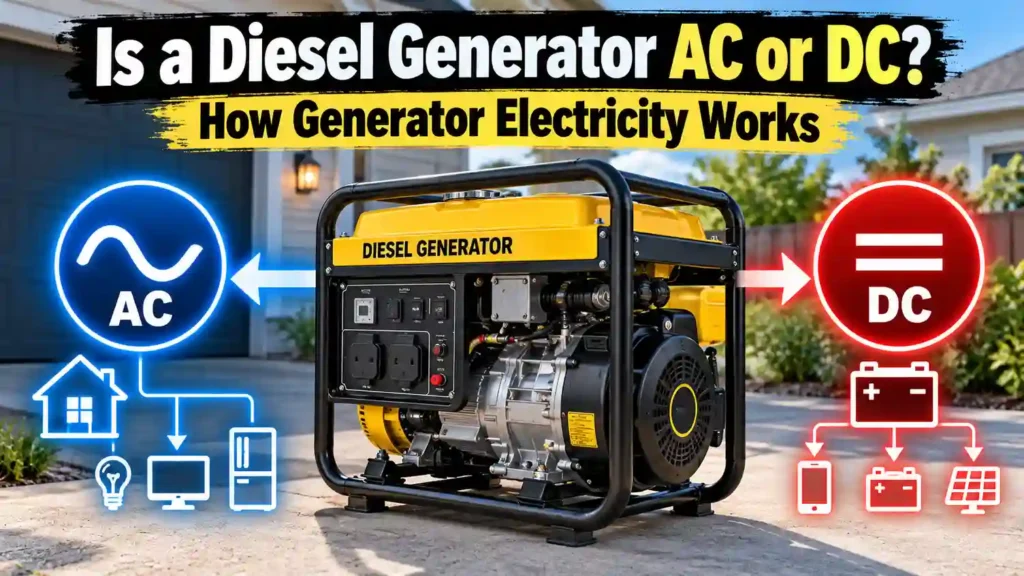


Quick answer: Most diesel generators are AC generators. The diesel engine does not create electricity directly. It turns a shaft connected to an alternator, and the alternator produces alternating current (AC). That AC can then be used directly by homes, businesses, tools, pumps, motors, and electrical panels. However, DC is still used inside many generator systems for the starting battery, control circuits, excitation, battery charging, and—in inverter-type systems—as an intermediate stage before the electricity is converted back to AC.
If you have ever looked at a diesel generator and wondered whether it is AC or DC, the answer can seem confusing because you may see a 12-volt or 24-volt battery, an alternator, a charger, an AVR, and an AC output panel all on the same machine. I will break all of that down in simple terms so you can understand exactly where the electricity comes from and how it gets to your load.
Is a Diesel Generator AC or DC?
In normal home, commercial, construction, standby, and industrial use, a diesel generator is an AC power source. The output terminals are designed to supply alternating-current electricity at a specified voltage and frequency such as 120/240 volts at 60 Hz, 230/400 volts at 50 Hz, 208 volts three-phase, 480 volts three-phase, or another configuration.
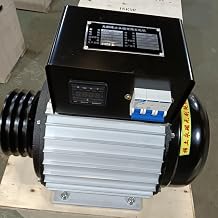
I like to think of the generator as two major machines bolted together:
- The diesel engine converts the chemical energy in diesel fuel into rotating mechanical energy.
- The alternator converts that rotating mechanical energy into electrical energy.
The engine itself does not care whether the final load is AC or DC. It simply turns the alternator shaft. The electrical design after that determines what kind of power you get.


| Part | Main Job | AC or DC? |
|---|---|---|
| Diesel engine | Creates mechanical rotation | Neither; mechanical energy |
| Main alternator | Produces generator output | Usually AC |
| Starting battery | Cranks engine and powers controls | DC |
| Battery charger | Keeps starting battery charged | Converts AC to DC |
| AVR/excitation system | Controls magnetic field and voltage | Uses rectified/control DC internally |
| Inverter, if fitted | Creates controlled AC output | DC-to-AC conversion stage |
How a Diesel Generator Makes Electricity
The process starts with combustion. Diesel fuel is injected into the engine cylinders, compressed air becomes hot enough to ignite the fuel, and the expanding gases push the pistons. The crankshaft turns, and that rotation is transferred directly or through a coupling to the alternator rotor.
Inside the alternator, a magnetic field rotates relative to stationary conductors in the stator. That changing magnetic field induces voltage in the stator windings. Because the magnetic field continuously rotates, the polarity of the induced voltage reverses repeatedly. That is why the electricity is alternating current.
So when I say a diesel generator produces AC, I am really saying that the alternator connected to the diesel engine produces AC.
Why Is It Called an Alternator Instead of a Generator?
In everyday language, people call the entire machine a generator. Technically, the electrical machine on most modern diesel generator sets is an alternator because it generates alternating current.
The term “generator” can describe a broader category of machines that convert mechanical energy into electrical energy. A DC generator is possible, but most modern diesel gensets use an alternator because AC is far more practical for distributing power to normal electrical loads.
Why Most Diesel Generators Produce AC
AC is used because the electrical systems in homes, commercial buildings, factories, hospitals, construction sites, and utility grids are primarily built around AC distribution.
Transformers can easily step AC voltage up or down. AC motors are common. Transfer switches and breaker panels are designed for AC. Most conventional appliances and industrial equipment expect AC input. For this reason, it makes sense for a diesel generator intended as backup or prime power to supply AC directly.
If you are using a diesel generator for home backup, for example, you normally want the generator output to resemble the utility power your house already receives. That is also why correct connection and transfer equipment matter. I explain that separately in my guide on how to connect a diesel generator to your home.
What Does AC Actually Mean?
AC stands for alternating current. The direction of current reverses periodically instead of flowing in only one direction.
In a 60 Hz system, one complete electrical cycle occurs 60 times every second. In a 50 Hz system, it occurs 50 times every second. That frequency is a major part of generator quality because many motors, clocks, transformers, and electronic devices are designed for a specific frequency.


| Electrical System | Typical Frequency | Common Regions/Applications |
|---|---|---|
| North American residential/commercial | 60 Hz | United States, Canada and others |
| Many European/Asian systems | 50 Hz | 230/400 V systems and similar |
| Special industrial/military systems | Other frequencies possible | Application-specific |
What Does DC Mean?
DC stands for direct current. In a DC circuit, current flows in one general direction. Batteries are the easiest example. A 12-volt battery supplies DC, which is why generator starters and control electronics often operate on DC even though the main generator output is AC.
This is where people often become confused. They see a large 12-volt or 24-volt battery on a diesel generator and assume the generator must make DC electricity. In reality, that battery is mainly there to crank the diesel engine and operate controls before the engine starts.
Where DC Is Used on a Diesel Generator
Even though the main output is usually AC, DC plays several important roles inside the generator set.
1. Starting Battery
Most small and medium diesel generators use a 12-volt starting system, while many larger machines use 24 volts. The battery powers the starter motor so the engine can reach cranking speed.
| Starting System | Nominal Voltage | Common Use |
|---|---|---|
| 12 V DC | 12 volts | Small and medium diesel engines |
| 24 V DC | 24 volts | Larger engines and industrial gensets |
| Higher-voltage DC | Application-specific | Specialized large equipment |
2. Control Electronics
The generator controller, shutdown solenoids, sensors, relays, and communication modules often operate from the battery’s DC supply. That allows the controller to remain alive even when the main AC alternator is not producing power.
3. Excitation System
The alternator needs a magnetic field. In many designs, the excitation system ultimately supplies controlled DC to the rotor field. The automatic voltage regulator, or AVR, adjusts this excitation so the generator can maintain the correct output voltage as load changes.
4. Battery Charger
Standby generators usually have a battery charger that converts available AC into DC so the starting battery stays charged while the machine is waiting for the next outage.
What Is the AVR and Why Does It Matter?
The AVR is the automatic voltage regulator. I think of it as the part that helps the alternator hold the target voltage.
If the electrical load increases, voltage can tend to change. The AVR senses generator output and adjusts field excitation. Increasing excitation can raise generated voltage; reducing excitation can lower it.
The AVR is therefore mostly responsible for voltage regulation, while engine speed and the governor are closely tied to frequency regulation.
| Parameter | Main Component Controlling It | Example |
|---|---|---|
| Voltage | AVR/excitation system | Keeping output near 240 V |
| Frequency | Engine governor/speed control | Keeping output near 60 Hz |
| Real power | Engine torque/fuel input | Supplying kW to the load |
| Reactive power | Excitation and load power factor | Supplying magnetizing current |
How Engine RPM Determines Generator Frequency
On a conventional synchronous alternator, electrical frequency is directly related to rotor speed and the number of magnetic poles.
The basic formula is:
Synchronous RPM = (120 × frequency) ÷ number of poles
That is why I commonly see the following speeds:
| Frequency | 2-Pole Alternator | 4-Pole Alternator |
|---|---|---|
| 50 Hz | 3,000 rpm | 1,500 rpm |
| 60 Hz | 3,600 rpm | 1,800 rpm |
If the engine slows too much under load, frequency can fall. If engine speed rises too far, frequency rises. That is one reason a diesel generator that is overloaded or suffering from fuel-delivery problems can produce poor-quality power even if the alternator itself is healthy.
Single-Phase vs. Three-Phase Diesel Generators
Whether the generator is single-phase or three-phase does not change the fact that it is producing AC. It describes how the AC waveforms are arranged.
Single-Phase AC
Single-phase output is common for smaller generators and residential backup. In North America, many standby units provide 120/240-volt split-phase service. That allows the generator to power both 120-volt loads and 240-volt loads.
Three-Phase AC
Three-phase generators are common in commercial and industrial applications because three-phase power is efficient for large motors and heavy electrical loads.
| Type | Typical Use | Example Voltages |
|---|---|---|
| Single-phase | Homes, small shops, portable power | 120 V, 120/240 V, 230 V |
| Three-phase | Factories, commercial buildings, pumps, HVAC | 208 V, 400 V, 480 V and others |
How Do I Calculate Generator Current?
Current depends on power, voltage, phase configuration, and power factor.
For a simple single-phase resistive example:
Current = watts ÷ volts
A 5,000-watt resistive load at 240 volts would draw about:
5,000 ÷ 240 = 20.8 amps
For three-phase systems, the calculation is different:
kW = √3 × volts × amps × power factor ÷ 1,000
That is why I do not compare three-phase generator current directly with single-phase current unless voltage and power factor are also known.
| Example Load | Voltage | Approx. Current | Assumption |
|---|---|---|---|
| 2,400 W | 120 V | 20 A | Single-phase, PF 1.0 |
| 5,000 W | 240 V | 20.8 A | Single-phase, PF 1.0 |
| 10,000 W | 240 V | 41.7 A | Single-phase, PF 1.0 |
If you are comparing generator sizes, my guide on how much power a 20 kW diesel generator provides goes deeper into usable load.
Can a Diesel Generator Produce DC Directly?
Yes, it is technically possible to build a diesel-driven DC generator. Specialized DC generator systems are used for certain telecom, battery-charging, welding, marine, railway, and industrial applications.
But if you are shopping for a normal portable, standby, rental, or industrial generator, I would assume the main output is AC unless the manufacturer specifically says otherwise.
What About a 12-Volt DC Outlet on a Portable Generator?
Some portable generators include a 12-volt DC charging outlet. That does not mean the main generator is DC. Usually the machine still produces AC as its primary output and uses a rectifier or auxiliary winding to provide a limited DC charging circuit.
I also do not treat a small generator DC outlet as a substitute for a quality smart battery charger unless the manufacturer specifically approves that use. Voltage regulation and charging behavior can be different.
What Is a Rectifier?
A rectifier converts AC into DC. Diodes allow current to flow mainly in one direction, turning alternating current into pulsating DC. Filtering and regulation can then smooth and control that DC voltage.
Rectifiers are important because many generator systems need DC internally even though the alternator produces AC.
What Is an Inverter?
An inverter does the opposite job: it converts DC into AC.
In an inverter generator, the electrical path is different from a conventional fixed-speed generator. The alternator may first produce variable-frequency AC. That AC is rectified into DC. Power electronics then invert the DC back into a controlled AC waveform at the target voltage and frequency.
This allows engine speed to vary more freely with load while the inverter maintains the final AC output. Diesel inverter generators are less common than gasoline inverter portables, but the same electrical principle can be used.
| Generator Type | Electrical Path | Main Output |
|---|---|---|
| Conventional synchronous diesel generator | Engine → alternator → AC | AC |
| Inverter-type generator | Engine → alternator → AC → DC → inverter → AC | AC |
| Dedicated DC generator system | Engine → generator/rectification system → DC | DC |
Is Generator AC the Same as Utility AC?
In principle, yes: both are alternating current. But the quality of generator power depends on voltage regulation, frequency regulation, waveform quality, load balance, harmonics, and transient response.
The utility grid is extremely large, so a small household load barely changes grid frequency. A standalone generator is much smaller. When a large motor starts, the sudden load can cause temporary voltage and frequency dips.
That is why proper generator sizing matters. A generator that is too small may still produce AC, but the voltage and frequency may not stay within acceptable limits when loads start.
What Is “Clean Power” From a Diesel Generator?
When people say “clean power,” they usually mean electricity with stable voltage, stable frequency, and a reasonably smooth sine wave with low harmonic distortion.
Sensitive electronics can be less tolerant of poor voltage regulation or distorted waveforms than heaters and incandescent lamps. Modern quality generators generally provide good power when they are correctly sized, maintained, and loaded.
If I suspect an output problem, I check the generator under load rather than only at idle. My guide on how to test whether a diesel generator is working properly covers that process in more detail.
Does a Diesel Generator Produce 120 V or 240 V?
It depends on the winding configuration and intended market. A residential generator in North America may provide 120/240 V split-phase output. A small portable unit may provide 120 V only or both 120 and 240 V. Industrial machines may provide 208 V, 240 V, 480 V, 600 V, 400 V, or other voltages.
| Application | Common Example Output | Phase |
|---|---|---|
| Small portable generator | 120 V | Single-phase |
| North American home standby | 120/240 V | Split-phase |
| Light commercial | 208Y/120 V | Three-phase |
| Industrial | 480Y/277 V | Three-phase |
| Many international systems | 230/400 V | Single/three-phase depending on connection |
These are examples, not universal values. I always check the generator nameplate before connecting equipment.
Does a Diesel Generator Produce AC When It Is Not Connected to a Load?
Yes. A healthy generator normally builds voltage even with no external load connected. The alternator creates the electrical potential; current increases when a circuit is connected and begins drawing power.
This is similar to a wall outlet. The outlet can have 120 or 230 volts present even when nothing is plugged into it, but almost no load current flows until an appliance is connected.
What Happens When the Load Increases?
As you connect more electrical load, the alternator must deliver more current. That requires more mechanical torque from the diesel engine. The governor responds by increasing fuel delivery so engine speed remains near the target RPM.
At the same time, the AVR adjusts excitation to help maintain voltage. This coordination between the engine governor and AVR is what lets a genset supply changing loads without large swings in frequency and voltage.
What Happens If the Generator Is Overloaded?
If you demand more than the generator can supply, several things can happen. Frequency may drop as the engine loses speed. Voltage may sag. The breaker may trip. The controller may detect an overload or underspeed condition. The engine may smoke or bog down.
This is why I pay attention to both running watts and motor starting requirements. Large motors, pumps, air conditioners, and compressors can briefly demand several times their normal running current.
If your generator struggles when loads are connected, see my guide on why a diesel generator bogs down under load.
AC vs. DC: Practical Differences for Generator Owners
| Feature | AC | DC |
|---|---|---|
| Direction of current | Reverses periodically | Flows primarily one direction |
| Typical diesel genset main output | Yes | No, except specialized units |
| Home/building distribution | Common | Uncommon |
| Starting batteries | No | Yes |
| Easy transformer voltage conversion | Yes | Requires electronics |
| Battery storage | Must be converted | Native form |
Can I Charge Batteries From a Diesel Generator?
Yes, but the usual method is to use the generator’s AC output to power a proper battery charger. The charger converts AC to the correct regulated DC voltage and current for the battery chemistry.
This is generally better than assuming any built-in DC outlet is suitable for long-term charging. Lead-acid, AGM, lithium, and other batteries may have different charging requirements.
Can a Diesel Generator Power DC Equipment?
Yes, but you normally need a suitable AC-to-DC power supply or charger between the generator and the DC equipment. For example, a 48-volt telecom load can be powered from a diesel genset through a rectifier system.
In hybrid systems, a diesel generator may charge a battery bank through a charger, while an inverter supplies AC loads from that battery bank. In that setup, power may change form several times:
Diesel generator AC → charger/rectifier → DC battery → inverter → AC load.
What Should I Look at on the Generator Nameplate?
If you want to know exactly what electricity your generator produces, the nameplate is more reliable than guessing from its size.
I look for:
- Rated voltage
- Frequency in Hz
- Single-phase or three-phase
- Rated current in amps
- kW rating
- kVA rating
- Power factor
- Rated RPM
- Standby, prime, or continuous rating
These numbers tell you far more than simply knowing that the machine runs on diesel.
Frequently Asked Questions
Are all diesel generators AC?
No. Specialized DC diesel generators exist, but the overwhelming majority of portable, standby, rental, commercial, and industrial diesel generator sets used for general electrical power produce AC.
Does the diesel engine generate electricity?
No. The diesel engine generates mechanical rotation. The alternator converts that rotation into electricity.
Why does my AC diesel generator have a DC battery?
The battery is used mainly to crank the engine and power controls, relays, sensors, and shutdown systems before and during operation.
Is a 12-volt generator output AC or DC?
You need to check the label. A dedicated 12-volt charging outlet is normally DC, while the generator’s main receptacles are normally AC.
Is 120/240 V generator power AC?
Yes. A conventional 120/240-volt residential or portable generator output is AC, typically 60 Hz in North America.
Does three-phase mean DC?
No. Three-phase power is AC. It uses three alternating waveforms separated in phase from one another.
What is the difference between an alternator and an inverter?
The alternator converts mechanical rotation into electrical energy. An inverter is an electronic device that converts DC into controlled AC.
Can generator AC damage electronics?
Poorly regulated voltage, unstable frequency, or excessive harmonic distortion can cause problems for sensitive devices. A properly functioning, correctly sized generator should maintain its specified output within the manufacturer’s limits.
Final Answer: Is a Diesel Generator AC or DC?
For almost every normal backup, portable, construction, commercial, or industrial application, I would describe a diesel generator as an AC generator. The diesel engine turns an alternator, and that alternator produces alternating-current electricity at a specified voltage and frequency.
DC is still an important part of the machine. The starting battery is DC, many control circuits use DC, the excitation system may use rectified DC, and battery chargers convert AC into DC. In inverter-based systems, the electrical output may even pass through a DC stage before being converted back into AC.
The simplest way to remember it is this: the engine provides rotation, the alternator produces AC, and DC supports the starting, control, charging, and conversion systems around it.
If you are choosing between generator types, you may also want to read my comparison of portable vs. standby diesel generators.