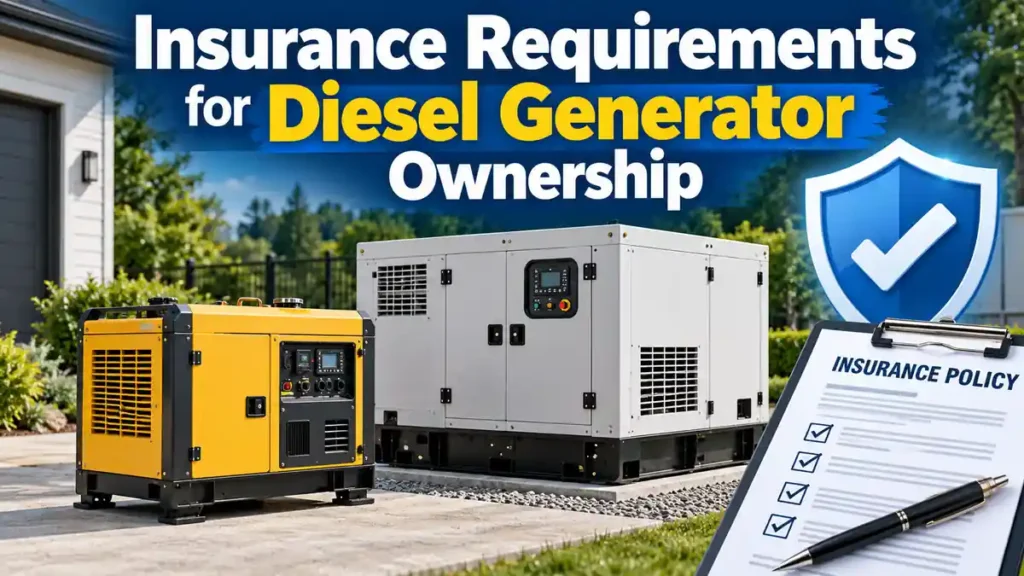


If I am buying a diesel generator, I do not wait until after installation to call my insurance agent. A permanent standby generator can add tens of thousands of dollars of equipment and installation value to a property, while a large diesel tank can add fire, spill, environmental, and liability exposures. Those details can matter to both an insurer and a lender.
In this guide, I’ll explain the insurance requirements for diesel generator ownership in practical terms. I’ll cover homeowners insurance, commercial property insurance, equipment breakdown, liability, business interruption, fuel-storage questions, mobile and rental generators, documentation, and the information I would give an insurance company before the generator goes into service.
Insurance Requirements for Diesel Generator Ownership: Quick Answer
| Situation | Coverage I review | What I ask my insurer |
|---|---|---|
| Home standby generator | Homeowners dwelling/other structures, liability | Is the permanent generator included in replacement value? Do you require notification, permits, or licensed installation? |
| Small business | Commercial property/BOP, liability, business income | Is the generator scheduled as business property, and is outage-related extra expense covered? |
| Large commercial generator | Commercial property, equipment breakdown, pollution, business income | Are mechanical/electrical breakdown and fuel-spill losses covered? |
| Trailer-mounted/mobile generator | Inland marine/equipment floater, commercial auto where applicable | Is the unit covered while transported, stored off-site, or temporarily located at a jobsite? |
| Rental generator | Rental contract damage waiver, business property/inland marine, liability | Who is responsible for physical damage, theft, fuel contamination, and third-party injury? |
The important point is that “I have insurance” is not enough. I want to know whether the specific generator, installation, fuel tank, and use case are covered.
Do I Need to Tell My Homeowners Insurance Company About a Generator?
If I install a permanent standby diesel generator at a home, I tell the insurer. A standard homeowners policy generally protects the dwelling, personal property, liability, and additional living expenses for covered losses, but the exact policy language controls. The Insurance Information Institute also notes that mortgage lenders generally require homeowners insurance even though homeowners insurance itself is not a federal requirement for owning a home.
A permanently installed generator can change the replacement cost of the property. It can also create new underwriting questions about electrical work, fuel storage, fire separation, flood exposure, wind anchoring, and who installed the system. If I spend a large amount on a generator and automatic transfer switch, I want the insurer to know the improved property value rather than discover after a loss that my dwelling limit was based on an older configuration.


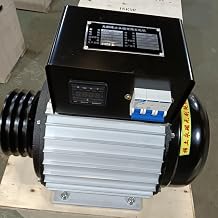
I also ask whether the generator is treated as part of the dwelling, an “other structure,” or separately scheduled equipment. Different insurers can classify installations differently.
Commercial Property Insurance for Diesel Generators
For a business, the first coverage I review is commercial property insurance. A Businessowners Policy (BOP) typically combines property, liability, and business interruption coverage for eligible small businesses. Commercial package policies can be customized more broadly.
Triple-I explains that business property insurance can cover buildings and business-owned property such as machinery and equipment. A generator can therefore be a significant insured asset, but I still confirm the valuation method and cause-of-loss form.
| Business coverage | What it may address | Why it matters to a generator owner |
|---|---|---|
| Commercial property | Physical damage to covered building/equipment from covered causes | The generator, ATS, controls, and related equipment may represent substantial property value |
| General liability | Third-party bodily injury/property damage claims | Relevant if generator operation, exhaust, electrical work, or site conditions injure others |
| Business income | Lost income after a covered property loss | Can help if a covered event forces the business to close |
| Extra expense | Additional costs to keep operating | May help with temporary facilities or emergency measures after a covered loss |
| Equipment breakdown | Mechanical/electrical breakdown of covered equipment | Can address losses not covered as ordinary external property damage |
| Inland marine/equipment floater | Mobile equipment in transit/off premises | Important for trailer-mounted or jobsite generators |
| Pollution liability | Certain pollution cleanup/injury costs | May matter for diesel spills and environmental exposure |
Why I Ask About Equipment Breakdown Coverage
A diesel generator can fail internally even when no storm, fire, theft, or other external event occurred. Travelers explains that equipment breakdown insurance is designed for equipment that uses or transmits mechanical or electrical energy, and that without this coverage, property owners may not be protected against losses caused by mechanical failure or electrical arcing.
That is exactly the gap I look for. If the alternator suffers an electrical breakdown, a control panel fails, a switchgear component arcs, or a major mechanical component breaks, the commercial property form alone may not respond the way I expect.
I ask whether equipment breakdown is included automatically, added by endorsement, or sold separately. I also ask whether the coverage includes consequential property damage, spoilage, business income, and expediting expense.
Technical Details an Insurer May Ask Me to Provide
Insurance companies and risk-control representatives may ask for more than the generator’s brand name. I keep a complete equipment record so I can answer technical questions quickly.
| Technical detail | Example information | Why an insurer may care |
|---|---|---|
| Generator rating | 20 kW, 100 kW, 500 kW | Indicates asset value, load, and potential hazard scale |
| Voltage/phase | 120/240 V single phase; 208/120 V or 480/277 V three phase | Helps describe the electrical system and installation |
| Duty rating | Standby, prime, continuous | Shows how heavily the unit is expected to operate |
| Fuel tank capacity | 50 gal, 250 gal, 1,000 gal, etc. | Fire, spill, environmental, and containment exposure |
| Tank type | Sub-base, aboveground bulk tank, day tank, underground tank | Different installation and environmental risks |
| Transfer equipment | Manual transfer switch or ATS | Electrical safety and automatic operation |
| Installation location | Outdoors, rooftop, mechanical yard, trailer | Wind, flood, fire, theft, and access considerations |
| Maintenance program | Monthly inspection, scheduled service, load testing | Shows risk control and reliability |
| Permits/inspection | Electrical, building, fire, air-quality, fuel permits as applicable | Shows code and regulatory compliance |
Fuel Storage Can Change the Insurance Discussion
With diesel equipment, the generator is only part of the risk. The fuel tank may matter just as much.
I tell the insurer the total fuel capacity, tank construction, location, secondary containment, protection from vehicle impact, distance from buildings, and whether the tank is indoors or outdoors. I also disclose whether the property stores other petroleum products because some environmental rules look at aggregate oil-storage capacity rather than one tank by itself.
For U.S. commercial facilities, the EPA Spill Prevention, Control, and Countermeasure rule can apply when a non-transportation-related facility has a reasonable expectation of a discharge to navigable waters or adjoining shorelines and exceeds certain oil-storage thresholds. The EPA uses container capacity, not the amount actually in the tank, when applying the threshold.


| EPA SPCC figure | Threshold | Important detail |
|---|---|---|
| Aggregate aboveground oil storage | Greater than 1,320 U.S. gallons | Only containers of 55 gallons or more generally count toward this threshold |
| Completely buried oil storage | Greater than 42,000 U.S. gallons | Certain tanks regulated under underground-storage-tank rules are excluded from the SPCC calculation |
| Small-container cutoff | Less than 55 gallons | These containers generally do not count toward the 1,320-gallon threshold |
I do not treat those federal thresholds as the only rules. State fire codes, environmental rules, local ordinances, insurer engineering standards, and tank permits can be more restrictive. If I am installing a large tank, I involve the fire marshal, environmental professional, installer, and insurer early.
Will Insurance Pay for Buying a Generator Before a Storm?
Usually, I should not expect homeowners insurance to reimburse the purchase simply because a storm is approaching. Travelers states that homeowners policies generally do not pay for buying a generator in anticipation of a power outage or to prevent food spoilage.
That is different from a claim for physical damage to a generator caused by a covered peril. The reason for the expense matters.
Installation Quality Matters to Insurance
I want the generator installed to the manufacturer’s instructions and all applicable electrical, building, fire, and environmental codes. Pacific Northwest National Laboratory notes that standby generator installations can require federal, state, and local permits, including emissions-related requirements, and that installations should follow applicable building codes and manufacturer instructions.
I keep copies of permits, inspection approvals, electrical one-line diagrams, startup records, and invoices. If there is ever a fire, electrical event, spill, or liability claim, those records can help demonstrate that I did not improvise the installation.
I also use proper transfer equipment. Backfeeding a building through an improvised connection creates severe electrocution and fire hazards. My guide on connecting a diesel generator to a home explains why approved transfer equipment matters.
Portable Generator Safety Can Affect Liability Risk
Travelers and Triple-I both emphasize proper generator placement, ventilation, and electrical connection. For portable generators, Travelers recommends never operating the unit indoors, in garages or basements, or near windows, vents, or doors.
From an insurance perspective, unsafe use can create fire, carbon-monoxide, and liability exposure. I keep portable units outdoors, follow manufacturer clearance requirements, use properly rated cords or approved transfer equipment, and keep fuel stored safely.
I never assume insurance will protect me from the consequences of knowingly unsafe operation.
What If I Rent a Diesel Generator?
Rental contracts deserve the same attention as insurance policies. When I rent a mobile diesel generator, I ask who pays if it is stolen, vandalized, flooded, damaged during transport, contaminated with bad fuel, or damaged by improper loading.
I also ask whether the rental company’s damage waiver is insurance, what exclusions apply, and whether my commercial property or inland marine policy covers rented equipment.
For rental cost and planning, I use my diesel generator rental cost guide.
My Insurance Checklist Before I Install a Diesel Generator
Before installation, I contact the agent or broker and provide the generator rating, purchase price, installed cost, location, fuel type, tank capacity, transfer-switch type, installer, and expected use.
I ask whether the insurer needs permits, inspection certificates, a site plan, photos, fuel-tank details, maintenance records, or proof of a service agreement. For a business, I also ask whether I need equipment breakdown, business income, inland marine, or pollution coverage.
After installation, I update the insured property value if necessary and keep the documentation with the generator records.
Records I Keep for Insurance and Claims
| Record | Why I keep it |
|---|---|
| Purchase invoice | Proves ownership and equipment value |
| Installation invoice | Shows total installed investment |
| Model and serial number | Identifies the exact unit |
| Permits and inspections | Shows code-compliant installation |
| Photos | Documents condition and placement before a loss |
| Maintenance log | Shows reasonable care and servicing |
| Fuel-tank documentation | Shows capacity, type, containment, and installation |
| Load-test reports | Documents functional condition |
| Insurance endorsement/policy schedule | Confirms how the generator is insured |
My diesel generator maintenance guide can help you build the service side of that record.
Frequently Asked Questions
Do I need a special insurance policy just because I own a diesel generator?
Usually not as a universal rule. Homeowners may have coverage under a homeowners policy, while businesses may need commercial property and related coverages. Large fuel storage, mobile use, contractual requirements, or special hazards can create additional insurance needs.
Should I notify my homeowners insurer after installing a standby generator?
I would. A permanent generator changes the property, adds equipment value, and may involve a fuel tank, electrical work, and permits. I want the policy and replacement-cost estimate to reflect the finished installation.
Does homeowners insurance cover a diesel generator that breaks down?
Not necessarily. Property insurance usually responds to covered causes of loss, while ordinary wear, maintenance, or internal mechanical failure may be excluded. I ask whether equipment-breakdown coverage or an endorsement is available.
Does my business need equipment breakdown insurance for a generator?
It is worth reviewing. Travelers notes that equipment breakdown coverage addresses certain mechanical and electrical breakdown losses that may not be covered under ordinary property coverage.
Does a diesel fuel tank need separate insurance?
Not always, but I disclose it. Tank size, location, containment, fire protection, and spill exposure can affect underwriting. Large commercial facilities may also have environmental compliance obligations.
Is a rented generator covered by my business policy?
Possibly, but I never assume it. I review the rental agreement, any damage waiver, and my inland marine or commercial property policy to see whether rented equipment is covered for theft, damage, and off-site use.
Can a generator lower my insurance premium?
Sometimes insurers may view backup power as a risk-reduction measure, but there is no universal discount. The effect depends on the insurer, building, location, installation, and what the generator protects.
My Bottom Line
When I look at insurance requirements for diesel generator ownership, I do not look for one universal “generator policy.” I look at the property, the generator, the fuel tank, the electrical system, and how the equipment will be used.
At home, I make sure the homeowners insurer knows about a permanent standby installation and that the replacement value is accurate. For a business, I review commercial property, liability, business income, equipment breakdown, inland marine, and pollution exposure. If the generator has a large fuel tank, I also review environmental and fire-code requirements.
The simplest approach is to call the insurer before installation, not after a claim. I give them the generator size, fuel capacity, location, installation plan, permits, and contractor information. Then I keep the paperwork, photos, maintenance records, and load-test reports.
A diesel generator is supposed to reduce risk during an outage. I want the insurance setup to do the same thing—not become another problem when I need to file a claim.
Sources and Technical References
I reviewed current guidance from the Insurance Information Institute on homeowners coverage, Triple-I guidance on Businessowners Policies, Travelers equipment-breakdown guidance, Travelers generator safety guidance, EPA SPCC applicability guidance, and Pacific Northwest National Laboratory standby-generator guidance. Insurance and permitting requirements vary by policy, state, municipality, lender, installation, and generator application, so I always confirm the current requirements for the specific property.