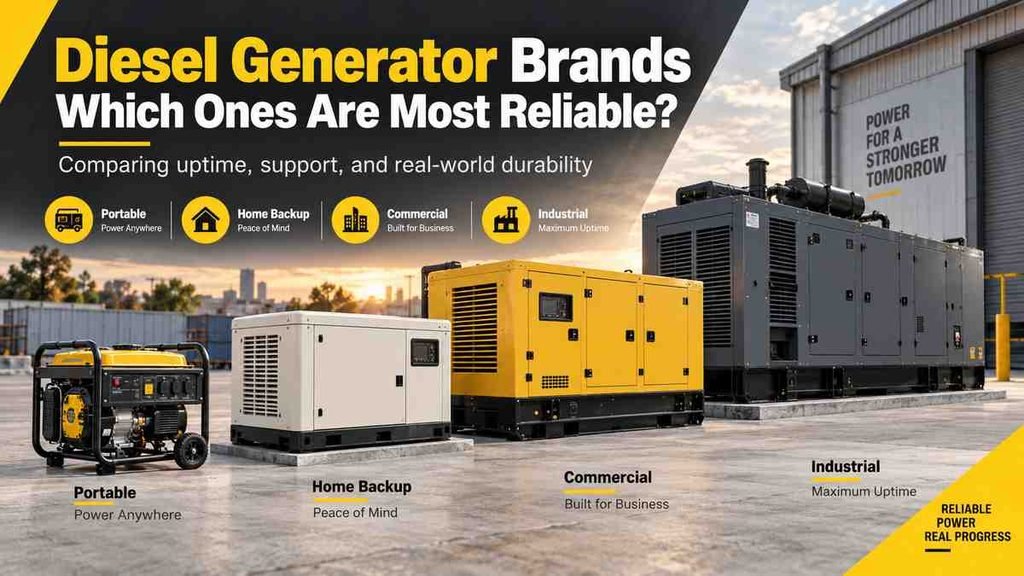
If you ask me which diesel generator brands are the most reliable, I would put Caterpillar, Cummins, Rehlko (formerly Kohler Power Systems), Generac Industrial, Kubota, Yanmar, and MQ Power on the shortlist—but I would not call any one brand the universal winner. Reliability depends on the size of the generator, whether you need standby or prime power, how quickly local parts and service are available, how the set handles motor-starting loads, and whether the unit is maintained correctly. For a hospital, factory, warehouse, data center, farm, small business, or home backup system, I would choose the brand whose complete package and local support fit the job rather than buying by name alone.
Most Reliable Diesel Generator Brands: Quick Comparison
If you want the short version, this is how I would think about the major brands. I am not treating this as a simple first-to-last ranking because a 7 kW compact Kubota and a 3,000 kW Rehlko KD generator are built for completely different jobs.
| Brand | Where I Would Shortlist It | Current Product Example | Why I Consider It Dependable | Main Buying Consideration |
|---|---|---|---|---|
| Caterpillar (Cat) | Commercial, industrial, mission-critical, large standby and prime power | C13: 350–400 ekW standby, 320–365 ekW prime | Integrated power systems, factory-tested packages, broad dealer/parts support | Premium equipment and service can cost more |
| Cummins | Commercial, industrial, data centers, motor-heavy loads | QSX15: 320–500 kW standby, 291–455 kW prime | Engine, alternator and PowerCommand controls designed as a system | Exact configuration and emissions package vary by market |
| Rehlko | Commercial standby, industrial, data centers, high-horsepower systems | KD Series: roughly 700–4,000 kW in current North American lineup | Strong mission-critical focus, dedicated generator engines, integrated controls | Kohler Power Systems is now branded Rehlko, which can confuse older buyers |
| Generac Industrial | U.S. commercial and industrial standby applications | Diesel stationary line includes 25 kW units and extends into megawatt-class systems | Broad stationary lineup, integrated controls, enclosures and dealer support | I would verify engine platform and local industrial dealer capability by model |
| Kubota | Small diesel backup, farms, remote sites, light commercial and portable/stationary use | GL14000: 12 kVA prime, 14 kVA standby | Compact industrial diesel engines, direct-coupled design, easy maintenance | Branded generator range is much smaller than Cat/Cummins/Rehlko |
| Yanmar | Compact portable diesel and specialized larger power applications | YDG portable series: 2–5.8 kVA prime | Long experience with compact diesel engines and efficient portable packages | Product availability differs significantly by country |
| MQ Power / Multiquip | Rental fleets, construction, mobile power, events and job sites | WhisperWatt line spans small portable units into hundreds of kVA | Purpose-built mobile packages, quiet enclosures, proven industrial engine suppliers | Better fit for mobile/rental duty than a permanent building standby installation |
What “Reliable” Really Means in a Diesel Generator
When I say a generator is reliable, I do not simply mean the engine starts. I mean the whole system starts when it is commanded to start, reaches rated voltage and frequency quickly, accepts the required electrical load without excessive voltage or frequency dip, runs for the required duration, protects itself correctly, and can be repaired without waiting weeks for parts.


That means reliability is partly mechanical and partly electrical. A strong diesel engine does not compensate for an undersized alternator. A good alternator does not compensate for a weak starting battery. A premium generator can still fail during an outage if the fuel is contaminated, the coolant heater is dead, or the automatic transfer switch has not been tested.
| Reliability Factor | What I Check | Why It Matters |
|---|---|---|
| Engine platform | Industrial-duty design, cooling system, fuel system, emissions equipment | The engine must start, accelerate and carry load consistently |
| Alternator | Motor-starting capability, insulation class, voltage regulation, excitation design | Large motors can cause severe voltage dip if the alternator is too small |
| Controller | Automatic start/stop, alarms, shutdowns, remote monitoring, communications | A generator may be mechanically healthy but unavailable because of control faults |
| Duty rating | Standby, prime or continuous rating | Using a standby-only unit as prime power can shorten life and violate the intended rating |
| Dealer support | Local technicians, parts stock, response time, warranty handling | Downtime often depends more on support than on the original purchase price |
| Maintenance access | Filters, belts, batteries, coolant, oil drains and service doors | Easy maintenance makes scheduled service more likely to be done correctly |
| Fuel quality | Water, microbial growth, storage age, filtration | Stored diesel is one of the most common weak links in standby systems |
If you are still working out capacity, I would do that before choosing a brand. I explain the process in my guide on what size diesel generator you actually need. For a commercial installation, I would also compare your load profile, transfer method and duty cycle using my guide on choosing the right diesel generator for your business.
1. Caterpillar: One of My First Choices for Heavy Commercial and Industrial Power
For large commercial, industrial and mission-critical installations, Caterpillar is one of the first brands I would investigate. The reason is not just the Cat engine name. Caterpillar sells complete generator systems and emphasizes package integration, factory testing, controls, parts and dealer support.
For example, the current Cat C13 60 Hz set is offered at 350 or 400 ekW standby and 320 or 365 ekW prime, depending on configuration. Caterpillar states that the package is designed to meet ISO 8528-5 transient-response requirements. Cat also says its power systems are supported through a dealer network with more than 1,800 branch stores in 200 countries on its current C13 product page.
Where I think Cat makes the most sense
I would put Cat high on the list for manufacturing, hospitals, water facilities, large commercial buildings, remote industrial sites, mining, major construction, data-related infrastructure and other applications where downtime is expensive. The main drawback is that you are usually buying into a premium industrial ecosystem, so I would compare both the purchase price and the long-term service agreement.
2. Cummins: Strong System Integration and Excellent Commercial Coverage
Cummins is another brand I would seriously consider for commercial and industrial power. One reason I like the Cummins approach is that the company has deep experience across the engine, alternator, controls and generator package rather than treating the generator as a collection of unrelated components.
The current QSX15 commercial/industrial family covers roughly 320–500 kW standby and 291–455 kW prime depending on the specific set. Cummins also offers much larger QSK systems. Its QSK60 family, for example, reaches 2,500 kW standby in current published configurations.
Cummins PowerCommand controls are another reason I would include the brand on a critical-power shortlist. Current product literature describes automatic remote starting and stopping, frequency and voltage regulation, system protection, alarm/status functions and integration features. On installations with pumps, compressors, HVAC motors or other high-inrush equipment, I also pay attention to Cummins alternator and permanent-magnet-generator options because motor starting can determine the real generator size.
3. Rehlko: The Brand Formerly Known as Kohler Power Systems
If you have been around generators for a while, you may know this line as Kohler Power Systems. The business is now called Rehlko. That name change is important when you search for service documents or compare older equipment, but the brand remains a major player in standby and industrial power.
For data centers, large commercial sites and mission-critical installations, I would compare Rehlko directly against Cat and Cummins rather than treating it as a secondary brand.
4. Generac Industrial: A Strong Choice for U.S. Standby Power
Generac is widely associated with residential generators, but I would not overlook Generac Industrial when the job moves into commercial diesel standby power. Its current stationary diesel lineup includes smaller commercial sets starting around 25 kW and extends through much larger industrial packages. In March 2026, Generac also announced new 1,250 kW and 1,500 kW diesel generators for larger mission-critical applications.
A useful example is the current SD150. It is a 150 kW diesel generator built around a 6.7-liter industrial engine platform, with configurations intended for commercial and critical standby applications. Generac publishes controller, enclosure, voltage-regulation, certification and installation data in detail, which is exactly what I want to see when comparing systems.
I see Generac Industrial as particularly practical for businesses in markets where the local Generac industrial dealer has strong installation and field-service capability. I would not select it merely because a residential dealer is nearby; commercial diesel service is a different discipline. Ask specifically who handles industrial commissioning, load-bank testing, controls and diesel engine work.
5. Kubota: My Shortlist for Compact Diesel Generators
Kubota occupies a different part of the market. If you need a relatively small diesel generator for a farm, remote building, workshop, small business, telecom-type load, jobsite or compact backup installation, Kubota deserves serious consideration.
The current GL series illustrates why. The GL7000 is around 6.5 kVA prime and 7 kVA standby, the GL11000 is around 10 kVA prime and 11 kVA standby, and the GL14000 is around 12 kVA prime and 14 kVA standby at 60 Hz. Kubota emphasizes direct coupling between the engine and generator, one-side service access and protective shutdowns for conditions such as low oil pressure or excessive coolant temperature.
For 2026, Kubota Engine America states that its industrial engines and Kubota-branded diesel generators carry a three-year or 3,000-hour warranty, whichever occurs first, subject to its warranty terms. That does not prove a generator will never fail, but it is useful information when you compare ownership support.


I would not compare a 14 kVA Kubota directly with a 1,500 kW Generac or a 3,000 kW Rehlko. For compact diesel equipment, however, Kubota’s engine reputation, serviceability and current dealer support make it one of the brands I would look at first.
6. Yanmar: Strong Compact Diesel Experience
Yanmar is another brand I associate with compact diesel engineering. Its current YDG portable diesel generator family is aimed at industrial jobsites, agriculture, landscaping, events and other applications where a small generator may run for long periods.
For me, Yanmar makes the most sense when you are buying a compact generator in a region with solid Yanmar service support. Product availability varies by country, so I would verify the exact model, emissions certification, voltage and parts channel before buying.
7. MQ Power: A Brand I Like for Mobile and Rental Duty
MQ Power, part of Multiquip, is a different kind of recommendation. If you operate a rental fleet, construction business, temporary event power system or mobile jobsite, I would look closely at its WhisperWatt line.
Current Multiquip product literature continues to show WhisperWatt generators from small single-phase units into large mobile three-phase sets. The design emphasis is on portable power, sound attenuation, voltage/frequency regulation, motor-starting capability, instrumentation and service support. Depending on the model, MQ Power packages use established industrial diesel engines from manufacturers such as Kubota, Isuzu, John Deere and others.
Technical Comparison: Representative Diesel Generator Specifications
The figures below are representative current examples, not a claim that every model from a brand has the same specification. Generator ratings vary by voltage, frequency, emissions package, temperature, altitude and duty classification.
| Brand / Example | Standby Rating | Prime Rating | Frequency / Speed | Technical Point I Notice |
|---|---|---|---|---|
| Cat C13 (60 Hz) | 350 / 400 ekW | 320 / 365 ekW | 60 Hz / 1,800 rpm | Designed to ISO 8528-5 transient response requirements |
| Cummins QSX15 | 320–500 kW | 291–455 kW | 50/60 Hz, model dependent | Integrated PowerCommand controls; motor-starting alternator options |
| Rehlko 350REOZJC | 280–350 kW | 275–320 kW | 60 Hz / 1,800 rpm | Industrial package with Rehlko controls and John Deere engine on this model |
| Generac SD150 | 150 kW class | Configuration dependent | 60 Hz | 6.7 L industrial diesel platform; commercial standby focus |
| Kubota GL14000 | 14 kVA | 12 kVA | 60 Hz | Direct-coupled compact diesel package |
| Yanmar YDG Series | Model/market dependent | 2–5.8 kVA | 50/60 Hz | Compact air-cooled diesel portable range |
| MQ Power WhisperWatt | Model dependent | 6 kW units through hundreds of kVA | Mostly 60 Hz U.S. mobile lineup | Purpose-built quiet mobile/rental packages |
Which Diesel Generator Brand Would I Choose by Application?
If you force me to narrow the field, I would choose by application rather than by a single “best brand” label.
| Application | Brands I Would Investigate First | Reason |
|---|---|---|
| Small compact diesel backup | Kubota, Yanmar | Compact engines, straightforward packages, strong small-diesel experience |
| Small/medium commercial standby | Generac Industrial, Rehlko, Cummins, Cat | Strong controls, ATS integration, commercial dealer channels |
| Manufacturing / large motors | Cummins, Cat, Rehlko | Broad alternator choices and established industrial packages |
| Hospital / data center / mission critical | Cat, Cummins, Rehlko; Generac on suitable projects | Large-output platforms, controls, paralleling and critical-power support |
| Rental / construction mobile power | MQ Power, Kubota, Yanmar | Portable packages designed for repeated field use |
| Very large multi-megawatt systems | Cat, Cummins, Rehlko | Deep high-horsepower product ranges and engineering support |
Do Not Confuse Brand Reputation With Correct Sizing
I have seen buyers focus so much on the logo that they overlook the load calculation. That is a mistake. An undersized premium generator can perform worse than a correctly sized mid-market generator.
Suppose your business has 140 kW of normal running load but also has a large compressor motor that creates a high starting demand. A simple 140 kW calculation does not tell the whole story. The alternator may need enough motor-starting kVA to keep voltage dip within an acceptable limit. You may also need load sequencing so the largest motors do not start simultaneously.
| Example Load | Running Load | Starting Concern | What I Would Do |
|---|---|---|---|
| Lighting, IT, small receptacles | 35 kW | Low to moderate | Include as steady load |
| HVAC compressors | 45 kW | High motor inrush | Check starting kVA and voltage dip |
| Process motor | 40 kW | Potentially high | Confirm motor starting method and sequence |
| Pumps | 20 kW | Moderate/high | Determine across-the-line, soft-start or VFD starting |
| Total running load | 140 kW | Not enough information by itself | Run a proper generator-sizing study before selecting a nameplate kW |
This is why I recommend using manufacturer sizing software or having an experienced generator contractor/engineer model the actual loads. The right brand cannot fix the wrong electrical design.
Parts and Service Can Matter More Than the Brand Name
Before I buy any generator, I would call the local dealer and ask questions before asking for a final price. How many field technicians do you have? Do you stock common filters, sensors, controllers and starters? Can you perform load-bank testing? Do you service the automatic transfer switch? Can you respond after normal business hours? Do you commission paralleling systems?
I would also ask who makes the engine on the exact model. Some generator brands use their own engines on certain ranges and third-party engines on others. That is not necessarily bad. In fact, it can be an advantage if the engine manufacturer has excellent local parts support. But you should know what you are buying.
How Maintenance Changes the Reliability of Any Brand
The most reliable diesel generator brand can still become unreliable if it sits for years with neglected batteries and contaminated fuel. For standby equipment, I pay particular attention to fuel because stored diesel can collect water and support microbial contamination.
If you see haze, sludge, separated water or repeated filter plugging, deal with the fuel problem rather than blaming the generator brand. I cover the warning signs in my guide to water in diesel fuel.
My Buying Checklist for a Reliable Diesel Generator
When I compare quotes, I do not just compare “500 kW versus 500 kW.” I compare the entire scope. If you are buying a generator now, these are the items I would put on the quote sheet so every supplier is bidding the same requirement.
- Required duty: standby, prime or continuous.
- Voltage, phase and frequency: for example 480 V, three-phase, 60 Hz.
- Running kW and kVA: based on measured or engineered loads.
- Largest motor and starting method: across-the-line, soft starter or VFD.
- Acceptable voltage/frequency dip: especially for sensitive equipment.
- Ambient temperature and altitude: both may reduce available power.
- Fuel capacity and required runtime: 8, 24, 48 or more hours changes the tank design.
- Enclosure and sound level: weather-protected, sound-attenuated or indoor open set.
- Automatic transfer switch: amp rating, transition type and controls.
- Remote monitoring: alarms, cellular/Ethernet connectivity and building-management integration.
- Emissions requirements: verify local stationary or non-road rules before ordering.
- Warranty: read hour limits, time limits and exclusions.
- Commissioning: include start-up, ATS test and load-bank or building-load testing where appropriate.
- Service agreement: ask for actual response coverage, not just a phone number.
Frequently Asked Questions
What is the most reliable diesel generator brand?
I do not think there is one universally most reliable brand. For large commercial and industrial systems, I would put Caterpillar, Cummins and Rehlko on a very strong shortlist. For U.S. commercial standby, I would also seriously consider Generac Industrial. For compact diesel generators, Kubota and Yanmar are strong candidates, while MQ Power is especially relevant to mobile and rental applications.
Is Caterpillar better than Cummins for generators?
I would not choose between them by reputation alone. Both offer serious commercial and industrial power systems. I would compare the exact model, load acceptance, alternator, controller, emissions configuration, local dealer support, parts availability and total installed cost. In many projects, the local dealer and the specific generator package will matter more than the difference between the two names.
Are Generac diesel generators reliable?
Generac Industrial offers dedicated diesel generator systems for commercial and industrial applications, including current models ranging from relatively small stationary sets into megawatt-class equipment. I would evaluate Generac based on the specific industrial model and the strength of the local industrial dealer—not simply on the company’s residential-generator reputation.
Are Kubota diesel generators good for backup power?
For smaller loads, I think Kubota is a very credible option. The current GL series uses Kubota diesel engines, direct-coupled generator designs and compact service-friendly packages. Just make sure the available kVA is enough for your starting loads and that your installation complies with local electrical and exhaust requirements.
Which brand has the easiest parts availability?
That depends heavily on your location. Cat, Cummins, Rehlko, Generac, Kubota and Yanmar all have established support networks, but the strongest brand in one city may be poorly represented in another. Before buying, I would call the local distributor and verify that it stocks parts and has trained technicians for the exact generator family you are considering.
Final Take: I Would Buy the Support System, Not Just the Logo
If reliability is the priority, I would start with a shortlist of established diesel generator manufacturers, but I would make the final decision only after comparing the specific model, duty rating, load response, engine and alternator platform, controller, fuel system, warranty and local support.
For heavy commercial and industrial work, Caterpillar, Cummins and Rehlko are the brands I would investigate first. Generac Industrial deserves a place on the commercial standby shortlist, especially in North America. Kubota and Yanmar make sense when the requirement is compact diesel power, while MQ Power is especially strong for mobile and rental-style operation.
The important point is that reliability is engineered into the whole installation. A correctly sized generator with clean fuel, a healthy battery system, a properly specified transfer switch and competent local service will almost always give you better results than buying a famous nameplate and ignoring the rest of the system.
Manufacturer References
I checked current manufacturer information while preparing this guide, including Caterpillar C13 specifications, Cummins QSX15 specifications, Rehlko KD Series information, Generac Industrial diesel generator listings, Kubota generator information, Yanmar YDG specifications, and Multiquip MQ Power literature. Specifications can change by market and model, so I would always confirm the current data sheet before purchasing.