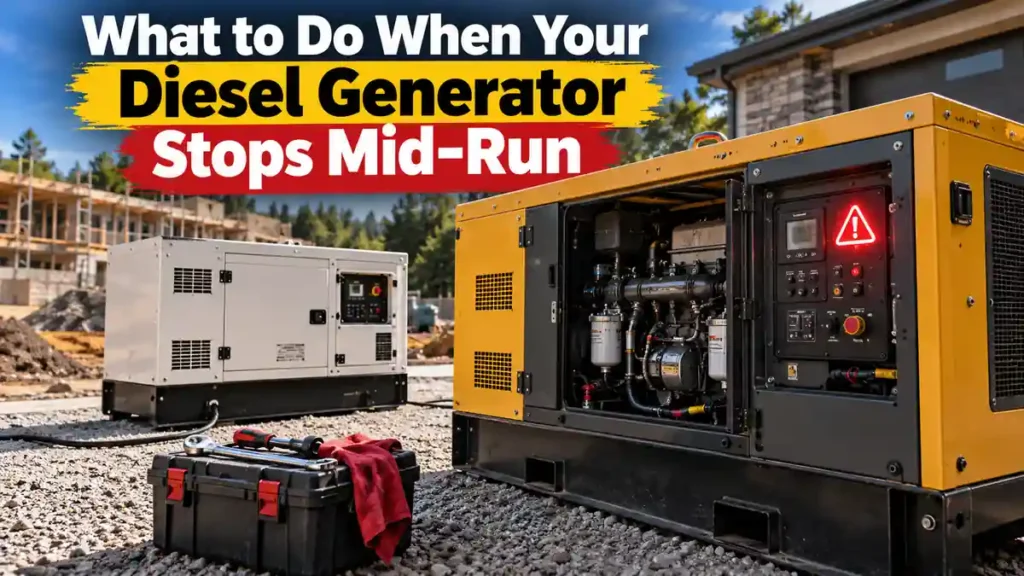


A diesel generator that quits in the middle of an outage, job, or event is frustrating because the failure often happens after the unit has already proven that it can start. That tells me something useful: the problem is often related to what changes after startup—fuel supply, temperature, load, oil pressure, ventilation, or a protective shutdown.
In this guide, I’ll show you exactly how I troubleshoot a diesel generator that stops while running. I’ll explain the difference between an engine shutdown and loss of electrical output, the most common causes, what I check first, which numbers matter, how I restart safely, and when I stop troubleshooting and call a technician.
What to Do First When a Diesel Generator Stops Mid-Run
I resist the urge to immediately press Start again. If the generator stopped because it overheated, lost oil pressure, or detected another protective fault, an instant restart can make the situation worse.
I use this quick sequence first.
| Step | What I do | Why it matters |
|---|---|---|
| 1 | Check whether the engine is stopped or still running | This separates an engine problem from an electrical-output problem |
| 2 | Read and record the fault code before clearing it | The code may identify the shutdown cause |
| 3 | Disconnect or reduce nonessential load | Prevents another overload during restart |
| 4 | Look for fuel, oil, or coolant leaks | A visible leak may explain the shutdown |
| 5 | Check fuel level, oil level, and cooling airflow | These are common mid-run failure areas |
| 6 | Allow the engine to cool if overheating is suspected | Hot coolant and engine parts can cause severe burns |
| 7 | Restart only after the likely cause is corrected | Protects the engine and helps prevent repeat shutdowns |
First Question: Did the Engine Stop, or Did the Power Stop?
This distinction saves me a lot of troubleshooting time.


If the engine shut down completely, I focus on fuel, oil pressure, high temperature, shutdown sensors, overspeed/underspeed, controller faults, and engine condition.
If the engine continues to run normally but your tools, home, or equipment suddenly lose power, I look at the electrical side: breakers, overload protection, GFCI protection, transfer equipment, loose connections, alternator excitation, or a shorted load.
| Symptom | Where I look first |
|---|---|
| Engine stopped completely | Fuel, oil pressure, coolant temperature, controller fault, safety shutdown |
| Engine still runs but no output | Main breaker, overload, GFCI, ATS, alternator/output controls |
| Engine slows badly, then stops | Overload, fuel starvation, clogged filter, air restriction |
| Runs for a fixed time, then dies | Fuel-tank vent, heat buildup, fuel pickup, restriction, sensor fault |
| Stops only when a large appliance starts | Starting surge, overload, low frequency, undersized generator |
If your unit never starts at all, I use a different troubleshooting path. See my guide on why a diesel generator will not start.
1. Check the Fault Code Before You Clear Anything
Modern diesel generators can save you a tremendous amount of time because the controller often records the reason for the shutdown. I write the code down, take a photo of the display, and note the hour meter before pressing Reset.
Common shutdown categories include low oil pressure, high coolant or engine temperature, low fuel, overcrank, overspeed, underspeed, overload, underfrequency, overfrequency, overvoltage, undervoltage, emergency stop, and sensor or communication faults.
I do not assume the sensor is wrong just because I dislike the fault code. If the controller says low oil pressure, I verify the oil level and check for leaks. If it says high temperature, I inspect the cooling system before I restart.
2. Low Fuel or Fuel Starvation Is One of the Most Common Causes
A diesel generator can start perfectly and still stop later because it is no longer receiving enough fuel. This can happen even when the gauge does not look completely empty.
I check the actual fuel level, the pickup arrangement, the water separator, the filter, any fuel shutoff valve, and whether the tank can vent properly. I also look for kinked or damaged fuel lines.
Fuel starvation often gives me clues before shutdown. The engine may surge, lose speed, hesitate, or run rough before finally stopping.
Fuel problems that can stop a generator mid-run
| Fuel problem | Typical clue | What I check |
|---|---|---|
| Tank nearly empty | Generator stops after running normally for hours | Actual fuel level and pickup height |
| Clogged fuel filter | Loss of power under load, then shutdown | Filter condition and restriction indicator |
| Blocked tank vent | Runs for a while, then starves; may restart after sitting | Vent system per manufacturer procedure |
| Water/contamination | Rough running, intermittent shutdown | Water separator and fuel sample |
| Air leak on suction side | Surging, bubbles, hard restart | Hoses, clamps, fittings, seals |
| Fuel-transfer problem | Day tank empties even though bulk tank has fuel | Transfer pump, float controls, valves |
If your generator ran completely out of fuel, air may enter the system and a normal restart may not work. My guide on what happens when a diesel generator runs out of fuel explains priming and restart issues.


3. Low Oil Pressure Can Shut the Engine Down to Protect It
A protective low-oil-pressure shutdown is not something I bypass. The engine depends on oil pressure to keep bearings, journals, turbocharger components where fitted, and other moving parts lubricated.
I let the generator stop and check the oil level on level ground using the manufacturer’s procedure. If the oil is below the safe range, I look for the reason rather than just topping it off and forgetting about it.
I inspect around the oil filter, drain plug, oil pan, hoses, crankcase, and underside of the engine for leaks.
One current Cummins HDKAG operator manual provides a useful model-specific example: its low-oil-pressure switch trips the fault circuit if pressure falls below 9 psi (62 kPa). That is not a universal shutdown value for diesel generators. Your engine may use a completely different pressure threshold.
| Oil-related condition | What I see | My response |
|---|---|---|
| Oil level low | Dipstick below safe range | Add correct oil and find the cause of loss |
| Oil level overfull | Above Full mark | Correct level; overfilling can cause aeration/foaming on some engines |
| Oil level normal but low-pressure fault remains | Shutdown repeats | Stop testing and have pressure/sensor system diagnosed |
| Fresh oil leak | Wet filter, pan, plug, hose, or fitting | Repair leak before extended operation |
I never defeat an oil-pressure switch just to make the generator keep running. If pressure really is low, engine damage can happen quickly.
4. Overheating Can Cause a Protective Shutdown
If the generator runs for 20 minutes, an hour, or several hours and then stops, temperature is high on my list of suspects—especially if it restarts after cooling.
I check coolant level only after the engine has cooled enough to do so safely. I inspect the radiator, cooling-air inlets, fan belt, hoses, coolant leaks, and whether hot air is recirculating back into the generator enclosure.
On the same Cummins HDKAG example, the high-coolant-temperature protection is associated with a temperature above 230°F (110°C). Again, that is a model-specific figure, not a number I apply to every diesel generator.
Common causes of generator overheating
| Cause | What I look for |
|---|---|
| Low coolant | Reservoir level, leaks, loose hose connections |
| Dirty radiator or heat exchanger | Dust, grass, debris, oil film, blocked fins |
| Blocked enclosure airflow | Stored items, plastic, leaves, walls too close to vents |
| Fan belt problem | Loose, broken, glazed, or damaged belt |
| Generator overloaded | High load plus rising temperature and black smoke |
| High ambient temperature | Operating environment beyond rated conditions |
| Hot-air recirculation | Discharged air pulled back into intake |
5. The Generator May Be Overloaded
Overload is another common reason a generator appears to fail mid-run. The load can increase after startup when an air conditioner, pump, compressor, welder, heater, or other high-demand device comes on.
I compare the running load with the generator’s rating, but I also account for starting surge. A system may run comfortably at 60% load until a large motor starts and briefly demands much more power.
| Generator rating | 50% load | 75% load | 100% load |
|---|---|---|---|
| 10 kW | 5 kW | 7.5 kW | 10 kW |
| 20 kW | 10 kW | 15 kW | 20 kW |
| 50 kW | 25 kW | 37.5 kW | 50 kW |
| 100 kW | 50 kW | 75 kW | 100 kW |
Those percentages are simple math, not recommended continuous-loading targets. I use the generator’s actual standby, prime, or continuous rating and the manufacturer’s operating limits.
Cummins notes in one current operator manual that if the line circuit breaker trips, the electrical load may be too great or a short circuit may be present. Caterpillar also advises reducing connected devices when a portable generator repeatedly shuts down.
If I suspect overload, I disconnect nonessential loads, reset the appropriate protection only after the cause is understood, restart the generator, and reconnect loads one at a time.
6. Sometimes the Engine Is Running but the Breaker Has Tripped
This is why I always confirm whether the engine itself stopped.
A generator can continue running while its AC output is disconnected by a breaker or protective control. To the person inside the house, trailer, or jobsite, it feels like “the generator stopped,” but the engine is actually still operating.
I look at the main generator breaker, GFCI devices where applicable, distribution breakers, transfer switch, and load-side faults.
If a breaker trips repeatedly, I do not keep resetting it. Repeated tripping usually means there is an overload, short circuit, ground fault, damaged cable, faulty appliance, or generator-side problem that needs to be found.
7. A Dirty Air Filter Can Make the Generator Lose Power
A diesel engine needs enough clean air to burn fuel correctly. If the filter or intake is badly restricted, the generator may run poorly under load, smoke, lose speed, and potentially shut down.
I inspect the air filter and intake ducting, but I do not automatically replace a filter solely because it looks dusty on the outside. I follow the service indicator or maintenance instructions for the specific engine.
I also make sure the enclosure itself can breathe. Construction dust, grass clippings, leaves, plastic sheeting, snow, and stored equipment can all block cooling and combustion airflow.
8. Fuel Contamination Can Cause Intermittent Shutdowns
Water, sediment, microbial growth, wax, or degraded stored diesel can produce problems that seem random. The generator may start and run normally until contamination reaches the pickup or filter.
I inspect the water separator and filters and consider taking a fuel sample from the proper drain or sampling point if the manufacturer provides one.
If I see water or suspect contamination, I do not simply keep replacing filters. I investigate the tank and fuel source. My article on water in diesel fuel symptoms covers the signs in more detail.
9. Low Frequency or Underspeed Can Trigger a Shutdown
Frequency is closely tied to engine speed on conventional generator sets. If the engine cannot maintain rated speed because of overload, restricted fuel, governor problems, or insufficient engine power, frequency can fall.
A controller may shut the set down if frequency or speed drops outside its allowed range.
I do not adjust governor settings casually. If load reduction and basic fuel checks do not solve the problem, I leave speed-control diagnosis to a technician with the proper service information.
10. Overspeed Is a Serious Fault
An overspeed shutdown is not a fault I simply reset and ignore. Overspeed means the engine or controller detected excessive rotational speed, and that can damage the engine and alternator.
I stop troubleshooting at the owner level if overspeed repeats. The cause may involve the governor, actuator, speed sensor, control system, or fuel-control components.
11. A Charging-System or Control-Power Fault Can Also Stop the Set
Once a diesel engine is running, the starting battery is no longer doing the same job it did during cranking, but the generator still depends on control power, sensors, relays, and charging systems.
A loose battery connection, failed charger, alternator problem, blown control fuse, or wiring fault can create intermittent controller shutdowns on some systems.
I inspect cables and connections and read the controller’s stored fault history before replacing parts.
12. Check for a Blocked Fuel-Tank Vent
A blocked vent is a classic “runs for a while, then dies” problem. As fuel leaves the tank, air must replace it. If the vent cannot admit air, vacuum can build and eventually restrict fuel flow.
If the generator stops after a repeatable amount of time and later restarts after sitting, I include tank venting in my diagnosis. I follow the manufacturer’s inspection procedure rather than drilling, modifying, or defeating the vent system.
13. Do Not Ignore the Environment Around the Generator
Sometimes nothing is wrong with the engine itself. The operating environment is the problem.
I look for high ambient temperature, poor ventilation, snow around air openings, dust, mud, standing water, exhaust recirculation, altitude, and an enclosure that has been modified or blocked.
If you operate outside, also review my guide on whether diesel generators can run in the rain.
What If the Generator Stops After a Specific Amount of Time?
The pattern can be diagnostic. I write down how long the generator runs before it fails.
| Shutdown pattern | What I suspect first |
|---|---|
| Stops within seconds | Oil-pressure signal, shutdown input, fuel solenoid, controller fault |
| Stops after 5–15 minutes | Fuel restriction, heat buildup, blocked airflow, sensor fault |
| Stops after 30–60 minutes | Overheating, tank vent restriction, fuel filter, load increase |
| Stops after several hours | Low fuel, day-tank issue, overheating, service-related condition |
| Stops only when major load starts | Overload, motor surge, undersized generator, weak fuel delivery |
These are troubleshooting clues, not guarantees. The fault code and manufacturer manual always carry more weight than a timing pattern by itself.
How I Restart a Diesel Generator After a Mid-Run Shutdown
Once I have identified and corrected the likely cause, I restart carefully.
First, I reduce the electrical load. Then I check fuel, oil, and coolant as appropriate. If the unit overheated, I wait until it has cooled enough to inspect safely. I clear the fault only after recording it.
If the generator ran out of fuel, I use the exact priming procedure for the engine. I do not loosen high-pressure common-rail injector lines.
I start the unit unloaded or with the transfer system in the appropriate test configuration, allow voltage and frequency to stabilize, then reconnect loads gradually while watching the controller.
My restart checklist
| Before restart | What I confirm |
|---|---|
| Fault recorded | I know why the previous shutdown occurred or have a strong diagnostic direction |
| Fuel | Enough clean diesel and no obvious restriction |
| Oil | Correct level, no major leak |
| Cooling | Coolant safe to check, airflow clear, no major leak |
| Electrical load | Nonessential loads disconnected or managed |
| Breakers | Reset only after overload/short cause has been addressed |
| Area | No fuel spill, loose parts, smoke, or blocked exhaust |
Test It Under Load After the Restart
A successful restart is not the end of my troubleshooting. I want to know whether the generator can continue running when the real load comes back.
I reconnect loads gradually and watch engine speed, frequency, voltage, coolant temperature, smoke, and alarms. If the problem comes back under load, that gives me a useful clue.
My full procedure is in How to Test If Your Diesel Generator Is Working Properly.
When I Do Not Restart the Generator
There are situations where I leave the generator shut down and call for service.
| I do not restart when… | Why |
|---|---|
| Oil-pressure fault repeats with correct oil level | Actual low pressure can destroy the engine |
| Coolant is leaking badly | Restarting can overheat the engine rapidly |
| Overspeed fault repeats | Mechanical damage risk |
| Heavy knocking is present | Possible internal engine damage |
| Fuel is spraying or leaking | Fire and injection-injury hazard |
| Breaker trips immediately with load removed | Possible generator or wiring fault |
| Burning smell or smoke from electrical components | Fire/electrical damage risk |
How to Prevent a Mid-Run Shutdown
The best troubleshooting is preventing the problem in the first place. I keep the maintenance simple and consistent.
I monitor fuel level, service filters on schedule, check the water separator, keep cooling-air paths clear, maintain correct oil and coolant levels, exercise the generator under meaningful load, inspect battery and control connections, and keep records of fault codes and run hours.
I also avoid letting the fuel tank run near empty during a long outage. If I know the unit’s fuel consumption, I can plan refueling instead of guessing. See How Much Fuel Does a Diesel Generator Use?.
For the broader maintenance schedule, see my diesel generator maintenance guide.
Frequently Asked Questions
Why does my diesel generator shut off after a few minutes?
I first check the fault code, fuel supply, oil pressure, coolant temperature, blocked airflow, tank venting, and electrical load. A generator that stops only after warming up often points me toward temperature, fuel restriction, or a sensor/protection issue.
Can low oil make a diesel generator stop while running?
Yes. Many generators shut down when oil pressure falls below a protective threshold. I check the oil level first, but if the level is correct and the fault repeats, I have the oil-pressure system diagnosed rather than bypassing the protection.
Can a clogged fuel filter shut down a generator?
Yes. A restricted filter can allow enough fuel for light operation but starve the engine as load increases. The engine may lose speed, surge, smoke, or stop.
Why does my generator run until I turn on the air conditioner or pump?
The new load may be pushing the generator over its capacity, especially during motor starting. I check running watts, starting surge, voltage/frequency response, and whether the engine is receiving enough fuel under load.
Can overheating make the generator shut itself off?
Yes. Protective controls commonly shut down diesel generators when engine or coolant temperature exceeds the model’s safe limit. I let the unit cool and inspect coolant level, radiator condition, belts, airflow, and load.
Why is the engine still running but I have no electricity?
That usually sends me toward the electrical-output side rather than the engine. I check the generator breaker, GFCI or protective devices, transfer switch, overload condition, and connected equipment.
Should I immediately restart after a shutdown?
No. I read the fault code and inspect the likely cause first. A protective shutdown is often the generator trying to prevent damage. Restarting repeatedly without diagnosing the fault can turn a small problem into a larger one.
How long can a diesel generator run before it needs a break?
That depends on the model, duty rating, load, maintenance requirements, fuel capacity, and environment. I do not use a universal maximum. See my guide on how long a diesel generator can run continuously.
My Bottom Line
When my diesel generator stops mid-run, I do not treat the shutdown itself as the whole problem. I ask what changed while it was running.
Did fuel level fall? Did a large motor come on? Did coolant temperature climb? Did oil pressure drop? Did a breaker trip? Did the tank stop venting? Did the controller record a fault?
I start by separating an engine shutdown from a loss of electrical output, record the fault code, remove unnecessary load, and check fuel, oil, coolant, airflow, and leaks. I only restart after I have a reasonable explanation for the shutdown.
If the generator repeats a low-oil-pressure, high-temperature, overspeed, severe electrical, or fuel-leak fault, I stop. A diesel generator is designed to protect itself from many damaging conditions, and I do not defeat those protections just to keep the lights on.
Once the cause is corrected, I test the unit under load and monitor it. That final step is what gives me confidence the generator is actually ready to carry the next outage instead of merely restarting for a few minutes.
Sources and Technical References
I used current manufacturer guidance from the 2024 Cummins HDKAG Operator Manual, which documents protective shutdowns for conditions including low oil pressure and high coolant temperature, and from current Caterpillar generator shutdown troubleshooting guidance. The 9 psi oil-pressure and 230°F coolant figures discussed above are examples from that specific Cummins model family and should not be applied to another generator unless its own manual specifies the same values.