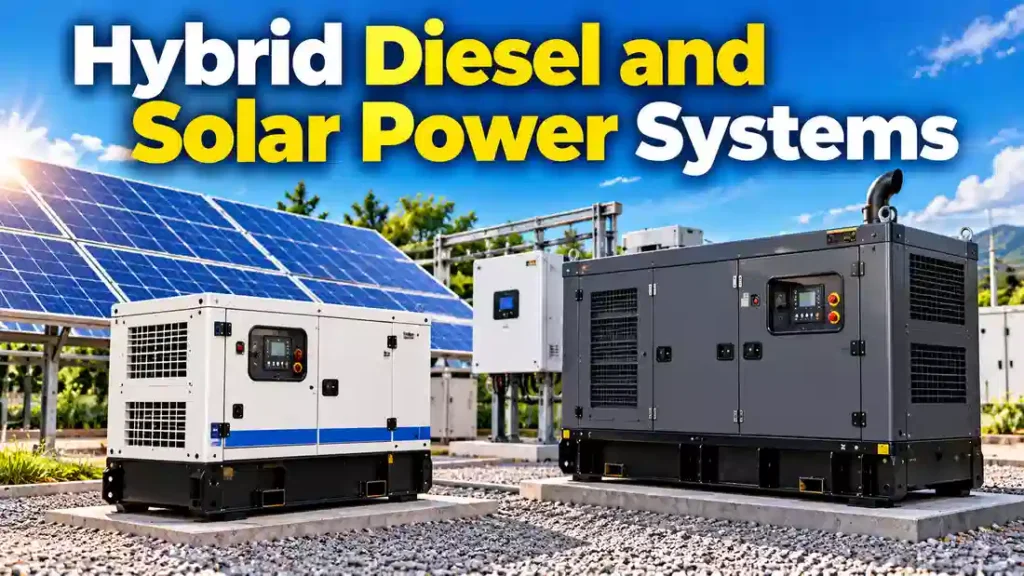


When people hear “solar plus diesel,” they sometimes imagine two separate systems that happen to feed the same building. A well-designed hybrid system is much more coordinated than that. The controller decides which source should run, when the battery should charge or discharge, when the generator should start, and how to keep voltage and frequency stable.
I like hybrid systems because they let each technology do what it is best at. Solar produces energy without fuel while sunlight is available. Batteries respond quickly, absorb short peaks, and can support quiet nighttime operation. Diesel provides dispatchable power for cloudy periods, sustained heavy loads, and emergencies that outlast stored battery energy.
Hybrid Diesel and Solar Power Systems: Main Components
| Component | What it does | What I size |
|---|---|---|
| Solar PV | Generates daytime electricity | kW of panel/inverter capacity and expected annual kWh |
| Battery storage | Stores energy and supplies fast-response power | kW output and kWh usable energy |
| Diesel generator | Supplies dispatchable backup/prime power | kW/kVA, starting load, duty rating |
| Microgrid controller | Coordinates sources and loads | Control logic, communications, protection |
| Switchgear/ATS | Connects, isolates, and transfers power safely | Voltage, phase, current, fault rating |
| Load management | Prioritizes essential loads | Which circuits can be shed or delayed |
How the Power Flow Works
During a sunny, low-load period, I may let solar power the site directly and use any excess to charge the battery. If a cloud passes, the battery can respond almost instantly so the generator does not have to start for a five-minute fluctuation.
As the battery state of charge falls, or if the load rises beyond what solar and battery can comfortably supply, the controller starts the diesel generator. The generator can then carry the site while also charging the battery if the design allows it.
At night, the battery may carry small loads until it reaches a minimum state of charge. Then the generator starts, preferably at a healthy load rather than idling for hours. The controller may shut it down again after the battery is recharged.


Why Batteries Matter Even When I Have Solar and Diesel
It is possible to combine solar and diesel without a battery, but batteries make the system much more flexible. Solar output changes quickly. Diesel engines respond more slowly and generally do not benefit from cycling on and off every few minutes.
A battery acts as a buffer. It can absorb excess solar, fill short power gaps, help with motor starting, and let the diesel engine run fewer but more productive hours.
| Battery function | Why it helps |
|---|---|
| Peak shaving | Reduces the maximum generator kW needed for short peaks |
| Solar smoothing | Handles fast changes from clouds |
| Night load | Allows engine-off operation during low demand |
| Generator loading | Lets the engine run at a healthier load while charging |
| Black start/control power | Can support controls and startup sequence depending on design |
kW and kWh Are Not the Same
I never size a battery by kWh alone. The battery must have enough kW to supply the instantaneous load and enough kWh to supply that load for the required time.
If my nighttime essential load averages 5 kW and I want the battery to carry it for six hours, the basic energy calculation is:
5 kW × 6 hours = 30 kWh
I then add allowance for reserve state of charge, inverter losses, temperature, battery aging, and future load growth.
| Average load | Desired battery-only time | Ideal energy before losses/reserve |
|---|---|---|
| 2 kW | 8 hours | 16 kWh |
| 5 kW | 6 hours | 30 kWh |
| 10 kW | 4 hours | 40 kWh |
| 25 kW | 2 hours | 50 kWh |
How I Size the Diesel Generator in a Hybrid System
I still size the generator around the loads it may need to carry. Hybridization can sometimes let me use a smaller engine because the battery handles brief peaks, but I do not count on battery support unless the control system is designed and commissioned for it.
I look at continuous load, motor starting, battery-charging load, altitude, ambient temperature, power factor, and the generator’s standby or prime rating. A 50 kW battery inverter does not automatically mean I can subtract 50 kW from the generator size under every operating condition.
My generator sizing guide covers the basic load calculation.
Example Hybrid System
Suppose I have a remote facility with a 30 kW daytime average load, a 10 kW nighttime load, and short peaks to 60 kW. One conceptual design could use 50 kW of solar, a 40 kW/100 kWh battery, and a 60 kW diesel generator.


| Component | Illustrative size | Role |
|---|---|---|
| Solar PV | 50 kW | Daytime energy and battery charging |
| Battery | 40 kW / 100 kWh | Peak support, night load, solar smoothing |
| Diesel generator | 60 kW | Long-duration backup and heavy loads |
| Peak site load | 60 kW | Maximum expected short-duration demand |
That table is only an example. Actual design requires hourly load data, solar production modeling, battery limits, generator transient response, protection coordination, and controls engineering.
When Hybrid Diesel-Solar Makes the Most Sense
The strongest case is usually a high-runtime diesel site. If a generator only runs for emergency outages a few hours per year, adding a large solar-battery system solely to reduce generator fuel may not pencil out. But if diesel is the main source of power, the fuel savings can be substantial.
Remote telecom towers, islands, mines, farms, construction camps, lodges, water pumping stations, clinics, and community microgrids are common examples. Fuel delivery to remote sites can cost almost as much as the fuel itself, so every gallon avoided has extra value.
| Site condition | Hybrid value |
|---|---|
| High annual diesel runtime | High potential fuel savings |
| Expensive fuel delivery | Strong case for solar/battery |
| Frequent short outages | Battery can avoid many generator starts |
| Long cloudy seasons | Diesel remains important |
| Critical loads | Multiple energy sources improve resilience |
| Very low annual generator use | Hybrid economics may be weaker |
Real-World DOE Microgrid Examples
The U.S. Department of Energy describes solar, batteries, and emergency diesel generators as distributed energy resources that can be integrated into microgrids. DOE project examples show that this is not theoretical.
At Grand Canyon West, a project combined a 993 kW solar array with a 750 kW/1,500 kWh battery system to supplement existing diesel generation. DOE said the project was designed to supply about 50% of annual energy needs and reduce fuel consumption.
Another DOE project for the Rincon Government Center integrates 290 kW of solar, 140 kW/560 kWh of battery storage, and an existing 150 kW diesel generator under a microgrid control system.
I use these examples to illustrate architecture, not as templates for a small business. The correct ratios change dramatically by load profile and solar resource.
How Much Diesel Can a Hybrid System Save?
The answer depends on how much generator energy solar and battery actually displace. I start with measured fuel burn and runtime.
If a generator averages 2 gallons per hour and I reduce runtime by 1,000 hours per year, the simple fuel reduction is:
2 gal/hr × 1,000 hr = 2,000 gallons per year
| Runtime reduction | Fuel burn assumption | Illustrative annual diesel saved |
|---|---|---|
| 250 hr | 2 gal/hr | 500 gal |
| 500 hr | 2 gal/hr | 1,000 gal |
| 1,000 hr | 2 gal/hr | 2,000 gal |
| 2,000 hr | 2 gal/hr | 4,000 gal |
I use the actual manufacturer’s fuel curve whenever possible rather than a generic gallons-per-hour number.
Fuel Savings Are Only Part of the Benefit
Fewer engine hours can also mean fewer oil changes, filter changes, coolant service events, fuel deliveries, and overhaul hours. Batteries can reduce nuisance starts and allow quiet operation at night. Solar reduces exposure to fuel-price spikes.
On the other hand, hybrid systems add inverters, batteries, communications, switchgear, controls, software, and more failure modes. I do not call a system “simpler” just because it uses renewable energy.
The Control System Is the Brain
The microgrid controller needs to coordinate generator start/stop, battery state of charge, solar curtailment, load shedding, transfer switching, synchronization if sources parallel, and protection limits.
At a basic level, control logic might say: use solar first, use battery second, start diesel when battery state of charge reaches 30%, stop diesel when the battery reaches 80%, and shed noncritical loads if the combined sources cannot meet demand.
Those percentages are merely examples. Battery manufacturers specify allowable state-of-charge windows, and generator manufacturers specify start/stop, loading, and cool-down requirements.
Technical Details I Check
| Parameter | Why it matters |
|---|---|
| System voltage and phase | All inverters, switchgear, generator and loads must be compatible |
| Battery kW | Determines instantaneous power contribution |
| Battery kWh | Determines energy duration |
| PV inverter kW | Limits solar AC output |
| Generator kW/kVA | Must cover sustained load and charging strategy |
| Power factor | Affects kVA and alternator loading |
| Short-circuit contribution | Important for protection design |
| Ramp rates | Determine how sources respond to sudden load changes |
Should the Generator Charge the Battery?
Often yes, especially off grid. If the diesel engine is already running, I may load it more efficiently by powering the site and charging the battery at the same time. Then the engine can shut down sooner and the battery carries the next low-load period.
I avoid excessive charging power that pushes the generator beyond a healthy load or creates poor transient margin. The charging schedule should be part of the original design.
What Happens During a Long Outage?
In a grid-connected hybrid system, a long outage is where the diesel engine earns its place. Solar may produce plenty of energy on a clear day, but several cloudy days can deplete storage. Diesel provides energy that can be replenished by fuel delivery.
That is why I see hybrid as resilience through diversity rather than a contest between technologies.
Maintenance Changes, Not Disappears
I still maintain the diesel engine, fuel tank, battery system, solar array, inverters, switchgear, and communications. Battery systems may require firmware updates and thermal management. Solar arrays need inspection. Generator fuel still needs to stay clean and dry.
I keep separate maintenance schedules but one integrated system log. If the controller cannot start the generator because a communication link failed, the fact that the diesel engine itself is healthy does not help me.
When Hybrid Does Not Make Sense
I am cautious when diesel runtime is extremely low, the site has poor solar exposure, loads are highly seasonal and unpredictable, batteries cannot be installed safely, or the capital cost is far greater than the expected fuel and resilience benefit.
I also avoid hybrid designs that are too complicated for the local maintenance team. A simple reliable diesel system can be better than a sophisticated microgrid nobody on site knows how to troubleshoot.
Frequently Asked Questions
Can solar and a diesel generator run at the same time?
Yes, if the electrical system and controls are designed for coordinated operation. In some systems solar offsets generator load; in others the battery and controller manage the interaction.
Do I need a battery?
Not always, but batteries make solar-diesel integration more flexible by smoothing solar changes, reducing cycling, and supporting low-load periods.
Can a hybrid system use a smaller generator?
Sometimes. Battery peak support may reduce the required generator rating, but only if the design guarantees adequate power under all required operating states.
What happens when the battery is empty?
The diesel generator can start and carry the load, assuming fuel is available and the control system is functioning.
Does hybrid power reduce emissions?
Usually yes when solar and battery displace diesel fuel. The magnitude depends on actual generator runtime and fuel savings.
My Bottom Line
I recommend looking at hybrid diesel and solar power systems when the generator is already running a lot, fuel delivery is expensive, or resilience is valuable enough to justify multiple energy sources. I do not add solar and batteries just because the technology sounds modern.
The best hybrid system starts with measured load data. I size solar for energy, batteries for both power and energy, and diesel for the loads it must reliably carry. Then I design the controls so those components operate as one system.
When done well, the result is not simply a greener generator. It is a power system that burns less fuel, runs the engine fewer hours, offers quieter operation, and can keep critical loads alive through a wider range of failures.
Sources and Technical References
I referenced the U.S. Department of Energy’s microgrid and distributed-energy guidance, the Grand Canyon West hybrid project, and the Rincon microgrid project. Actual system design should be performed by qualified power-system and electrical professionals.