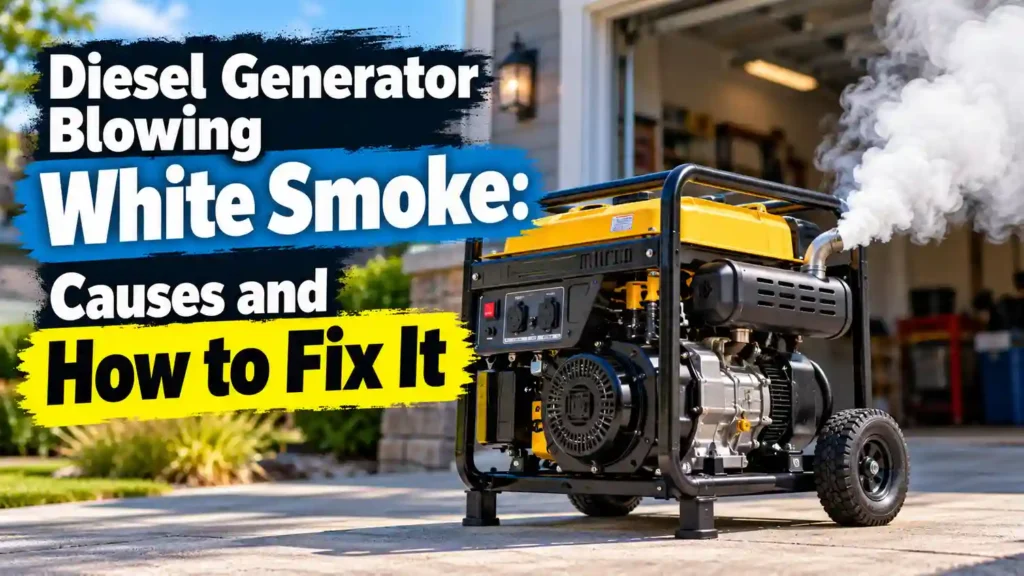


Meta description: Diesel generator blowing white smoke? Learn the common causes, what white exhaust means, how to diagnose it, and the safest ways to fix the problem.
Quick answer: When a diesel generator blows white smoke, I usually think about one of two things first: fuel is entering the cylinders but is not burning completely, or coolant is getting into the combustion chamber. A small amount of white smoke for a short time during a cold start can be normal, especially in low temperatures. Persistent white smoke after the engine warms up is not normal. I check cold-start conditions, glow plugs or intake heaters, fuel quality, air in the fuel system, injector condition, injection timing, engine compression, and coolant level before deciding what repair is needed.
What Does White Smoke From a Diesel Generator Mean?
White smoke from a diesel generator usually means that something entering the combustion chamber is leaving the exhaust without burning normally. Most of the time, that substance is diesel fuel that has not fully ignited. In more serious cases, the white vapor can come from coolant entering a cylinder.
I do not diagnose white smoke from color alone. I also pay attention to when the smoke appears, how long it lasts, whether the engine starts easily, whether it runs rough, whether the smoke smells like raw diesel, and whether coolant level is dropping.
A diesel engine depends on compression heat to ignite fuel. If the cylinder is too cold, compression is weak, injection timing is incorrect, or fuel is not atomized correctly, part of the fuel can leave the exhaust as a white or gray-white cloud.


| White Smoke Condition | What It Often Suggests | My First Check |
|---|---|---|
| Only during cold start | Cold combustion / incomplete ignition | Ambient temperature and preheat system |
| Clears after 1–5 minutes | Cold engine warming up | Observe warm-up and load behavior |
| Persistent after warm-up | Injector, timing, compression, or fuel issue | Fuel system and engine condition |
| White smoke plus rough running | Misfire or poor combustion | Injectors, compression, preheat |
| White smoke plus coolant loss | Possible coolant intrusion | Cooling system and cylinder sealing |
| White smoke after running out of fuel | Air trapped in fuel system | Prime fuel system correctly |
Is White Smoke on Startup Normal?
Sometimes, yes. If I start a diesel generator in cold weather and see a light white haze for a short period, I do not immediately assume the engine has a major fault. Cold cylinder walls and cold intake air reduce combustion temperature, making ignition less complete.
Once the engine warms up, the smoke should normally decrease significantly or disappear. If it continues at operating temperature, then I start troubleshooting.
Cold-start smoke becomes more common when the generator has weak glow plugs, a failed intake heater, a weak battery that reduces cranking speed, incorrect oil viscosity, poor-quality fuel, or low compression.
1. Cold Engine and Low Combustion Temperature
The most harmless cause of white smoke is simply a cold diesel engine. Diesel fuel does not ignite from a spark. It ignites because compression raises cylinder temperature high enough for combustion.
When ambient temperature is low, the cylinder head, piston, and intake air absorb heat from the compressed air. The fuel may begin burning late or may not burn completely. The result can be white exhaust smoke.
I allow the generator to warm up according to the manufacturer’s instructions before applying a heavy electrical load.
| Ambient Temperature | Typical Cold-Start Concern | What I Check |
|---|---|---|
| Above 50°F (10°C) | Usually easier starting | Normal preheat procedure |
| 32–50°F (0–10°C) | More visible startup haze possible | Glow plugs / intake heater |
| 0–32°F (-17–0°C) | Harder ignition | Preheat system, battery, oil viscosity |
| Below 0°F (-17°C) | High risk of hard starting and white smoke | Manufacturer cold-start aids |
These are general diagnostic ranges, not universal operating limits. I always follow the generator manufacturer’s cold-start instructions.
2. Failed Glow Plugs or Intake Heater
Many smaller and medium-size diesel generators use glow plugs, an intake heater, or another preheat system to help the engine start when cold.
If the preheat system fails, fuel can enter the cylinders before the combustion chamber is warm enough to burn it correctly. The engine may crank longer, start roughly, misfire, and produce white smoke.
I check whether the glow-plug indicator or preheat cycle behaves normally. I also inspect the fuse, relay, wiring, and power supply before replacing glow plugs.


How I Recognize a Preheat Problem
- The engine starts much harder when cold than when warm.
- White smoke is heavy immediately after startup.
- The engine runs roughly for the first several seconds or minutes.
- One or more cylinders appear slow to begin firing.
- The problem becomes worse as outside temperature drops.
3. Air in the Diesel Fuel System
Air in the fuel lines is another common cause I consider, especially if the generator recently ran out of fuel, had a fuel filter replaced, or had fuel-line work performed.
Air can interrupt normal injection pressure and timing. The engine may start but misfire, surge, or produce white smoke because fuel delivery becomes inconsistent.
If the generator has a manufacturer-specified priming system, I use it exactly as instructed. Some generators use a manual primer while others have an electric lift pump or an automatic prime mode.
I do not loosen high-pressure common-rail fittings just to “bleed” the system. Modern high-pressure diesel injection systems can cause serious injection injuries.
4. Poor-Quality or Contaminated Diesel Fuel
Fuel quality has a major effect on combustion. Water contamination, wrong fuel grade, stale diesel, microbial contamination, and cold-weather waxing can all create poor combustion and white smoke.
I inspect the water separator and fuel filter whenever white smoke appears unexpectedly. If I see water, unusual sediment, cloudy diesel, slime, or repeated filter plugging, I investigate the tank itself rather than changing filters repeatedly.
| Fuel Problem | Possible Symptoms | Recommended Check |
|---|---|---|
| Water contamination | White smoke, misfire, hard starting | Drain water separator and inspect fuel |
| Stale diesel | Rough running, smoke, deposits | Check age and condition of stored fuel |
| Wrong fuel grade | Poor cold starting and combustion | Verify manufacturer fuel specification |
| Waxed fuel | Restricted flow in cold weather | Inspect filter and temperature suitability |
| Microbial growth | Repeated clogged filters | Inspect tank and fuel samples |
5. Faulty or Worn Fuel Injectors
A diesel injector must deliver the correct amount of fuel at the correct pressure and in a finely atomized spray pattern. If an injector dribbles, leaks, sticks, or has a damaged nozzle, the fuel may not burn properly.
That can create white smoke, rough running, knocking, uneven exhaust temperature, poor fuel economy, or difficulty starting.
I do not assume an injector is bad just because I see smoke. I first rule out easier causes such as air in the system, poor fuel, low temperature, and preheat problems.
On electronically controlled common-rail engines, injector testing may require diagnostic software, cylinder contribution tests, return-flow measurement, or specialized bench testing.
6. Incorrect Injection Timing
Fuel must be injected at a very specific point in the compression stroke. If injection happens too early or too late, combustion quality suffers.
Late injection is particularly associated with white smoke because the fuel enters too late to burn efficiently at the ideal cylinder temperature and pressure.
On older mechanically injected engines, timing can be affected by pump adjustment, worn drive components, or incorrect service work. On modern electronic engines, timing is controlled by the engine control module but can still be affected by sensor faults, injector problems, or incorrect calibration.
7. Low Compression
A diesel engine needs high compression not only for power but also to generate ignition temperature. If compression becomes too low, fuel may not ignite completely.
Low compression can come from worn piston rings, damaged cylinder walls, leaking valves, valve-clearance problems, a failed head gasket, or incorrect valve timing.
If the engine is hard to start both hot and cold, continues smoking white after warm-up, and has poor power even after the fuel system checks out, compression becomes a stronger suspect.
Signs That Make Me Suspect Low Compression
- Long cranking time
- Persistent white smoke
- Uneven firing
- Low engine power
- Excessive crankcase blow-by
- High engine hours
8. Coolant Entering the Combustion Chamber
Not all white exhaust is unburned diesel. If coolant enters a cylinder, it can create dense white vapor that may continue even after the engine is fully warm.
This is more serious. Possible causes include a blown head gasket, cracked cylinder head, cracked block, failed cylinder liner seal on certain engines, or another internal cooling-system leak.
I pay close attention to coolant level. If coolant disappears without an obvious external leak and the generator continues producing heavy white vapor, I stop operating it until the cause is identified.
| Clue | Unburned Fuel More Likely | Coolant Leak More Likely |
|---|---|---|
| Raw diesel smell | Yes | Less likely |
| Smoke clears as engine warms | Common | Less likely |
| Coolant level dropping | No | Strong warning |
| Sweet-smelling vapor | Less likely | Possible |
| Cooling system pressurizes quickly | Less likely | Possible combustion leak |
| Milky oil | Not typical | Possible coolant contamination |
9. Weak Battery and Slow Cranking
This connection is easy to miss. A weak battery can cause white smoke because the engine does not crank fast enough to develop strong compression heat.
A battery can still light the control panel and appear functional while dropping too low under starter load.
| 12V Battery Reading at Rest | General Interpretation |
|---|---|
| 12.6–12.8 V | Near full charge |
| About 12.4 V | Moderately charged |
| About 12.2 V | Partially discharged |
| 12.0 V or below | Weak/discharged; recharge and test |
I treat resting voltage only as a preliminary check. A proper load test and cranking-voltage test tell me much more about battery condition.
10. Wrong Engine Oil Viscosity
Oil that is too thick for the ambient temperature increases cranking resistance. Slower cranking can lower cylinder temperature enough to make cold starting more difficult.
I always use the viscosity grade and diesel-engine oil specification listed in the engine manual. I do not choose oil solely by habit or by what I use in another generator.
11. Extended Low-Load Operation
Diesel generators are designed to work. Operating for long periods at very light loads can keep cylinder and exhaust temperatures too low.
This can contribute to incomplete combustion, carbon deposits, wet stacking, smoke, and poor engine condition. Some generator manufacturers specifically warn against prolonged operation at very low percentages of rated load.
If a generator is consistently oversized for the actual electrical load, I look at whether load management or a properly sized generator would improve long-term operation.
White Smoke During Cold Start vs. White Smoke Under Load
When the smoke occurs gives me useful diagnostic information.
| When White Smoke Appears | Likely Areas to Investigate |
|---|---|
| Only first few seconds | Cold combustion, normal warm-up |
| First several minutes | Preheat, low coolant temperature, cold ambient |
| At idle but clears under load | Low combustion temperature / light loading |
| Gets worse under load | Injector, compression, fuel delivery problem |
| Constant at all loads | Injector, timing, compression, coolant intrusion |
How I Troubleshoot a Diesel Generator Blowing White Smoke
I like to follow a sequence rather than replacing parts at random.
- Determine when the smoke appears. Cold start only, idle, load, or continuously?
- Allow normal warm-up. See whether the smoke clears as temperature rises.
- Check the controller. Look for active or stored fault codes.
- Inspect fuel quality. Check for water, contamination, wrong grade, or stale fuel.
- Check the fuel system for air. Especially after running out of fuel or changing filters.
- Verify preheat operation. Test glow plugs, relays, fuses, or intake-heater circuits as applicable.
- Check battery and cranking speed.
- Monitor coolant level. A dropping level changes the diagnosis significantly.
- Inspect injectors and timing. If simpler causes are ruled out.
- Perform compression or leak-down testing. When mechanical condition is suspected.
Can I Keep Running a Diesel Generator That Is Blowing White Smoke?
That depends on the cause and severity.
If I see a small amount of white haze during a very cold start and it clears quickly as the engine warms, I usually monitor it rather than shutting the engine down immediately.
If the smoke remains heavy, the engine is misfiring, coolant is disappearing, the oil looks contaminated, or there are abnormal noises or overheating, I stop the generator and investigate.
Continuing to run an engine that is ingesting coolant can cause serious damage. A large quantity of liquid entering a cylinder can even create hydrolock, which can bend connecting rods or cause other internal damage.
How to Fix White Smoke From a Diesel Generator
The fix depends on what the diagnosis reveals.
| Cause | Typical Corrective Action |
|---|---|
| Cold engine | Warm engine correctly and use proper cold-start procedure |
| Failed glow plugs | Test and replace failed plugs or repair relay/wiring |
| Air in fuel system | Prime according to manufacturer procedure |
| Water-contaminated fuel | Drain separator, service filter, correct tank contamination |
| Bad injector | Test, service, or replace injector |
| Incorrect injection timing | Diagnose and correct timing |
| Weak battery | Charge, load-test, repair connections, or replace battery |
| Low compression | Repair valves, rings, cylinder, head, or related mechanical issue |
| Coolant intrusion | Repair head gasket, head, liner, or other cooling-system fault |
Do Fuel Additives Fix White Smoke?
I do not use additives as a substitute for diagnosis. If the problem is water contamination, bad injectors, low compression, coolant intrusion, or incorrect timing, an additive will not repair the underlying fault.
A properly approved treatment may have a role in fuel storage or cold-weather operation, but I use only products that are compatible with the engine manufacturer’s recommendations.
Can a Clogged Air Filter Cause White Smoke?
A severely restricted air filter is more commonly associated with black smoke because it reduces available oxygen. However, poor airflow can still contribute to weak combustion under certain operating conditions.
When I troubleshoot smoke of any color, I inspect the air filter because it is simple, inexpensive, and important to engine performance.
Can a Bad Injector Cause White Smoke?
Yes. A worn or malfunctioning injector can produce white smoke if fuel is not atomized properly or is delivered at the wrong time.
The engine may also knock, misfire, run roughly, have poor fuel economy, or be difficult to start. Injector diagnosis should be based on testing rather than smoke color alone.
Can Low Compression Cause White Smoke?
Yes. Low compression reduces the heat generated during the compression stroke. Without enough heat, diesel fuel may fail to ignite completely.
Low compression is especially likely if a high-hour engine remains difficult to start after the battery, fuel system, injectors, and preheat system have been checked.
Can a Blown Head Gasket Cause White Smoke?
Yes. A damaged head gasket can allow coolant to enter a combustion chamber. Persistent white vapor, unexplained coolant loss, cooling-system pressure, overheating, or contaminated oil can all point toward this type of failure.
I do not continue operating the generator if I strongly suspect coolant is entering the cylinders.
How Long Should White Smoke Last on a Cold Start?
There is no universal number because engines, temperatures, preheat systems, fuel quality, and operating conditions vary. A brief haze that fades as the engine warms can be normal. Smoke that remains heavy after the engine reaches normal operating temperature deserves investigation.
Preventing White Smoke Problems
I reduce the risk of white smoke problems by maintaining the generator rather than waiting for symptoms.
- Use the correct diesel fuel.
- Keep water out of the fuel tank.
- Drain the water separator as required.
- Change fuel filters at the specified interval.
- Maintain the starting battery.
- Test the preheat system before cold weather.
- Use the correct oil viscosity.
- Avoid prolonged unnecessary no-load operation.
- Watch coolant level.
- Service injectors when engine symptoms justify it.
When I Would Call a Diesel Generator Technician
I would stop DIY troubleshooting when the likely repair involves high-pressure common-rail fuel components, internal injection-pump timing, injector coding, compression testing that requires specialized tools, cylinder-head removal, or an internal coolant leak.
Modern diesel fuel systems operate at extremely high pressure. I never put my hands near a suspected high-pressure leak while the engine is operating.
Frequently Asked Questions
Why is my diesel generator suddenly blowing white smoke?
If the change is sudden, I check fuel contamination, air in the fuel lines, failed preheat components, an injector problem, or coolant loss. The timing of the smoke and any recent service work are important clues.
Why does my diesel generator blow white smoke but still run?
The engine may have one or more cylinders that are not burning fuel efficiently. Cold combustion, injector problems, poor fuel, low compression, or incorrect timing can allow the engine to keep running while producing white exhaust.
Why does white smoke disappear after the generator warms up?
That often indicates combustion temperature was too low during startup. Cold metal surfaces absorb heat, and fuel does not burn as completely until the cylinders warm.
Is white smoke always coolant?
No. On a diesel engine, white smoke is frequently unburned or partially burned fuel. Coolant becomes more likely when the smoke persists after warm-up and coolant level is dropping.
Can bad diesel fuel cause white smoke?
Yes. Water contamination, poor fuel quality, the wrong grade, or degraded fuel can interfere with combustion and create white smoke.
Can running out of fuel cause white smoke afterward?
Yes. Air may remain in the low-pressure fuel system after the tank runs dry. Proper priming is often needed before the engine will run smoothly again.
Final Thoughts
If my diesel generator is blowing white smoke, I first decide whether I am seeing a temporary cold-start condition or a persistent combustion problem. That distinction prevents me from replacing expensive parts unnecessarily.
Brief smoke that clears as the engine warms can be normal in cold conditions. Persistent white smoke deserves a systematic check of the preheat system, battery and cranking speed, fuel quality, air in the fuel system, injectors, injection timing, compression, and coolant system.
If coolant is disappearing or the generator continues producing heavy white vapor after warming up, I take the condition seriously and stop operating the engine until the source is identified.