
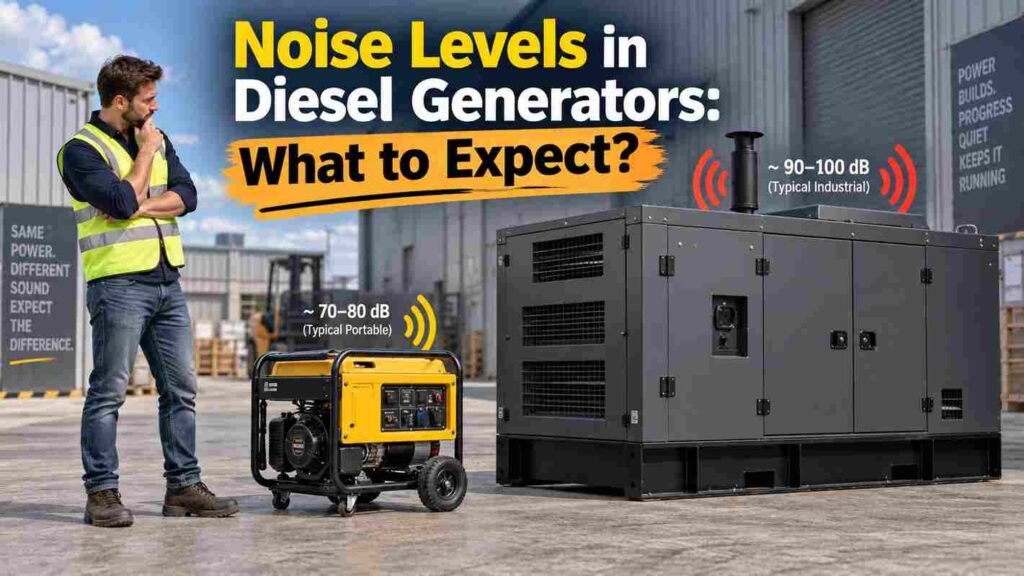
If you are comparing diesel generators for a home, business, jobsite, rental, farm, or emergency-power system, noise deserves almost as much attention as kW output. A generator that meets the electrical requirement can still create complaints, disturb sleep, make communication difficult, or expose workers to excessive noise if it is badly placed or poorly enclosed.
In this guide, I’ll explain what diesel generator noise levels actually mean, show you real manufacturer examples, compare different sizes and enclosure types, and walk through the ways I reduce generator noise without causing overheating or exhaust problems.
How Loud Is a Diesel Generator?
There is no single diesel generator noise level. The answer depends on engine size, engine speed, cooling fan design, exhaust system, enclosure, operating load, surroundings, and the distance from the generator to the listener.
For a useful real-world reference, Cummins publishes noise-compliant generator data showing several enclosed diesel sets in the range of about 62 to 77 dBA at 7 meters, depending on model and size. Caterpillar publishes a current XQ20 rental generator at about 61 dBA at 7 meters with its enclosure, while a current Cat XQ125 is listed at about 68.7 dBA at 7 meters. Those numbers show why I never judge a generator only by its kW rating: enclosure and acoustic design can make a large difference.
| Example diesel generator | Power / class | Published sound level | Measurement condition |
|---|---|---|---|
| Cat XQ20 rental generator | 16 kW prime / 20 kVA | 61 dBA | 7 m (23 ft), with enclosure |
| Cummins C11 D6 / C15 D6 | Small enclosed diesel sets | 64 dBA | 7 m, 75% load |
| Generac 20 kW Protector diesel | 20 kW standby | 70 dBA normal load | 7 m (23 ft) |
| Cummins 50–100 kW QSB5 range | 50–100 kW class | About 70.3–72.2 dBA | 7 m |
| Cat XQ125 rental generator | 100 kW prime | 68.7 dBA | 7 m (23 ft), prime rating |
| Cummins larger enclosed examples | Various models up to 500 kW | Approximately 67–77 dBA | 7 m, 75% load in cited brochure |
These are manufacturer examples, not a universal chart. I use them to show the scale you may encounter. A different enclosure, operating point, frequency, ambient condition, or measurement method can produce a different result.
You can review the manufacturer data directly in the Cummins noise-compliant generator brochure, the Cat XQ125 specification, and the Cat XQ20 technical data.
What Does dBA Mean on a Generator Specification?
Generator noise is usually published in dBA, which means A-weighted decibels. The A-weighting adjusts the measurement to better approximate how the human ear responds to different frequencies.
The decibel scale is logarithmic, not linear. That means a change that looks small on paper can represent a meaningful increase in sound energy. I do not treat 80 dBA as simply “a little louder” than 70 dBA.
I also pay attention to whether the manufacturer gives sound pressure level or sound power level. Sound pressure is what a microphone measures at a specified position or distance. Sound power is a calculated measure of the total acoustic energy emitted by the source. They are not interchangeable numbers.
| Term | What it tells me | Why it matters |
|---|---|---|
| dB | Decibel measurement | General sound-level unit |
| dBA | A-weighted decibel level | Closer to human hearing sensitivity |
| Sound pressure level (SPL) | Noise measured at a location | Changes with distance and surroundings |
| Sound power level | Total acoustic output of the source | Useful for engineering comparisons |
| 7 m / 23 ft rating | Sound measured at a specified distance | Lets me compare units on a similar basis |
| Load percentage | Generator operating load during test | Noise can change as engine and fan load change |
Why Two Generators With the Same kW Can Sound Different
A 20 kW generator is not automatically quieter than a 100 kW generator. I have seen manufacturer specifications where a larger rental set has a lower published dBA figure than a smaller standby unit because the larger machine uses an effective acoustic enclosure and a different cooling/exhaust design.
When I compare generator noise, I look at the complete package rather than engine displacement alone.
The enclosure makes a major difference
A weather-protective enclosure mainly shields the equipment from the environment. A sound-attenuated enclosure is specifically designed to absorb and block noise while still providing enough combustion and cooling airflow.
Caterpillar data for some 125–200 kW generator sets illustrates the difference. Depending on model, its weather-protective versions can publish substantially higher sound pressure than Level 1 or Level 2 sound-attenuated configurations at the same 7-meter reference distance.
That is why I ask for the exact enclosure option when buying or renting. A dealer saying “it is a 150 kW diesel generator” does not tell me enough about the noise.
Cooling fans can be a major noise source
People often assume most generator noise comes from combustion and exhaust. Those matter, but the radiator fan can also be a major contributor, especially on larger sets moving large amounts of cooling air.
The faster the fan and the more air the generator must move, the more attention the acoustic design needs. A badly designed homemade enclosure can make this worse by restricting airflow, raising temperature, and forcing the cooling system to work harder.
Exhaust design matters
A quality silencer or muffler can reduce exhaust noise significantly, but exhaust cannot simply be restricted in the pursuit of quiet operation. Excess backpressure can hurt engine performance and reliability.
I only use exhaust components that are correctly sized for the engine and installation.
Vibration travels through structures
A generator can sound louder inside a building than the outdoor specification suggests if engine vibration travels through a slab, wall, steel frame, platform, or piping system. Isolation mounts and flexible connections help prevent structural vibration from becoming secondary noise.
How Distance Changes Diesel Generator Noise
Distance is one of the simplest noise-control tools. OSHA notes that in open space, doubling the distance from a noise source can reduce the sound level by approximately 6 dBA. I use that as a useful planning rule, but real sites can behave differently because buildings, walls, ground surfaces, and other objects reflect or block sound.
Here is what the idealized 6 dBA-per-doubling rule would look like for a generator producing 74 dBA at 7 meters:
| Distance from generator | Illustrative sound level | Change from 7 m |
|---|---|---|
| 7 m (23 ft) | 74 dBA | Baseline |
| 14 m (46 ft) | 68 dBA | -6 dBA |
| 28 m (92 ft) | 62 dBA | -12 dBA |
| 56 m (184 ft) | 56 dBA | -18 dBA |
OSHA discusses distance as a noise-control method in its occupational noise guidance.
Does a Diesel Generator Get Louder Under Load?
Often, yes, but the amount depends on the machine. When electrical load rises, the engine burns more fuel and produces more exhaust flow and heat. Cooling airflow may increase, and combustion noise can become more pronounced. Some generators maintain nearly the same engine speed from light to full load but still become louder because the engine is doing more work.
This is why I prefer a manufacturer sound rating that tells me the load condition. Cummins, for example, publishes several enclosure ratings at 75% load in its noise-compliant generator literature, while other manufacturers publish values at prime or full-load conditions.
If noise is critical, I do not compare a “no-load exercise” rating from one generator with a “100% load” rating from another and pretend the numbers are equivalent.
How Loud Is a 20 kW Diesel Generator?
A 20 kW diesel generator can be around the upper-60s to low-70s dBA at 7 meters when it uses a proper acoustic enclosure, but the exact model matters.
One Generac 20 kW Protector diesel specification lists about 65 dBA at 23 feet during exercise and about 70 dBA at 23 feet under normal load. Caterpillar’s current XQ20 rental set is rated at 61 dBA at 7 meters with its enclosure, although its prime electrical rating is 16 kW / 20 kVA. Those examples show a meaningful spread even in roughly the same small-generator class.
| 20 kW-class example | Published level | Test condition |
|---|---|---|
| Generac Protector 20 kW diesel | 65 dBA | 23 ft / 7 m, exercise mode |
| Generac Protector 20 kW diesel | 70 dBA | 23 ft / 7 m, normal load |
| Cat XQ20 rental set | 61 dBA | 23 ft / 7 m, with enclosure |
If you are also evaluating output, see my guide on how much power a 20 kW diesel generator provides.
Are Diesel Generators Too Loud for Residential Use?
Not necessarily. A modern sound-attenuated diesel standby generator can be practical in residential applications, but placement matters. I would never assume a generator is acceptable simply because the brochure says 65 or 70 dBA.
I check the property line, bedroom windows, neighboring homes, walls that may reflect sound, prevailing use times, and local noise rules. Municipal noise ordinances vary widely, and some distinguish daytime from nighttime limits. The installation may also be subject to building, fire, electrical, and fuel-storage requirements.
For a home, I prefer to solve noise before installation by selecting a quiet package and placing it intelligently rather than trying to fix complaints later.
What Noise Level Is Safe for Workers?
For workplace exposure, I separate “annoying” from “hazardous.” OSHA requires a hearing conservation program in general industry when employee exposure equals or exceeds an 8-hour time-weighted average of 85 dBA. OSHA’s permissible exposure table uses 90 dBA for 8 hours, with shorter allowable durations as sound levels rise.
NIOSH uses a more protective recommended exposure limit of 85 dBA over 8 hours with a 3 dB exchange rate. Under that approach, every 3 dB increase cuts the recommended exposure time in half.
| Noise level | NIOSH time to 100% daily dose |
|---|---|
| 85 dBA | 8 hours |
| 88 dBA | 4 hours |
| 91 dBA | 2 hours |
| 94 dBA | 1 hour |
| 97 dBA | 30 minutes |
| 100 dBA | 15 minutes |
You can review the official values in OSHA 29 CFR 1910.95 and the NIOSH occupational noise guidance.
For workers who spend time close to a generator, I use actual exposure measurements instead of relying only on the brochure value at 7 meters. A mechanic working beside the enclosure is in a very different acoustic position from a person standing 23 feet away.
How I Reduce Diesel Generator Noise
If I need a quieter installation, I work through the noise path rather than randomly adding insulation.
1. Choose a sound-attenuated enclosure from the start
This is usually the cleanest solution. Factory acoustic enclosures are designed together with cooling airflow, service access, fire considerations, and exhaust routing.
2. Increase distance where the site allows it
Even modest additional separation from occupied spaces can help. I keep the generator away from bedroom windows, offices, patios, classrooms, and neighboring property when practical, while still meeting electrical, fuel, exhaust, and manufacturer installation requirements.
3. Use barriers intelligently
A solid barrier can block the direct line of sight between the generator and receiver, but I do not box the generator into a hot pocket. Cooling-air intake and discharge paths must remain open.
4. Control vibration
I use the specified vibration isolators, flexible exhaust sections, and flexible fuel or electrical connections where required. This can reduce low-frequency vibration that travels through structures.
5. Maintain the machine
A generator that suddenly becomes louder may have a failing exhaust component, loose panel, worn mount, damaged fan, bearing problem, or abnormal combustion condition. Noise can be an early diagnostic clue.
My diesel generator maintenance guide covers the inspection points I would check.
6. Do not sacrifice cooling for quietness
I never stuff acoustic foam into ventilation openings or build an airtight shed around a generator. Restricted airflow can cause overheating, derating, premature component failure, and potentially unsafe exhaust accumulation.
Sound-Attenuated vs. Weather-Protective Enclosures
This is one of the most important distinctions when you are shopping for a generator.
| Feature | Weather-protective enclosure | Sound-attenuated enclosure |
|---|---|---|
| Primary purpose | Weather and equipment protection | Weather protection plus noise reduction |
| Acoustic lining | May be limited | Usually engineered into enclosure |
| Airflow path | Designed mainly for cooling | Cooling path also designed to limit sound escape |
| Cost | Usually lower | Usually higher |
| Best use | Remote or noise-tolerant locations | Homes, businesses, urban sites, events, sensitive properties |
Caterpillar enclosure data shows why the distinction matters: on some generator models, sound-attenuated packages reduce the 7-meter sound-pressure figure by many decibels compared with a basic weather enclosure.
What Should I Ask Before Buying or Renting a Diesel Generator?
If noise matters, I ask for the actual acoustic specification instead of accepting words like “quiet,” “silent,” or “super silent.” Those marketing terms are not enough for me.
I want the dBA value, measurement distance, load condition, frequency, enclosure type, and whether the figure is sound pressure or sound power. I also ask whether the rental company can provide a quieter package if the unit will be used near homes, offices, hospitals, hotels, schools, events, or nighttime work.
| Question I ask | Why I ask it |
|---|---|
| What is the dBA rating? | Gives me a comparable noise figure |
| At what distance was it measured? | Sound pressure changes with distance |
| At what load? | No-load and full-load figures may differ |
| Is that sound pressure or sound power? | They are different metrics |
| What enclosure is included? | Acoustic package can strongly affect noise |
| Can I get a quieter rental model? | Rental fleets often have multiple enclosure options |
If you are considering temporary equipment, I also explain the financial side in Can I Rent a Diesel Generator Instead of Buying? and my diesel generator rental cost guide.
Can I Measure Generator Noise With a Phone?
A phone app can be useful for screening and comparing locations, but I would not use a casual phone reading as the final basis for legal compliance or an occupational exposure decision.
OSHA notes that the NIOSH Sound Level Meter App can be used as a screening tool on supported iOS devices. For workplace compliance, property-line disputes, or engineered acoustic design, I would use appropriate calibrated instrumentation and a qualified person when necessary.
Why Generator Noise Sometimes Seems Worse at Night
Even if the generator produces the same dBA, it can seem much more noticeable at night because background traffic, construction, lawn equipment, and general activity are lower. A steady diesel hum that disappears into daytime noise may stand out clearly in a quiet neighborhood at 2 a.m.
That is why I pay attention to nighttime placement before buying a home standby generator. I also check local ordinances because some communities use different limits or enforcement rules after certain hours.
Noise and Generator Size: Is Bigger Always Louder?
No. Bigger generators have larger engines, fans, and exhaust systems, but acoustic engineering matters enough that a larger sound-attenuated unit can publish a lower dBA number than a smaller generator with a simpler enclosure.
I treat size as one factor, not the answer. The only dependable comparison is the actual specification measured under comparable conditions.
If you are still choosing capacity, use my guide to what size diesel generator you need before making noise the deciding factor. A quiet generator that cannot start your largest motor is still the wrong generator.
Frequently Asked Questions About Diesel Generator Noise
Are diesel generators louder than gasoline generators?
They can be, especially when comparing open-frame equipment, but fuel type alone does not determine the final sound level. Enclosure design, engine speed, exhaust, cooling fan, size, and load can matter more. I compare actual dBA specifications rather than assuming every diesel is louder.
Is 70 dBA loud for a generator?
At a 7-meter reference distance, 70 dBA is a common type of figure for a sound-attenuated generator and may be acceptable in many applications. Whether it is acceptable at your property line, bedroom, workplace, or event depends on distance, duration, background sound, and local rules.
How far away should a generator be to reduce noise?
From a sound standpoint, more distance usually helps. OSHA notes that in open space, each doubling of distance can reduce sound by roughly 6 dBA. Placement must also satisfy the generator manufacturer’s fire, ventilation, exhaust, electrical, and fuel requirements.
Can I build a box around my diesel generator?
I would not build a simple sealed box. A generator needs large amounts of combustion and cooling air and must discharge hot air and exhaust safely. If I add acoustic treatment, I use an engineered enclosure or a design that preserves required airflow and service clearances.
Why is my diesel generator suddenly noisier?
I would inspect the exhaust system, enclosure panels, mounts, fan, bearings, belts, engine condition, and load. A new rattle, knock, squeal, exhaust bark, or vibration can indicate a mechanical problem rather than normal sound.
Do quieter generators cost more?
Often they do because acoustic enclosures, silencers, baffled airflow paths, isolation systems, and additional engineering add cost. I compare that extra cost with the value of avoiding complaints, hearing exposure, site restrictions, and retrofit work later.
My Bottom Line
When you ask me what noise level to expect from a diesel generator, I do not give one universal number. Modern sound-attenuated equipment can publish figures from roughly the low-60s into the 70s dBA at a 7-meter reference distance, while other configurations can be significantly louder. The enclosure, load, fan, exhaust, installation, surroundings, and distance all matter.
I always compare generators using the same measurement conditions. I check dBA at a stated distance, confirm the enclosure type, look at the test load, and consider where people will actually be standing or sleeping. For workplaces, I also consider exposure duration rather than only the instantaneous number.
If quiet operation matters, I choose the acoustic package before installation, increase distance where practical, isolate vibration, use the correct exhaust system, and maintain the generator properly. That approach is far more reliable than buying a loud generator first and trying to silence it afterward.
Sources and Technical References
I used current manufacturer and safety references while preparing this guide, including Cummins noise-compliant generator data, Caterpillar XQ125 specifications, Caterpillar XQ20 specifications, OSHA occupational noise standards, and NIOSH noise-exposure guidance.