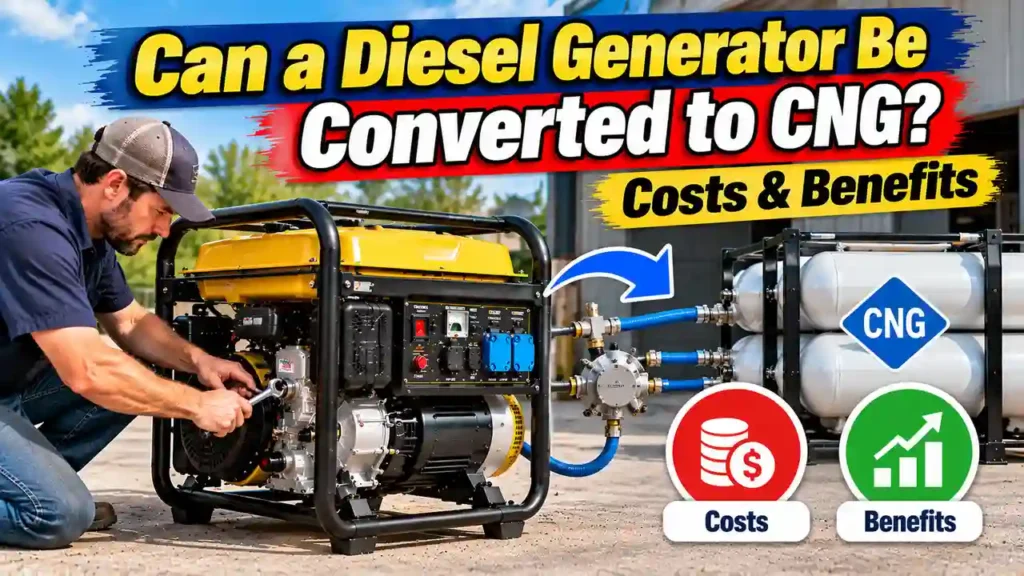


Meta description: Can a diesel generator be converted to CNG? Learn how diesel-to-CNG and dual-fuel conversions work, typical costs, benefits, fuel savings, limitations, safety issues, and when conversion makes sense.
Quick answer: Yes, a diesel generator can sometimes be converted to use compressed natural gas, but in most cases the practical retrofit is not a true 100% CNG conversion. Instead, the diesel engine is converted to dual-fuel operation, where CNG or pipeline natural gas replaces part of the diesel while a smaller diesel injection remains as the ignition source. A full conversion to 100% CNG is possible on some engines, but it generally requires much more extensive changes to the ignition, fuel-delivery, controls, combustion system, and emissions package. If you already own a healthy diesel genset and have reliable, inexpensive natural gas available, a dual-fuel retrofit can reduce diesel consumption and operating cost. If you are buying new, a purpose-built natural-gas generator is often the simpler choice.
Can You Really Convert a Diesel Generator to CNG?
When someone asks me whether a diesel generator can be converted to CNG, I first separate two very different ideas. The first is a diesel-CNG dual-fuel conversion. The second is a complete conversion from compression-ignition diesel operation to spark-ignited natural-gas operation.
The first option is common enough to be commercially practical. The second is much more involved.
A conventional diesel engine has no spark plugs. It compresses air until the temperature becomes high enough for injected diesel fuel to ignite. Natural gas has different ignition characteristics, so a standard diesel engine normally cannot simply stop using diesel and run on CNG after adding a gas hose. In a dual-fuel conversion, gas is mixed with the intake air while a smaller quantity of diesel is still injected near the end of the compression stroke. That diesel acts as the pilot ignition source.


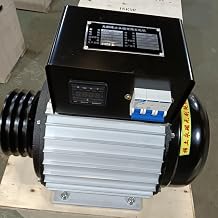
This approach lets you retain the basic diesel engine while displacing a significant portion of diesel fuel with natural gas. Factory and retrofit systems can be designed to change the gas substitution percentage automatically as generator load changes.
| Conversion approach | Diesel still required? | Can run on 100% CNG? | Modification level | Typical use |
|---|---|---|---|---|
| Diesel-CNG dual fuel | Yes | No | Moderate | Existing healthy diesel gensets |
| Full spark-ignition conversion | No | Potentially | Extensive | Special engineered projects |
| Replace with purpose-built gas genset | No | Yes | New equipment | New installations or aging diesel sets |
How a Diesel-CNG Dual-Fuel Generator Works
In a dual-fuel setup, the generator still starts as a diesel generator. This is one reason I like the concept for standby and remote applications: if the gas system is unavailable, the engine can often fall back to 100% diesel operation.
Once the engine is running and the controller confirms that operating conditions are suitable, the conversion system begins introducing natural gas into the intake. Depending on the design, gas can be metered through a mixer, electronically controlled valve, port injection system, or another gas admission device. The controller monitors load, engine speed, gas pressure, exhaust conditions, and sometimes knock or cylinder pressure. It then reduces diesel delivery while increasing the gas fraction.
Caterpillar’s Dynamic Gas Blending systems are a good real-world example of the principle. On supported applications, Cat states that natural gas can substitute for up to about 70% of diesel consumption while the engine preserves diesel capability when gas is unavailable. I would not assume that every aftermarket kit can safely achieve that number. The allowable substitution rate depends on the engine, load, combustion temperature, gas quality, controls, turbocharging, and emissions requirements.
What Parts Are Added During a CNG Dual-Fuel Conversion?
The exact kit varies by engine size, but I usually expect the project to involve much more than a simple regulator. A properly engineered system needs to meter gas in proportion to engine load and shut the gas off immediately if unsafe conditions appear.
| Component | What it does | Why it matters |
|---|---|---|
| CNG cylinders or gas supply | Stores or supplies methane | Must provide enough gas flow at full load |
| High-pressure regulator | Reduces CNG storage pressure | Engine cannot receive storage pressure directly |
| Gas shutoff valves | Stops flow during shutdown or fault | Critical safety function |
| Gas filter | Protects valves and injectors | Helps maintain stable flow |
| Mixer or gas injectors | Introduces gas into intake air | Controls air-fuel distribution |
| Electronic controller | Adjusts substitution with load | Prevents excessive gas fueling |
| Pressure and temperature sensors | Monitors system condition | Supports alarms and shutdowns |
| Emergency gas shutoff | Isolates fuel in an emergency | Required in a professionally designed installation |
How Much Diesel Can CNG Replace?
This is one of the first numbers people ask about, but I would be careful with any seller who promises one fixed percentage for every engine. Gas substitution changes with load. At light load, the engine may need a larger diesel fraction to maintain stable combustion. At medium-to-high load, a well-controlled system may be able to substitute a much greater share with gas.
As a planning concept, I would think of roughly 30% to 70% gas substitution as a broad possible range for properly engineered dual-fuel systems, with the actual number depending heavily on engine model and operating condition. Some OEM systems advertise up to 70% substitution. That does not mean your specific generator should be tuned to 70%.
| Generator load | Illustrative gas substitution | Diesel share remaining | Comment |
|---|---|---|---|
| 25% | 20–40% | 60–80% | Low load can limit stable substitution |
| 50% | 30–60% | 40–70% | Often a more favorable operating region |
| 75% | 40–70% | 30–60% | Higher substitution may be possible |
| 100% | System-specific | System-specific | Must stay within engine temperature, knock and emissions limits |
These percentages are illustrative operating ranges, not a specification for a particular engine. I would always use the conversion-system manufacturer’s approved map for the exact genset.
Why Can’t Most Diesel Generators Run on 100% CNG After a Simple Retrofit?
The main reason is ignition. A diesel engine relies on compression ignition. It does not normally have the spark-plug ignition system used by a dedicated natural-gas engine.
With dual fuel, a small diesel injection ignites first and lights the surrounding natural-gas-air mixture. Remove the diesel pilot completely and you also remove the normal ignition source.


A true 100% gas conversion can therefore require major work, such as a spark ignition system, new engine controls, revised fuel metering, different compression ratio or combustion hardware on some engines, knock detection, ignition timing control, modified pistons or cylinder-head components depending on design, and a new emissions calibration. At that point I would compare the conversion cost with replacing the engine or entire genset with a purpose-built gas model.
CNG Is Not the Same as Pipeline Natural Gas
The engine ultimately uses methane-rich gas in both cases, but the storage and delivery systems are very different.
Pipeline natural gas may arrive at comparatively low pressure and can be regulated through a stationary gas train. CNG is natural gas compressed into high-pressure cylinders. In U.S. transportation applications, the common nominal storage pressure is 3,600 psi, with some systems using 3,000 psi. That pressure must be reduced through correctly rated regulators before gas can reach the engine.
This is one of the biggest practical limitations of CNG for a stationary generator. Diesel is energy-dense and easy to store in a tank. CNG requires high-pressure cylinders, approved valves, relief devices, regulators, mounting structures, ventilation, separation distances, inspection, and safe refueling procedures.
| Fuel system | Typical storage/delivery condition | Main installation issue |
|---|---|---|
| Diesel | Atmospheric liquid tank | Spill containment, fire protection, fuel quality |
| Pipeline natural gas | Utility or site gas line | Available pressure and flow |
| CNG | Commonly 3,000–3,600 psi storage | High-pressure cylinders, regulation, refueling and inspection |
How Much Does It Cost to Convert a Diesel Generator to CNG?
There is no honest single conversion price. The cost depends on generator kW or kVA, engine make and model, whether the engine is mechanical or electronically controlled, number of cylinders, turbocharging, required gas flow, CNG storage capacity, local code requirements, emissions testing, installation labor, and whether you need a compressor or refueling station.
I would divide the project into five cost buckets rather than focusing only on the conversion kit.
| Cost item | What may be included | Why cost varies |
|---|---|---|
| Conversion hardware | Controller, injectors/mixer, sensors, valves | Engine size and control sophistication |
| Gas train | Regulators, filters, shutoff valves, piping | Pressure and required flow |
| CNG storage | Cylinders, frames, relief devices, valves | Required runtime and local rules |
| Installation/commissioning | Mechanical work, wiring, tuning, load testing | Site complexity and generator size |
| Compliance | Permits, engineering, emissions or fire review | Jurisdiction and application |
Small projects may cost only several thousand dollars if gas infrastructure is already available and the engine has a supported retrofit kit. Industrial projects can move well into the tens of thousands of dollars once storage, compression, piping, controls, engineering, and commissioning are included. I would never approve a project based on an online kit price alone.
A Simple Payback Example
Suppose I have a 200 kW diesel generator that burns 12 gallons of diesel per hour at a particular operating load. Assume a properly engineered dual-fuel system replaces 50% of the diesel energy with natural gas while maintaining the required output.
| Input | Example value |
|---|---|
| Original diesel use | 12 gal/hr |
| Diesel price | $4.00/gal |
| Original diesel fuel cost | $48/hr |
| Diesel displaced | 6 gal/hr equivalent |
| Remaining diesel cost | $24/hr |
| Example natural-gas equivalent cost | $12/hr |
| Dual-fuel total fuel cost | $36/hr |
| Illustrative saving | $12/hr |
If the entire installed conversion costs $24,000 in this hypothetical example, simple fuel-only payback would be about 2,000 operating hours:
$24,000 ÷ $12 per hour = 2,000 hours.
This is only an example. Your result can be dramatically different. If gas is expensive, CNG compression is costly, the generator runs only 50 hours per year, or substitution falls at your normal load, the conversion may never pay for itself. If the generator runs thousands of hours per year and gas is substantially cheaper than diesel, payback can improve quickly.
What Are the Main Benefits of a Diesel-to-CNG Dual-Fuel Conversion?
1. Lower Diesel Consumption
The most obvious benefit is reducing the number of gallons of diesel you burn. If you operate prime power, remote power, a factory, a mine, a data facility, or another high-hour application, fuel can dominate operating cost. That is where substitution can be financially meaningful.
If you are trying to estimate your baseline fuel use before considering conversion, see my guide on diesel generator burn rate.
2. Fuel Flexibility
A good dual-fuel system normally retains full-diesel capability. If gas pressure drops or the CNG bank empties, the controller can return the engine to diesel operation. That gives you more resilience than relying on one fuel alone.
3. Potentially Lower Fuel Cost per kWh
If natural gas is cheaper than diesel on an energy-equivalent basis, replacing part of the diesel can reduce the fuel component of your electricity cost. You still need to include maintenance, conversion depreciation, CNG compression energy, storage, and financing when calculating the true cost per kWh.
4. Lower Particulate Emissions
Substituting gaseous fuel for a portion of diesel can reduce particulate matter because less liquid diesel is being injected. The exact emissions outcome is not automatically positive for every pollutant, however. NOx, methane slip, carbon monoxide, and total greenhouse-gas impact depend on engine calibration, catalyst systems, gas quality, load, and local regulations.
For broader emissions context, you can also read my article on the environmental impact of diesel generators.
5. Less On-Site Diesel Storage
If you can substitute a large fraction of diesel with pipeline natural gas, you may reduce how quickly you consume the day tank or bulk tank. With CNG cylinders, however, you are trading some liquid-fuel storage for high-pressure gas storage, so the site still needs careful fuel planning.
What Are the Limitations?
CNG Storage Takes Space
CNG contains less energy per unit of storage volume than diesel. That means long generator runtime can require a large cylinder bank. For a stationary site, the footprint and cost of the cylinders may become more important than the conversion kit itself.
You Still Need Diesel
With the common dual-fuel approach, you cannot eliminate diesel. You still need the diesel tank, injection system, fuel filters, injectors, and normal diesel maintenance.
Gas Substitution Changes With Load
A generator that spends most of its life at very low load may not achieve the same gas substitution as a heavily loaded prime-power machine. I would review the real load profile before buying a kit.
Transient Performance Can Be More Difficult
Diesel generators are excellent at accepting sudden load changes. A poorly tuned dual-fuel system can hesitate, knock, overshoot, or lose stability when a large motor starts. Good systems solve this by reducing gas and adding diesel during transients.
Warranty Can Become Complicated
An aftermarket system does not necessarily mean that every warranty claim will be denied, but I would get the engine manufacturer’s and conversion supplier’s position in writing before modifying a valuable genset. OEM-supported systems are easier to manage because hardware, calibration, and warranty responsibility are defined by one manufacturer or dealer network.
Emissions Compliance May Change
If the generator is regulated by an emissions permit, converting the fuel system may change the certified configuration. A retrofit that runs well mechanically can still create a compliance problem if the modified system no longer matches the approved engine configuration.
Will a CNG Conversion Reduce Generator Power?
It can, but it does not have to. A professionally engineered dual-fuel system can be designed to preserve rated output by increasing the diesel fraction whenever gas flow or combustion limits are reached. Factory systems are specifically calibrated around engine protection and performance.
A poorly designed retrofit may restrict intake airflow, run too lean or too rich, encounter knock, raise exhaust temperature, or force the operator to derate the generator. Altitude and high ambient temperature can make the margin smaller because the engine already has less available air density.
How Much CNG Storage Would I Need?
The answer depends on the amount of diesel being displaced and how many hours you want to run between CNG refills. A useful rule is to begin with energy equivalence, then have the gas supplier size the actual storage bank after accounting for pressure, temperature, usable cylinder capacity, regulator behavior, and required reserve.
One commercial dual-fuel supplier uses approximately 140 standard cubic feet of pipeline-quality natural gas as an energy-equivalent replacement for one gallon of diesel. I would use that only for early planning because actual heating value varies.
| Diesel displaced | Approx. natural gas equivalent | 8-hour shift |
|---|---|---|
| 1 gal/hr | ~140 scf/hr | ~1,120 scf |
| 3 gal/hr | ~420 scf/hr | ~3,360 scf |
| 5 gal/hr | ~700 scf/hr | ~5,600 scf |
| 10 gal/hr | ~1,400 scf/hr | ~11,200 scf |
What Generators Are the Best Candidates for Conversion?
I would favor generators that are mechanically healthy, have many useful operating hours remaining, run regularly enough to create meaningful fuel savings, and operate at moderate-to-high load for long periods.
A worn-out engine with low compression, injector problems, overheating, blow-by, or unstable speed is a poor conversion candidate. Adding a second fuel system does not repair the underlying diesel engine.
Before spending money, I would perform a full service, inspect the cooling system, verify rated power on a load bank, check fuel consumption, review engine fault history, and confirm that the alternator and voltage regulator are healthy. If you are considering an older unit, my guide to used diesel generator risks and benefits covers many of the same inspection points.
When Does Conversion Make Financial Sense?
I would seriously model a conversion when most of the following are true:
- The generator runs hundreds or thousands of hours per year.
- Diesel is expensive relative to natural gas.
- The engine is in good condition with substantial life remaining.
- Your normal load is high enough for meaningful gas substitution.
- You already have pipeline gas, a CNG source, or economical compression nearby.
- The generator’s engine model has a proven conversion package.
- Local fire, gas, environmental, and electrical authorities permit the installation.
When Would I Avoid the Conversion?
I would normally avoid a retrofit when the generator is used only a few hours each year for emergency backup, when CNG requires an expensive new compressor and cylinder bank, when the engine is near overhaul, when the generator must maintain an untouched OEM emissions certification, or when load changes are extremely fast and the proposed system has not been proven on that exact engine.
For a standby generator that runs 20 or 30 hours per year, even a $10-per-hour fuel saving may take decades to recover a $20,000 conversion cost. In that case, the economics are difficult to justify unless there are nonfinancial reasons for using gas.
CNG Conversion vs. Buying a Natural-Gas Generator
| Factor | Convert existing diesel | Buy purpose-built gas genset |
|---|---|---|
| Initial equipment reuse | High | Low |
| Can retain 100% diesel backup | Usually yes with dual fuel | Usually no |
| Gas-system integration | Retrofit | Factory engineered |
| 100% natural-gas operation | Not with normal dual-fuel kit | Yes |
| Warranty simplicity | Depends on retrofit | Usually simpler |
| Best fit | Healthy existing high-hour diesel | New project or aging diesel unit |
Safety Issues I Would Not Compromise On
CNG is stored at very high pressure, so this is not a DIY fuel-hose project. I would use approved pressure vessels, regulators, excess-flow protection, manual and automatic shutoff valves, relief devices, gas-rated piping, proper ventilation, electrical bonding where required, gas detection where required by the design, fire-code separation, and trained commissioning personnel.
I would also ensure the gas shuts off automatically if the engine stops. You never want gas continuing to flow into a stationary engine or enclosure after a shutdown.
If CNG cylinders are used, their mounting, inspection, service life, pressure rating, and refueling connection must match applicable standards. High-pressure gas storage deserves the same level of engineering attention as the generator itself.
My Pre-Conversion Checklist
| Check | What I want to confirm |
|---|---|
| Engine condition | Good compression, no major blow-by, stable oil pressure |
| Cooling system | No overheating under rated load |
| Fuel consumption | Measured diesel burn at normal load |
| Load profile | Typical kW and transient demands |
| Gas source | Required pressure, flow, heating value and reliability |
| CNG storage | Enough capacity for target runtime |
| Kit compatibility | Proven on exact engine model |
| Warranty | Written OEM/dealer and retrofit terms |
| Permits | Fire, gas, emissions and electrical approval |
| Payback | Real fuel-cost model based on annual hours |
Frequently Asked Questions
Can I convert any diesel generator to CNG?
No. Many diesel engines can potentially use a dual-fuel system, but compatibility depends on engine design, control system, condition, application, emissions status, and whether a proven conversion kit exists. I would not treat a universal kit as automatically suitable for every generator.
Will the generator still run on diesel after conversion?
With most diesel-natural gas dual-fuel systems, yes. In fact, the ability to revert automatically to 100% diesel when gas is unavailable is one of the main advantages.
Can a converted diesel generator run entirely on CNG?
Not with the normal dual-fuel retrofit. It still needs a diesel pilot injection for ignition. A true 100% gas conversion requires substantially different engine hardware and controls.
How much diesel can CNG replace?
It depends on the system, engine and load. Some OEM dual-fuel systems can reach around 70% diesel substitution under suitable conditions, but I would never assume that number without an approved engine-specific fuel map.
Does converting to CNG reduce maintenance?
It may reduce soot loading because less diesel is burned, but you are also adding regulators, valves, sensors and gas-control hardware that require inspection. The underlying diesel injection and lubrication systems still need normal service. See my guide on how often diesel generators should be serviced.
Is CNG safer than diesel?
They have different risks. Diesel is a combustible liquid that can spill and contaminate soil. CNG is lighter than air but is stored at very high pressure. A properly engineered system can be operated safely, but cylinder integrity, ventilation, leak control and automatic shutoffs become essential.
Is CNG conversion worth it for a home standby generator?
Usually the economics are less attractive when the generator runs only a few hours per year. For a new residential installation with natural gas already available, I would generally compare the retrofit cost against simply using a factory-built natural-gas standby generator.
Final Thoughts
So, can a diesel generator be converted to CNG? Yes—but the most practical retrofit is usually diesel-CNG dual fuel, not a complete switch to 100% CNG. The generator continues to use diesel as an ignition source while natural gas replaces part of the diesel energy.
I think the conversion makes the most sense when you already own a healthy diesel generator, run it many hours per year, have a reliable low-cost gas source, and can install the gas system without excessive storage or infrastructure cost. In that situation, reducing diesel consumption can lower operating expense and give you useful fuel flexibility.
If the generator is old, rarely used, heavily regulated, or requires expensive CNG compression and storage, I would compare the retrofit with a purpose-built natural-gas generator before spending money. The right answer is not determined by the conversion kit price alone. You need to calculate fuel cost, annual runtime, gas availability, storage, permitting, engine condition, maintenance, and the remaining life of the genset as one complete project.