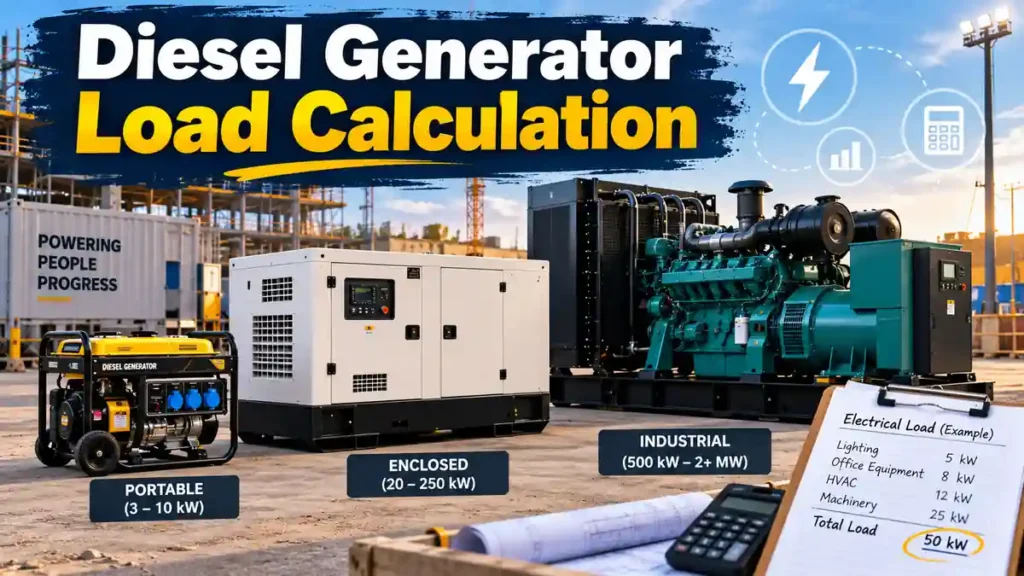


If you are trying to size a diesel generator correctly, the most important number is not the building’s total connected load. It is the maximum realistic load the generator will need to carry at one time. That sounds simple, but generator load calculation becomes more complicated when you add motors, air conditioners, pumps, compressors, three-phase equipment, low power factor, and loads that cycle on and off.
In this guide, I will show you how I calculate generator load step by step. I will cover watts, kilowatts, kVA, amps, power factor, single-phase and three-phase formulas, motor starting load, demand, diversity, load percentage, and practical sizing margin. I will also walk through home, workshop, and commercial examples so you can see how the calculation works in the real world.
What Does Diesel Generator Load Mean?
Generator load is the electrical demand being placed on the generator at a particular moment. If a 100 kW generator is supplying 50 kW of real electrical power, I would describe it as operating at about 50% load.
The generator has to do two jobs. First, the diesel engine must produce enough mechanical power. Second, the alternator must supply the required voltage, current, kW, and kVA without overheating or allowing the voltage and frequency to fall outside acceptable limits.
This is why I do not size a generator from watts alone. A generator can have enough kW on paper but still struggle with a large motor because the motor may require high starting current and a large amount of apparent power for a few seconds.


Diesel Generator Load Calculation Technical Details
| Item | What It Means | Why I Check It |
|---|---|---|
| Watts (W) | Real electrical power for smaller loads | Useful for appliances, tools, lights, and small equipment |
| Kilowatts (kW) | 1,000 watts of real power | Main measurement of useful generator output |
| Volt-amperes (VA) | Apparent power | Accounts for voltage and current even when power factor is below 1.0 |
| kVA | 1,000 volt-amperes | Common generator rating, especially for three-phase sets |
| Power factor (PF) | Ratio of kW to kVA | Needed to convert between real and apparent power |
| Amps (A) | Electrical current | Useful when equipment nameplates list current instead of watts |
| Voltage (V) | Electrical potential | Required for converting amps to kW or kVA |
| Phase | Single-phase or three-phase supply | Changes the electrical calculation |
| Running load | Power required after equipment is operating normally | Determines continuous generator demand |
| Starting load | Temporary demand while motors or compressors accelerate | Can determine the generator size even when running kW is modest |
| Load factor | Actual load divided by generator rating | Shows how heavily the generator is being used |
The Basic Generator Load Formula
For a simple system where every load is already listed in watts, I start with this:
Total running load (kW) = total simultaneous running watts ÷ 1,000
For example, suppose I have the following loads running together:
| Load | Running Watts |
|---|---|
| Lighting | 1,200 W |
| Refrigeration | 900 W |
| Electronics | 600 W |
| Pump | 2,200 W |
| Other loads | 1,100 W |
| Total | 6,000 W |
The steady running load is 6,000 W, or 6 kW. But I would not stop there. I still need to check whether the pump or refrigeration compressor has a higher starting requirement.
Running Watts vs. Starting Watts
One of the biggest generator-sizing mistakes I see is adding only running watts. Resistive loads such as many heaters and incandescent lamps do not usually create a major starting surge. Motors, compressors, pumps, refrigerators, air conditioners, and some power tools can.
Motor starting current can be several times the normal running current, but I do not use one universal multiplier for every motor. Actual starting demand depends on the motor design, starter type, voltage, mechanical load, and whether a variable-frequency drive or soft starter is used. I prefer the equipment nameplate, manufacturer data, locked-rotor information, or a measured startup profile.
| Load Type | Running Demand | Starting Concern |
|---|---|---|
| Resistive heater | Usually close to rated watts | Normally small startup difference |
| LED lighting | Low continuous watts | Drivers may produce brief inrush |
| Refrigerator/freezer | Moderate | Compressor startup can be much higher |
| Air conditioner | Moderate to high | Compressor starting can be the limiting event |
| Water pump | Depends on motor size | Direct-on-line starting can require high current |
| Air compressor | Moderate to high | Motor starting and unloaded/loaded start condition matter |
| VFD-driven motor | Depends on process load | Usually lower mechanical starting surge, but harmonics and drive input characteristics matter |
If the largest motor starts while other loads are already running, I calculate the generator for the existing running load plus the temporary starting requirement of that motor.
How I Calculate kW from Amps
Equipment nameplates often give me volts and amps rather than watts. The formula depends on whether the system is single-phase or three-phase.
Single-Phase Formula
For single-phase AC power:
kW = volts × amps × power factor ÷ 1,000


If I have a 230 V load drawing 20 A at a power factor of 0.90:
230 × 20 × 0.90 ÷ 1,000 = 4.14 kW
Three-Phase Formula
For a balanced three-phase load using line-to-line voltage:
kW = 1.732 × volts × amps × power factor ÷ 1,000
For example, a 400 V three-phase load drawing 50 A at 0.85 PF would be:
1.732 × 400 × 50 × 0.85 ÷ 1,000 = 29.44 kW
How I Calculate kVA
Many diesel generators are rated in kVA. kVA is apparent power, while kW is real power. The relationship is:
kVA = kW ÷ power factor
If a load requires 80 kW at 0.80 PF:
80 ÷ 0.80 = 100 kVA
Likewise:
kW = kVA × power factor
| kW Load | Power Factor | Required kVA |
|---|---|---|
| 10 kW | 1.00 | 10.0 kVA |
| 10 kW | 0.90 | 11.1 kVA |
| 10 kW | 0.80 | 12.5 kVA |
| 40 kW | 0.90 | 44.4 kVA |
| 40 kW | 0.80 | 50.0 kVA |
| 80 kW | 0.80 | 100.0 kVA |
Lower power factor means the alternator must carry more current for the same useful kW output. This is why I look at both kW and kVA rather than assuming they are interchangeable.
Single-Phase Generator Current Examples
For an idealized single-phase load at PF 1.0, current is approximately watts divided by volts. The following table is useful for understanding the relationship, but it is not a breaker or conductor sizing chart.
| Real Power | 120 V at PF 1.0 | 240 V at PF 1.0 |
|---|---|---|
| 2 kW | 16.7 A | 8.3 A |
| 5 kW | 41.7 A | 20.8 A |
| 10 kW | 83.3 A | 41.7 A |
| 15 kW | 125.0 A | 62.5 A |
| 20 kW | 166.7 A | 83.3 A |
Three-Phase Generator Current Examples
For three-phase systems, voltage makes a major difference in current. The examples below assume PF 0.80 and balanced loads.
| Generator Load | 208 V, 3-Phase | 400 V, 3-Phase | 480 V, 3-Phase |
|---|---|---|---|
| 25 kW | 86.7 A | 45.1 A | 37.6 A |
| 50 kW | 173.5 A | 90.2 A | 75.2 A |
| 100 kW | 347.0 A | 180.4 A | 150.4 A |
| 200 kW | 694.0 A | 360.8 A | 300.7 A |
Again, I use this only for load understanding. Real electrical design must also account for equipment ratings, continuous-load rules, temperature, conductor ampacity, fault current, overcurrent protection, voltage drop, and local code requirements.
Step-by-Step Diesel Generator Load Calculation
1. List Every Load the Generator May Supply
I begin by making an equipment schedule. I list lights, pumps, compressors, HVAC, refrigeration, receptacles, computers, process equipment, chargers, controls, and anything else that may be powered during an outage.
2. Record Nameplate Data
I record watts or kW when available. If the nameplate gives volts and amps, I record those. For motors, I also look for horsepower, full-load amps, locked-rotor information, starter type, and any manufacturer starting data.
3. Decide Which Loads Can Run at the Same Time
This is where connected load and actual generator load separate. If ten loads total 100 kW but only 60 kW can realistically operate at once, sizing for all 100 kW may be unnecessary. On the other hand, if the facility is mission-critical and every load could operate together, I cannot assume diversity that does not exist.
4. Calculate Running kW
I add the simultaneous running kW. If some loads are listed in amps, I convert them using the appropriate single-phase or three-phase formula.
5. Calculate Running kVA
Where power factor is relevant, I calculate kVA. The alternator must have enough apparent-power capacity even if the engine has enough kW.
6. Identify the Largest Starting Event
I then ask which motor, compressor, pump, transformer, or electronic load creates the largest step load. In many systems, this event determines whether the generator will start the load successfully without an unacceptable voltage dip.
7. Consider the Starting Sequence
Loads do not always need to start together. A staged sequence can dramatically reduce required generator size. For example, I may start refrigeration first, wait for the compressor to stabilize, then enable an air conditioner, then add noncritical receptacle loads.
8. Add a Practical Operating Margin
I normally avoid selecting a generator whose expected steady load sits exactly at the nameplate rating. A margin gives room for load growth, short transients, temperature and altitude effects, and normal changes in operation. The correct margin is application-specific rather than a universal percentage.
Generator Load Percentage Formula
Once I know the actual real-power load, I calculate generator load percentage as:
Load % = actual kW ÷ generator rated kW × 100
| Generator Rating | Actual Load | Load Percentage |
|---|---|---|
| 20 kW | 5 kW | 25% |
| 20 kW | 10 kW | 50% |
| 20 kW | 15 kW | 75% |
| 20 kW | 20 kW | 100% |
| 100 kW | 65 kW | 65% |
| 500 kW | 350 kW | 70% |
If you want a broader explanation of generator capacity, I recommend reading my diesel generator sizing guide. I also explain the output of one common size in how much power a 20 kW diesel generator provides.
Example 1: Home Backup Generator Load Calculation
Suppose I want to power selected essential loads rather than an entire house. My example load list looks like this:
| Home Load | Running Watts | Illustrative Starting Addition |
|---|---|---|
| Refrigerator | 700 W | 1,300 W |
| Freezer | 500 W | 900 W |
| Well pump | 1,500 W | 3,500 W |
| Lighting | 800 W | Minimal |
| Internet/electronics | 400 W | Minimal |
| Microwave | 1,500 W | Minimal |
| Total running load | 5,400 W | — |
If the well pump has the largest starting requirement and its example 3,500 W starting addition occurs while the other loads are running, the short-duration demand becomes approximately:
5,400 W + 3,500 W = 8,900 W
I would then compare this with actual generator surge capability, the pump’s true starting data, voltage-drop limits, and the operating margin I want. I would not automatically conclude that any generator advertised as 9 kW is acceptable, because generator surge duration and motor-starting performance vary.
If you are planning residential backup, my article on connecting a diesel generator to a home explains why proper transfer equipment matters.
Example 2: Small Workshop Load Calculation
Now suppose I have a workshop where the following equipment may run:
| Equipment | Running kW | Notes |
|---|---|---|
| Lighting and office | 2.0 kW | Mostly steady |
| Air compressor | 7.5 kW | Large motor start |
| Welder | 8.0 kW equivalent operating demand | Highly variable; actual input data should be used |
| Exhaust fan | 1.5 kW | Motor load |
| Small tools | 3.0 kW | Intermittent |
The connected running total is 22 kW, but suppose the welder and small tools are not used while the compressor starts. The most demanding realistic condition might be the steady base load plus compressor starting, not all five loads at their maximum simultaneously.
This is why a load sequence and operating profile are often more valuable than a simple total-watts spreadsheet.
Example 3: Three-Phase Commercial Load
Imagine a 400 V three-phase facility with the following balanced operating loads:
| Load | kW | Power Factor | kVA |
|---|---|---|---|
| Lighting and electronics | 20 kW | 0.95 | 21.1 kVA |
| HVAC | 35 kW | 0.85 | 41.2 kVA |
| Pumps | 25 kW | 0.82 | 30.5 kVA |
| Process load | 30 kW | 0.90 | 33.3 kVA |
| Total | 110 kW | — | 126.1 kVA |
If I selected only by 110 kW, I might overlook the alternator kVA requirement. I would also need to evaluate the largest motor start, load steps, harmonics, and whether the generator rating is standby, prime, or continuous.
What Is Demand Factor?
Demand factor recognizes that the maximum operating load may be lower than the total connected load. If I have 100 kW of connected equipment but the measured or engineered maximum demand is 70 kW, the demand factor is:
70 ÷ 100 = 0.70, or 70%
I use demand carefully. It should come from actual operating requirements, measured data, or a defensible engineering assumption. I would not simply pick a low percentage to make the generator smaller.
What Is Diversity?
Diversity describes the fact that individual loads often peak at different times. In a commercial building, for example, every motor, heater, charger, and appliance may not reach maximum input simultaneously. In a process plant, however, a startup sequence may briefly create a much higher combined demand than normal operation.
The key question I ask is: What combinations can actually occur?
Why the Largest Motor Can Control Generator Size
A 100 kW facility with no large motor may be easier for a generator to supply than a 60 kW facility with a very large direct-on-line compressor. During motor acceleration, voltage can dip and engine speed can fall. If the generator is too small, the motor may fail to accelerate, protective devices may trip, or the generator may bog down.
I cover this symptom in more detail in Diesel Generator Bogs Down Under Load.
Motor Starting Methods Change the Calculation
| Starting Method | General Effect on Generator | What I Verify |
|---|---|---|
| Direct-on-line | Potentially high starting current | Motor starting kVA and acceptable voltage dip |
| Star-delta | Can reduce starting current but also starting torque | Actual motor/load compatibility |
| Soft starter | Can limit current during acceleration | Configured current limit and acceleration time |
| Variable-frequency drive | Controlled motor acceleration | Drive input kVA, harmonics, bypass conditions, regenerative behavior if applicable |
This is another reason I avoid generic motor multipliers when a real project is being designed.
Do I Need to Add 20% or 25% Extra Capacity?
You will often see blanket advice to add 20% or 25%. I prefer not to treat one percentage as a universal rule. A modest residential system with predictable loads may need a different margin from a factory that expects future motors, a data center that needs redundancy, or a rental generator used across changing job sites.
I choose margin based on:
- Expected future load growth
- Largest load step
- Motor starting requirements
- Ambient temperature and altitude
- Standby, prime, or continuous rating
- Expected normal operating load
- Maintenance and redundancy strategy
- Manufacturer transient-performance data
Why Oversizing Is Not Always Better
A generator that is far larger than the real load costs more, takes more space, and may operate inefficiently at very low load. Long periods of low-load operation can also contribute to combustion-related issues on some diesel engines. The acceptable minimum loading and exercise strategy depend on the engine and generator manufacturer, so I do not apply one universal minimum-load percentage.
For fuel implications, see my diesel generator burn-rate guide.
Why Undersizing Is a Problem
An undersized generator may experience:
- Low voltage during startup
- Frequency drop
- Engine bogging
- Breaker trips
- Overload alarms
- Motor starting failure
- Excessive alternator heating
- Unstable operation as loads cycle
If you already have a generator installed, a controlled test can reveal how it behaves as load increases. My article How to Test If Your Diesel Generator Is Working Properly explains the basic checks I use.
Load Balancing on a Three-Phase Generator
Three-phase generator load is not just about total kW. I also look at how single-phase loads are distributed among the phases. A badly unbalanced system can overload one phase even when total generator kW appears acceptable.
| Phase | Example Current | Observation |
|---|---|---|
| L1 | 120 A | High |
| L2 | 82 A | Moderate |
| L3 | 78 A | Moderate |
Even if the average looks reasonable, I would investigate why L1 is carrying much more current. The allowable phase imbalance depends on the equipment and manufacturer, so I use the generator’s technical documentation rather than a one-size-fits-all limit.
Nonlinear Loads and Harmonics
Modern facilities can contain UPS systems, variable-frequency drives, battery chargers, servers, LED drivers, and other electronic loads. These loads may draw current in a nonlinear way and create harmonics. A simple kW total may not capture their effect on the alternator, neutral conductors, voltage waveform, or voltage regulator.
For a large electronic-load project, I would ask the generator manufacturer or electrical engineer to review harmonic content, alternator sizing, reactance, regulator performance, and load-step requirements.
How to Measure Actual Generator Load
If a generator is already installed, measured data is often better than estimates. Depending on the controller and metering system, I may be able to record:
| Measurement | Why It Helps |
|---|---|
| kW | Shows real power being delivered |
| kVA | Shows apparent power demand |
| Power factor | Shows relationship between real and apparent power |
| Current per phase | Reveals loading and phase imbalance |
| Voltage per phase | Shows voltage stability |
| Frequency | Shows engine-speed response |
| Peak demand | Helps identify the actual maximum operating condition |
High-energy electrical measurements should be performed using properly rated equipment and safe procedures. I would not open live panels or probe energized generator terminals unless I were qualified and equipped for that work.
Common Generator Load Calculation Mistakes
| Mistake | Why It Causes Problems |
|---|---|
| Adding only running watts | Ignores motor and compressor starting demand |
| Using generator kW but ignoring kVA | Can overload the alternator at low power factor |
| Assuming every load runs simultaneously | Can oversize the generator unnecessarily |
| Assuming too much diversity | Can undersize the generator |
| Using nameplate generator rating as the expected operating load | Leaves little room for transient events and growth |
| Ignoring altitude and temperature | Available engine/generator output may be derated |
| Ignoring phase balance | One phase may be overloaded before total kW looks excessive |
| Using generic motor multipliers for final engineering | Real motor starting characteristics may differ substantially |
Generator Load Calculation Worksheet
For each load, I would record the following:
| Field | What to Enter |
|---|---|
| Equipment name | Pump, A/C, freezer, machine, UPS, etc. |
| Voltage | Nameplate voltage |
| Phase | 1-phase or 3-phase |
| Running amps | Nameplate or measured current |
| Running kW | Rated or calculated real power |
| Power factor | Nameplate, measured, or manufacturer value |
| Running kVA | kW ÷ PF |
| Starting data | Starting amps, starting kVA, LRA, or manufacturer surge data |
| Duty | Continuous, intermittent, or cycling |
| Priority | Essential or shed-able |
| Start sequence | When the load is allowed to start |
When Load Shedding Lets Me Use a Smaller Generator
Load shedding means temporarily preventing lower-priority loads from operating when generator demand is high. For example, a controller might disable an electric water heater while an air conditioner starts, or delay a secondary pump until the main motor is stable.
This can be a smart strategy when properly engineered because it reduces the maximum simultaneous load without sacrificing critical functions.
Standby vs. Prime Rating Matters
I also make sure the generator rating matches how the unit will be used. A standby rating is intended for emergency operation under the manufacturer’s defined duty conditions. Prime and continuous ratings are intended for different operating profiles. The exact definitions and permissible average loads vary by manufacturer and model.
If the generator will run for long periods rather than only during outages, I do not assume the standby nameplate number can be used as a continuous operating target.
Final Generator Sizing Example
Suppose my calculated steady load is 72 kW and 88 kVA. The largest motor-start event temporarily adds 35 kVA while the rest of the facility remains at 88 kVA. My starting event is therefore approximately 123 kVA.
| Calculation Item | Result |
|---|---|
| Steady running load | 72 kW |
| Steady apparent load | 88 kVA |
| Largest added starting requirement | 35 kVA |
| Approximate short-duration apparent demand | 123 kVA |
I would not simply purchase a 123 kVA generator from that arithmetic. My next step would be to compare actual generator models for motor-starting capability, voltage dip, frequency response, alternator excitation, ambient derating, duty rating, and future load margin. Manufacturer sizing software or an engineer’s transient calculation is appropriate for large motors and critical facilities.
Frequently Asked Questions
How do I calculate the load on a diesel generator?
Add the loads that will run at the same time, convert them to kW and kVA, account for power factor, and then check the largest starting or surge event. I also consider load sequence, demand, phase balance, and a practical operating margin.
Should I add every appliance and machine together?
Only if they can realistically operate at the same time. Otherwise, I calculate maximum simultaneous demand rather than total connected load.
What is the difference between kW and kVA?
kW is real power that performs useful work. kVA is apparent power. They are related by power factor: kW = kVA × PF.
How do I calculate three-phase generator load?
For a balanced three-phase AC load, kW = 1.732 × line voltage × line current × power factor ÷ 1,000.
Can I size a generator from breaker size?
I would not rely on breaker rating alone. A breaker can be larger than the actual operating load, and motor circuits may have special protection and starting characteristics. I prefer actual equipment data and measured demand.
How much spare generator capacity should I leave?
There is no single percentage that fits every installation. I consider future growth, motor starts, transient load steps, environmental derating, rating type, and manufacturer recommendations.
What happens if my generator is overloaded?
You may see voltage drop, frequency drop, engine bogging, overheating, breaker trips, controller alarms, or shutdown. Repeated overload should be investigated rather than treated as normal operation.
Is a bigger generator always better?
No. Excessive oversizing increases cost and can leave a diesel generator operating at inefficiently low loads for long periods. The better approach is to match the set to the real load profile and expected future demand.
Bottom Line
When I perform a diesel generator load calculation, I start with simultaneous running kW, but I do not stop there. I calculate kVA, check power factor, identify the largest motor or compressor start, review phase balance, and consider how loads will be sequenced. I then compare that demand with the actual transient and continuous capabilities of the generator model.
The formula itself is easy. The difficult part is describing the real operating condition correctly. If you get that part right, you can choose a generator that starts the loads reliably without paying for far more capacity than you need.
If your generator already shows unstable performance or repeated load-related faults, my guide to common diesel generator problems can help you narrow down whether the issue is sizing, maintenance, fuel, cooling, or electrical output.