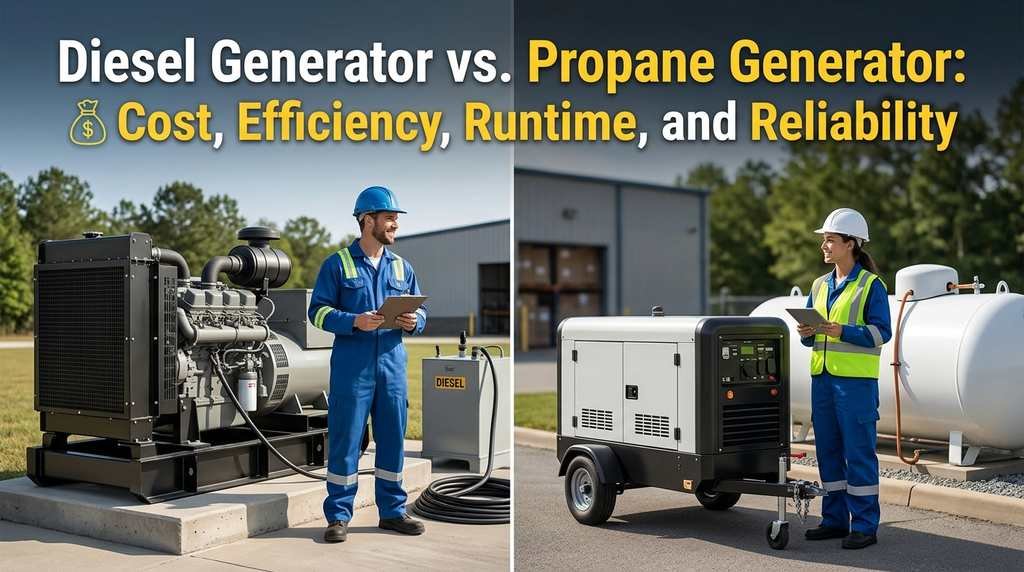
Quick answer: If I need a generator for long runtimes, heavy loads, commercial work, or a site where fuel efficiency matters most, I usually look first at diesel. If I want cleaner fuel storage, easier cold-weather fuel handling, lower routine fuel-maintenance concerns, or a residential standby setup with a large propane tank already on site, propane can be very attractive. Neither fuel is automatically “better.” The right choice depends on fuel price, required runtime, load profile, storage, maintenance, and how important on-site fuel independence is to you.
When you compare a diesel generator vs. propane generator, it is easy to focus on only one thing, usually fuel price. I do not think that is enough. A backup generator is a complete system, and the best choice depends on how efficiently the engine converts fuel into electricity, how much fuel you can store, how long you expect to run, what the generator costs to maintain, and what happens when the outage lasts longer than expected.
In this guide, I will walk you through cost, efficiency, runtime, reliability, maintenance, fuel storage, cold-weather operation, emissions, and sizing. I will also show you simple calculations so you can estimate your own operating cost instead of relying on a generic claim that one fuel is always cheaper.



Diesel Generator vs. Propane Generator: Technical Comparison
| Factor | Diesel Generator | Propane Generator |
|---|---|---|
| Fuel form | Liquid diesel | Liquefied petroleum gas stored under pressure |
| Approximate fuel energy | About 137,000 BTU per U.S. gallon | About 91,500 BTU per U.S. gallon |
| Typical strength | Fuel efficiency, heavy-load performance, long-duty applications | Clean storage, low fuel degradation, convenient standby use |
| On-site fuel supply | Day tank, belly tank, or bulk diesel tank | Portable cylinder or stationary propane tank |
| Fuel aging concern | Higher; water, microbes, oxidation, and sediment can matter | Low; propane does not degrade like liquid fuel |
| Cold-weather fuel issue | Diesel can gel or wax if fuel is not suitable for the temperature | Tank vaporization rate can fall sharply in cold weather |
| Part-load behavior | Can be inefficient and may suffer from prolonged light loading on some engines | Also becomes less efficient at light load, but does not have diesel wet-stacking concerns |
| Common applications | Commercial, industrial, construction, critical backup, remote power | Residential standby, farms, remote cabins, light commercial backup |
The energy-content difference matters. A gallon of diesel contains substantially more heat energy than a gallon of propane. That does not mean a diesel generator always costs less to operate, because price per gallon and engine efficiency are separate variables. It does mean that comparing the two fuels by gallons alone can be misleading.
Which Is More Efficient: Diesel or Propane?
For similar output classes, diesel engines often have an efficiency advantage, especially when the generator is carrying a substantial and steady load. Compression-ignition diesel engines operate at high compression ratios and are well suited to converting a high-energy-density liquid fuel into shaft power.
Propane engines are generally spark-ignited. They can be reliable and clean-burning, but the same generator output may require more gallons of propane than diesel because propane contains less energy per gallon and because the engine architecture is different.
I do not use one universal “litres per kWh” or “gallons per kWh” number for either fuel. Generator size, load percentage, engine design, alternator efficiency, ambient temperature, altitude, and emissions calibration all change fuel use. The manufacturer’s fuel-consumption curve is the best number for a real purchase decision.
Illustrative Fuel-Use Comparison
The table below is an example only. I am using round planning numbers to show how the calculation works, not to represent a particular generator model.
| Electrical Load | Illustrative Diesel Use | Illustrative Propane Use | 8-Hour Diesel Use | 8-Hour Propane Use |
|---|---|---|---|---|
| 5 kW | 0.45 gal/hr | 0.75 gal/hr | 3.6 gal | 6.0 gal |
| 10 kW | 0.75 gal/hr | 1.25 gal/hr | 6.0 gal | 10.0 gal |
| 20 kW | 1.35 gal/hr | 2.20 gal/hr | 10.8 gal | 17.6 gal |
| 30 kW | 1.95 gal/hr | 3.10 gal/hr | 15.6 gal | 24.8 gal |
If you want to dig deeper into diesel consumption, I have a separate guide on diesel generator burn rate and another on how much fuel a diesel generator uses.
How I Compare Operating Cost
The right comparison is not simply “diesel costs X per gallon and propane costs Y.” I calculate the fuel cost per hour and, ideally, the fuel cost per kilowatt-hour actually produced.
Fuel cost per hour = fuel consumption per hour × fuel price
Fuel cost per kWh = fuel cost per hour ÷ actual electrical output in kW
Example: 10 kW Load
Assume a diesel generator uses 0.75 gallon per hour at the load you care about and diesel costs $4.00 per gallon. Assume the propane generator uses 1.25 gallons per hour and propane costs $2.50 per gallon.
| Item | Diesel Example | Propane Example |
|---|---|---|
| Actual load | 10 kW | 10 kW |
| Fuel use | 0.75 gal/hr | 1.25 gal/hr |
| Fuel price | $4.00/gal | $2.50/gal |
| Fuel cost per hour | $3.00/hr | $3.13/hr |
| Fuel-only cost per kWh | $0.30/kWh | $0.31/kWh |
| 24-hour fuel cost | $72.00 | $75.00 |
This example shows why I prefer calculations over slogans. Even though propane uses more gallons, a lower local propane price can narrow the operating-cost gap. Reverse the local prices and the result can change quickly.
Important: Fuel-only cost is not the full cost of generator power. Maintenance, oil, filters, repairs, battery replacement, fuel delivery, tank rental, depreciation, installation, and labor can all matter. For a broader calculation, see my guide to diesel generator cost per kWh.


Runtime: Which Fuel Lets You Run Longer?
Runtime is where storage becomes just as important as efficiency. A diesel generator can run for a long time if you have enough diesel on site and the generator is approved for the duty cycle. A propane generator can also run for days if it is connected to a sufficiently large stationary tank and the tank can vaporize fuel fast enough for the load and weather.
I calculate theoretical runtime with a simple formula:
Runtime = usable fuel quantity ÷ fuel consumption per hour
Example Runtime Table
| Fuel Supply | Consumption | Theoretical Runtime |
|---|---|---|
| 50 gal diesel usable | 1.0 gal/hr | 50 hours |
| 100 gal diesel usable | 1.5 gal/hr | 66.7 hours |
| 200 gal propane usable | 2.0 gal/hr | 100 hours |
| 400 gal propane usable | 2.5 gal/hr | 160 hours |
Those numbers are theoretical. I would not plan emergency runtime using 100% of a tank’s nominal capacity. Propane tanks are not filled completely with liquid, and diesel systems may have unusable fuel below pickup level or reserve requirements. Long outages also bring service intervals, oil consumption, coolant checks, and refueling logistics into the picture.
If continuous operation is important to you, read my guide on how long a diesel generator can run continuously.
Propane Tank Size Matters More Than Many Buyers Expect
With propane, gallons stored are only part of the story. The generator normally receives propane vapor, so the tank must be able to vaporize liquid propane fast enough to supply the engine. Vaporization capacity depends heavily on tank size, liquid level, outdoor temperature, and required BTU input.
This is especially important in cold weather. A small cylinder may contain enough total fuel for several hours on paper but still fail to supply vapor at the required rate when the temperature drops.
| Propane Storage Situation | What I Check | Why It Matters |
|---|---|---|
| 20–40 lb portable cylinder | Generator BTU demand, temperature, approved connection | Vaporization may be limiting for larger generators |
| 100 lb cylinder | Ambient temperature and sustained load | Better capacity than small cylinders but still temperature-sensitive |
| 120–250 gal stationary tank | Usable volume, tank surface area, regulator sizing | Common for moderate standby loads |
| 500–1,000 gal tank | Fuel reserve, vaporization, delivery access | Can support much longer outage planning |
I always want the propane supplier or generator installer to verify tank and regulator capacity for the actual generator. Guessing from tank gallons alone is not enough.
Diesel Fuel Storage: Efficient but More Maintenance-Intensive
Diesel gives you excellent energy density and straightforward liquid-fuel delivery, but stored diesel needs attention. Over time, water can enter through condensation or contaminated deliveries. Water encourages corrosion and microbial growth. Sediment can collect in tanks, and old fuel can oxidize.
For a lightly used standby generator, fuel condition can become just as important as engine condition. A generator with only a few hundred hours can still fail during an outage if the tank contains water, sludge, or badly degraded fuel.
I look at fuel turnover, tank drainage, filtration, water monitoring, and periodic fuel sampling as part of the reliability plan. If fuel is stored for long periods, you should follow the engine and fuel-system manufacturer’s recommendations rather than adding products blindly.
Reliability: Diesel vs. Propane
Both fuels can be highly reliable when the system is correctly designed. The failure modes are simply different.
| Reliability Issue | Diesel | Propane |
|---|---|---|
| Fuel degradation | Can occur during long storage | Very low concern |
| Water contamination | Important concern | Not comparable to liquid diesel storage |
| Cold-weather fuel delivery | Waxing/gelling possible with unsuitable fuel | Vaporization capacity decreases as temperature falls |
| Fuel pump/injection complexity | Higher on modern engines | Different regulator/mixer/injection hardware |
| On-site fuel independence | Strong if bulk tank is maintained | Strong if large propane tank is installed |
| Long heavy-load duty | Major strength | Model-dependent |
I tend to favor diesel where long heavy-load operation and rapid refueling from liquid fuel are central requirements. I tend to favor propane when long-term fuel storage simplicity matters more than squeezing the most electricity from each gallon.
Starting and Cold-Weather Performance
Cold weather can challenge both systems, but in different ways. Diesel engines depend on battery condition, cranking speed, compression heat, correct winter-grade fuel, and sometimes intake or coolant heating systems. A poorly maintained diesel generator may crank slowly or fail to start when the temperature falls.
Propane itself does not “gel,” but that does not make propane immune to cold-weather limitations. As the tank gets colder, propane pressure and vaporization capacity fall. A tank that works well at moderate temperature can become marginal when it is cold, especially if the tank is small or nearly empty.
For either fuel, I want the installation sized for the lowest realistic ambient temperature, not just the average weather.
Maintenance Differences
Diesel engines are durable, but they have fuel filters, fuel-water separation concerns, injection systems, oil service, cooling systems, starting batteries, and sometimes aftertreatment. Propane engines still need oil, filters, plugs or ignition-system attention on many designs, cooling maintenance, batteries, and regulator/fuel-system inspection.
| Maintenance Item | Diesel Generator | Propane Generator |
|---|---|---|
| Engine oil/filter | Required | Required |
| Fuel filter | Common service item | Fuel-system service differs by design |
| Water separator | Common on diesel systems | Not used the same way |
| Spark plugs | No conventional spark plugs on compression-ignition diesel | Common on spark-ignition engines |
| Fuel storage inspection | Tank condition, water, sediment, fuel quality | Tank, regulator, valves, pressure system |
| Battery maintenance | Required | Required |
| Cooling system | Required on liquid-cooled units | Required on liquid-cooled units |
The service schedule in the owner’s manual always wins over a generic interval. Hours, calendar time, environment, and duty rating all matter.
Purchase Price and Installation Cost
There is no universal price winner. Small portable models, residential standby generators, commercial sets, and industrial generators live in completely different cost ranges. Installation can also cost as much as—or more than—the difference between the generator engines themselves.
With diesel, installation may involve a sub-base tank, separate bulk tank, spill containment, venting, fuel piping, fire-code requirements, and refueling access. With propane, the project may include a stationary propane tank, regulator system, gas piping, trenching, permits, and delivery setup.
| Cost Component | Diesel | Propane |
|---|---|---|
| Generator set | Varies widely by duty and size | Varies widely by standby/portable design |
| Fuel storage | Diesel tank and associated controls | Propane tank and regulator system |
| Fuel delivery system | Pumps, supply/return lines as applicable | Regulators, vapor piping, valves |
| Electrical work | Transfer switch, conductors, protection | Same basic electrical categories |
| Site preparation | Pad, clearances, drainage, access | Pad plus tank siting and gas clearances |
| Permits/inspection | Location-dependent | Location-dependent |
For a permanent project, I budget the whole installation rather than comparing only generator list prices. My guide on the cost to install a permanent diesel generator explains those additional expenses in more detail.
Emissions and Exhaust
Propane generally burns with lower particulate emissions and less visible smoke than diesel. That can be attractive around homes, hospitality sites, food-service areas, and locations where soot is a concern.
Modern diesel engines can be very clean when they use the correct emissions technology and are operated properly, but larger regulated engines may include more emissions hardware. In either case, carbon monoxide and exhaust gases are dangerous. Neither generator belongs in an occupied building, garage, crawlspace, or other enclosed area unless it is specifically engineered as a code-compliant indoor generator installation with proper combustion air and exhaust systems.
For outdoor placement, I follow the generator manufacturer, applicable codes, and local authority requirements. Portable generators need especially conservative exhaust separation from occupied buildings.
Noise
Fuel type alone does not determine noise. Engine speed, enclosure design, muffler, cooling fan, load, mounting, and distance are often more important. A large sound-attenuated diesel generator can be quieter at a property line than a small open-frame propane unit.
When noise matters, compare the manufacturer’s sound data at the same load and measurement distance. My separate article on diesel generator noise levels explains how decibels and distance affect what you actually hear.
Which Fuel Is Better for Home Backup?
For many homes, propane is convenient because a standby generator can connect to a stationary tank that also supplies heating, cooking, or hot water. The fuel stores well, and the homeowner does not need to manage diesel quality.
Diesel can make more sense for a property that already stores diesel, needs unusually long outage runtime, runs large electrical loads, or is located where diesel delivery is more dependable than propane delivery.
Example Residential Backup Load
| Load | Illustrative Running Load |
|---|---|
| Refrigerator/freezer | 0.5 kW |
| Well pump | 1.5 kW |
| Lighting/electronics | 0.8 kW |
| Gas furnace blower | 0.6 kW |
| Sump pump | 0.8 kW |
| Selected kitchen loads | 1.5 kW |
| Illustrative simultaneous running load | 5.7 kW |
I would not simply buy a 6 kW generator from that table. Motor starting current, load sequencing, power factor, voltage, and desired spare capacity still matter. For sizing, use my diesel generator sizing guide.
Which Is Better for Commercial and Industrial Backup?
Diesel remains especially strong where the generator must accept large motor loads, operate for extended periods, or support critical facilities. Hospitals, data facilities, industrial plants, telecommunications, construction sites, and remote operations often value compact fuel storage and the mature diesel-generator service ecosystem.
Propane can still be a good commercial fuel where the load is moderate, emissions and fuel-storage cleanliness matter, and a reliable bulk-propane supply is available. I would evaluate the actual duty rating rather than assuming any propane generator can substitute directly for an industrial diesel set.
Portable Generator Use
In the portable category, propane has a useful practical advantage: cylinders are clean to handle and the fuel does not become stale in the same way gasoline or diesel can. Dual-fuel and tri-fuel portable generators are popular partly because you can choose the available fuel.
Diesel portables are attractive for job sites and remote work where diesel is already stored for trucks, tractors, excavators, or other equipment. They can also deliver long runtime efficiently, although small diesel generators are often heavier and more expensive than comparable spark-ignition portable units.
Fuel Availability During a Major Disaster
I do not assume either fuel will always be available. A widespread outage can affect roads, filling stations, propane terminals, delivery schedules, and payment systems. The most reliable emergency fuel is often the fuel you have safely stored on site before the outage begins.
| Planning Question | Why I Ask It |
|---|---|
| How many hours must the generator support? | Determines minimum useful fuel reserve |
| Can delivery trucks reach the site during bad weather? | Affects refueling strategy |
| Does the site already use diesel or propane? | Existing infrastructure can lower cost and complexity |
| Can the fuel be stored safely and legally? | Tank siting and permits may constrain the design |
| What happens if the outage lasts 72 hours or longer? | Short backup assumptions often fail in real emergencies |
Diesel vs. Propane Reliability During Long Outages
For a long outage, I separate “engine reliability” from “system reliability.” A diesel engine can be extremely durable, but contaminated stored fuel can stop it. A propane engine can be mechanically healthy, but an undersized cold tank can fail to vaporize enough fuel. Reliability comes from matching the whole installation to the operating conditions.
That means I want enough tank capacity, correct fuel-system sizing, proper transfer equipment, a maintained starting battery, routine exercise, realistic load testing, and service parts on hand. Fuel choice is only one part of the reliability equation.
How to Decide: My Practical Checklist
| If This Is Your Priority | Technology I Would Evaluate First | Reason |
|---|---|---|
| Best fuel efficiency under heavy load | Diesel | High energy density and efficient compression-ignition operation |
| Fuel that stores for years without liquid-fuel degradation | Propane | Propane does not age like diesel |
| Very long heavy-duty operation | Diesel | Strong industrial duty-cycle history |
| Residential standby with an existing propane tank | Propane | Existing infrastructure may simplify installation |
| Remote work site already supplied with diesel | Diesel | One fuel can serve multiple machines |
| Low soot and clean fuel handling | Propane | Cleaner storage and combustion characteristics |
| Very cold climate | Depends on system design | Diesel needs cold-flow planning; propane needs adequate vaporization capacity |
| Lowest operating cost | Calculate locally | Fuel price and actual consumption determine the answer |
Frequently Asked Questions
Is a diesel generator cheaper to run than propane?
Often, diesel can use fewer gallons per hour for the same electrical output, but that does not automatically make it cheaper. I multiply actual fuel consumption by the local delivered fuel price. If propane is substantially cheaper per gallon in your area, the cost difference may shrink or reverse at some loads.
Does propane last longer in storage than diesel?
Yes, propane has a major storage advantage because the fuel does not oxidize, grow microbes, or absorb water in the same way stored diesel can. The propane tank and regulator system still need inspection and maintenance.
Can a propane generator run continuously?
Some propane generators are designed for extended operation, but the duty rating, oil-service interval, cooling system, fuel vaporization capacity, and manufacturer limits must all be considered. “Unlimited fuel” does not mean unlimited engine runtime.
Which starts better in winter?
There is no universal answer. Diesel starting depends heavily on battery condition, correct winter fuel, engine temperature, and starting aids. Propane avoids diesel gelling but loses tank pressure and vaporization capacity as temperature falls. Proper cold-weather design matters for both.
Which generator lasts longer?
Commercial and industrial diesel generators are often built for very long service life, but lifespan depends heavily on duty cycle and maintenance. Propane generators can also last many years in standby service. Compare the actual engine platform, warranty, duty rating, and maintenance record rather than fuel alone.
Can I convert a diesel generator to propane?
A conventional diesel engine is not normally converted to run only on propane with a simple carburetor-style kit because it uses compression ignition. Some specialized dual-fuel systems introduce gaseous fuel while retaining diesel pilot fuel, but these are engineered systems. I would not improvise a conversion.
Which is safer to store?
Both fuels require compliant storage. Diesel is a combustible liquid that can spill and contaminate soil or water. Propane is stored under pressure and can create a flammable vapor cloud if released. I follow applicable fire code, tank-placement rules, manufacturer instructions, and local permitting requirements for either fuel.
Final Thoughts
When I compare a diesel generator vs. propane generator, I do not choose based on a single specification. Diesel usually stands out for fuel efficiency, energy density, heavy-load capability, and long-duty applications. Propane stands out for stable long-term fuel storage, clean handling, and convenient residential standby use when a properly sized tank is already available.
The best way to choose is to write down your actual electrical load, desired outage duration, local delivered fuel prices, available tank space, winter temperature, maintenance resources, and refueling options. Then use real manufacturer fuel-consumption data for the exact generator models you are considering.
If you are still deciding how much generator you need before comparing fuels, start with What Size Diesel Generator Do I Actually Need?. Once the load is known, you can compare diesel and propane on equal terms instead of comparing two differently sized machines.