Quick Answer
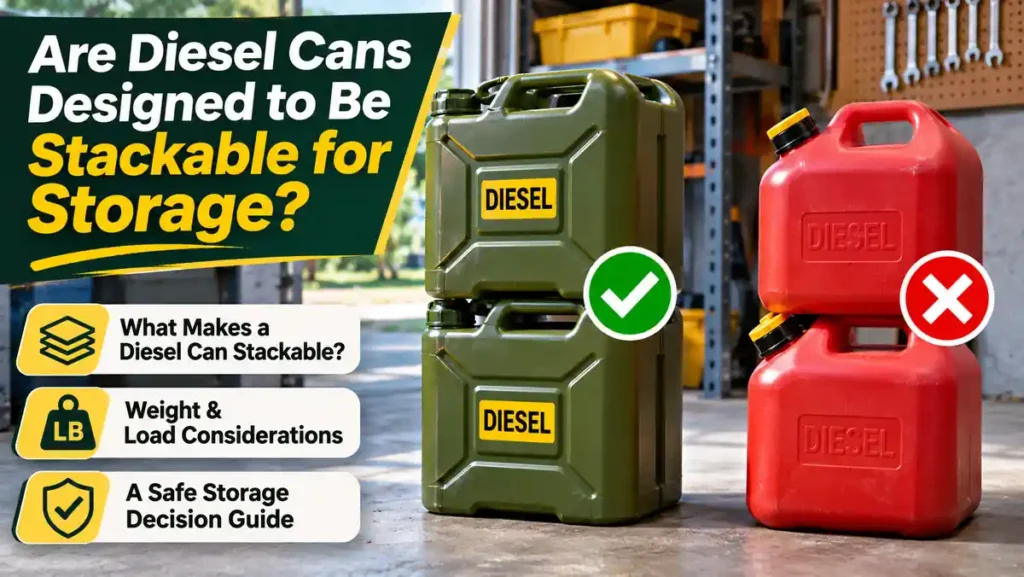
Some diesel cans are designed to be stackable, but many ordinary fuel cans are not. Purpose-built stackable models may have reinforced walls, recessed caps, and matching interlocking surfaces. Never assume that a rectangular shape, a flat lid, or a UN transport mark makes a filled can safe to stack. Check the exact manufacturer’s instructions for stacking when filled , the maximum number of layers, and any required rack or mount. If you cannot verify those details, store each diesel can upright, individually supported, and secured against tipping .
When diesel cans crowd a garage or equipment shed, I understand the temptation to stack them. But the real question isn’t Will one can balance on another? It’s Was the lower can designed to carry that weight over time?
I’ll show you what to check, how much full cans weigh, and when a rack is the better option. A four-can example makes the space savings—and trade-offs—easy to see.
Are All Diesel Fuel Cans Stackable?
No. Diesel cans vary widely in how they are made and intended to be used. Some are designed for frequent carrying and pouring, while others are industrial jerricans engineered for compact storage or transport. The fact that both hold diesel does not mean they handle vertical loads the same way.
A lightweight five-gallon consumer can, for example, may have a raised handle, a curved shoulder, a protruding spout, and a relatively flexible top. Those features are convenient for pouring, but they can make it a poor support for another full container. A purpose-built stackable jerrican may instead have a broad load-bearing surface, a recessed closure, and mating features that help prevent the upper can from sliding.
Even then, stackable does not necessarily mean stackable while filled . A product may be intended for empty-container storage, shipment in a particular package, or use with a proprietary mounting plate. That’s why I treat marketing photos as a starting point, never as permission.
Which Types of Diesel Containers Are Most Likely to Stack?
| Diesel container type | Typical design | My stacking decision |
|---|---|---|
| Basic plastic consumer fuel can | Curved top, projecting handle or nozzle | Do not stack unless its manufacturer explicitly permits it |
| Purpose-built stackable HDPE jerrican | Flat/recessed contact areas and reinforced body | Potentially suitable , subject to fuel compatibility and documented loaded-stack limits |
| Traditional metal jerry can | Rectangular steel body with recessed side panels | Model-dependent ; shape alone is not proof |
| Metal safety can | Self-closing fittings, pressure-relief features and a pouring handle | Usually store separately ; do not place weight on fittings |
| Mountable overland fuel can | Dedicated mounting points, plates or brackets | Only in the approved mount configuration , within its load limit |
| Larger diesel transfer tank | Tank structure, fill and vent connections, sometimes an integral pump | Never assume it stacks ; use only equipment expressly rated for that use |
The table is a screening guide rather than a certification list. Two containers of the same size can have very different stacking instructions. I would rather see a clear manual saying “two high when full” than a vague product description saying “space saving.”
If you use a larger transfer tank instead of small cans, there’s another important question: Do Diesel Transfer Tanks Need to Be Vented? . Venting and structural stacking are separate safety issues, and neither one replaces the other.
What Makes a Diesel Can Stackable?
I look for six features, but I still require confirmation from the manufacturer. None of these features alone proves that a can is safe to stack.
- A supported top and bottom. The upper container’s weight should pass through intended structural contact areas, not through a cap, nozzle or thin center panel.
- Matching shapes. Recesses, ribs or molded locating features can help prevent lateral movement when the cans are arranged exactly as intended.
- Strength appropriate to a full container. The lower walls and corners must resist deformation under prolonged weight. Plastic can slowly change shape under a constant load, especially in heat.
- Protected closures. Caps, vents, child-resistant fittings and dispensing spouts should not become the bearing points.
- A documented stacking limit. I want the actual number of layers or supported load, plus whether the instruction applies to empty or filled cans.
- An approved storage environment. The manufacturer may specify a level floor, pallet, rack, bracket, temperature range or securement method.
A common mistake is to see a molded groove that seems to fit another container and assume it must be an interlock. It might just be part of the handle or molding process. If the manufacturer does not identify it as a stacking feature, I don’t use it as one.
Does a UN-Rated Diesel Can Mean It Can Be Stacked?
Not automatically. Certain UN performance-tested packaging designs undergo a stacking test as part of their transportation qualification. In the United States, the applicable design-test rules include 49 CFR 178.606 , which addresses pressure applied to packaging during a specified test. Some plastic jerricans intended for liquids must endure a longer elevated-temperature stacking test.
That’s meaningful information about a tested packaging design, but it is not a universal instruction to build a tall stack in your garage . Testing assumes a defined package, contents, closure, load and procedure. Your mixed assortment of aging containers on an uneven floor might not match those conditions. A UN mark also does not tell you that a particular diesel formulation is compatible with that container, that the container is still undamaged, or how its manufacturer wants you to store it.
My practical rule is simple: UN-rated is a qualification clue; the specific product instructions are the stacking permission. If the manual is missing, ask the manufacturer rather than interpreting a code stamped into the plastic.
Can You Stack Full Diesel Cans or Only Empty Ones?
This is the question I consider most important. An empty plastic container may weigh only a few pounds. The same can filled with five gallons of diesel holds roughly 35.5 pounds of fuel alone , using an illustrative diesel density of 7.1 pounds per US gallon. Add the weight of the can, and the bottom container carries a substantial load.
I separate three situations:
- Empty, clean cans: These may be easier to organize, but residual fuel and vapors still need safe handling. Never modify or crush a fuel can to make it nest.
- Partly filled cans: These are not automatically safer to stack. Liquid movement, uneven weight and temperature changes can complicate handling.
- Filled cans: These need an explicit filled-stack rating and a stable, approved support system. I would not guess a load limit from thickness or appearance.
Also, I never treat a “maximum two cans” statement as permission to stack different brands or sizes. If the instructions require identical matched containers, that’s the configuration you need to follow.


How Much Weight Does a Stack of Diesel Cans Create?
Diesel fuel is heavy enough that an innocent-looking stack can become difficult to manage. To make the numbers easy to compare, the following table uses 7.1 lb per US gallon as an example , excludes the empty container’s weight, and assumes the stated quantity of fuel is actually in each can.
| Diesel volume in one can | Approx. fuel weight | Two cans’ combined fuel weight | What I would consider |
|---|---|---|---|
| 1 gallon | 7.1 lb | 14.2 lb | Small load, but the shape and closure still matter |
| 2.5 gallons | 17.8 lb | 35.5 lb | Check carrying, shelf and stacking instructions |
| 5 gallons | 35.5 lb | 71.0 lb | Full cans can quickly overload an unapproved stack |
| 10 gallons | 71.0 lb | 142.0 lb | Consider a dedicated low-level storage solution |
Those numbers do not establish safe loads. They only show the mass you’re asking the storage arrangement to support. The lower container in a two-high stack must carry the upper filled can plus its own weight , while the floor or rack must support both.
For example, if each filled five-gallon can weighs approximately 40 pounds including the container, the bottom can in a two-high stack supports approximately 40 pounds from above . In a hypothetical four-high stack, the bottom would carry around 120 pounds above it . That is not a recommendation to stack four high; it is a reason not to improvise.
Worked Example: Storing Four Five-Gallon Diesel Cans
Suppose you have four identical five-gallon cans and a limited storage area. For planning purposes, assume each can has a 14-by-10-inch footprint , contains five gallons of diesel, and weighs 4.5 pounds empty . These measurements are illustrative, not a product specification.
Step 1: Calculate the weight. Five gallons times 7.1 pounds equals 35.5 pounds of diesel. Add 4.5 pounds for the container and you get approximately 40 pounds per filled can . Four full cans weigh about 160 pounds combined .
Step 2: Compare floor footprints. Four separate cans need roughly 4 × 14 × 10 = 560 square inches , or 3.89 square feet , before allowing room for access and separation. If the manufacturer permits two identical full cans per stack, two stacks would use a theoretical 280 square inches, or 1.94 square feet .
Step 3: Look at the trade-off. A two-high arrangement could reduce the nominal container footprint by 50% , but the bottom cans must carry the top cans. You also need enough height, stable contact, spill protection and access to inspect every container.
Step 4: Make the actual decision. If the product instructions clearly allow two-high filled stacking under your conditions, I would follow those instructions exactly. If they don’t, I would use a properly rated fuel-storage rack or arrange all four on a low level rather than gambling on the floor-space savings.
This is why I calculate weight first and floor space second . A compact setup is only an improvement when it remains safe and easy to inspect.
Is It Better to Stack Diesel Cans on a Rack or Directly on the Floor?
For many small storage areas, a well-designed rack is the more practical option. A rack can give each can a separate horizontal surface so that one can does not press directly on another. But the shelves, anchors and flooring still need to be rated for the combined weight, and the storage arrangement must comply with applicable fire rules.
I favor low, accessible storage over tall shelving. A full five-gallon can may weigh around 40 pounds, which is awkward to lift from above shoulder height. An overhead fuel spill is a much bigger problem than a slightly crowded floor.
Here is a small convenience cost I think people overlook: if you remove and replace an upper 40-pound can twice a week to reach fuel below, that is 4 heavy-can movements each week, or 208 over a year . A single-level rack may save less floor space but eliminate that extra handling.
If you store cans on the floor, choose a stable, level area protected from impact. Keep containers upright, clearly labeled and away from traffic lanes, heaters, electrical ignition sources and drains. Where appropriate, use a compatible secondary-containment tray. If you use shelves, check the shelf’s per-level rating , total rack capacity, anchoring and any requirements for spill containment or a flammable-liquid storage cabinet.
A rack is not permission to exceed the limits that apply to fuel quantities or indoor storage. Those limits can differ between a private property and a workplace, and local fire codes matter.
The Safe Diesel Can Stacking Checklist
Before stacking even two cans, I would work through this list in order:
- Confirm that both containers are intended for diesel and are the exact compatible models named by the manufacturer.
- Find the written instruction that permits stacking while filled , if the cans are filled.
- Verify the maximum layers, load, storage temperature and any required rack, mount or pallet.
- Inspect the body, handles, seams, cap, seal, spout and base for deformation, damage or leaks.
- Use a stable, level, appropriately rated support in an approved fuel-storage location.
- Keep the stack upright, protected from tipping or impact, and accessible for inspection.
- Confirm that the upper container does not press on the lower can’s cap, spout, vent or pump.
- Store away from ignition sources, direct heat and unauthorized access; follow the local fire code.
- Label each can with its fuel type and filling date, and maintain a sensible fuel-rotation schedule.
- Stop using the stacked arrangement if anything shifts, bows, leaks or becomes difficult to handle.
If I cannot confidently check every applicable item, I don’t stack the cans. There is no need to prove the design is weak by waiting for it to fail.
Decision Guide: Stack, Use a Rack, or Store Side by Side?
| Your situation | Best next step | Why |
|---|---|---|
| Manufacturer documents two-high filled stacking for your exact cans | Stack only in that approved configuration | You have specific instructions to follow |
| “Stackable” appears only in a sales photo or brief listing | Request the manual; meanwhile store separately | The actual rated conditions are unknown |
| Can has a protruding nozzle, pump or cap | Keep each can separately supported | Fittings should not carry another can |
| You use the fuel every day | Choose low individual positions or a rated rack | Faster access with less repeated lifting |
| You have mixed brands or sizes | Keep them in separate upright positions | Contact surfaces and ratings may not match |
| Storage surface is sloped, unstable or exposed to impacts | Correct the site before storing fuel | Even approved cans need a safe foundation |
| You need substantially more fuel than a few portable cans | Review an appropriately designed tank system | Multiple small cans may no longer be efficient |
This is the decision rule I keep coming back to: stack only when the container, the load and the location are all approved for the same arrangement . If one of those three is uncertain, a different storage layout is a better solution.
Frequently Asked Questions
How many diesel cans can I stack?
There is no universal number. The limit depends on the exact can, whether it is full, its mounting system and the manufacturer’s instructions. If those instructions do not explicitly permit a loaded stack, I would keep the cans separately supported.
Can I stack five-gallon diesel cans two high?
Only when the manufacturer specifically approves two-high stacking of filled cans under your storage conditions. Five gallons of diesel alone weighs about 35.5 pounds in our example, so the bottom can’s load is not trivial.
Can I stack empty diesel cans?
Some models permit it, but empty does not automatically mean safe. Residual vapors, unsuitable closures, incompatible shapes and unstable surfaces still matter. Follow the manufacturer’s guidance for empty-container storage and handling.
Is a UN-certified jerrican automatically stackable in my shed?
No. UN packaging tests address defined transportation-performance conditions. They do not replace the manufacturer’s product-specific storage instructions or local fire requirements.
Can I put diesel cans on wooden shelves?
Don’t rely on the material alone. Confirm that the entire shelf system and storage location are suitable for the fuel, that each shelf supports the real loaded weight, and that spill control, stability and local fire requirements are met. Use approved fuel-storage equipment where required.
Do diesel cans need to be upright during storage?
Unless the manufacturer expressly authorizes a different orientation, I keep portable diesel cans upright with caps secured as directed. Upright storage helps protect closures from sustained fuel contact and makes inspection easier.
Final Thoughts: The Best Stack Is the One You Can Verify
Some diesel cans really are designed to be stacked. Most ordinary fuel cans should not be treated that way without explicit approval. To save space, verify the filled-stack limit, the support surface and how you will access the fuel. Then choose an approved stack, rated rack or separate upright positions.
My preference is not the tallest stack or the tightest packing. It’s a layout where you can find a leak, read the label, remove one can and refill equipment without disturbing the others. For day-to-day use, that’s often more valuable than saving a small patch of floor.
Read next: If you are deciding between manual pouring and easier refueling, see Do Diesel Cans Come With Built-In Fuel Transfer Pumps? . If you are moving from portable cans to a larger system, continue with Do Diesel Transfer Tanks Need to Be Vented? . And if an existing tank looks damaged, see Can You Repair a Cracked Diesel Transfer Tank? .