
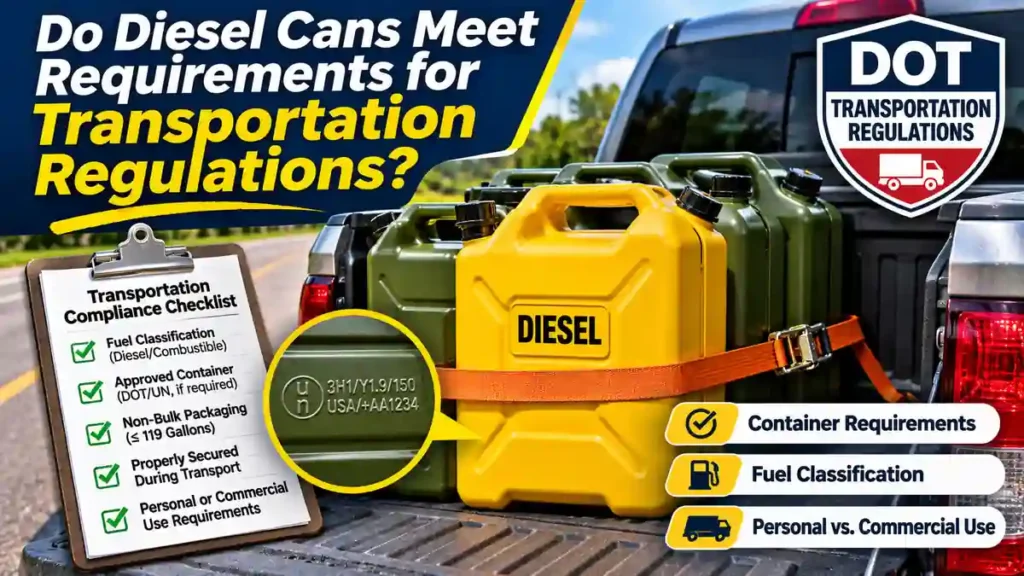
QUICK ANSWER — Are diesel cans DOT compliant? Some diesel cans meet applicable transportation requirements, but not every fuel can is DOT-approved or suitable for every shipment. In the United States, the answer depends on the diesel fuel’s actual hazard classification, the capacity and construction of the container, whether the trip is personal or commercial, and the mode of transportation. Many ordinary non-bulk diesel shipments by domestic highway qualify for an exception under 49 CFR 173.150(f) when the fuel is properly classed as a combustible liquid and is not a hazardous substance, hazardous waste, or marine pollutant. That exception is not permission to use a leaking, damaged, or unsecured can. If the exception does not apply, specific hazardous-material packaging and shipping requirements may apply. My recommendation: check the fuel’s safety data sheet, the can’s manufacturer instructions, and the actual shipping circumstances before making a trip.
You’ve probably seen the phrase “DOT approved” on a diesel can and wondered whether that is all you need to travel legally with fuel in your truck. I think that question deserves a more useful answer than a simple yes or no.
This guide focuses on United States federal regulations for diesel transported by road, with important cautions about state rules, workplace requirements, and air or water transport. I’ll also give you a practical checklist, a worked weight example, and a decision guide you can use before buying or loading a container.
Are All Diesel Fuel Cans DOT Approved?
No. A can being sold for diesel does not necessarily mean it is a UN-specification hazardous-material package. Nor does every lawful trip require a UN-rated can.
A portable fuel container might be intended for personal refueling of a mower, tractor, or generator. Another product might be a certified jerrican specifically designed and tested as transport packaging. A third might be a metal safety can intended primarily for use in an industrial facility.
The most helpful first step is to read what the manufacturer actually claims. Does the label say “for diesel,” “UN 3H1,” “UL listed,” or simply “heavy-duty”? Those descriptions answer different questions.
If you’re comparing lids and closures, see my related guide, Are There Any Child Safety Features on Diesel Can Lids?. Child resistance and transportation compliance solve overlapping but different problems.
Why Does Diesel Classification Matter More Than Can Color?
Under U.S. hazardous-material rules, a product’s flash point helps determine whether it is classed as a flammable or combustible liquid. The flash point is the temperature at which the liquid produces enough vapor under specified test conditions to ignite near its surface.
Diesel isn’t one perfectly uniform product. Formulations and flash points differ. I would check the specific fuel’s safety data sheet (SDS), especially Section 9 for flash point and Section 14 for transportation information, rather than assuming every product described as diesel receives identical treatment.
The basic U.S. transportation framework is as follows:
This distinction is governed by 49 CFR 173.120 and 173.150, with additional conditions. It doesn’t authorize someone to choose whichever classification sounds easier.
What Does 49 CFR 173.150(f) Say About Diesel Cans?
This is the exception I would investigate first for a typical small-container diesel shipment by road.
Under 49 CFR 173.150(f)(2), a material properly classed as a combustible liquid in a non-bulk packaging is generally not subject to the federal Hazardous Materials Regulations, provided it is not a hazardous substance, hazardous waste, or marine pollutant.
For liquids, the federal non-bulk definition generally means a packaging with a maximum capacity of 119 U.S. gallons (450 liters) or less. That’s a capacity definition for a single packaging, not a universal permit to carry 119 gallons or a blanket exemption from all other laws.
There are several qualifications I want you to remember:
- The combustible-liquid classification or permitted reclassification must be valid for the actual fuel.
- The qualifying exception applies to particular transportation modes; don’t automatically transfer highway rules to an airplane or vessel.
- The packaging must be genuinely non-bulk under the regulatory definition.
- The material must not fall into the specified hazardous-substance, hazardous-waste, or marine-pollutant exclusions.
- State and local rules, workplace safety rules, carrier policies, and ordinary load securement duties may still matter.
Personal Use Versus Commercial Transportation
I think the easiest way to avoid confusion is to ask why the fuel is being transported and by whom.


A private individual carrying fuel in a personal vehicle for personal use is generally outside the federal Hazardous Materials Regulations’ transportation-in-commerce scope. PHMSA has specifically addressed personal transport in private vehicles in its interpretations and FAQs.
However, a business transporting diesel as part of its operations is a different situation. Federal hazardous-material rules may apply unless a specific exception covers the shipment. This is true even when the vehicle isn’t a large tanker truck.
Do I need a special permit for five gallons of diesel?
Not automatically. For a normal personal-use road trip, federal hazmat shipping requirements generally don’t apply. In business transport, a qualifying combustible-liquid non-bulk exception may also remove the shipment from the HMR. Other circumstances can require additional compliance, and state rules may differ.
I wouldn’t claim that five gallons is a magic nationwide threshold for every trip.
How Do I Recognize a UN-Rated Diesel Jerrican?
A genuine UN specification marking is more informative than a sales listing that merely says “DOT-style.” It includes a packaging code and performance information under 49 CFR 178.503.
For jerricans, you may encounter codes such as 3H1 for certain plastic jerricans and 3A1 for certain steel jerricans. The complete marking tells a much fuller story than the code alone.
Important: This table is an interpretation guide, not an example of an actual certified marking. Actual marks contain several elements in a required sequence.
UN performance levels don’t mean the same thing as fuel grades. A Y rating, for instance, is not a promise that every liquid may be put inside the can. You still have to consider packaging compatibility, the authorized packing instructions, closure requirements, and the tested configuration.
For plastic containers, I pay particular attention to age, brittleness, UV exposure, cap replacement, and the manufacturer’s reuse limits. Damage can make a once-suitable container unsuitable.
How Should I Secure Diesel Cans in a Pickup or Trailer?
Legal classification is only half the job. A container that tips over at a roundabout is a problem regardless of whether its shipment qualifies for a hazmat exception.
Here’s the loading routine I recommend:
- Inspect each can. Look for cracks, dents, swollen walls, failing seals, and signs of leakage. Don’t transport a can that cannot retain its contents safely.
- Confirm every cap and vent is correctly closed. Follow the manufacturer’s instructions; don’t improvise a vent setting for travel.
- Leave appropriate expansion space. Don’t fill to the brim. Use the container’s stated fill limit rather than assuming a universal percentage for diesel.
- Keep cans upright. Set them on a stable, flat surface where closures won’t take the load.
- Restrain them. Use a suitable crate, rack, or approved tie-down arrangement to prevent sliding, tipping, or rolling.
- Protect them from impact and heat. Keep them away from exhaust components, sharp cargo, sparks, and other ignition sources.
- Plan your unloading. Avoid placing cans where you’ll have to climb over loose equipment or drag them over sharp edges.
For commercial motor vehicles subject to federal cargo-securement standards, 49 CFR 393.100 addresses preventing cargo loss, spilling, and dangerous shifting. Other cargo-securement provisions may apply depending on the vehicle and load.
My rule is that a properly closed container should remain upright and stable even during realistic braking or a sharp turn. This is a planning principle, not a substitute for required tie-down ratings or vehicle-specific rules.
Worked Example: Are Four Five-Gallon Diesel Cans Ready for Transport?
Let’s put some numbers behind a common situation.
Imagine you run a small equipment-maintenance business and need to drive four five-gallon diesel cans to a nearby worksite in a pickup. The trip is on a public road, and all four cans contain the same fuel.
I’ll assume a diesel density of 7.1 pounds per U.S. gallon, and an empty-can weight of 4 pounds per can. These are illustrative values rather than universal specifications.
Step 1: Check classification. You obtain the exact fuel’s SDS and confirm that the applicable combustible-liquid classification and transport exception are valid. If you cannot verify that step, don’t simply assume the exception.
Step 2: Check capacity. Each five-gallon can is a non-bulk packaging by size. But that alone does not establish compliance.
Step 3: Check the container. Are the cans intended for diesel, sound, compatible, correctly closed, and suitable for the specific use? If the shipment is excepted from the HMR, a UN mark may not be required by those federal hazmat rules, but that doesn’t excuse poor containers.
Step 4: Secure the load. You now have roughly 158 pounds of cans and diesel before considering the crate, rack, or other gear. Verify the vehicle’s payload limit and use adequate restraint. The nominal 158 pounds is not a tie-down strength specification.
Step 5: Consider other requirements. Because this is a business trip, check any relevant state, workplace, and vehicle requirements, even if the federal combustible-liquid exception applies.
This is why I treat the rule check and the practical transport check as separate tasks. Both must pass before a load is ready to travel.
Decision Guide: Does Your Diesel Can Need DOT Specification Packaging?
I use this simple sequence to decide what to verify next. It isn’t a legal determination, but it helps identify the questions that matter.
What about the “materials of trade” exception?
You may also come across 49 CFR 173.6, which establishes a separate materials-of-trade exception for certain qualifying hazardous materials carried on motor vehicles for specified business purposes.
It has its own conditions. Depending on classification, limits can include 8 gallons or 66 pounds per package for specified Packing Group II or III materials and a 440-pound aggregate gross weight limit for covered materials of trade, along with packaging, marking, and driver-information requirements.
I would not use those figures as a general diesel-can rule. When 173.150(f) fully excepts a qualifying non-bulk combustible-liquid shipment, that analysis is different. When it does not, a qualified shipper can determine whether the materials-of-trade exception is available.
Does a Diesel Can Need Warning Labels, Shipping Papers, or Placards?
Not every diesel-can trip requires all three. Requirements depend on whether the shipment is regulated under the HMR and which exceptions or specific provisions apply.
If a shipment is fully excepted under 49 CFR 173.150(f)(2), federal HMR shipping-paper, hazmat-label, and placarding requirements generally do not apply to that shipment. It is still sensible to label the can plainly as DIESEL to avoid using the wrong fuel.
If the shipment is regulated, the shipper must assess the relevant marking, labeling, documentation, and placarding provisions. Don’t copy the markings from another fuel or assume a safety color substitutes for shipping identification.
Are Diesel Transfer Tanks Regulated the Same Way as Portable Cans?
Not necessarily. Transfer tanks may have pumps, hoses, mounting hardware, or interconnecting lines that change the practical and regulatory analysis. A non-bulk tank with qualifying combustible diesel might use the same exception; larger or connected tanks can be treated differently.
Read Do Diesel Transfer Tanks Need to Be Vented? before selecting a tank, and Can You Repair a Cracked Diesel Transfer Tank? if a container is damaged. I wouldn’t transport a leaking or structurally compromised tank.
Frequently Asked Questions
Are regular plastic diesel cans legal to transport?
They may be appropriate for many personal-use road trips and some qualifying excepted commercial road shipments. A regular plastic can is not automatically approved for every regulated hazmat shipment. Check the container and your circumstances.
Does a five-gallon diesel can have to be UN rated?
Not in every case. Federal hazmat packaging specifications generally don’t apply to personal transport in private vehicles, and they may not apply to qualifying non-bulk combustible-liquid shipments covered by 49 CFR 173.150(f)(2). Regulated shipments outside those exceptions may require authorized packaging.
How many gallons of diesel can I legally carry in a pickup?
There isn’t one nationwide number that answers every situation. The answer depends on personal versus commercial use, packaging, fuel classification, vehicle limits, and state or local rules. The 119-gallon figure defines non-bulk liquid packaging under the federal hazmat rules; it isn’t a universal pickup-truck limit.
Can I ship a filled diesel can by air?
Do not assume so. Air shipments are subject to different dangerous-goods restrictions, and many ordinary consumer fuel cans are not suitable for air carriage. You need a qualified shipper and carrier approval where relevant.
Final Thoughts: Check the Shipment, Not Just the Can
When someone asks me whether diesel cans meet transportation regulations, my answer is some do, but compliance is more than a container label. For personal transport, federal hazmat shipping rules generally aren’t the controlling issue. For business transport, I first verify the diesel’s classification and whether the non-bulk combustible-liquid exception applies. For a fully regulated shipment, I confirm the authorized packaging and shipping conditions.
Remember my four-part check: fuel, container, vehicle, and journey. If one is uncertain, the transport plan isn’t complete.
Once you know the can is appropriate, consider Do Diesel Cans Come With Built-In Fuel Transfer Pumps? or, for larger equipment, Do Diesel Transfer Tanks Need to Be Vented?.

Pingback: Choosing Between Manual and Automatic Diesel Transfer: Which Works Best?
Pingback: Diesel Transfer Pump Options and Selection: Complete Buying Guide -
Pingback: Is the Funnel on a Diesel Can Removable? Spout Types & Safe Removal -