
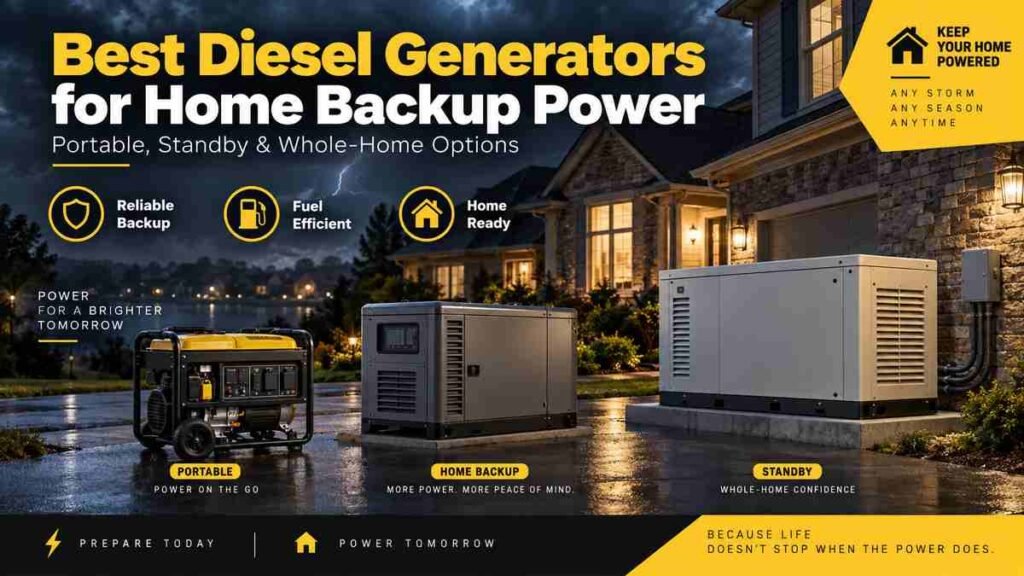
If you want the best diesel generator for home backup power, I would start by deciding whether you need an automatic whole-house standby system or a smaller portable unit for essential circuits. For most homes that truly need diesel, I think the sweet spot is usually somewhere between a compact 6–7 kW portable generator and a 15–20 kW automatic standby generator. Larger homes with multiple HVAC systems, well pumps, electric water heating, workshops, or other heavy loads may need 30 kW or more.
In this guide, I’m not pretending that one generator is perfect for every house. I’m comparing current diesel models by output, fuel use, noise, installation style, automation, serviceability, and the type of homeowner each one makes sense for. I’m also using manufacturer-published specifications rather than guessing from marketplace listings.
If you have not sized your home yet, I recommend reading my diesel generator sizing guide first. Choosing the right size matters just as much as choosing the brand.
Best Diesel Generators for Home Backup Power: My Shortlist
| Generator | Rated Output | Best For | Type | My Take |
|---|---|---|---|---|
| Generac Protector RD020 | 20 kW standby | Most whole-house diesel installations | Automatic standby | Best overall balance of output, automation, tank options, and residential support |
| Generac Protector RD015 | 15 kW standby | Smaller homes and managed loads | Automatic standby | A practical choice when 20 kW is more capacity than you need |
| Cummins C20D6 | 20 kW standby | Homeowners who want a Cummins diesel platform | Standby / light commercial | Strong alternative with residential/light-commercial positioning |
| Cummins C30D6 | 30 kW standby | Large homes and heavier electrical loads | Standby / light commercial | More headroom for multiple large loads |
| Multiquip DA7000SSA3 | 6 kW prime / 7 kW standby | Essential-circuit backup | Portable / towable-capable | Compact, sound-attenuated diesel option with Kubota power |
| Yanmar eG55N | 5.2 kVA continuous at 60 Hz | Simple portable home backup | Portable | Compact choice for selected appliances and circuits |
I would not choose from that table by looking at kW alone. The generator has to match your transfer method, voltage, starting loads, local installation rules, noise tolerance, fuel-storage plan, and how much automation you want during an outage.
1. Generac Protector RD020 — Best Overall Diesel Generator for Whole-House Backup
If I were planning a dedicated diesel standby system for a typical larger home, the Generac Protector RD020 would be one of the first models I would price. It is a purpose-built automatic standby generator rather than a construction generator that happens to be connected to a house.
The current RD020 is rated at 20 kW for standby service. Generac offers it in configurations intended for residential and light-commercial use, with an Evolution controller, automatic operation, Mobile Link connectivity, Quiet-Test exercise operation, and code-oriented fuel-tank options.
What I like about the RD020 is that the overall package is designed around permanent installation. You are not improvising a portable generator connection every time the utility fails. When it is paired with the correct automatic transfer switch and installed properly, the system can detect an outage, start, transfer the selected load, and return to utility power without you dragging cables around in bad weather.
| Generac Protector RD020 Technical Detail | Published Specification |
|---|---|
| Standby output | 20 kW |
| Typical residential voltage | 120/240 V single phase |
| Standby current at 120/240 V | 83 A |
| Engine speed | 1,800 rpm |
| Engine | 2.5 L inline 4-cylinder diesel |
| Voltage regulation | ±1% |
| Sound at normal load | About 70 dB(A) at 23 ft, manufacturer published |
| Standard usable tank option | 32 gal |
| Extended usable tank option | 95 gal |
| Approx. half-load runtime, 32-gal option | 31 hours |
| Approx. half-load runtime, 95-gal option | 92.2 hours |
| Warranty | 5-year limited warranty |
The biggest reason I would choose this model is convenience. If you want diesel but still want the experience people expect from a modern whole-house standby generator, the Protector line makes sense.
Where the RD020 fits best
I think this size is especially useful for a home where you want to keep refrigeration, lighting, internet, a well pump, furnace or boiler equipment, sump pumps, selected kitchen circuits, and some air conditioning available during an outage. Whether it can run every load simultaneously depends on your actual electrical demand and starting currents.
The mistake I would avoid is assuming that “20 kW” automatically means “every appliance in every house.” A large central air conditioner, electric resistance heat, electric water heater, range, dryer, well pump, and shop equipment can stack up quickly. I would always have the load calculation done before buying.
2. Generac Protector RD015 — Best Diesel Standby Generator for Smaller Homes
If your load calculation comes in below the 20 kW class, I would rather buy a properly sized 15 kW generator than pay for capacity I rarely use. The Generac Protector RD015 uses the same general residential standby concept in a smaller output class.
This is the model I would look at for a smaller home, a well-managed essential-load panel, or a property where the heaviest loads can be shed during an outage. It still gives you automatic standby capability without jumping straight to a larger machine.
| Generac Protector RD015 Technical Detail | Published Specification |
|---|---|
| Standby output | 15 kW |
| Typical residential voltage | 120/240 V single phase |
| Standby current at 120/240 V | 62 A |
| Engine speed | 1,800 rpm |
| Engine family | 2.5 L inline 4-cylinder diesel |
| Usable tank option | 32 gal |
| Extended usable tank option | 95 gal |
| Approx. half-load runtime, 32-gal option | 39 hours |
| Approx. half-load runtime, 95-gal option | 115.8 hours |
| Published starting MSRP | $13,709 for the referenced current configuration |
That longer half-load runtime compared with the 20 kW model is a good reminder that generator size affects fuel planning. A smaller generator carrying an appropriate load can make better use of stored fuel than an oversized unit that spends most of its life lightly loaded.
I would not downsize too aggressively, though. Motors and compressors need starting current. If the unit repeatedly struggles when the well pump or air conditioner starts, the cheaper generator was not really cheaper.
3. Cummins C20D6 — Best 20 kW Alternative to Generac
If you prefer Cummins equipment, already have a strong Cummins dealer nearby, or want another serious diesel option in the same general power class, I would put the C20D6 on the quote list.
Cummins identifies the C20D6 as a residential and light-commercial generator. Its published rating is 20 kW standby and 18.2 kW prime at 60 Hz, with a V2203M diesel engine. Sound-attenuated and weather-protective enclosure options are available.
| Cummins C20D6 Technical Detail | Published Specification |
|---|---|
| Standby output | 20 kW / 25 kVA |
| Prime output | 18.2 kW / 22.8 kVA |
| Frequency | 60 Hz |
| Fuel | Diesel |
| Engine model | V2203M |
| Product positioning | Residential and light commercial |
| Enclosure availability | Sound-attenuated and weather-protective |
For me, the decision between the Generac RD020 and Cummins C20D6 would not come down to the badge alone. I would compare the installed quote, transfer-switch package, local dealer response time, parts availability, maintenance agreement, enclosure and tank configuration, and the exact electrical setup your home needs.
A generator is a long-term system. The quality of the installer and the service network around the unit can matter more than a small difference in a brochure specification.
4. Cummins C30D6 — Best for a Large Home With Heavy Loads
If your home has heavier electrical demand, I would move beyond the 20 kW class rather than trying to make a smaller unit do too much. The Cummins C30D6 is rated at 30 kW standby and 27 kW prime, and Cummins lists it for residential and light-commercial applications.
This is the kind of generator I would consider for a large custom home, a rural property with pumps and outbuildings, or a house with several large motor loads. I would still perform a proper load study, because bigger is not automatically better. A diesel generator that is dramatically oversized can spend too much time at low load, which is not how I want a diesel engine to operate.
| Cummins C30D6 Technical Detail | Published Specification |
|---|---|
| Standby output | 30 kW / 37.5 kVA |
| Prime output | 27 kW / 33.8 kVA |
| Frequency | 60 Hz |
| Engine | Cummins 4BT3.3-G5 diesel |
| Engine configuration | 4-cylinder |
| Typical generator speed | 1,800 rpm |
| Product positioning | Residential and light commercial |
I would choose a generator in this class only after confirming that the load justifies it. If your real outage load is much lower, load management can sometimes let you use a smaller generator more efficiently.
5. Multiquip DA7000SSA3 — Best Compact Quiet Diesel for Essential Loads
Not every homeowner needs a permanently installed whole-house system. If your goal is to keep a refrigerator, freezer, lights, electronics, a few receptacles, and selected mechanical equipment running, a smaller diesel generator can be a better fit.
The Multiquip DA7000SSA3 is interesting because it is a compact, sound-attenuated diesel generator using a Kubota engine. Multiquip publishes a 6 kW prime rating and 7 kW standby rating, with 120/240 V single-phase output.
I see this more as a serious portable or semi-portable power source than a typical plug-and-play homeowner generator. It weighs far more than a consumer gasoline unit, so “portable” here means movable with the right wheel kit, trailer, or equipment rather than something I would expect one person to lift.
| Multiquip DA7000SSA3 Technical Detail | Published Specification |
|---|---|
| Prime output | 6 kW |
| Standby output | 7 kW |
| Voltage | 120/240 V single phase |
| Engine | Kubota Z482 diesel |
| Generator speed | 3,600 rpm |
| Sound level | 65 dB(A) at 23 ft at full load |
| Fuel tank | 6.6 gal |
| Fuel consumption at full load | 0.69 gal/hr |
| Fuel consumption at half load | 0.48 gal/hr |
| Dry weight | 534 lb |
The appeal for me is that it is a real diesel generator from a commercial equipment manufacturer, not an unknown marketplace unit with unclear parts support. The downside is that you still need a safe, code-compliant way to connect it to the house. I would use a proper transfer switch or approved interlock arrangement installed by a qualified electrician, not a backfeed cable.
6. Yanmar eG55N — Best Small Diesel Generator for Basic Home Backup
If your outage plan is intentionally modest, I also like the idea of a smaller Yanmar diesel generator. The eG55N is a compact single-phase unit with a 60 Hz continuous output of 5.2 kVA and a maximum output of 5.8 kVA.
This size is not intended to imitate a whole-house 20 kW standby system. I would use it for a carefully selected set of loads where fuel economy, compactness, and diesel operation matter more than running every appliance at once.
| Yanmar eG55N Technical Detail | Published 60 Hz Specification |
|---|---|
| Continuous output | 5.2 kVA |
| Maximum output | 5.8 kVA |
| Voltage options | 220 V or 110/220 V, depending on configuration |
| Engine | Yanmar L100N6 air-cooled diesel |
| Engine displacement | 0.435 L |
| Fuel tank | 14.5 L |
| Fuel consumption at 75% load | 1.63 L/hr |
| Dry weight | 171 kg |
| Noise at 7 m, full load | 73 dB(A) |
I would consider this class for essential appliances, a small rural home, a cabin, or a property where you already understand exactly which circuits will be powered. If you need central air conditioning or several large electric appliances at the same time, I would move up in size.
Which Diesel Generator Size Is Best for Home Backup?
I would choose the size from your actual load, not from the square footage of the house. Two homes of the same size can have very different electrical demand. One may use gas heat, gas water heating, and a small air conditioner. Another may have multiple heat pumps, electric cooking, a well, a pool pump, and a workshop.
| Generator Class | Typical Home Backup Role | What I Would Expect It to Handle |
|---|---|---|
| 5–7 kW | Essential loads only | Refrigeration, lights, electronics, selected outlets, small pumps, limited appliances |
| 10–15 kW | Managed home backup | Most essential circuits plus selected larger loads, depending on starting surge |
| 15–20 kW | Common whole-house range | Many homes with load management and appropriately sized HVAC |
| 20–30 kW | Large-home backup | Heavier HVAC, pumps, multiple appliances, larger service demands |
| 30 kW and above | Large/custom properties | High-demand homes, workshops, multiple buildings, or unusually heavy electrical loads |
If you want a step-by-step calculation, use my guide on what size diesel generator you actually need. That article explains running watts, starting watts, motor surge, kW versus kVA, phase, and safety margin.
Automatic Standby vs. Portable Diesel Generator
This is one of the biggest decisions I would make before comparing brands. A permanent standby generator and a portable diesel generator solve the same basic problem, but they do it very differently.
| Feature | Automatic Standby Diesel | Portable / Mobile Diesel |
|---|---|---|
| Starts during outage automatically | Yes, with proper controls and transfer switch | Usually no unless specifically configured |
| Connection to home | Permanent installation | Transfer inlet / switch or other approved connection |
| Fuel capacity | Often larger integrated or external tank | Usually smaller onboard tank |
| Best use | Whole-house convenience and unattended backup | Essential loads and flexible use |
| Installation cost | Higher | Lower, although safe electrical connection is still required |
| Mobility | Fixed | Movable, depending on weight and trailer/wheel setup |
If outages happen while you are away from home, automatic standby has a major advantage. It can protect refrigeration, sump pumps, heating systems, medical equipment, and other critical loads without waiting for someone to arrive and start a portable unit.
If outages are rare and you are comfortable managing a smaller group of circuits, I can understand choosing a portable diesel generator instead. The savings can be substantial, and you are not maintaining a large permanent system year-round.
Fuel Consumption: What the Numbers Mean in a Real Outage
Diesel generators are often chosen because diesel fuel is energy-dense, widely used in commercial backup systems, and easy to store in approved tanks. But I would still calculate how much fuel the generator can consume before I buy it.
Manufacturer fuel-consumption data also shows why oversizing has consequences. A bigger generator usually burns more fuel even when you are not using its full electrical capacity.
| Model | Published Load Point | Approx. Fuel Consumption |
|---|---|---|
| Generac RD015 | 50% load | 0.85 gal/hr |
| Generac RD015 | 100% load | 1.46 gal/hr |
| Generac RD020 | 50% load | 1.03 gal/hr |
| Generac RD020 | 100% load | 1.97 gal/hr |
| Generac RD030 | 50% load | 1.37 gal/hr |
| Generac RD030 | 100% load | 2.77 gal/hr |
| Multiquip DA7000SSA3 | 50% load | 0.48 gal/hr |
| Multiquip DA7000SSA3 | 100% load | 0.69 gal/hr |
| Yanmar eG55N | 75% load | 1.63 L/hr |
I would use those numbers as planning data, not as a promise of exact real-world consumption. Temperature, altitude, electrical load, generator condition, fuel quality, and operating pattern can change actual usage.
If you store diesel for emergency power, fuel condition matters. Water, microbial growth, oxidation, and contamination can create problems long before the engine needs to run. I have separate guides on diesel fuel storage and additives and water in diesel fuel that are useful for generator owners.
Why I Would Choose Diesel for Some Homes — but Not Every Home
Diesel makes the most sense to me when fuel reliability, long-duration backup, durability, or an existing diesel fuel supply matters. Rural properties, farms, large homes, workshops, and locations already using diesel equipment can be especially good candidates.
But diesel is not automatically the best fuel for every suburban home. Natural gas can be extremely convenient where a reliable utility gas supply exists. Propane stores well and can be attractive for homeowners who already have a large tank. Diesel requires fuel management, tank space, maintenance, and attention to cold-weather conditions.
| Factor | Diesel Backup Generator | What I Would Consider |
|---|---|---|
| Fuel storage | Stored onsite | You control your reserve, but you must maintain fuel quality |
| Long-duration outages | Strong option with adequate tank capacity | Plan refueling access before a storm or disaster |
| Engine durability | Diesel designs are common in demanding standby use | Maintenance schedule still matters |
| Noise | Varies widely by enclosure and speed | Compare published dB data at the same distance |
| Installation | Fuel tank, exhaust, electrical and code requirements | Expect professional design for permanent systems |
| Initial cost | Often higher than smaller consumer generators | Compare total installed cost, not generator price alone |
What I Look for Before Calling a Diesel Generator “Best”
I do not like generator lists that rank products only by advertised wattage. For home backup, I would evaluate the entire system.
1. Correct output for your real loads
The generator has to carry the running load and survive the starting surge of motors and compressors. Air conditioners, well pumps, refrigerators, freezers, sump pumps, and shop tools can draw significantly more power at startup than during normal operation.
2. 120/240 V single-phase compatibility
Most U.S. homes use 120/240 V single-phase service. I would confirm the exact generator configuration before ordering because some diesel models are also sold in three-phase configurations for commercial work.
3. Automatic transfer capability
If I am buying a permanent home standby generator, I want the generator, transfer switch, controller, and installation plan designed as a complete system. The transfer equipment is not an afterthought.
4. Local service support
A generator that cannot be serviced locally is a poor emergency asset. I would call nearby dealers before buying and ask who performs warranty work, who stocks normal service parts, and what emergency response looks like during a major outage.
5. Fuel-tank and runtime options
The generator is only useful while fuel is available. I would estimate the outage duration I am preparing for and compare that with tank capacity at realistic load levels.
6. Noise at a stated distance
I only compare noise numbers when the measurement conditions are clear. A sound rating without a distance or load condition tells me very little.
7. Emissions and local installation requirements
Permanent diesel installations can involve local building, fire, electrical, environmental, setback, spill-control, and fuel-storage requirements. I would have the dealer or installer verify the rules for the exact property before equipment is ordered.
How Much Should I Budget?
For permanent diesel standby power, the generator itself is only part of the project cost. The final installed price can include the transfer switch, concrete pad, trenching, electrical work, fuel tank or base tank, delivery, lifting equipment, permits, startup, and sometimes load-management hardware.
| Cost Component | Why It Matters |
|---|---|
| Generator set | Core equipment price varies significantly by output and configuration |
| Automatic transfer switch | Transfers the home between utility and generator power |
| Fuel system | Tank size, fill, venting, piping and spill-control requirements affect cost |
| Electrical installation | Service size, panel layout, conductor length and load management change labor/materials |
| Site preparation | Pad, drainage, clearances, access and protection may be required |
| Permits and inspections | Local requirements vary |
| Maintenance | Oil, filters, coolant, batteries, fuel care and periodic testing are ongoing costs |
If you only need backup for a temporary project or a few weeks, buying may not be the best answer. I have a separate guide explaining diesel generator rental costs for daily, weekly, and longer rental periods.
Diesel Generator Safety at Home
This is not an area where I would take shortcuts. Portable generators produce carbon monoxide, and improper electrical connection can injure utility workers, damage equipment, or start a fire.
The CDC says portable generators should be operated outdoors and more than 20 feet from windows, doors, and vents. It also recommends battery-powered or battery-backup carbon monoxide detectors in the home. I would follow the generator manufacturer’s instructions as well as all local electrical and fire requirements.
For a permanent standby diesel generator, installation is different from simply parking a portable generator outside. Exhaust discharge, combustion air, cooling airflow, tank venting, clearances, wiring, transfer equipment, and fuel-system details all have to be designed correctly.
| Safety Item | My Minimum Approach |
|---|---|
| Portable generator location | Outside, away from openings, following CDC and manufacturer guidance |
| Carbon monoxide detection | Working battery-powered or battery-backup CO detectors |
| Home connection | Approved transfer equipment or properly installed interlock system |
| Backfeeding | Never connect a generator to a house through an improvised male-to-male cord |
| Fuel | Use approved storage, keep contamination out, and follow local fuel-storage rules |
| Maintenance | Exercise and service the generator according to the manufacturer’s schedule |
My Final Picks by Home Type
If you want the simplest way to narrow this down, this is how I would match the generators to common home-backup situations.
| Your Situation | Generator I Would Start Comparing | Reason |
|---|---|---|
| Small home, essential circuits only | Yanmar eG55N or Multiquip DA7000SSA3 | Compact diesel backup without paying for whole-house capacity |
| Smaller home with automatic standby | Generac Protector RD015 | Permanent automatic system in a lower output class |
| Typical whole-house diesel project | Generac Protector RD020 | Strong mix of residential features, output, tank options and automation |
| Want a Cummins 20 kW platform | Cummins C20D6 | Residential/light-commercial diesel alternative |
| Large home with heavier loads | Cummins C30D6 | More standby capacity and load headroom |
I would treat that table as a starting point, not a substitute for sizing. The “best” generator is the one that can start and carry your required loads, can be serviced where you live, has a practical fuel plan, and is installed safely.
Frequently Asked Questions
Is a diesel generator good for home backup?
Yes, especially when you want onsite fuel storage, long-duration backup capability, and a generator platform commonly used in demanding standby applications. I think diesel is particularly attractive for rural homes, large properties, and homeowners who already store or use diesel fuel. It can be less convenient than natural gas or propane for some suburban installations.
What size diesel generator is best for a house?
There is no single best size. I would calculate the running load, add the largest starting surge, and then select a generator with enough capacity and an appropriate safety margin. Many whole-house projects fall into the 15–20 kW class, while essential-load backup can be much smaller and large custom homes can require 30 kW or more.
Is 20 kW enough to power a whole house?
It can be enough for many homes, but not all. The answer depends on HVAC, electric heat, water heating, pumps, cooking equipment, dryers, workshops, and which loads operate at the same time. I would never buy strictly from house size or bedroom count.
Is a diesel generator better than a gasoline generator for home use?
For occasional portable use, gasoline generators are widely available and often cheaper. I would choose diesel when fuel storage strategy, long runtimes, durability, or compatibility with other diesel equipment matters. The right answer depends on how often you expect outages and how much power you need.
Can I connect a portable diesel generator directly to my house?
Yes, but only through properly designed connection equipment. I would use an approved transfer switch, generator inlet, or other code-compliant arrangement installed for the property. I would never backfeed a home through an improvised cord.
How long can a diesel generator run during an outage?
Runtime depends on tank capacity, generator size, electrical load, and the manufacturer’s duty rating. Some permanent standby units can be configured with tanks that provide multiple days of half-load runtime, while compact portable units may need refueling much sooner. I would plan runtime from published fuel-consumption data rather than the marketing claim alone.
Do I need to exercise a standby generator?
Yes. Automatic standby generators normally have an exercise schedule so the engine, battery, controls, and starting system are checked regularly. I would follow the exact manufacturer schedule and keep a maintenance record.
Bottom Line: Which Diesel Generator Would I Buy for Home Backup?
For a permanent whole-house diesel system, I would start with the Generac Protector RD020 because the 20 kW class fits a broad range of home-backup projects and the product is built around automatic standby use. I would compare it directly with the Cummins C20D6, especially if Cummins has stronger dealer support in your area.
For a smaller automatic system, I would look at the Generac RD015. For a large home with legitimately heavy demand, I would move toward the Cummins C30D6 or another properly sized generator in that class rather than overloading a smaller set.
If you only need essential circuits, I would not automatically spend whole-house money. The Multiquip DA7000SSA3 and Yanmar eG55N show what a more compact diesel backup plan can look like.
Most importantly, I would size first and buy second. A generator that is too small may trip, bog down, or fail to start important loads. A generator that is much too large costs more, can use more fuel, and may operate inefficiently at very light load. Start with the loads you actually need during an outage, then choose the generator and installation around that job.
Sources I Used for Current Specifications
- Generac Protector 20 kW product page
- Generac Protector 15 kW product page
- Cummins C20D6 product page
- Cummins C30D6 product page
- Multiquip DA7000SSA3 product page
- Yanmar eG55 series specifications
- CDC carbon monoxide and generator safety guidance
Specifications, model availability, pricing, and configurations can change. I recommend confirming the current spec sheet and installation requirements with the manufacturer or an authorized dealer before purchase.