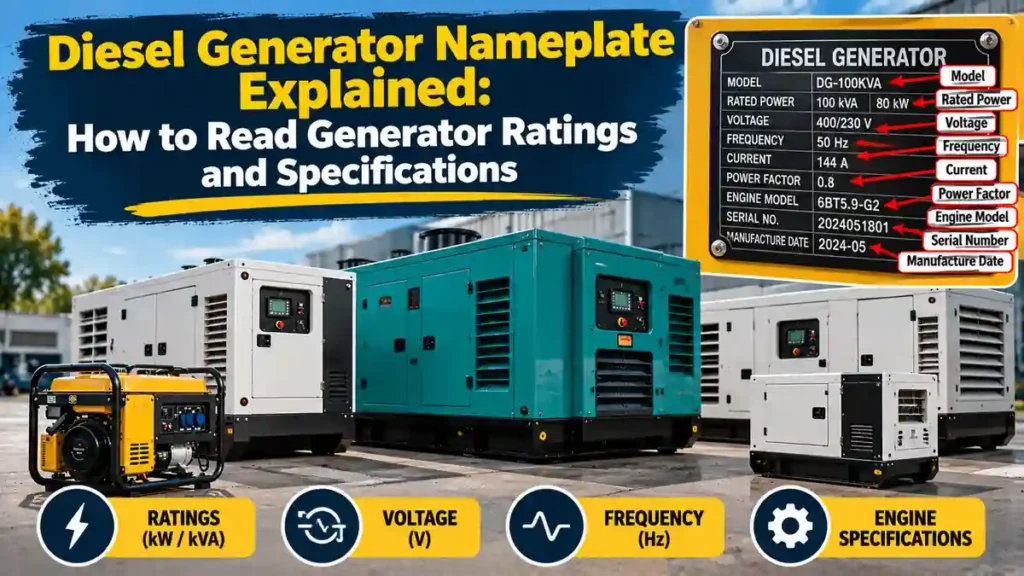


If you have ever looked at a diesel generator nameplate and seen a block of numbers such as 100 kVA, 80 kW, 480 V, 120 A, 0.8 PF, 60 Hz, and 1800 RPM, it can look like a different language. I see this all the time when people are buying a used generator, comparing two models, sizing backup power, or troubleshooting an existing set.
In this guide, I am going to walk you through the diesel generator nameplate line by line. I will explain what the ratings mean, how the figures relate to each other, which numbers matter most for sizing, and what mistakes I would avoid when using a nameplate to make a buying or installation decision.
What Is a Diesel Generator Nameplate?
A generator nameplate is the manufacturer’s identification and rating label. Depending on the machine, you may find one nameplate for the complete generator set and separate plates for the diesel engine and alternator. The complete-set plate is usually the most useful starting point because it combines the electrical rating with model and serial information.
I treat the nameplate as the generator’s electrical identity card. It tells me what the unit was designed to produce when operated under its stated rating conditions. It does not tell me every detail about the machine, but it gives enough information to check whether the generator is suitable for a particular electrical system.
Diesel Generator Nameplate Technical Details
| Nameplate item | Typical example | What it tells you |
|---|---|---|
| Rated output | 80 kW | Real electrical power available to the load |
| Apparent power | 100 kVA | Total volt-ampere capacity of the alternator |
| Power factor | 0.8 | Relationship between kW and kVA at the rated condition |
| Voltage | 480 V | Rated system voltage |
| Current | 120 A | Rated output current at the stated voltage and phase |
| Phase | 3-phase | Single-phase or three-phase configuration |
| Frequency | 60 Hz | Required output frequency |
| Engine speed | 1800 RPM | Typical synchronous speed for a 60 Hz four-pole alternator |
| Duty rating | Standby / Prime | How the generator is intended to be loaded and used |
| Model number | Manufacturer specific | Exact generator configuration |
| Serial number | Unique number | Identifies the individual machine |
| Alternator insulation | Class H | Thermal class of winding insulation |
| Enclosure / protection | Manufacturer specific | Environmental protection information when shown |
| Manufacture date | Month/year | Useful for service history, age, and parts lookup |
Start With kW: The Generator’s Real Power Rating
The kW figure is usually the number most owners care about because kilowatts represent real usable electrical power. If the nameplate says 80 kW, that means the generator is rated to deliver up to 80 kilowatts under the conditions attached to that rating.


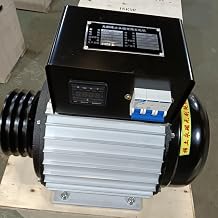
I would not automatically assume that 80 kW means you should plan to run an 80 kW connected load continuously. Starting loads, ambient temperature, altitude, duty rating, nonlinear loads, load steps, and future expansion can all change the practical generator size you need.
If you are still deciding how much capacity you actually need, I would pair the nameplate information with my diesel generator sizing guide. The nameplate tells you what a generator is rated for; a load calculation tells you whether that rating is right for your building or equipment.
What Does kVA Mean on a Diesel Generator Nameplate?
kVA stands for kilovolt-amperes. This is apparent power. Alternators are commonly rated in kVA because the electrical loading of the windings depends on both voltage and current, not just the useful kW consumed by the load.
The basic relationship is:
kW = kVA × power factor
So, if a generator is rated 100 kVA at 0.8 power factor:
100 kVA × 0.8 = 80 kW
| kVA rating | Power factor | Equivalent kW |
|---|---|---|
| 25 kVA | 0.8 | 20 kW |
| 50 kVA | 0.8 | 40 kW |
| 75 kVA | 0.8 | 60 kW |
| 100 kVA | 0.8 | 80 kW |
| 125 kVA | 0.8 | 100 kW |
| 250 kVA | 0.8 | 200 kW |
| 500 kVA | 0.8 | 400 kW |
Do not assume every generator uses 0.8 power factor for every operating condition. Always use the actual nameplate and manufacturer documentation for the unit in front of you.
Power Factor: Why 0.8 Appears So Often
Power factor describes how effectively current is converted into useful real power. A purely resistive load can have a power factor close to 1.0, while motors, transformers, and other inductive equipment can operate at lower power factors.
If a nameplate shows 100 kVA and 80 kW, you can calculate the rated power factor:


Power factor = kW ÷ kVA
80 ÷ 100 = 0.8
This matters because two loads with the same kW can place different current demands on the alternator if their power factors differ.
How to Read the Voltage Rating
The voltage line tells you the nominal output voltage the generator is configured to supply. Common generator voltages vary by region and application. You may see values such as 120/240 V single-phase, 208/120 V three-phase, 400/230 V three-phase, 415/240 V three-phase, 480/277 V three-phase, or other industrial voltages.
I never recommend assuming a generator can simply be connected to any building because its kW rating looks correct. The system voltage, phase, neutral arrangement, transfer equipment, overcurrent protection, and grounding/bonding configuration must all match the installation design.
| Example system | Typical phase | Common use |
|---|---|---|
| 120/240 V | Single-phase | Homes, small shops, light commercial loads |
| 208Y/120 V | Three-phase | Commercial buildings |
| 400/230 V | Three-phase | Commercial and industrial systems in many countries |
| 415/240 V | Three-phase | Industrial and commercial systems |
| 480Y/277 V | Three-phase | Larger commercial and industrial loads |
How to Read Generator Amps on the Nameplate
The current rating tells you how much output current the alternator is designed to carry at the stated voltage and phase. This is one of the best ways to cross-check whether the other nameplate values make sense.
For three-phase power, a common calculation is:
Current (A) = kVA × 1000 ÷ (1.732 × voltage)
For a 100 kVA, 480 V three-phase generator:
100,000 ÷ (1.732 × 480) ≈ 120 A
| Generator rating | Voltage | Phase | Approximate rated current |
|---|---|---|---|
| 25 kVA | 400 V | 3-phase | 36 A |
| 50 kVA | 400 V | 3-phase | 72 A |
| 100 kVA | 400 V | 3-phase | 144 A |
| 100 kVA | 480 V | 3-phase | 120 A |
| 250 kVA | 480 V | 3-phase | 301 A |
| 500 kVA | 480 V | 3-phase | 601 A |
These are calculation examples, not conductor, breaker, or installation recommendations. Actual electrical design must follow the generator documentation and applicable electrical code.
Single-Phase vs. Three-Phase
The phase field tells you whether the generator is built or configured for single-phase or three-phase output. This is not a minor detail. A 50 kW single-phase generator and a 50 kW three-phase generator are not interchangeable in every installation.
Single-phase is common in homes and smaller facilities. Three-phase is common in commercial and industrial applications because it is well suited to larger motors and higher power levels.
If you are looking at a generator for a business, I would also compare the nameplate information with your actual panel and load schedule. My guide on choosing a diesel generator for a business explains why the type of load matters as much as the total wattage.
Frequency: 50 Hz vs. 60 Hz
Frequency is measured in hertz. The generator must match the electrical system it is intended to serve. A nameplate may show 50 Hz or 60 Hz depending on the country and model.
| Frequency | Typical four-pole alternator speed | Common regions/applications |
|---|---|---|
| 50 Hz | 1500 RPM | Many countries outside North America |
| 60 Hz | 1800 RPM | North America and other 60 Hz systems |
Those RPM figures are common examples for four-pole synchronous alternators. Generator designs can differ, so I still check the actual plate.
Why RPM Appears on the Nameplate
The diesel engine must turn the alternator at the correct speed to maintain frequency. For many larger stationary sets, 1500 RPM corresponds to 50 Hz and 1800 RPM corresponds to 60 Hz when using a four-pole alternator.
If engine speed falls under load, frequency can fall too. If a generator bogs when large loads are applied, the problem may involve fuel delivery, overload, governor response, or engine condition. I cover that diagnostic path separately in my diesel generator bogging under load guide.
Standby, Prime, and Continuous Ratings
This is one of the most important parts of a generator nameplate because two units with the same physical engine can have different allowable ratings depending on duty.
| Rating type | General purpose | What I check |
|---|---|---|
| Standby | Emergency backup during utility outages | Permitted annual use, load profile, manufacturer limitations |
| Prime | Variable-load operation where utility power may be unavailable | Average load limits, overload allowance if applicable, annual hours |
| Continuous | Long-duration constant-load service | Continuous output rating and operating restrictions |
I would never assume a standby rating can be treated as a continuous rating. If a generator is marked 100 kW standby and 90 kW prime, those are different operating categories. The manufacturer’s rating sheet is the final authority.
If long runtime is your priority, see my article on how long a diesel generator can run continuously.
Nameplate Rating vs. Actual Usable Load
One mistake I see is reading “100 kW” on the plate and assuming the generator can support any combination of loads adding up to exactly 100 kW. Real systems are not that simple.
You also need to consider:
- Motor starting current
- Compressor inrush
- Elevator or pump starting
- UPS and rectifier loads
- Low power factor
- Phase imbalance
- Load step size
- Altitude
- Ambient temperature
- Future load growth
That is why I separate nameplate reading from generator sizing. If you want to calculate the correct size from actual loads, use my diesel generator sizing calculation guide.
Understanding a 100 kVA / 80 kW Nameplate Example
Suppose I am looking at a nameplate with these values:
| Item | Nameplate value |
|---|---|
| Apparent power | 100 kVA |
| Real power | 80 kW |
| Power factor | 0.8 |
| Voltage | 480 V |
| Phase | 3 |
| Frequency | 60 Hz |
| Speed | 1800 RPM |
| Rated current | About 120 A |
I can quickly confirm several relationships. First, 100 kVA × 0.8 = 80 kW. Second, 100 kVA at 480 V three-phase works out to about 120 A. Third, 60 Hz and 1800 RPM are consistent with a common four-pole configuration.
That does not prove every detail of the generator is correct, but it tells me the major numbers are internally consistent.
What Is the Difference Between Generator Model and Serial Number?
The model number identifies the generator family or configuration. The serial number identifies the exact machine. I always photograph both before ordering parts, requesting a service manual, buying a control module, replacing an AVR, or calling the manufacturer.
On older used generators, the serial number can be especially important because components may have changed during production. Two units with similar model names can use different alternators, controllers, radiators, or engines.
Engine Nameplate vs. Generator Nameplate
The engine plate and generator-set plate are not the same thing. The engine plate may show engine model, displacement, rated engine power, emissions information, serial number, and other engine-specific data. The generator-set plate shows the electrical output rating of the complete unit.
I do not use engine horsepower alone to determine generator electrical capacity. Alternator capability, cooling, controls, duty rating, and complete-set engineering all matter.
Alternator Nameplate: What to Look For
The alternator may have its own plate containing information such as:
- Alternator model and serial number
- kVA rating
- Voltage
- Current
- Frequency
- RPM
- Power factor
- Insulation class
- Temperature-rise information
- Winding or connection data
This plate is useful if the alternator has ever been rewound or replaced. If the alternator plate and complete-set plate do not match, I would investigate the history before relying on the machine’s original rating.
Insulation Class and Temperature Rise
You may see an insulation class such as F or H. This identifies the thermal capability of the insulation system used in the windings. It does not mean you should operate the generator at that temperature continuously. The allowable temperature rise depends on design, ambient temperature, rating, and manufacturer specifications.
Ambient Temperature and Altitude Ratings
Some nameplates or data sheets specify the environmental conditions under which the generator achieves its rated output. High ambient temperature and high altitude can reduce engine and alternator performance.
If a generator is installed well above sea level or in a very hot enclosure, I would not assume the sea-level nameplate output is still available. I would use the manufacturer’s derating data.
| Condition | Potential effect | What to verify |
|---|---|---|
| High altitude | Less air density can reduce engine output | Manufacturer altitude derating |
| High ambient temperature | Reduced cooling margin and alternator capacity | Ambient-temperature rating |
| Restricted ventilation | Higher enclosure and coolant temperatures | Airflow requirements |
| Dirty radiator | Reduced heat rejection | Cooling-system condition |
How Fuel Consumption Relates to the Nameplate
The nameplate normally tells you generator capacity, not actual fuel burn at every load. Fuel consumption depends on engine model, load percentage, operating condition, and rating.
If you want to estimate operating cost, I would use the manufacturer’s fuel curve rather than guessing from the kW plate. You can also compare it with my diesel generator burn-rate guide.
| Nameplate rating | Actual load | Load percentage |
|---|---|---|
| 100 kW | 25 kW | 25% |
| 100 kW | 50 kW | 50% |
| 100 kW | 75 kW | 75% |
| 100 kW | 80 kW | 80% |
| 100 kW | 100 kW | 100% |
The load percentage is simply:
Actual kW ÷ rated kW × 100
Can I Use the Nameplate to Size the Breaker?
The nameplate provides rated current, but I would not size conductors, breakers, transfer switches, or grounding arrangements from a quick nameplate calculation alone. Electrical protection must account for the generator manufacturer’s instructions, applicable code, conductor ampacity, fault characteristics, transfer equipment, and the system design.
If the generator will connect to a building, use approved transfer equipment and have the installation designed or verified by a qualified electrician. Never backfeed a building through a receptacle or improvised cable. My home generator connection guide explains the basic architecture and safety issues.
How to Compare Two Generator Nameplates
If I am comparing two used or new generators, I do not compare kW alone. I create a short checklist:
| Specification | Generator A | Generator B | Why it matters |
|---|---|---|---|
| Standby kW | Example: 100 | Example: 110 | Emergency output capacity |
| Prime kW | Example: 90 | Example: 100 | Longer-duration duty comparison |
| kVA | Example: 125 | Example: 125 | Alternator apparent-power capacity |
| Voltage | 480 V | 480 V | Must match the system |
| Phase | 3 | 3 | Must match the load |
| Frequency | 60 Hz | 60 Hz | Must match the system |
| Rated amps | Check plate | Check plate | Alternator current capability |
| Hours | Check meter | Check meter | Useful for condition assessment |
| Model/serial | Record | Record | Parts and service history |
What If the Nameplate Is Missing or Unreadable?
On older generator sets, nameplates can be painted over, corroded, or missing. I would not guess the rating from engine size alone. Instead, I would look for the model and serial number on the generator frame, engine, alternator, controller, and service records.
With those identifiers, the manufacturer or distributor may be able to provide the original specification sheet. If the alternator or engine has been replaced, the original set rating may no longer describe the machine accurately, so a technician may need to verify the configuration.
Common Diesel Generator Nameplate Mistakes
- Confusing kVA with kW. They are related but not identical.
- Ignoring power factor. This can make a generator appear larger than its real-power rating.
- Ignoring duty rating. Standby, prime, and continuous ratings are not interchangeable.
- Ignoring voltage and phase. Correct kW does not make an incompatible electrical system usable.
- Assuming rated amps are breaker size. Protection design requires more information.
- Ignoring altitude and temperature. Actual available output may be lower than nameplate rating.
- Sizing only from connected watts. Motors and compressors can create large starting demands.
- Using engine horsepower as electrical output. The complete generator-set rating is what matters.
Quick Generator Nameplate Reading Checklist
When I walk up to an unfamiliar diesel generator, this is the order I use:
- Photograph the complete-set nameplate.
- Record model and serial number.
- Identify standby, prime, or continuous rating.
- Read kW and kVA.
- Check power factor.
- Confirm voltage.
- Confirm single-phase or three-phase.
- Read rated current.
- Confirm 50 Hz or 60 Hz.
- Check RPM.
- Record engine and alternator model numbers.
- Check insulation, temperature, or environmental information if shown.
- Compare the plate with the manufacturer’s specification sheet before sizing or installing the unit.
Frequently Asked Questions
What is the most important number on a diesel generator nameplate?
For load capacity, I usually start with rated kW, but kW should never be read by itself. I also need kVA, power factor, voltage, phase, frequency, current, and duty rating.
Why does my generator show both kW and kVA?
kW is real usable power, while kVA is apparent power. At a 0.8 power factor, a 100 kVA rating corresponds to 80 kW.
What does 0.8 PF mean on a generator?
It means the stated kW rating is 80% of the kVA rating at that rated power factor. For example, 125 kVA × 0.8 = 100 kW.
Can a 100 kVA generator supply 100 kW?
Not if its rated power factor is 0.8. In that case, the corresponding real-power rating is 80 kW. Always use the actual nameplate.
What does 1800 RPM mean on a generator?
On many 60 Hz stationary generators with four-pole alternators, 1800 RPM is the synchronous operating speed. Other designs are possible, so check the machine’s specifications.
What is the difference between standby and prime kW?
Standby output is intended for emergency backup use under the manufacturer’s standby-duty rules. Prime output is intended for longer variable-load operation. The exact permitted hours and loading rules are manufacturer-specific.
Can I tell generator fuel consumption from the nameplate?
Not accurately. The nameplate tells you rated output. For fuel planning, use the manufacturer’s fuel-consumption curve at the expected load percentage.
Can I identify generator age from the serial number?
Often, yes, but the serial-number format is manufacturer-specific. A dealer or manufacturer can usually help decode the production date if it is not printed directly on the plate.
Final Thoughts
A diesel generator nameplate looks complicated until you understand how the numbers fit together. I start with kW and kVA, confirm power factor, then check voltage, amps, phase, frequency, RPM, and duty rating. After that, I record model and serial numbers and check the engine and alternator identification.
The biggest mistake is treating one number as the whole story. A generator marked 100 kW may still be wrong for your application if the voltage, phase, frequency, duty rating, motor-starting capability, or environmental conditions do not match.
If you are evaluating a generator for a real installation, use the nameplate as your starting point, then verify the full manufacturer data sheet and perform a proper load calculation. That gives you a much safer and more accurate picture of what the generator can actually do.