
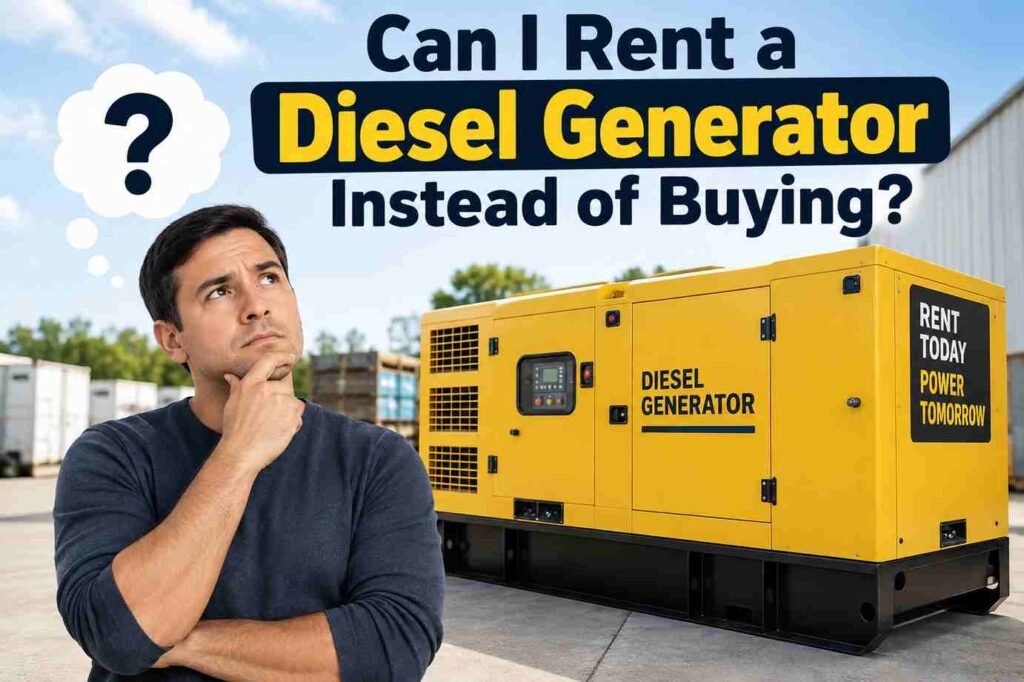
If you are asking, “Can I rent a diesel generator instead of buying?”, the real question is not whether rental is possible. Diesel generator rental is widely available. The important question is whether renting fits your expected runtime, frequency of use, required power, delivery logistics, fuel plan, and total cost.
I look at generator rental the same way I look at renting heavy equipment. If I need a machine for a defined project and I know when I will return it, rental is often easy to justify. If I need that machine every week for years, ownership starts making more sense.
In this guide, I’ll walk you through when I would rent, when I would buy, how rental pricing usually works, what size generator you may need, which technical details matter, and which costs people often forget when comparing a rental quote with a purchase price.



When Renting a Diesel Generator Makes the Most Sense
I usually lean toward rental when the need is temporary, uncertain, seasonal, or urgent. You are paying for access to the generator when you need it without taking on the full cost of ownership.
| Situation | Would I consider renting? | Why |
|---|---|---|
| One-day or weekend project | Yes | Buying rarely makes financial sense for a short job |
| Construction project lasting several weeks | Yes | You can match the generator to the project and return it afterward |
| Temporary emergency backup after equipment failure | Yes | Rental can bridge the gap while permanent equipment is repaired |
| Storm preparation or outage response | Often | Useful when local availability exists, although demand can tighten during disasters |
| Seasonal agricultural work | Often | You avoid owning equipment that sits unused most of the year |
| Recurring monthly use for several years | Maybe not | Repeated rental charges may eventually exceed ownership cost |
| Permanent standby power for a business or home | Usually no | A permanently installed generator may be more practical long term |
If I am unsure whether a temporary diesel generator is appropriate in the first place, I first define the emergency or operating need. My guide on when you actually need a diesel generator for emergency power can help with that decision.
What Sizes of Diesel Generators Can You Rent?
Rental fleets cover a very wide range. Small portable sets can power selected tools or circuits, while trailer-mounted commercial generators can supply buildings, job sites, events, pumps, refrigeration, industrial equipment, and temporary facilities.
United Rentals currently lists generators across a broad output range, while Sunbelt offers rental diesel units in sizes such as 20 kW and 56 kW. Larger temporary-power projects can require generators in the hundreds of kilowatts or multiple synchronized sets.
| Approximate generator class | Typical rental use | Important sizing concern |
|---|---|---|
| 5–10 kW | Tools, selected home circuits, small temporary loads | Starting surge from motors and compressors |
| 15–25 kW | Homes, small businesses, job trailers, pumps | Voltage, phase, motor starts, transfer equipment |
| 30–60 kW | Commercial sites, larger homes, construction, refrigeration | Load distribution and fuel consumption |
| 75–150 kW | Commercial facilities, industrial equipment, larger events | Three-phase power, cable size, distribution equipment |
| 200 kW and above | Industrial plants, data facilities, hospitals, large temporary systems | Engineering, synchronization, fuel logistics, permits |
A Real 20 kW Rental Generator Example
To show what a rental unit can look like, Sunbelt currently lists a 20 kW diesel generator for temporary, standby, and emergency use. Depending on the supplied model, the full-load fuel-consumption figure is about 1.6 to 1.8 gallons per hour. Sunbelt also describes these rental units as configurable for multiple voltages and capable of single- and three-phase output.
| Technical item | Example 20 kW rental class | Why I care |
|---|---|---|
| Rated output | 20 kW | Defines the real-power capability |
| Full-load fuel consumption | About 1.6–1.8 gal/hr on listed models | Helps me estimate fuel delivery and operating cost |
| Noise | Listed rental models may be 60 dBA or lower at full load | Important near homes, offices, events, and neighbors |
| Electrical configuration | Multiple voltage options; single- and three-phase configurations may be available | The generator must match the load and distribution system |
| Fuel system | Onboard tank; auxiliary tanks may be available | Determines refueling frequency |
The specific machine you receive may differ from the example above, so I always ask the rental company for the exact model and data sheet before I plan cables, breakers, fuel, or runtime.
A 56 kW Rental Generator Example
The same point becomes even clearer with a larger rental unit. Sunbelt currently lists 56 kW diesel generators using different engine and generator models. One listed configuration consumes about 4.4 gallons per hour at full load and carries roughly 103 gallons of onboard fuel, while another listed configuration consumes about 6.62 gallons per hour and carries about 132 gallons.
| Example 56 kW specification | Listed value range |
|---|---|
| Prime rating | 56 kW |
| Full-load fuel use | About 4.4–6.62 gal/hr depending on model |
| Onboard fuel capacity | About 103–132 gal depending on model |
| Approximate full-load runtime | About 20–23 hours on listed models |
| Frequency | 60 Hz |
That is why I never use a generic fuel-burn number simply because two generators have the same kW rating. Engine efficiency, emissions equipment, alternator configuration, and model design all matter.
How Diesel Generator Rental Pricing Usually Works
Most rental companies price equipment by a time period such as daily, weekly, or monthly. United Rentals states that users can enter a ZIP code to see daily, weekly, and monthly rates, with its monthly rental period displayed as 28 days. The actual rate depends on local inventory, generator size, market demand, rental duration, and other factors.
I do not assume the displayed equipment rate is my total cost. Delivery, pickup, fuel, cables, distribution panels, transformers, auxiliary tanks, environmental packages, damage waivers, taxes, overtime usage, and emergency-response conditions can all change the invoice.
For current pricing examples and a deeper cost breakdown, I would also look at my guide to diesel generator rental costs.
Rental Price Is Only Part of the Cost
When I compare renting with buying, I build the total cost instead of comparing a one-line rental rate with a purchase price.
| Cost item | Rental | Ownership |
|---|---|---|
| Equipment acquisition | Rental fee | Purchase price or financing |
| Delivery / pickup | Often charged separately | Initial transport/installation |
| Fuel | Usually renter responsibility | Owner responsibility |
| Routine maintenance | Often partly handled by rental provider, but contract matters | Owner responsibility |
| Repairs | Depends on cause and rental agreement | Owner responsibility after warranty |
| Storage | None after return | Owner must provide space |
| Insurance / damage protection | May be added to rental | Owner insurance may be required |
| Depreciation | Rental company absorbs it | Owner absorbs it |
| Resale value | None | Owner may recover some value |
That last point is important. Renting can feel expensive because every dollar is an expense. Buying can feel cheaper because you still own an asset. But ownership also means your money is tied up in a machine that may sit unused, age, require batteries and fluids, and eventually lose value.
Renting vs. Buying: A Simple Break-Even Method
I use a basic break-even calculation when the decision is not obvious. I estimate the total annual rental cost for the number of days or weeks I expect to use the generator, then compare that with the annualized cost of owning one.
Here is a hypothetical example to show the method. These are not national rental rates or dealer quotes.
| Illustrative item | Example amount |
|---|---|
| Rental charge per week | $1,000 |
| Expected rentals per year | 4 weeks |
| Annual rental equipment cost | $4,000 |
| Purchase price of comparable generator | $25,000 |
| Estimated annual ownership costs excluding fuel | $2,000 |
In that simplified example, renting four weeks a year may remain attractive because I avoid tying up $25,000. If I start renting the same machine for many months every year, the math can shift quickly toward buying. The correct break-even point depends on your real quote, financing cost, maintenance, storage, insurance, resale value, and how many years you expect to keep the machine.


When I Would Definitely Rent Instead of Buy
I would strongly consider renting when the project has a clear end date. A construction site that needs temporary power for six weeks is a perfect example. I can rent the correct generator, return it when utility service is established, and avoid finding storage for a trailer-mounted machine afterward.
I also rent when my permanent generator is down for repair. In that situation, the rental is essentially temporary insurance. The same applies during planned maintenance, facility upgrades, electrical shutdowns, or major events where losing power would be unacceptable.
Another situation is testing demand before committing to a purchase. If I am unsure whether a 20 kW, 30 kW, or 50 kW generator is right for a particular operation, a rental can provide valuable real-world data before I buy.
When Buying Usually Makes More Sense
I start leaning toward ownership when the generator is part of the permanent infrastructure. If I need automatic standby power every day of the year, I usually want a permanently installed generator with a transfer switch, dedicated fuel supply, exercise schedule, maintenance program, and known service history.
Buying also makes more sense when utilization is high. A contractor using a generator on nearly every project may spend so much on repeated rentals, delivery charges, and scheduling that ownership becomes easier to justify.
There is also an availability issue. During storms, disasters, utility emergencies, and large regional construction projects, rental generators can become difficult to find. Ownership gives me guaranteed access to my own machine, assuming I maintain it properly.
Emergency Rental Availability Can Change Fast
This is one of the biggest weaknesses of a rental-only emergency plan. The generator may be available today but not when an entire region loses power.
Sunbelt currently notes that during a declared state of emergency or a pending or existing natural disaster, rentals of some generator types may be billed with a one-week minimum and around-the-clock usage assumptions. That policy is a useful reminder that emergency conditions can change both availability and rental terms.
If a generator protects a life-safety function, expensive refrigeration, a critical business process, or a medical need, I would not build the entire emergency plan around the assumption that I can always find a rental after the outage starts.
How Do I Know What Size Rental Generator I Need?
I size a rental generator the same way I size one I plan to buy. I list every load that must operate, note its running power, identify the largest motor or compressor starting requirement, and check whether those loads will run at the same time.
I also verify voltage and phase. Renting a generator with enough kW does not help if the electrical configuration does not match the equipment you need to run.
| Technical detail | What I verify before renting |
|---|---|
| Running load | Total kW expected during normal operation |
| Starting load | Largest motor, pump, compressor, or transformer inrush |
| Voltage | Examples include 120/240 V, 208 V, 240 V, 480 V depending on application |
| Phase | Single phase or three phase |
| Frequency | Typically 60 Hz in the United States |
| Connection | Receptacles, cam-locks, lugs, transfer switch, distribution panel |
| Duty | Expected hours per day and continuous load level |
| Environment | Temperature, altitude, dust, rain, noise restrictions |
If you are not sure about size, my diesel generator sizing guide explains the process in more detail.
Do Not Forget Starting Watts
This is where many rental mistakes happen. A motor can require substantially more power during startup than while running. Pumps, air conditioners, refrigeration compressors, air compressors, and large fans can all create short starting peaks.
If I rent a generator that barely covers the running load, the voltage can sag or the generator can trip when the largest motor starts. I give the rental company the motor horsepower, voltage, phase, starting method, and nameplate information when the load is important.
How Much Fuel Will a Rental Diesel Generator Use?
Fuel use depends on generator size and load. I calculate fuel needs from the exact rental model instead of using a universal gallons-per-hour rule.
For example, using the listed Sunbelt 20 kW models at full load, a 24-hour period at 1.6 to 1.8 gallons per hour would theoretically consume about 38.4 to 43.2 gallons if the generator remained at full load the entire time.
| Full-load fuel rate | 8 hours | 12 hours | 24 hours |
|---|---|---|---|
| 1.6 gal/hr | 12.8 gal | 19.2 gal | 38.4 gal |
| 1.8 gal/hr | 14.4 gal | 21.6 gal | 43.2 gal |
| 4.4 gal/hr | 35.2 gal | 52.8 gal | 105.6 gal |
| 6.62 gal/hr | 52.96 gal | 79.44 gal | 158.88 gal |
Those calculations assume the stated full-load rate continuously. Real fuel use will change with actual load. If your project runs around the clock, fuel logistics can become just as important as rental price.
Who Pays for Fuel?
In most ordinary rentals, I expect the renter to pay for the diesel consumed. The rental company may offer fuel service, an auxiliary tank, remote monitoring, or scheduled refueling, but I never assume these are included.
I ask whether the generator must be returned full, whether off-road diesel is permitted for the specific application and jurisdiction, and whether a fuel-service charge applies. For long projects, I also ask how the supplier handles fuel quality, tank placement, spill containment, and after-hours refueling.
What About Delivery and Pickup?
Many commercial diesel rental generators are trailer-mounted and heavy. I do not assume I can tow one myself just because it has wheels.
I check the generator weight, tow-vehicle rating, hitch requirements, braking system, driver-license requirements, route restrictions, and whether the rental company requires its own delivery service. A 56 kW trailer-mounted rental unit can weigh several thousand pounds, so delivery is often the practical choice.
Delivery cost may depend on distance, site access, timing, and whether special placement is required. If a crane, forklift, or other equipment is needed to position a larger unit, that should be included in the project plan.
What Accessories Might I Need to Rent?
The generator itself may be only one part of the rental package. Depending on the job, I may also need cables, distribution panels, transformers, transfer switches, load banks, grounding equipment, auxiliary fuel tanks, cable ramps, environmental containment, or temporary lighting.
| Accessory | When I may need it |
|---|---|
| Power-distribution panel | When several circuits or tools need safe branch connections |
| Cam-lock cables | For larger temporary-power distribution systems |
| Transformer | When generator voltage and load voltage differ |
| Automatic/manual transfer equipment | When connecting to a building electrical system |
| Auxiliary fuel tank | For long runtime between refueling visits |
| Load bank | For testing or applying controlled load |
| Cable ramps | Where cables cross walkways or vehicle paths |
| Spill containment | Where environmental protection is required |
These accessories can change the total rental cost significantly, especially for larger commercial systems.
Can I Rent a Generator for My House?
Yes. I can rent a diesel generator for a home, but I still need a safe way to connect it. I do not backfeed the home through a dryer outlet or another receptacle.
For selected appliances, a portable generator may power loads through appropriately rated cords when the manufacturer allows it. For a building connection, I use approved transfer equipment installed by a qualified electrician so the generator cannot energize utility lines.
A rental generator may be especially useful if a home’s permanent standby generator has failed or if a long outage is expected. If you are considering a permanent system, my guide to diesel generators for home backup power may help you compare the long-term option.
Can I Rent One for a Business?
Yes, and commercial temporary power is one of the strongest use cases for rental. I can bring in a generator for a planned shutdown, utility upgrade, transformer replacement, temporary expansion, event, construction project, equipment failure, or emergency outage.
For a business, I pay even more attention to phase, motor starting, harmonics, sensitive electronics, load sequencing, cable routing, and fuel autonomy. If the building has three-phase equipment, I make sure the rental generator and temporary distribution system are configured correctly.
What Happens if the Rental Generator Breaks Down?
One major advantage of renting from a large equipment provider is access to service support. However, I read the contract carefully because responsibility can depend on whether the failure was normal equipment failure, misuse, contamination, incorrect loading, physical damage, or lack of required daily checks.
I ask what number to call after hours, what response time is offered, and whether a replacement generator can be supplied if the unit cannot be repaired quickly. If the application is mission-critical, I may even consider redundant generation rather than depending on a single machine.
Maintenance During a Rental
Renting does not mean I can ignore the machine. I still check fuel, oil, coolant, visible leaks, alarms, ventilation, and general condition according to the rental company’s instructions.
For longer rentals, I ask who performs scheduled service when the hour meter reaches a maintenance interval. The rental company may send a technician, exchange the unit, or require specific coordination. I document hours and keep the service contact information available.
For general maintenance information, see my guide to diesel generator maintenance.
Rental Generator Safety
I treat rental generators exactly like owned generators when it comes to safety. Exhaust contains carbon monoxide. Portable combustion generators must be kept outdoors and away from doors, windows, vents, and other openings according to manufacturer and safety guidance.
I also keep combustible material away from hot exhaust components, protect cables from traffic and water, follow grounding and bonding requirements for the application, and make sure the generator cannot energize utility lines through an unsafe connection.
For larger rentals, I let qualified electricians handle temporary distribution and building connections. High-current temporary power can be dangerous even when the generator itself looks straightforward to operate.
Questions I Ask Before Signing a Rental Agreement
I do not reserve a generator until I understand exactly what I am getting. These are the questions I ask the rental company:
- What is the exact generator make and model?
- What is the prime or standby kW rating?
- Which voltages and phases can it supply?
- What is the fuel consumption at 25%, 50%, 75%, and 100% load if those figures are available?
- How large is the onboard fuel tank?
- How many hours are included in the rental rate?
- Are overtime or 24-hour usage charges different?
- What are the delivery and pickup charges?
- Which cables, panels, tanks, and accessories are included?
- Who handles maintenance during a longer rental?
- What happens if the generator fails?
- What damage waiver, insurance, deposit, or credit requirements apply?
- Are there minimum rental periods during storms or declared emergencies?
I want all of those answers in writing because they affect both cost and reliability.
Renting vs. Buying: My Practical Decision Table
| If this describes you… | I would lean toward… |
|---|---|
| I need a generator for a day, week, or one project | Renting |
| I need a temporary replacement while my permanent unit is repaired | Renting |
| I only need extra power during a seasonal peak | Renting |
| I want to test generator capacity before buying | Renting |
| I need emergency power available instantly all year | Buying / permanent standby system |
| I use a generator on most jobs every month | Buying may be more economical |
| I cannot risk regional rental shortages during an emergency | Buying or maintaining dedicated standby capacity |
| I have no storage space and use the generator rarely | Renting |
Frequently Asked Questions
Can I rent a diesel generator for just one day?
Often, yes. Many equipment-rental companies offer daily rentals, although larger generators, emergency conditions, local inventory, or specialty equipment can come with minimum rental periods. I confirm the exact terms before reserving.
Is it cheaper to rent or buy a diesel generator?
Renting is usually easier to justify for occasional or temporary use. Buying becomes more attractive as usage becomes frequent and long-term. I compare total annual rental cost with financing, maintenance, storage, depreciation, insurance, and resale value rather than looking at the purchase price alone.
Can I rent a 20 kW diesel generator?
Yes. Major rental companies offer diesel generators in the 20 kW class. I still verify voltage, phase, starting surge, fuel consumption, and connection requirements before ordering one.
Can a rental generator power my whole house?
Potentially, if it is large enough and connected safely through proper transfer equipment. A 20 kW unit can support many homes, but a large all-electric house may need more. I size from actual loads rather than the home’s service-entrance amperage alone.
Do rental generators come full of fuel?
Policies vary. I ask how much fuel is supplied at delivery, whether the generator must be returned full, and whether the rental company offers scheduled refueling. I never assume fuel is included in the equipment rate.
Can I keep a rental generator for several months?
Yes, long-term rentals are common. Monthly pricing can be more economical than repeatedly extending daily or weekly rentals, but I confirm the provider’s billing period, included usage, service schedule, and termination terms.
Do I need an electrician for a rental generator?
If the generator is being connected to a building electrical system, transfer equipment, large temporary distribution system, or three-phase equipment, I use a qualified electrician. Simple portable loads may be connected differently, but I still follow the generator and rental company’s instructions.
My Bottom Line
Yes, you can absolutely rent a diesel generator instead of buying one. I think renting is one of the best options when the need is temporary, project-based, seasonal, emergency-driven, or uncertain. It lets you get the power capacity you need without committing capital to equipment that may spend most of its life sitting idle.
I lean toward buying when the generator is a permanent part of the property, when I need guaranteed emergency availability, or when repeated rental charges and delivery fees are becoming a regular operating expense.
Before I make the choice, I calculate the real rental cost, confirm the generator size, check voltage and phase, account for motor starting, estimate fuel consumption, add delivery and accessories, and read the rental agreement carefully. That gives me a much better answer than simply asking whether the daily rate looks cheap.
If your need is temporary, rental can be the simplest path. If your need is permanent, frequent, or critical, ownership may give you more control and better long-term economics.
Sources and Technical References
I used current rental-fleet information from United Rentals and current 20 kW and 56 kW diesel generator specifications from Sunbelt Rentals and Sunbelt’s 56 kW rental listing. Rental rates, included hours, emergency policies, available models, and accessories can vary by location and date, so I would always request a current local quote before making a cost decision.
Pingback: Rental Diesel Generators for Events and Festivals -