
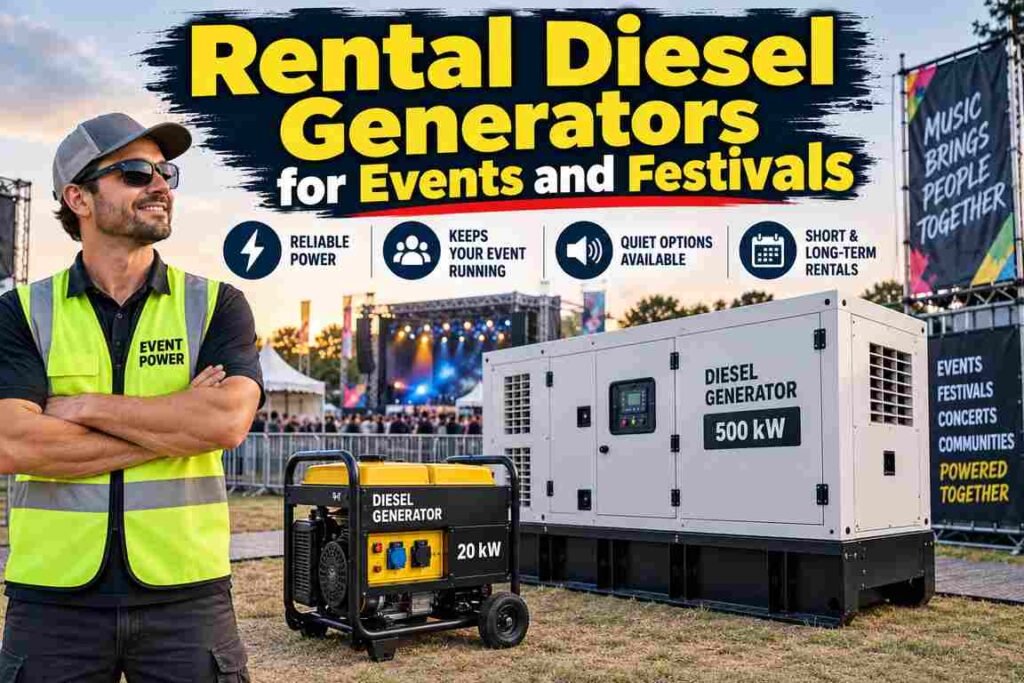
When I plan temporary power for an outdoor concert, fair, food festival, sporting event, corporate gathering, or community celebration, I treat electricity as event infrastructure. If the power fails, the problem is bigger than a dark stage. Point-of-sale systems can go down, refrigeration can stop, security lighting can disappear, communications can fail, and vendors may have to close.
That is why rental diesel generators for events and festivals deserve the same level of planning as staging, fencing, crowd flow, toilets, and emergency access. In this guide, I’ll show you how I size rental generators, divide loads into zones, plan fuel and redundancy, manage noise, and build a safer temporary distribution system.
Why Rental Diesel Generators Work Well for Events
I like rental diesel generators for temporary events because they are available in a wide range of outputs, can run for long periods when properly sized and maintained, and are commonly offered as towable sound-attenuated units. Rental companies can also supply distribution panels, cable, ramps, auxiliary fuel tanks, transformers, light towers, HVAC equipment, and technicians.
For a one-day festival or a week-long event, renting also means I do not have to own, store, transport, service, and periodically load-test a generator that may sit unused most of the year.
| Event requirement | Why a rental diesel generator can fit |
|---|---|
| Temporary site with no utility service | Power can be brought to the site without waiting for permanent electrical service |
| Large or changing loads | Rental fleets offer multiple generator sizes and voltage configurations |
| Long event days | Commercial diesel units are designed for extended operation when used within their rating |
| Noise-sensitive venue | Sound-attenuated mobile units are commonly available |
| Multiple power zones | Several generators can be distributed around the venue instead of relying on one central source |
| Short-term need | Rental avoids the capital cost and storage burden of ownership |
If you are deciding between renting and owning, I have a separate guide on renting a diesel generator instead of buying, along with a detailed look at diesel generator rental costs.
What Normally Needs Power at an Event or Festival?
The first thing I do is create a load inventory. I do not ask, “How big is the event?” I ask, “What exactly needs electricity, where is it located, and when will it operate?”
A small wedding with a DJ, catering tent, and decorative lighting may have a modest load. A music festival with multiple stages, food courts, LED walls, refrigeration trailers, site offices, ticketing lanes, and temporary air conditioning can require several independent power systems.
| Power zone | Typical loads | Main planning concern |
|---|---|---|
| Main stage | Audio amplifiers, consoles, LED walls, stage lighting, backline support | Power quality, transient loads, redundancy, cable routing |
| Secondary stage | Sound, lighting, video, instrument support | Independent capacity and isolation from other loads |
| Food vendors | Refrigerators, freezers, warmers, cooking equipment, POS systems | High combined load, compressors, long operating hours |
| Site lighting | Walkway lights, parking lights, security lights, towers | Continuous nighttime operation |
| Guest services | Ticketing, scanning, charging stations, information tents | Continuity and clean distribution |
| Restroom trailers | Pumps, lighting, ventilation, water heaters | Motor starting and continuous service |
| HVAC | Portable air conditioners, fans, heaters | Large continuous loads and compressor starting |
| Back of house | Production office, radios, catering, staff areas | Critical operational continuity |
How I Size a Rental Diesel Generator for an Event
I begin with the nameplate or specification for every significant load. If equipment is listed in watts, I record watts. If it is listed in volts and amps, I calculate apparent or real power as appropriate for the equipment and have the temporary-power contractor confirm the final sizing.
For simple resistive loads, watts are approximately volts multiplied by amps. Motors, compressors, lighting controllers, amplifiers, and electronic equipment can be more complicated because power factor, startup current, harmonics, and phase loading matter.
United Rentals currently recommends listing all event loads, totaling their wattage, and adding a planning margin of at least 20 percent to account for inrush and unplanned demand. I treat that as a useful starting point, not a substitute for an engineer or qualified temporary-power specialist on a large show.
Example event load calculation
| Load group | Illustrative running load |
|---|---|
| Main stage audio and control | 12 kW |
| Stage lighting | 10 kW |
| LED/video system | 8 kW |
| Vendor refrigeration | 5 kW |
| Site and security lighting | 3 kW |
| Ticketing and operations | 2 kW |
| Total estimated running load | 40 kW |
Adding planning margin
| Calculation step | Example |
|---|---|
| Estimated running load | 40 kW |
| Planning margin | 20% |
| Added capacity | 8 kW |
| Planning target | 48 kW |
I would not automatically rent the next generator size based on that arithmetic alone. I would still check the largest motor or compressor startup, stage equipment requirements, whether the load is single-phase or three-phase, how much load will actually be simultaneous, and whether critical systems should be moved to a separate generator.
If you need a deeper explanation of generator sizing, see my guide on what size diesel generator you actually need.
Generator Size Is Only Part of the Decision
A rental generator can have enough kW and still be wrong for the job. I also verify voltage, frequency, phase, receptacles or cam-lock connections, power factor, breaker capacity, neutral configuration, grounding and bonding, and the type of distribution equipment being used.
| Technical detail | Why I check it |
|---|---|
| kW rating | Determines real-power capability |
| kVA rating | Important for equipment with non-unity power factor |
| Voltage | Must match the distribution system and connected loads |
| Single-phase vs. three-phase | Determines compatibility with stage, HVAC, and commercial equipment |
| Frequency | Most U.S. event equipment expects 60 Hz |
| Prime vs. standby rating | Event operation may involve long variable-load run times rather than short emergency use |
| Sound attenuation | Important near stages, VIP areas, hotels, homes, and broadcast locations |
| Fuel capacity | Determines how long the generator can operate before refueling |
| Distribution connections | Must match the cable and power-distribution package |
Current Rental Generator Sizes You May See
Rental fleets change by market, but current listings show how broad the range can be. United Rentals lists towable event-capable diesel units from the low tens of kilowatts through large commercial sizes, while Sunbelt offers temporary-power units well into the hundreds of kilowatts.
| Current rental class example | Published output | Typical event role |
|---|---|---|
| United Rentals small towable diesel | 11–22 kW | Smaller event zones, trailers, vendor clusters |
| United Rentals event/jobsite towable | 20–25 kW | Temporary event power, equipment, local distribution |
| Sunbelt mid-size mobile diesel | 56 kW | Stage support, vendor areas, HVAC, larger distribution zones |
| United Rentals large towable diesel | 90–100 kW | Large stages, event compounds, major temporary-power zones |
| Sunbelt large event generator | 350 kW | Large outdoor events and high-capacity temporary systems |
One Large Generator or Several Smaller Generators?
I rarely decide this from rental price alone. One large central generator can simplify fuel management and may reduce the number of machines to monitor, but it creates a bigger single point of failure and can require long feeder runs.
Several smaller generators let me divide the event into zones. That can shorten cable runs, isolate noisy or sensitive loads, and prevent a food-vendor problem from taking down the main stage. The tradeoff is more engines, more fuel points, more inspections, and more coordination.
| Approach | Advantages | Tradeoffs |
|---|---|---|
| One central generator | Fewer engines, centralized fueling, simpler monitoring | Long cable runs and larger single point of failure |
| Several distributed generators | Shorter feeder runs, easier load isolation, flexible placement | More machines to fuel, inspect, secure, and monitor |
| Primary plus backup generator | Better continuity for critical production | Higher rental and distribution cost |
| Generator plus battery system | Can reduce low-load runtime, fuel use, and noise during quiet periods | Requires compatible controls and additional planning |
I Separate Critical Loads From Convenience Loads
One of the most useful things I do is classify loads before assigning generators. Critical loads are the things I do not want to lose even briefly: safety lighting, communications, essential production control, medical or accessibility equipment where applicable, ticketing backbone, refrigeration that protects food, and selected stage systems.
Convenience loads can usually tolerate a temporary interruption: decorative lighting, nonessential charging stations, some hospitality equipment, or selected vendor loads.
When the consequences of failure are high, I do not put every critical function on one unprotected feeder just because the math says the generator is large enough. I discuss redundancy, separate distribution, and backup power with the event electrician or rental-power specialist.
Stage Audio and Video Need Careful Power Planning
Stage power deserves its own conversation. Audio amplifiers, digital consoles, LED processors, lighting dimmers, video walls, and motors can create rapidly changing loads. A generator may handle the average demand but still respond poorly if the system is undersized or phase loading is badly unbalanced.
I also avoid mixing electrically noisy loads with sensitive AV systems unless the distribution plan is designed for it. Refrigeration compressors, motors, pumps, and large HVAC equipment can create disturbances that the production team would rather not share with audio and video equipment.
For major shows, I want the production power requirements from the AV vendor before the generator order is finalized—not after the truck arrives.
Fuel Planning: I Work Backward From the Event Schedule
Fuel planning starts with the load profile and operating hours. I do not base it only on tank size because fuel burn changes with generator model and load percentage.
A current Sunbelt 56 kW rental class illustrates how much model variation can exist even within one size category.
| 56 kW rental example | Model A | Model B |
|---|---|---|
| Full-load fuel consumption | 6.62 gal/hr | 4.4 gal/hr |
| Onboard fuel capacity | 132 gal | 103 gal |
| Published full-load runtime | 20 hr | 23 hr |
That difference is why I ask the rental company for the actual model and its fuel-burn chart. I then calculate the planned event day, setup and sound-check hours, overnight loads, teardown, and reserve fuel.
If you want more detail on load-based consumption, see How Much Fuel Does a Diesel Generator Use?.
Do Not Forget Setup, Sound Check, and Teardown Hours
A festival may be open to guests for only part of the day, but the generator can run much longer. Production crews may need power during load-in, line checks, rehearsals, catering prep, refrigeration, security setup, overnight lighting, and load-out.
I build the fuel plan around the generator’s actual operating schedule, not the advertised event hours. I also assign a person or vendor to monitor fuel rather than assuming someone will notice when the gauge is low.
Running a diesel generator completely out of fuel can introduce air into the fuel system and create restart delays. I cover that problem in What Happens if Your Diesel Generator Runs Out of Fuel?.
Noise Matters More at Events Than on Jobsites
At a construction site, generator noise may blend into the background. At a wedding, acoustic performance, film screening, awards ceremony, or outdoor theater event, it can ruin the guest experience.
I look for sound-attenuated rental generators and then place them strategically. Distance, barriers, terrain, enclosure design, load, and exhaust direction all affect what guests actually hear.
I never compare generators using a dBA number without checking the measurement distance and test condition. My detailed guide to diesel generator noise levels explains why those numbers can be misleading when the test conditions are different.
Temporary Electrical Distribution Is Just as Important as the Generator
The generator is only the source. The rest of the system may include feeder cable, distro panels, spider boxes, breakers, transformers, branch circuits, cord sets, cable ramps, and connectors. A powerful generator does not make an undersized or poorly protected distribution system safe.
For workplaces covered by OSHA general-industry electrical rules, temporary wiring has specific requirements. OSHA 1910.305 allows temporary electrical power and lighting for carnivals and similar purposes for a limited period and requires temporary wiring to be removed when the purpose is complete. Feeders must originate from an approved distribution center, and temporary branch circuits and receptacles have grounding and overcurrent-protection requirements.
| OSHA temporary-wiring point | Published requirement |
|---|---|
| Carnivals and similar temporary purposes | Temporary installations may be used for a period not exceeding 90 days |
| End of temporary use | Temporary wiring is to be removed when the purpose is complete |
| Feeders | Originate from an approved distribution center |
| Temporary branch circuits | Require appropriate wiring methods and overcurrent protection |
| Receptacles | Grounding-type requirements apply |
I use these rules as a reminder that “temporary” does not mean improvised. The event electrician still has to comply with the electrical rules and any local code requirements that apply to the venue.
GFCI Protection, Grounding, and Bonding Need a Qualified Plan
Generator grounding questions are easy to oversimplify. OSHA’s general-industry rules allow a portable generator frame to serve as the grounding electrode in specific configurations where it supplies only generator-mounted or cord-and-plug-connected equipment and the required metal parts and receptacle grounding terminals are bonded to the frame.
Once the generator feeds a larger distribution system, structure, transfer equipment, separately derived system, or other configuration, the grounding and bonding design can change. I do not tell an event crew to “just add a ground rod” or “never use a ground rod.” I have the temporary-power contractor design and verify the system.
GFCI requirements also depend on how the temporary wiring is used and which OSHA or local electrical provisions apply. I make sure that issue is settled before vendors begin plugging in equipment.
Protect Cables From Guests, Vehicles, and Equipment
Festivals create constant cable hazards. Guests walk across pathways, golf carts and forklifts cross service roads, vendors roll refrigerators and carts into booths, and production crews keep changing the site.
I route power away from public areas whenever possible. Where a crossing is unavoidable, I use properly rated cable ramps or other approved protection and keep the route visible. I do not bury connectors under rugs, run cords through standing water, or place distribution equipment where guests can access it.
Rain and Wet Weather Can Change the Entire Setup
Outdoor events have to survive weather changes. A generator or distribution component that is acceptable in dry conditions may not be appropriate when wind-driven rain, puddles, mud, or flooding arrives.
I confirm the generator enclosure rating, distribution equipment suitability, connector protection, cable routing, drainage, and shutdown plan before bad weather starts. I also avoid low areas where water can collect around the generator or cables.
My guide Can Diesel Generators Run in the Rain? explains the difference between weather-rated equipment and exposing open equipment to rain.
Exhaust and Carbon Monoxide Are Event-Safety Issues
A diesel generator belongs outdoors in a well-ventilated location with exhaust directed away from occupied spaces, tents, trailers, doors, windows, and air intakes. I also think about where people will queue, where staff will work, and where wind may carry exhaust as conditions change.
CPSC’s current consumer-generator guidance says portable generators should be used outdoors and at least 20 feet from homes and buildings, with exhaust facing away. A professional event generator may fall under different site-specific rules and manufacturer clearances, but the basic lesson is the same: I never treat exhaust location as an afterthought.
| Portable-generator safety reference | Current CPSC guidance |
|---|---|
| Location | Outdoors only |
| Distance from homes/buildings | At least 20 ft for portable consumer generators |
| Exhaust direction | Away from doors, windows, vents, and occupied areas |
| Wet weather | Follow manufacturer instructions to reduce shock hazards |
Permits, Fire-Marshal Review, and Venue Rules
I never assume the rental company’s equipment automatically satisfies the event permit. Cities, counties, venues, parks, universities, and fire departments can have requirements for temporary electrical systems, generator placement, fuel storage, emergency access, tents, cooking areas, and cable crossings.
For a larger event, I ask early who has jurisdiction and what documentation they expect. That may include a site plan, generator locations, fuel quantities, electrical one-line diagrams, load schedules, grounding details, cable routes, fire extinguishers, spill controls, and emergency shutoff access.
Waiting until inspection morning to discover that a generator is in the wrong location can create a very expensive delay.
Food Festivals Need Their Own Power Strategy
Food vendors can create surprisingly large loads. Refrigerators and freezers cycle on and off. Electric griddles, warmers, coffee machines, ice makers, water heaters, and HVAC equipment can consume substantial power. Vendors may also arrive with equipment that was not included on the original application.
I require vendors to submit their electrical requirements in advance and I do not let everyone simply plug into the nearest available outlet. I also keep food refrigeration and critical cold-storage loads from being sacrificed when a nonessential vendor adds an unexpected appliance.
HVAC Can Become the Largest Load at the Event
Temporary air conditioning, tent cooling, restroom-trailer HVAC, and electric heating can exceed stage loads at some events. Compressors also have startup demand that must be accounted for.
If weather is extreme, I plan HVAC power before the generator order is finalized. I also decide whether climate-control loads should have their own generator so a compressor startup does not disturb stage or production power.
Hybrid Generator and Battery Options Are Becoming More Common
Battery energy storage can make sense when event loads change dramatically through the day. A battery system can supply lower nighttime or background demand while the diesel generator shuts down, then the generator can recharge the battery when necessary.
United Rentals currently lists hybrid towable generator options that combine a diesel engine with battery storage in the same rental category. For an event with sustainability goals, quiet hours, or long periods of low demand, I would ask the rental provider whether a hybrid package is practical.
Should I Plan a Backup Generator?
For a small community event, a single correctly sized generator may be enough. For a major concert, broadcast, ticketed festival, or event where a shutdown would create crowd-safety or financial consequences, I want a documented contingency plan.
That does not always mean an identical generator running beside the first one. Backup may involve a second generator, parallel capability, separate critical-load generator, battery storage, spare distribution equipment, or a rental provider with guaranteed response support.
The important question I ask is simple: “If this generator stops during the busiest part of the event, what happens next?” If nobody can answer that clearly, the power plan is not finished.
My Event Generator Rental Checklist
| Before I sign the rental | What I confirm |
|---|---|
| Load schedule | All stages, vendors, HVAC, lighting, refrigeration, and support loads included |
| Generator capacity | Running demand, startup loads, and operating margin checked |
| Voltage and phase | Match production and distribution equipment |
| Distribution package | Panels, cable, connectors, breakers, ramps, and adapters included |
| Fuel plan | Expected consumption, delivery schedule, reserve, and refueling responsibility defined |
| Noise | Generator placement and enclosure appropriate for guest areas |
| Weather | Equipment and cable routes suitable for expected conditions |
| Exhaust | Directed away from guests, tents, structures, and air intakes |
| Grounding/GFCI | Temporary-power contractor has defined the required protection |
| Permits | Venue, electrical, fire, fuel, and local approvals identified |
| Backup plan | Response to generator, cable, or distribution failure documented |
| Support | Rental-company emergency contact and technician availability confirmed |
Day-of-Event Checks I Do Before Guests Arrive
Before gates open, I walk the power system rather than relying only on paperwork. I confirm that generators are in the approved locations, fuel levels are adequate, cables are protected, distribution boxes are secure, barriers are in place, exhaust paths are clear, and no vendor has added an unapproved high-load appliance.
I also want the person responsible for power to know where the disconnects are, how to contact the rental company, what alarms to watch for, and which loads are critical if capacity has to be reduced.
For longer rentals, maintenance matters too. My article on how often diesel generators should be serviced explains why hour-based service intervals still matter during extended operation.
Common Mistakes I Avoid With Festival Generators
The most common problems I see come from incomplete load lists, too much faith in one large generator, last-minute vendor additions, long unplanned cable runs, missing fuel responsibility, poor noise placement, and assuming temporary electrical work can be improvised.
Another mistake is oversizing by a huge margin “just to be safe.” A much larger diesel generator can cost more to rent and fuel, may operate at inefficiently low load, and can still fail if the distribution system is poorly planned. I prefer right-sizing plus sensible redundancy.
Frequently Asked Questions
What size diesel generator do I need for a festival?
There is no universal size. I total the simultaneous loads, account for startup demand, confirm voltage and phase, and add reasonable operating margin. Small zones may use generators in the tens of kilowatts, while large stages or festival compounds may need units in the hundreds of kilowatts or multiple generators.
Are diesel generators too loud for weddings and concerts?
They can be if they are poorly selected or placed. Sound-attenuated rental units, distance, barriers, and thoughtful placement can reduce guest exposure. I always compare sound specifications using the same distance and load conditions.
Can one generator power the whole event?
Sometimes, but I do not assume that one source is best. Multiple generators can shorten cable runs, isolate critical systems, and reduce the impact of a single distribution problem.
How early should I reserve an event generator?
I reserve as soon as the load plan and event date are stable, especially during peak festival, storm, or construction seasons. Large sound-attenuated units, specialty distribution gear, and technicians can become limited.
Can food trucks plug into the same generator as the stage?
They can in some properly engineered systems, but I usually prefer to separate unpredictable vendor and compressor loads from sensitive production power when practical. The temporary-power contractor should balance the actual circuits and phases.
How long can a rental diesel generator run at an event?
Runtime depends on fuel capacity, load, generator rating, maintenance requirements, and the exact model. Some commercial rental units are designed for long continuous service, but I still plan refueling and maintenance around the manufacturer’s limits. See my guide on how long diesel generators can run continuously.
Do I need a permit for an event generator?
Possibly. Permit requirements depend on the city, venue, fuel system, electrical distribution, and event type. I check the venue, local building/electrical authority, and fire marshal early rather than assuming the rental contract covers approvals.
My Bottom Line
Rental diesel generators for events and festivals work best when I treat them as part of a complete temporary-power system rather than as stand-alone machines. The generator size matters, but so do voltage, phase, startup loads, distribution, cable protection, fuel, noise, weather, exhaust, grounding, permits, and backup planning.
I start with a complete load inventory, divide the venue into logical power zones, and identify the systems that cannot afford an interruption. Then I work with the rental provider and qualified temporary-power personnel to select the generator package, distribution equipment, fuel plan, and contingency strategy.
A well-designed power system is almost invisible to guests. The stage stays on, food stays cold, lights stay lit, ticketing keeps working, and nobody thinks about the generators. That is exactly what I want from event power.
Sources and Technical References
I used current information from United Rentals’ event generator planning guide, current United Rentals diesel-generator listings, current Sunbelt 56 kW rental specifications, OSHA 1910.305 temporary-wiring requirements, OSHA 1910.304 grounding and protection requirements, and current CPSC portable-generator safety guidance. Local codes, venue rules, and the actual rental-generator manual always control the final installation.