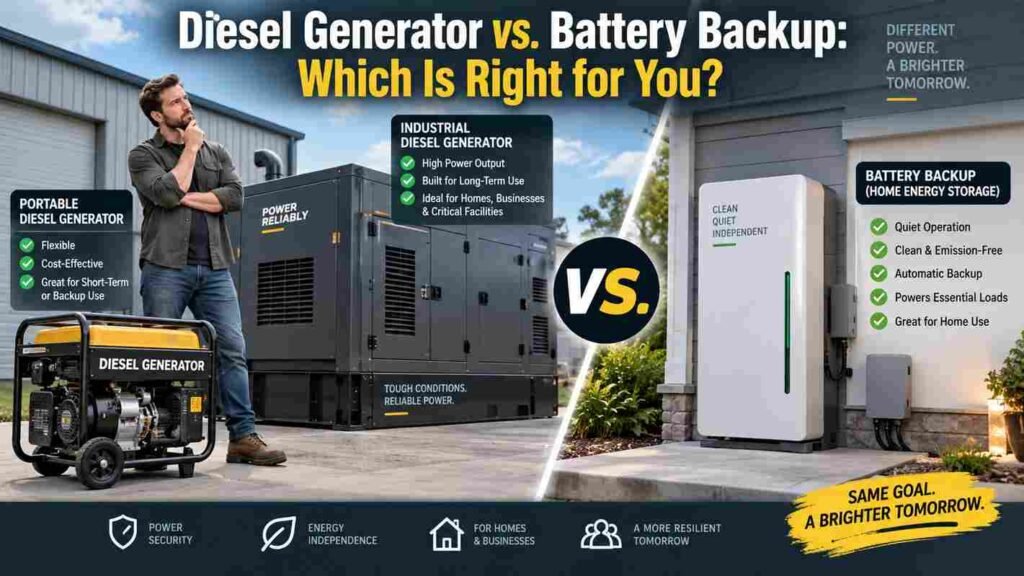
The comparison sounds simple until you start looking at real numbers. A battery may be rated at 13.5 kWh, while a diesel generator may be rated at 20 kW. Those numbers are not measuring the same thing. One describes stored energy; the other describes power output. If you mix them up, it is easy to buy the wrong backup system.
In this guide, I’ll walk you through diesel generator vs. battery backup systems the way I would compare them for my own home or small business. I’ll look at runtime, power, starting loads, fuel, cost, noise, maintenance, solar charging, long outages, installation, and what happens when the grid stays down longer than expected.
Diesel Generator vs. Battery Backup: Quick Comparison
| Feature | Diesel generator | Battery backup |
|---|---|---|
| How energy is supplied | Diesel fuel is converted to electricity | Stored electrical energy is discharged through an inverter |
| Typical strength | Long-duration, high-load backup | Silent, automatic, short-to-medium outage backup |
| Runtime | Can continue as long as fuel, maintenance, and operating limits allow | Limited by stored kWh unless recharged by solar or another source |
| Startup during outage | Engine starts, stabilizes, then transfer occurs | Usually very fast or seamless with compatible backup controls |
| Noise | Engine and exhaust noise | Very quiet in operation |
| On-site emissions | Combustion exhaust | No combustion exhaust at the home |
| Fuel handling | Required | Not required for battery-only operation |
| Maintenance | Oil, coolant, filters, battery, fuel system, exercise | Generally lower routine mechanical maintenance |
| Solar integration | Indirect; depends on system design | Excellent when paired with compatible solar |
| Best fit for multi-day outage | Strong if fuel supply is dependable | Needs enough storage and/or solar recharge |
I do not treat that table as a universal winner. The right choice depends on your outage pattern, electrical loads, budget, fuel access, solar plans, and tolerance for noise and maintenance.



The Most Important Difference: kW vs. kWh
This is the first technical point I explain because it changes the entire comparison.
kW, or kilowatts, measures power. It tells me how much electrical load a system can supply at one moment.
kWh, or kilowatt-hours, measures energy. It tells me how much stored energy a battery has available over time.
A 20 kW diesel generator can theoretically supply up to 20 kW of rated load while it is running, subject to its rating, operating conditions, and manufacturer limits. A 13.5 kWh battery stores 13.5 kWh of energy, but the inverter also has a maximum kW output.
| Measurement | What it tells me | Example |
|---|---|---|
| kW | How much power can be delivered at one time | 11.5 kW battery inverter or 20 kW generator |
| kWh | How much energy is stored or consumed over time | 13.5 kWh battery capacity |
| Hours of backup | Approximate stored energy divided by average load | 13.5 kWh ÷ 1.5 kW = 9 hours before allowing for losses/reserves |
That last calculation is only a planning shortcut. Actual battery runtime depends on usable capacity, inverter efficiency, reserve settings, temperature, battery age, changing loads, and whether solar is producing power during the outage.
Current Home Battery Examples
To make the comparison concrete, I like looking at actual manufacturer specifications rather than vague claims about “whole-home batteries.” Current systems vary significantly in both energy capacity and power output.
| Battery system | Usable energy | Continuous power | Important note |
|---|---|---|---|
| Tesla Powerwall 3 | 13.5 kWh | 11.5 kW | Can be expanded; integrated backup controls and solar inverter |
| Enphase IQ Battery 5P | 5.0 kWh per unit | 3.84 kW per unit at 240 V | Modular; multiple units can increase capacity and output |
| Generac PWRcell 2 | 9–18 kWh depending on module count | About 5.2–10.5 kW depending on configuration | Modular and supports whole- or partial-home backup configurations |
Tesla currently lists Powerwall 3 at 13.5 kWh of energy and 11.5 kW continuous backup power. Enphase lists its IQ Battery 5P at 5.0 kWh usable energy and 3.84 kW continuous output at 240 volts. Generac’s current PWRcell 2 specification allows 9, 12, 15, or 18 kWh configurations, with continuous power increasing as modules are added.
This is why I never compare batteries by capacity alone. A battery can have enough kWh for the night but still lack enough instantaneous kW to start or run a large air conditioner, well pump, heat pump, electric range, or other high-demand load.
How Long Will a Battery Backup Run?
I estimate battery runtime from the average load, not from the home’s service size. A house with a 200-amp service does not continuously use 200 amps. During an outage, the actual load may be a refrigerator, lights, Wi-Fi, a few outlets, and perhaps a pump or HVAC system.
Using a 13.5 kWh battery as a simple example, the ideal mathematical runtime looks like this:
| Average load | Ideal runtime from 13.5 kWh | How I interpret it |
|---|---|---|
| 0.5 kW | 27 hours | Light essential-load operation |
| 1.0 kW | 13.5 hours | Moderate essential loads |
| 2.0 kW | 6.75 hours | Several appliances operating |
| 3.0 kW | 4.5 hours | Heavier household use |
| 5.0 kW | 2.7 hours | High sustained load |
| 10.0 kW | 1.35 hours | Very high sustained load |
The key lesson is that a battery can look very large in kWh but empty quickly if you try to run high-demand equipment continuously.
How Long Will a Diesel Generator Run?
A diesel generator works differently because its stored energy is in the fuel tank. If the generator has adequate fuel, it can continue producing electricity far longer than a single home battery can discharge.
For example, one Generac 20 kW industrial diesel specification lists approximate consumption of 0.9 gallons per hour at 25% load, 1.1 gph at 50%, 1.3 gph at 75%, and 1.7 gph at full standby load. A Cummins Onan SD20 specification shows about 0.70 gph at 50% load and 1.44 gph at full load. Different engines and ratings vary, so I always use the exact manufacturer table for the model I am considering.
Illustrative 50-gallon fuel-supply runtime
| Fuel burn | Calculated runtime from 50 gallons |
|---|---|
| 0.7 gal/hr | About 71.4 hours |
| 1.0 gal/hr | 50 hours |
| 1.1 gal/hr | About 45.5 hours |
| 1.5 gal/hr | About 33.3 hours |
| 1.7 gal/hr | About 29.4 hours |
Again, that is arithmetic, not a promise of uninterrupted operation. Actual usable fuel may be lower than the tank’s nominal capacity, and a generator still needs proper service, cooling, oil level, fuel quality, and operating conditions. My guide on how long a diesel generator can run continuously goes deeper into duty ratings and long-runtime operation.
Which One Handles High Loads Better?
If I have large loads, I compare both continuous power and starting capability. A diesel generator usually gives me access to higher sustained power ratings without buying multiple battery cabinets, especially in larger home, commercial, farm, and industrial applications.
But modern batteries are much stronger than many people realize. Tesla Powerwall 3, for example, lists 11.5 kW continuous backup power and motor-start capability rated at 185 LRA. That may be enough for many homes, depending on the loads and installation.


What I never do is assume that “whole-home battery” means every appliance can run at the same time. The same caution applies to generators. If the combined load exceeds the unit’s capacity, breakers can trip or the system may shed loads.
For generator sizing, see What Size Diesel Generator Do I Actually Need?.
What About Air Conditioners, Pumps, and Motors?
Motor loads are where this decision gets more technical. Air conditioners, refrigerators, well pumps, sump pumps, compressors, and some shop equipment draw extra current when they start.
I look at three figures: normal running watts, starting or locked-rotor demand, and how many large motors can start close together. A battery inverter may have excellent short-duration surge capability, while a correctly sized generator can also accept substantial motor-starting load.
Load management can make either system more practical. Instead of allowing an electric range, water heater, dryer, central air conditioner, and well pump to operate together, smart controls can prioritize essential loads and temporarily disconnect lower-priority ones.
Battery Backup Wins on Instant, Quiet Power
One reason I like batteries is how unobtrusive they are during a short outage. A properly configured home battery automatically isolates the home from the grid and begins supplying backup power. There is no engine to crank, no warm-up noise, and no exhaust.
That matters if outages are usually brief. If your grid goes down for 20 minutes, two hours, or one evening, a battery may handle the event without you doing anything.
It is also much easier to live next to. There is no routine diesel smell, no engine vibration, and essentially no combustion noise. That can be a major advantage in dense neighborhoods or locations with strict noise limits.
Diesel Wins When the Outage Keeps Going
The diesel generator’s biggest advantage is energy replenishment. When the tank gets low, I can add fuel. That means backup duration is not permanently fixed by the energy stored inside the machine.
If I am preparing for hurricanes, ice storms, wildfires, remote-grid failures, or utility outages that may last several days, I pay very close attention to this difference. A single battery can be excellent for overnight backup but may be depleted by morning if loads are high and there is no solar recharge.
A diesel generator can keep operating as long as I have fuel and stay within the manufacturer’s operating and maintenance requirements.
Solar Changes the Battery Equation
A battery without solar is mainly an energy reservoir. During a long grid outage, once the stored energy is depleted, the battery needs another charging source.
When a compatible battery is paired with solar and configured for backup operation, solar can power loads and recharge the battery during daylight. EnergySage notes that a properly designed solar-plus-battery system can continue operating through extended outages as long as there is enough sunlight and the system can repeatedly recharge.
That does not mean solar guarantees unlimited backup. Cloud cover, winter production, roof size, shading, seasonal energy use, and daytime load all matter. But solar can turn a battery from a fixed-duration backup into a system that may support much longer outages.
Battery Backup Can Also Save Money Every Day
A diesel generator usually sits idle until it is needed. A battery can provide value every day if you have time-of-use electricity rates, demand charges, poor solar export compensation, or a utility program that rewards battery participation.
I can charge a battery when electricity is cheaper or when solar is abundant, then discharge when grid power is expensive. Whether that actually saves money depends entirely on the local tariff and incentives.
This is one area where a battery is not just backup equipment. It can be part of daily energy management.
Upfront Cost: Diesel Generator vs. Battery Backup
Both systems can be expensive, and I avoid comparing sticker prices without including installation.
EnergySage reports that in 2026, the average home battery price on its marketplace is about $1,159 per kWh of stored energy, or about $15,647 installed for a typical 13.5 kWh system before state or local incentives.
For diesel equipment, Generac currently lists its 20 kW residential diesel standby model at a starting MSRP of about $15,089, before the site-specific installation work. A diesel installation can then add transfer equipment, electrical labor, concrete or mounting work, fuel storage, trenching, permits, and commissioning.
| Cost item | Battery backup | Diesel generator |
|---|---|---|
| Core equipment | Battery modules, inverter, gateway/controller | Generator set, controls, enclosure |
| Electrical installation | Backup gateway, circuits, panel work, wiring | Transfer switch, conductors, breakers, panel work |
| Energy storage/fuel | Additional battery modules increase kWh | Fuel tank and stored diesel increase runtime |
| Site work | Wall/floor mounting and code clearances | Pad, anchoring, exhaust clearances, tank placement |
| Permits | Electrical/building/utility requirements vary | Electrical, building, fuel, fire, zoning, and possibly emissions rules |
| Long-term operating cost | Electricity used to charge; battery eventually ages | Diesel fuel plus engine maintenance |
If you want a deeper generator budget, I have a separate guide to the cost to install a permanent diesel generator.
Maintenance Is Very Different
A battery has no combustion engine, so the mechanical maintenance burden is much lower. I still want the system monitored, firmware updated where applicable, electrical connections maintained by qualified technicians, and manufacturer alerts taken seriously, but there is no oil change or fuel filter.
A diesel generator needs a real maintenance program. That can include engine oil, oil filters, fuel filters, coolant, belts, hoses, starting battery condition, air filters, fuel quality, exercise testing, and periodic load testing.
| Maintenance area | Battery backup | Diesel generator |
|---|---|---|
| Engine oil | None | Required |
| Fuel filter | None | Required |
| Coolant | None for typical home battery system | Required on liquid-cooled models |
| Starting battery | Not an engine-starting battery | Must be maintained/replaced |
| Fuel quality | Not applicable | Important, especially for stored diesel |
| Software/monitoring | Important | Increasingly important on modern controllers |
| Exercise schedule | System self-management varies | Regular generator exercise commonly required |
For the diesel side, see my full diesel generator maintenance guide.
Noise, Exhaust, and Placement
A battery is the easy choice when noise and exhaust are major concerns. It is essentially silent during discharge, although inverters and cooling equipment can make some sound.
A diesel generator has an engine, cooling fan, intake noise, and exhaust. Sound-attenuated enclosures reduce noise, but they do not make the unit silent.
The generator must also be installed outdoors with proper clearances and exhaust placement. I never treat an enclosure as permission to put a combustion generator in an attached garage or other occupied enclosure.
For sound comparisons, see Noise Levels in Diesel Generators: What to Expect.
What Happens During a Multi-Day Outage?
This is where I think the decision becomes clearest.
| Outage situation | Battery only | Diesel generator |
|---|---|---|
| 30 minutes | Excellent fit if capacity is available | Works, but the engine may run for a very short event |
| 2–6 hours | Often a strong fit with managed loads | Strong fit |
| 12–24 hours | Depends heavily on kWh capacity and load | Usually manageable with adequate fuel |
| 2–3 days | May need multiple batteries, aggressive load management, and/or solar | Strong if fuel supply and maintenance are available |
| Several days or longer | Solar recharge or large storage becomes increasingly important | Fuel logistics become the main challenge |
If extended outage resilience is your main goal, also read Emergency Power: When You Actually Need a Diesel Generator.
Fuel Storage vs. Battery Capacity
With diesel, I plan in gallons. With batteries, I plan in kWh.
If my generator burns 1 gallon per hour and I want 48 hours of operation, the arithmetic says 48 gallons. Then I add planning margin and consider usable tank volume, delivery access, local fuel-storage rules, and the fact that fuel consumption changes with load.
If my home averages 1.5 kW during an outage and I want 24 hours of stored battery energy without solar, the simple calculation is:
1.5 kW × 24 hours = 36 kWh
That means one 13.5 kWh battery is nowhere near enough for that specific load profile without recharging. I would need substantially more storage or I would need to reduce the load.
Which Is Better for Refrigeration and Essential Loads?
For a refrigerator, freezer, internet equipment, LED lighting, electronics, and a few small circuits, batteries are very attractive. These are usually lower-energy loads, and silent automatic backup is convenient.
For a home with multiple refrigeration units, well pumps, large sump pumps, electric heating, central air, medical equipment, or a workshop, I look more carefully at total kW and daily kWh. A generator may provide more comfortable long-duration coverage, but a larger battery bank can also work if the budget and charging source support it.
Which Is Better for a Home With Solar?
If I already have solar—or plan to install it—I give battery backup serious consideration. A compatible solar-plus-storage system can use daytime production during an outage, recharge the battery, and reduce dependence on stored fuel.
But solar alone does not automatically provide power during an outage. The system needs equipment and controls that can safely isolate from the grid and operate in backup mode.
Which Is Better for Remote Property?
Remote properties can favor either system depending on access. If fuel delivery is reliable and long outages are common, diesel can be very practical. If fuel delivery is difficult but the site has strong solar resources, a larger solar-plus-battery system can reduce generator runtime dramatically.
In very remote applications, I often like the idea of a hybrid rather than forcing one technology to do everything.
The Hybrid Option: Battery Plus Diesel Generator
For maximum resilience, I do not always choose between the two. I may combine them.
The battery can carry the home instantly through brief outages, handle quiet nighttime loads, and reduce generator run hours. If the outage lasts long enough, the generator can support the home and, in a compatible system, help recharge the battery.
This approach can be especially useful where outages are frequent but usually short, with occasional multi-day events. The battery handles everyday interruptions; the generator is there when energy storage runs low.
Compatibility matters. The battery system, generator controls, transfer equipment, charging method, grounding arrangement, and load-management logic need to be designed to work together. Generac’s PWRcell 2 literature, for example, notes integration with select Generac standby generators.
My Decision Checklist
| If this describes you… | I would investigate first |
|---|---|
| Outages usually last under a few hours | Battery backup |
| You already have or plan to add solar | Battery or hybrid system |
| You need near-silent backup | Battery backup |
| You want daily time-of-use energy savings | Battery backup |
| You face multi-day outages | Diesel generator or hybrid |
| You have high continuous loads | Carefully sized generator, large battery bank, or hybrid |
| You have dependable on-site diesel storage | Diesel becomes more attractive |
| You strongly want to avoid engine maintenance | Battery backup |
| You want maximum resilience from more than one energy source | Hybrid battery + generator |
Frequently Asked Questions
Is a battery backup cheaper than a diesel generator?
Not automatically. In 2026, EnergySage reports an average installed battery cost around $15,647 for roughly 13.5 kWh of storage. A current 20 kW Generac diesel standby generator starts around $15,089 before installation. The final installed costs can overlap, but the two systems deliver very different amounts of stored energy and runtime.
Can a battery replace a whole-house generator?
Yes, in some homes. It depends on the battery’s kWh capacity, inverter kW rating, motor-start capability, outage duration, and whether solar can recharge it. One battery may be enough for essentials but not for unrestricted whole-home use during a long outage.
Can a diesel generator run longer than a home battery?
Usually yes, because you can replenish diesel fuel. A battery has a fixed stored-energy capacity unless it is recharged. Long generator runtime still depends on the unit’s duty rating, maintenance, cooling, and fuel supply.
Does a battery start faster than a diesel generator?
Typically yes. Modern home batteries can transition to backup very quickly, while a standby generator needs to start its engine and stabilize before the transfer switch moves the load.
Which is better during a hurricane?
I base that decision on expected outage length, fuel availability, solar conditions, and critical loads. A battery is excellent for quiet automatic backup, but multi-day outages can require substantial storage. A diesel generator offers longer runtime if fuel can be stored or delivered. A hybrid system can provide both advantages.
Can I use solar panels to recharge a home battery during an outage?
Yes, if the solar-plus-battery system is designed for backup operation and can island safely from the grid. Not every solar installation has that capability.
Which option needs less maintenance?
A battery generally requires less routine mechanical maintenance because it has no engine, oil, coolant, fuel filters, or exhaust system. Diesel generators need scheduled engine and fuel-system maintenance.
My Bottom Line
When I compare a diesel generator vs. battery backup, I do not ask which technology is better in general. I ask what problem I am trying to solve.
If I want quiet, seamless protection from short outages, I already have solar, or I want to manage electricity costs every day, a battery is extremely attractive. If I need to run large loads for many hours or survive several days without utility power, a diesel generator gives me something a single battery cannot: the ability to keep adding stored energy in the form of fuel.
For many homes, the most important calculation is not generator kW or battery kWh by itself. It is the combination of maximum load, daily energy use, and expected outage duration. Once I know those three numbers, the right backup strategy becomes much easier to see.
And if I want the strongest resilience rather than the simplest system, I look hard at a hybrid. A battery can handle the quiet, instant work. A diesel generator can handle the long haul.
Sources and Technical References
I used current manufacturer specifications from Tesla Powerwall, Enphase IQ Battery 5P, Generac PWRcell 2, and Generac’s 20 kW diesel standby generator. For 2026 battery cost benchmarks, I referenced EnergySage’s 2026 home battery guide. Generator fuel-rate examples were checked against published Generac and Cummins 20 kW diesel specifications. Exact performance, runtime, and installation requirements always depend on the specific model and local electrical, fire, fuel-storage, and building rules.