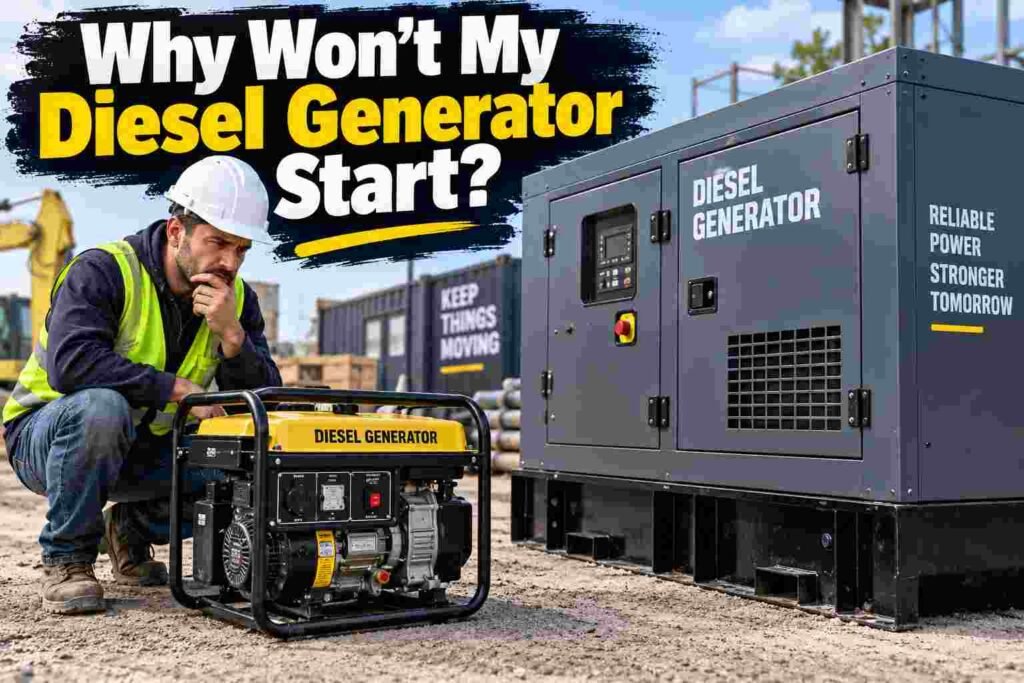
When someone asks me, “Why won’t my diesel generator start?”, I do not begin by replacing parts. I begin with what the generator is actually doing. Does the starter turn the engine? Does it crank slowly or at normal speed? Is there smoke from the exhaust while cranking? Did the generator recently run out of fuel? Is the emergency stop pressed? Is there a fault code on the controller?
In this troubleshooting guide, I’ll walk you through the same sequence I use to narrow the problem down. I’ll keep the checks practical, but I’ll also point out where I stop and call a technician—especially around high-pressure diesel fuel systems and energized electrical equipment.
Why Won’t My Diesel Generator Start? Start With the Symptom
| What the generator does | Most likely areas I check first |
|---|---|
| Nothing happens when I press Start | Battery, battery switch, emergency stop, fuse, controller power, wiring |
| Single click or repeated clicking | Weak battery, loose terminals, starter solenoid, poor ground connection |
| Cranks slowly | Weak battery, corroded cables, cold oil, starter problem, poor ground |
| Cranks normally but will not fire | No fuel, shutoff valve, air in fuel, clogged filter, cold-start system, fuel solenoid, sensors |
| Starts and immediately shuts down | Low oil pressure, fuel restriction, controller shutdown, low fuel pickup, sensor fault |
| Starts but runs rough | Air in fuel, contaminated diesel, injector issue, restricted air, cold engine, low compression |
This is the most important first step. If I know which of these categories I am dealing with, I can troubleshoot logically instead of jumping between unrelated components.



1. If the Diesel Generator Does Not Crank at All
If the starter does not turn the engine, I do not waste time checking injectors or the fuel filter yet. The engine has to crank before the fuel system even gets a chance to start combustion.
I start with the obvious controls. I make sure the generator control is in the correct mode, the battery disconnect is on if the unit has one, and the emergency-stop button is released. On standby generators, I also check the controller display for lockout or shutdown messages.
Then I move to the starting circuit.
| No-crank check | What I look for | What the clue may mean |
|---|---|---|
| Controller display | Blank or powered | Blank display may point to battery, fuse, disconnect, or control-power problem |
| Emergency stop | Pressed or released | Many generators will not crank with E-stop active |
| Battery terminals | Corrosion, looseness, heat damage | High resistance can prevent normal starter current |
| Battery cables | Loose ground, broken strands, rubbed insulation | Poor cable condition can mimic a bad battery |
| Starter response | No sound, one click, repeated clicks | Helps separate control, solenoid, battery, and starter problems |
| Fuse or breaker | Blown or tripped | May interrupt the starter/controller circuit |
Cummins maintenance guidance specifically tells owners to keep battery terminals clean and tight because loose or corroded connections add resistance and make starting harder. That is one reason I inspect the cables before assuming the battery itself is bad.
2. A Weak Starting Battery Is One of My First Suspects
Diesel engines need strong cranking speed. A battery can still light the controller and make the starter click while being too weak to spin the engine fast enough to start.
I pay attention to how the engine sounds while cranking. If the crank speed is clearly slower than normal, I check battery condition, terminal tightness, cable resistance, and the starter circuit before blaming the fuel system.
I prefer a proper battery conductance or load test over judging a battery only by open-circuit voltage. A battery can show a reasonable voltage with no load and collapse the moment the starter demands high current.
3. The Engine Cranks Normally but Will Not Start
This is where the troubleshooting path changes. If the engine is turning at normal speed but never fires, I start thinking about fuel delivery, air in the fuel system, cold-start assistance, fuel shutoff controls, air intake, compression, and controller inputs.
One of the first questions I ask is simple: Is there actually usable diesel getting to the engine?
4. Check the Fuel Level—Then Check It Again
I never trust the fuel gauge blindly. A tank can have fuel and still fail to supply the generator because the pickup tube sits above the bottom of the tank, the tank is mounted at an angle, the gauge is inaccurate, or the fuel has sloshed away from the pickup.
Cummins manuals for some generator installations specifically note that the generator fuel pickup can be positioned so the generator loses fuel before the main vehicle or tank appears completely empty.
If the generator recently ran very low, I add enough clean diesel to eliminate fuel level as a possibility before doing anything more complicated.
5. Did the Generator Run Out of Fuel?
If it did, air may have entered the fuel system. That can make a healthy diesel engine crank and crank without starting.
Some diesel generators include an electric priming function. Other systems have a manual primer, while some modern high-pressure systems require a model-specific service procedure.
| Example manufacturer guidance | Figure | How I use it |
|---|---|---|
| Cummins Onan example after an over-crank/no-fuel condition | Prime for 30 seconds | I treat this only as a model-specific example and follow the exact manual for my generator |
| Cummins example over-crank threshold | 30 seconds of cranking without starting | I do not keep cranking endlessly; I investigate the cause and follow the controller/manual procedure |
If your generator ran dry, my separate guide on what happens when a diesel generator runs out of fuel explains priming and restart issues in more detail.
6. Check Fuel Shutoff Valves and Solenoids
Many generators have a fuel shutoff valve or electronically controlled fuel solenoid. If the valve is closed or the solenoid does not open, the engine can crank normally without receiving fuel.


I first confirm any manual valve is in its correct operating position. Then I check the controller for related fault messages. If the problem appears electrical—such as a fuel solenoid that is not being energized—I stop before bypassing controls and move to wiring diagrams or professional diagnosis.
I do not bypass a shutdown solenoid just to make the engine run. The controller may be withholding fuel because it has detected a real fault.
7. A Clogged Fuel Filter Can Make Starting Difficult
A diesel filter that is restricted by dirt, wax, microbial growth, or water contamination can reduce fuel flow enough that the engine will not start or will start and die.
I inspect the water separator and any restriction indicator the generator provides. If service is due or the filter is visibly contaminated, I follow the manufacturer’s replacement and priming procedure.
Water in diesel is especially troublesome because it can corrode components, promote microbial growth, and disrupt combustion. If you suspect contamination, see my article on water in diesel fuel symptoms.
8. What the Exhaust Does While Cranking Gives Me Clues
I use exhaust smoke as a clue, not as a final diagnosis.
| What I see while cranking | What it can suggest |
|---|---|
| No visible smoke at all | Fuel may not be reaching the cylinders, or injection may not be occurring |
| White mist/smoke while cranking | Fuel may be reaching the cylinders but not igniting properly due to cold temperature, low compression, timing, or glow/intake-heat issues |
| Heavy black smoke | Too much fuel for the available air, restricted intake, or another combustion problem |
| Blue smoke | Oil entering the combustion process |
A little smoke on a cold diesel start can be normal. Persistent smoke combined with a no-start condition is more useful diagnostically.
9. Cold Weather Can Turn a Healthy Generator Into a No-Start
Cold temperatures affect several systems at once. The battery produces less cranking power, engine oil becomes thicker, diesel may begin to cloud or gel depending on fuel formulation, and combustion chambers are harder to heat enough for ignition.
I check whether the generator uses glow plugs, an intake-air heater, a block heater, a battery heater, or another cold-start aid. Then I verify those systems are actually receiving power and being used according to the manufacturer’s procedure.
If the generator only refuses to start in cold weather, I also review the oil viscosity, fuel grade, water in the fuel system, battery condition, and heater operation. My winter maintenance guide for diesel generators covers these issues in depth.
10. Do Not Use Starting Fluid Unless the Manufacturer Specifically Allows It
I avoid ether or starting fluid unless the engine manufacturer explicitly approves it for that exact engine and gives a procedure.
Many diesel engines use glow plugs or intake heaters. Introducing ether into an intake with an active heating element can cause violent pre-ignition, engine damage, or injury.
If an engine needs starting fluid to run, I would rather diagnose why it lacks normal combustion than mask the problem.
11. Check the Air Intake and Filter
A diesel engine needs air as much as it needs fuel. A severely restricted air filter, blocked intake, collapsed hose, or debris around the enclosure can contribute to hard starting and rough running.
I inspect the filter and intake path for blockage. On enclosed standby generators, I also make sure the cooling and combustion-air openings are clear. Cummins maintenance guidance specifically recommends checking that generator air inlet and outlet openings are not blocked or clogged with debris.
12. Low Oil Level or a Shutdown Sensor Can Prevent Starting
Many generators protect the engine by shutting it down—or refusing to keep running—if oil pressure or oil level is unsafe.
I check the dipstick on level ground according to the manual. I do not automatically assume the sensor is faulty just because there is a low-oil fault. I confirm the actual oil level first.
If the oil level is correct but the controller continues to show low oil pressure or another shutdown condition, I stop repeated start attempts. A genuine oil-pressure problem can damage the engine quickly.
13. Read the Controller Fault Code Before Clearing It
Modern standby generators often tell you more than you think. If there is an over-crank, low battery, low oil pressure, high coolant temperature, emergency stop, fuel level, overspeed, underspeed, or sensor fault, I write the code down before resetting anything.
That matters because clearing the alarm can erase the clue that explains why the generator would not start.
I compare the code with the exact controller manual. Cummins, Generac, Caterpillar, Kohler, and other manufacturers use different numbering and terminology.
14. If It Starts and Then Dies, I Change My Troubleshooting Path
A generator that fires for a few seconds and shuts down is different from one that never fires.
I start thinking about fuel starvation, a blocked vent, clogged filter, air leaking into the suction side, low oil pressure, high temperature, overspeed/underspeed protection, or a controller that is shutting the engine down after it sees an abnormal condition.
| Starts then stops symptom | What I investigate |
|---|---|
| Runs only a few seconds | Shutdown fault, fuel solenoid, oil-pressure signal, control logic |
| Runs a few minutes, then loses power | Fuel restriction, blocked tank vent, overheating, low fuel pickup |
| Runs rough before stopping | Air in fuel, contaminated diesel, restricted fuel filter |
| Stops when load is applied | Overload, weak engine output, fuel restriction, low frequency/voltage protection |
If your generator starts but will not stay running, I also review the broader troubleshooting steps in my article on common diesel generator problems and prevention.
15. Try Starting With the Electrical Load Removed
For a portable generator, I make sure tools and appliances are unplugged before starting. For a standby generator, the transfer system should normally allow the engine to start and stabilize before load is applied.
A generator that is being forced to crank or come up to speed under load can be harder to start and may trip protection.
Generac’s current portable-generator troubleshooting guidance also tells users not to start a generator with appliances or extension cords already connected. The specific controls differ on diesel units, but the basic principle is the same: let the engine start and stabilize before applying normal electrical demand.
16. Check for Overload or a Breaker Problem After a Failed Start
Sometimes the engine starts normally but the owner says “the generator won’t start” because the building or tools never receive power. That is actually a power-output or transfer problem, not an engine-start problem.
I check the generator breaker, transfer-switch position, controller status, and any output fault. If the engine is running but there is no electricity, I do not keep troubleshooting the fuel system.
My guide on how to test if a diesel generator is working properly explains voltage, frequency, load, and transfer checks.
17. When Compression Becomes a Suspect
If the engine cranks at normal speed, fuel is reaching the cylinders, cold-start aids are working, and there are no controller faults, I start considering engine mechanical condition.
Low compression can come from worn piston rings, valve problems, cylinder wear, head-gasket issues, or incorrect valve clearance depending on the engine design. Compression diagnosis is not where I start because it is less common than battery and fuel problems, but it becomes important when the basic checks are good.
A compression test or cylinder-leakdown test should be done according to the engine service manual.
18. When I Stop Troubleshooting and Call a Technician
I am comfortable with visual checks, fluid levels, battery terminals, normal filter service, controller fault codes, and manufacturer-approved priming. I stop when the next step involves high-pressure fuel, internal injection components, live electrical terminals, starter-current testing, controller programming, or internal engine work.
| I call for service when… | Why |
|---|---|
| High-pressure common-rail fuel diagnosis is required | Injection pressures can cause severe injury |
| Fuel rail or injector lines would need loosening | Not a safe owner-level bleeding method |
| The controller shows repeated oil-pressure or temperature shutdowns | Running can damage the engine |
| The starter circuit needs energized testing | High current and moving machinery hazards |
| The engine has fuel but still will not fire | May need compression, timing, injector, or ECU diagnosis |
| The generator repeatedly blows a fuse | The short circuit or wiring fault needs to be found, not masked |
My Step-by-Step No-Start Checklist
If I am standing in front of a diesel generator that will not start, this is the order I use:
1. I identify whether it does not crank, cranks but does not start, or starts and dies.
2. I read and record any controller fault code before clearing it.
3. I confirm the emergency stop, battery disconnect, controller mode, and any manual fuel valve are in the correct positions.
4. I inspect the starting battery, terminals, ground cable, and starter behavior.
5. I confirm there is enough clean diesel and inspect the water separator and fuel filter.
6. If it ran out of fuel, I prime it using the exact manufacturer procedure.
7. I check the oil level, coolant level, air intake, and visible wiring.
8. In cold weather, I verify glow plugs, intake heaters, block heaters, fuel grade, and battery condition.
9. I watch the exhaust while cranking for clues about whether fuel is reaching the cylinders.
10. If basic checks pass and it still will not start, I stop before bypassing safety devices or opening a high-pressure fuel system and call a qualified technician.
Frequently Asked Questions
Why does my diesel generator crank but not start?
The most common areas I check are fuel level, air in the fuel system, clogged fuel filters, contaminated fuel, fuel shutoff controls, weak cranking speed, cold-start aids, controller faults, and engine compression. If the generator recently ran dry, priming may be required.
Can a weak battery cause a diesel generator to crank but not start?
Yes. A weak battery may still turn the starter but not spin the engine fast enough for reliable diesel ignition, especially in cold weather. I pay attention to cranking speed and test the battery under load rather than relying only on static voltage.
Why does my generator start and then shut off?
I look for low oil pressure, fuel restriction, air in the fuel system, low fuel pickup, overheating, a blocked tank vent, overspeed/underspeed protection, or a controller shutdown fault.
Should I bleed the injectors after running out of fuel?
Only if the exact engine manufacturer instructs you to do so and the procedure is intended for the owner. I do not loosen high-pressure common-rail injector lines. Modern diesel injection pressure can be dangerous.
Can low oil stop a diesel generator from starting?
Yes, depending on the generator’s protection system. Some units will shut down or prevent normal operation when low oil level or low oil pressure is detected. I verify the actual oil level before assuming the sensor is bad.
Why is my diesel generator harder to start when it is cold?
Cold weather weakens battery output, thickens oil, reduces combustion-chamber temperature, and can cause fuel clouding or gelling. I check the battery, heater systems, fuel grade, oil viscosity, and cold-start procedure.
How many times should I keep trying to start it?
I follow the controller and engine manual rather than repeatedly cranking. Some Cummins Onan systems log an over-crank condition after 30 seconds of unsuccessful cranking. Your generator may use a different limit. Repeated long cranking can overheat the starter and drain the battery.
My Bottom Line
When my diesel generator will not start, I do not assume the engine itself has failed. Most no-start problems can be narrowed down quickly by separating them into no crank, crank-no-start, or starts-and-dies.
If it will not crank, I focus on the battery, cables, starter circuit, emergency stop, fuse, and controller. If it cranks normally but will not start, I move to fuel supply, air in the fuel system, filters, cold-start aids, shutdown controls, and engine condition. If it starts and dies, I watch for fuel starvation and protective shutdowns.
The most important thing I avoid is unsafe improvisation. I do not bypass oil-pressure protection, jumper fuel-shutoff controls, keep cranking indefinitely, or loosen common-rail fuel lines. I use the fault code and manufacturer manual to guide the next step.
Once you troubleshoot in that order, the question “Why won’t my diesel generator start?” becomes much easier to answer—and you are far less likely to replace parts that were never the problem.
Sources and Technical References
I used current and manufacturer-published guidance from Cummins standby-generator maintenance guidance, Cummins Onan troubleshooting guidance, Cummins generator troubleshooting guidance, and Generac current no-start troubleshooting guidance. Exact starting, priming, battery, cranking, fuel-system, and fault-code procedures should always come from the manual for your specific generator and engine.